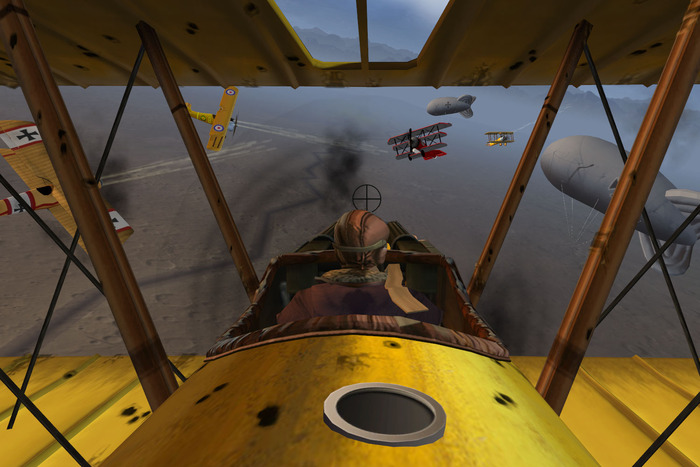
 A few decades back, before I became a software and media executive and long before I returned to writing, I wrote the “screenplay” for a succesful computer game called Wings. That “interactive movie” — as it was marketed — was a World War I flight simulation that followed the lives of the very first fighter pilots, trying to make combat sense of fragile biplanes curiously equipped with machine guns. It was published by an early innovator in gaming known as Cinemaware, which set out to make games look, feel, and tell stories more like movies. Recently the Cinemaware brand was resurrected via a Kickstarter campaign to fund a mobile version of Wings, that if successful will contain the entirety of the many pages of story and dialogue, plus a lot of new material. I have no financial interest in the new Wings, but it does bring back fantastic memories, a slice of life from an earlier time. The new team asked me to do a text interview to support their campaign, which I decided for nostalgia to publish here as well. Enjoy!
Please provide a brief bio of yourself.
At the moment I’m a first time novelist, my book This is Rage: A Novel of Silicon Valley and Other Madness just released last month to good reviews. I’m also an investor, a start-up board member, an executive coach instructor, a blogger, and former corporate executive. I was CEO of SHOP.COM, Executive VP of Disney Online, and VP Entertainment and Education at Broderbund Software. I read a lot, follow the L.A. Dodgers, study wine, and am active in children’s welfare issues as well as local government. If that’s not brief enough, cut everything except the part about reading and the Dodgers.
How did you originally join Cinemaware and get to work on Wings?
I met some of the Cinemaware team at a UCLA conference called The Future of Television in the late 1980s. They told me they were creating interactive movies. I had just written a spec screenplay called Miniatures about radio controlled model aircraft that sort of predicted the U.S. drone program. It was the first thing I had written on a computer, a monochrome XT. They asked me if I ever thought about working on a computer game. I said No. They showed me Rocket Ranger and It Came from the Desert on the Amiga. Then I said Yes. Quickly.
How was it working with the Wings team on the Amiga? What do you remember most about that time?
It was a magical time, a time of possibilities. I had experienced five years in traditional media of hearing why we couldn’t do certain things, how everything had to be done a rigid way, and how little respect there seemed to be for the writer. Everything at Cinemaware was, yeah, let’s try that and see if we can make it work, why not? I also remember writing on a Mac SE/30 for the first time, and I couldn’t believe why anyone would use anything other than that — so much for my XT. And I remember when our competitor, Origin Systems, leaked a demo of their outer space saga Wing Commander, and our team was like, hmm, that’s a pretty compelling 3D engine, but our story is way better, so back to the drawing board, and they completely rewrote our flight simulator in about 2 weeks to be more state of the art. Oh, and I remember when someone brought in the first Amiga with a 20MB hard drive and we could install both floppy disks without having to play with disk swapping or a slow seeking second external floppy drive, and that just seemed like the best possible gaming experience you could ever have — until we heard rumor about something coming called a CD-ROM.
How did you go about doing research for the game?
John Cutter, the game’s visionary designer, and I got ourselves invited backstage at the Air & Space Archives in San Diego, where we discovered a lot of the old U.S. Army Air Corp files were stashed. We were blown away by how welcomed we were there, the military librarians spent hours with us digging out old files, it was a smorgasbord of history, and they couldn’t have been more helpful. They kept bringing out boxes and boxes of dusty old papers and black & white photographs and let us have at it. It was a super find and let us dig deep into a very special time of innovation, courage, and pain. We devoured stacks of books on World War I (we even included a bibliography in the Aviator’s Briefing Manual, I’m guessing the first bibliography for a computer game). We watched the 1927 silent movie Wings — winner of the first Academy Award for Best Picture — and The Dawn Patrol (1930) so many times on VHS by our QA release date I think we could recite the storylines in realtime without anything on the monitor — then we chose to borrow only the atmosphere: the title, the sets, the costumes, font styles from the text cards, but none of the stories or characters.
What do you think makes Wings such a special gaming experience?
I think it really was the first computer game to try to tell an epic story that was more theater than shoot ’em up, but we kept plenty of shoot ’em up. We tried extremely hard to make the character role-playing real, to get inside the head of a 19-year-old kid who probably had about as much chance coming home alive as he did surviving enough sorties to live long enough to become squadron commander. We obsessed on details of the period, used every pixel wisely, created a true sense of responsiveness in the story, something that would set off endless discussions about the true nature of interactivity. We also kept the game controls immensely simple. It wasn’t a super complex gravity based simulation where you had to be an engineer to takeoff and land the plane or fight virtual physics to keep the contraption airborne. We simply “cut to” you in the air and said Just Fly and Shoot. We brought in a lot of non-gamers with that simplicity, but funny enough, the hard-core gamers praised us for it as well.
Can you tell us what the team wanted to implement in the game, but didn’t have the time or resources to do? Any special hidden gems or trivia for Cinemaware fans?
First you have to remember what we were dealing with getting the game to ship on two 512K floppy disks, as if any big blockbuster developer today could comprehend how little data that is. Our programmers were masters of compression, and kept squeezing and squeezing. The music was astonishingly intelligent, but the short redundant loops made our composers crazy, so I’m sure they will be delighted with the enhanced score on the remastered version. Every screen shot was a big hit to storage, and I remember the artists begging to include more storyboards, but that wasn’t possible. Luckily for me text was as economical to store then as it is now, so I didn’t feel the same thrashing. I do remember the branching tree logic making me nuts and having to write multiple outcomes for every mission, wondering if it was humanly possible to cover every fork in the story and how many people would care that on a given pass through the game they would only see fractions of the screenplay (we positioned this as a customer benefit, creating replay value). I remember when the marketing folks “requested” we cut from three floppy disks in beta down to two in order to improve gross margin on wholesale, which almost created a revolution in the hallways. Our indefatigable producer, Jerry Albright, reminded us it was OK for them to ask, and that we had to respect them for trying, then emphatically told them not a chance. Then somehow our miracle programmers pulled it off and we shipped the master on Reel 1 and Reel 2. I also remember a few brainstorms we had after we realized what a unique product we had developed, one for a CD-ROM version with recorded spoken dialogue that of course never happened, and one for a Wings sequel that would have been set in WWII, and who knows where that would have taken us.
If Cinemaware had a chance to expand on Wings, what do you think could be better developed or explored?
That’s sort of like asking the creative team who made the original movie version of Wings how they would have made it a talkie. The remastered version being funded on Kickstarter is doing all the right things — improved graphics, enhanced music, more missions, improved physics in the engine — all of that brings out the best in what we did so long ago. The important thing is that we gave the game heart, layered grounding in reality staying true to the source material, emotional resonance woven through a role-playing experience. As long as you remain true to heart, the polished production values will fully bring out the best.
Ken, you also pledged for this campaign, thank you so much for the support. What made you do it?
It is a very small sum of money to let an entirely new generation of gamers see where we started as an industry, and maybe a few grown-up parents will get to share the experience with their kids. Really, it’s not much money for a lot of game, and it is a fun game, part of what got us here. It’s kind of like the silent movie version of Wings we watched over and over — what if someone hadn’t bothered to preserve it, can you imagine having lost a gem like that? I can’t, no way. We all come from somewhere, it’s important to remember that and even more important to share the memories.



 CorporateIntel