Eyes on HP

Hewlett-Packard is not just any company. It is iconic. Like Disney, Ford, General Electric, Apple, Microsoft, and a few others, it is not only part of business history, it is deeply wound into the fabric of American history. Modern Silicon Valley pretty much begins with Hewlett-Packard—the foundations of information technology as a new sector of productivity, the power of innovation, the hardware/software product life-cycle, the beginnings of west coast venture capital, and the splitting atom of employees spinning off from the mothership to become founders themselves. The Hewlett-Packard story until recently is a magnificent tale.
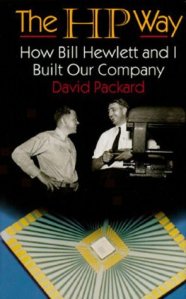
HP WayBill Hewlett and Dave Packard really did start in a garage. One of the very first products they sold was a precision audio oscillator, to of all people, Walt Disney. They captured their thoughts in a book, The HP Way, reinforcing the need for a company to have a mission and a vision. When we talk about a job being more than a paycheck, a lot of that comes from the work ethic and values of Hewlett and Packard. They set the stage for a generation of entrepreneurs. They made it okay to fail, as long as that failure contained learning that was honestly disseminated. HP on an engineer’s resume was gold. The sales and marketing team was second to none.

It is almost impossible to understand the impact of a global company with over $125B in annual revenue and 325,000 employees changing CEOs four times in six years, not including the interim CEOs between hires. Carly Fiorina, Mark Hurd, and Leo Apotheker each left the company for different reasons, and while the HP board is now taking a lot of heat for perhaps not scrutinizing their decisions around these leaders carefully enough, that is unfortunately water under the bridge. The company is now under the direction of former eBay CEO and recent California Gubernatorial candidate Meg Whitman, who will need to move quickly and definitively to steady the ship.

HP has seen numerous mergers, divestitures, and acquisitions throughout this period of seismic change, and each time one strategy replaces a previous version, the impact is costly. Whitman has said she believes the strategy in place at HP now is largely correct, so if the issues she is facing are managerial, perhaps we will see a positive impact sooner rather than later. My guess is she will dig into strategy a bit more in the coming months, and then move aggressively to make her mark. The sooner she can restore confidence with customers, employees, and shareholders, the better it will be for all those who do care deeply about the company’s future.

Why is HP so important in the scope of business enterprise? When you dig into exceptional business books like Built to Last and Good to Great, both by Jim Collins, you realize just how hard it is for even the strongest corporations to go the distance in an environment of creative destruction. As Collins points out so often in the data he cites, only 62 of the original Fortune 500 companies named on the original list in 1955 remain there in 2011.

The great former CEO of Intel, Andy Grove, talks at length about the “strategic inflection points” facing companies at every stage of their evolution—particularly technology companies—in his critical study Only the Paranoid Survive. Grove makes it all too clear how easy it is for a well established organization with vast resources and expansive markets to miss a fundamental change in the continuum of progress, only to catch its error to late to be fixed, having been lapped by any number of competitors.

Where Collins approaches the challenge largely from the aspect of defining and reinforcing a brand, Grove looks at it from the point of view of ceaseless innovation and refusal to accept the status quo as satisfying. Both approaches are vital, but neither has a chance in the face of organizational chaos. Products, features, and benefits must remain in constant flux, but ideals and values are their balancing counterparts. Remove the rudder from a very fast ship and it really doesn’t much matter what is powering the engine room.

It takes both leadership and strategy to steer one of these mammoth ships through the rough seas of business change, and simply taking those notions for granted is the easiest way for a company to fall from grace. Robert Burgelman, a colleague of Andy Grove who teaches strategy at the Stanford Graduate School of Business (and is also a former board member of mine), tells us that strategy becomes real when we apply resources to concepts. We see that very much in action now at HP, but we see those resource decisions changing too frequently in real-time. The leadership of the CEO drives that strategy from concept to action, from white board idea to investment cost center, and if strategic shifts are reversed before cost centers become profit centers, value can be destroyed at an astonishing pace.

No CEO or strategy is meant to last forever, but change them too often, and costs pile up without reward. The toll on staff morale is immeasurable, and the lost jobs from reversing decisions may never be recovered. Employees feel the impact in loss of income, shareholders get pummeled. Customers just move on.

It’s time now for HP to turn the corner. As I said, HP is iconic, it is Silicon Valley. We need it as an example in the tech sector of a company that is Built to Last and can continue to grow from Good to Great. HP dates to 1939. It is the standard-bearer for all the great companies that followed its mantra, were born in garages, and now have office space in the adjacent neighborhoods. If we want to believe companies like AOL and Yahoo can find new creative life through reinvention, we have to have models for long-term success. We need succession plans that show great companies can transcend their founders and achieve new levels of success by ensuring that values are more than words in the employee handbook, and that they are liberating, not confining, as long as the leaders who embrace them help guide their teams through increased commitment to innovation with coherent planning and rigorous evaluation. No shooting from the hip, but no fear of change.

On a pragmatic level, we also need the jobs, particularly in HP’s home state of California. Surely the majority of new jobs in our nation will come from small business and startups, but we can’t afford to lose the ones we have in the enterprise, not for the families who depend on them, not for the state budget that needs the payroll tax. Because of its deep history in the community and legend, HP leads the ethos in Silicon Valley in so many ways, its stability is a reflection of hope, its instability a drag on the headlines when we need a shot of optimism.

This is a once in a lifetime career and company defining opportunity for the new CEO at HP. It’s like getting the chance to manage the NY Yankees after three bad seasons no one saw coming. They might be on a losing streak, they might have made a bunch of bad trades, but they’re still the Yankees. Everyone knows they can win, that they have the resources to win and a history of winning. Meg Whitman just needs to ask herself, what kind of game does she want her team playing, who does she want in the line-up, and where does she need to better read the competitive landscape. A little consistency in management will go a long way.

Let’s hope Hewlett-Packard has it right this time. There is already new criticism of HP’s board that they acted too quickly in hiring Meg Whitman, that she should have first been named interim CEO, or that her background is not right for the job. Their decision has been made, so I am rooting for the new CEO. This isn’t politics, this is P&L. It is critical that Meg gets this right and succeeds. A win for her in this role is a win for all of us.

Not Just a Test

Maybe we have so many problems right now that we’re simply at overload, so much so that there is practically no bad news headline that can hold our attention for very long.  We don’t have enough jobs, we’re stuck in two wars, contractors are fleecing our government when they are supposed to be helping with the wars, we are at internal political gridlock, our tax code is horribly broken, our roads and bridges and pipes are giving out, home prices are going in the wrong direction and too many people are stuck underwater with bad mortgages, and mother nature has been serving up an unusual amount of natural disaster pounding.  That’s not all of it, but it’s a lot.  It’s a wonder we aren’t in a worse mood.

So when yet another negative headline comes at us, it is any wonder it’s a one day wonder, if that, and we just don’t have any appetite to deal with it?  No, human nature at a certain point just shuts down, so it’s understandable.  But I think this one is core, and we can’t let it go:

Last week we learned that U.S. SAT scores for reading and writing hit a new low, with math scores also declining.  Here’s a quick summary as noted in the Wall Street Journal:

The results from the college-entrance exam, taken by about 1.6 million students, also revealed that only 43% of students posted a score high enough to indicate they were ready to succeed in college, according to the College Board, the nonprofit that administers the exam. Students had to score a 1550 out of a possible 2400 to meet that benchmark, which would indicate a 65% chance of getting at least a B-minus average in the first year of college, the Board calculated.

Okay, so not everyone does great on tests, it’s an acquired skill, and not everyone is college bound.  What’s the big deal?  Quoting further:

“At the precise time the importance of a college degree is increasing, the ability of the U.S. to compete in a global economy is decreasing,” said Jim Montoya, vice president of the College Board. “We, as a nation, have to do a better job preparing our kids for college.”

Let’s go back to the litany of problems, starting with the one about which President Obama recently gave a special speech to a joint session of Congress and the American People.  In that speech, the President said that right now, Job #1 is Jobs.  Barring some untold natural or unnatural crisis on the horizon, I am guessing that Job #1 doesn’t change through the next Presidential election.  After that, Jobs will probably remain Job #1 until unemployment is below 7% or so, which could be a long, long time — and there is no guarantee that it will ever be corrected, we have no natural entitlement to Jobs.  We have to create them.

Is there not a little irony here?  Is it possible we are trying to solve a problem in the short-term that was created in the long-term and can only be solved in the long-term?  Do we not see a link between falling test scores and an inability to compete?  Perhaps it’s fair to say that’s a little abstract, even obtuse — we all know plenty of well-educated, intelligent people who are out of work, so maybe that’s not the problem.  But let’s try to roll the clock forward a generation or two, at which time it is likely yours truly and many of you will be but particles of dust and memories.  Is there anyone who believes if a lot more than 43% of our kids can’t do better than 1550 out of 2400 that we are going to be the first stop on the investment train?  I’m not talking goosing the scores through prep programs and gaming strategies, I’m talking read the paragraph and answer the question, add the numbers in a column, writing a few coherently linked sentences that make a point.  That can’t be too much to ask for a high majority of the citizens of the #1 economy in the world, unless that doesn’t matter to us anymore either.

How did we slip?  Well, just when we got a little too distracted by so many consumer options created by our magnificent economy, as Thomas L. Friedman told us, the World Got Flat.  Competition for jobs become global.  Demand for commodities became global.  The internet and telecom made easy information exchange global.  Industrial contracts are up for bid regardless of geography.  Lots more people are attending many more years of school in places like India and China — and they are taking school very seriously, as an opportunity and a privilege, a gift that lets them advance the way we thought about education when our middle class was emerging over 100 years ago.

If we don’t think of education as a gift but instead a legal mandate to be tolerated, how do we compete in a world that is flat?  If we don’t use the time we have to be here with each other to absorb the knowledge collective, how much of life have we missed?  If our kids don’t learn math and science and history and language, what kind of leaders will they fall prey to electing?  Learning is at the core of prosperity, fulfillment, and public safety.  Why aren’t we treating it that way?

We can’t afford to let this be just another piece of bad news, another negative headline that just goes by because we are overwhelmed.  If we want to fix the problem at its core, we need to think long-term.  This isn’t unemployment, this isn’t terrorism, this isn’t social security or Medicare, this isn’t the banking system, this isn’t GNP, this isn’t an emergency brought on by the ground shaking or the winds howling or the rivers flooding.  It isn’t even global warming or protecting our precious planet.  I get it, we have a lot of priorities, too much to fix and not enough dough to fix it all.

I would still make our education system our #1 priority — because if we don’t fix that, the other stuff is just going to stay broken.

It’s not just a test.  It’s an evaluation, a form of measurement, a benchmark, an early warning system.  We’re getting bad grades.  We need to do better.  Shame on us for letting it slip to this level.  We either get on it now, or we don’t.

I say hit the books — make that Job #1.


The Ins and Outs of Yahoo!

Shortly after it was announced that Yahoo CEO Carol Bartz was departing, the always funny Andy Borowitz tweeted:

“The CEO of Yahoo just resigned. I had never heard of her so I Googled her.”

What makes any great comic funny is the truth underlying a punchline.  I wonder if Andy knew just how close he got on this one, which was reported by the Los Angeles Times.  What Andy points to in far fewer words than I will use is precisely the problem of what went wrong at Yahoo.  Yahoo was one of the three great search engines still standing on the web as late as 2009, in fact it was #2 behind Google and ahead of Bing (a.k.a. Microsoft).  Search was in Yahoo’s DNA, it was a core competency, Yahoo was very good at Search and a tremendous amount of self-selected traffic still flowed through Yahoo Search (Microsoft noticed this, too).

Remember that Yahoo bought Overture in 2003, the pioneer of text-link keyword advertising, and honed paid search advertising as mainstream before Google took it to perfection.  Remember also that Yahoo helped put Google on the map when for a long period of time it outsourced Search to Google in exchange for “Powered By” credit and revenue sharing — a business development deal it later regretted because that little “Powered By” logo pretty much put the Google brand on the global map.  At the end of that deal in 2004, Yahoo took Search back and went on to be a respectable competitor to Google.  Sure its Panama search ad buying system upgrade was a little late to market, but it was also very good.

I have great misgivings about the notion of Monday morning quarterbacking any fellow CEO’s performance, since no one on the outside of any problem ever has enough detail or information to make a well-reasoned assessment of someone else’s decision-making. In the case of Yahoo, I offer this personal observation only for the lessons that I believe need to be evangelized.

Early in her tenure, Carol Bartz made a decision to outsource Search and the text ad auction platform to Microsoft. Her rationale seemed to make sense in the savings she would achieve, but that presumed there was no growth left in Search, which had become dominated by Google to the tune of 65% market share, the remaining share going to Yahoo and Bing.  We all know that Microsoft was spending heavily to gain share, up to and including offering to buy Yahoo for more than $44B.  This post is not about that decision, nor does it have anything to do with the circumstances or theatrics of Bartz’s departure.  It has to do with one and only one thing, my own opinion that the decision for Yahoo to exit Search was not a good decision.  Here is why:

In any company, you strike a balance between what you build and what you buy.  Every senior executive and management team struggles with this every day.  No company — not one of the Fortune 500 companies, not the one person startup in your garage — has all the resources to do everything it wants to do or needs to do.  Management must make tradeoffs, sometimes hourly.  Talent is not unlimited, access to capital is not unlimited, time is anything but unlimited.  Management has to decide what it will build and what it will buy.  Will a company hire talent, buy another company, or outsource a task?  These questions never go away, thus management always needs a framework for making these decisions without guesswork or emotion.  Here in a nutshell is that framework:

You in-source that which is strategic — that which is vital and essential and defining to a company’s success in the landscape of its peers.

You outsource that which is tactical — that which is non-essential to the company’s definition in its chosen competitive space

Let’ start with the basics: an intellectual property company — whether technology based, media based, or design based — is a creative company.  That means success begins with an assessment of one’s unique core competency, and that informs leadership through product strategy, not structural adjustment.  Applying unique core competency to product vision drives innovation, forcing a company to determine how it will always be as good as or better than its peer group or competitive circle.   Creative destruction — the continual reinvention of a product or service through ceaseless innovation — begins with the decision not to position one’s output as a commodity, where price rather than differentiation calls the shots.

When Steve Jobs returned to Apple in 1997, he applied a product vision to absolutely embrace the internet through leapfrog design, which was exactly the right move at the right time.  When Eisner and Wells took over management at Disney in 1984 when it was on the verge of a breakup, they applied a product vision to reinvent the company’s product lines through best in class storytelling, merchandising, and delivery mechanisms.  When Jack Welch took over General Electric in 1981 and decided he wanted to exit small appliances, he applied a product vision to become a market leader in industry leading medical equipment and aircraft engines.  In all three cases, it was product strategy — knowing what to keep, knowing what to dump, and knowing what to pioneer — that led to unparalleled success.  They did not outsource their winning moves, they owned them.

The turnaround at Yahoo after the refusal of the Microsoft buyout offer was positioned broadly as structural adjustment.  I am sure there were inefficiencies at Yahoo like there are in any big company, but if you solved all those and added no product vision, it really didn’t matter what you solved.  You would have a more efficient machine that produced less visionary work.  That is not a growth company with promise.  It is a factory.  A factory is not a creative company, it is a factory.

For any “portal” platform, Search is not tactical, it is strategic.  I have heard the argument against this for ten years and it just wrong.  How do I know that?  Look at Google.  Search is their core competency, it is their DNA.  So if Search is strategic for Google and you are competing against them, then how is it tactical?  You may choose to decide you can’t compete with them, which is fine, but if Yahoo was not competing with Google, then who was their competition?  Content companies with big editorial and production costs?  Ad networks?  Telecom?  The problem for the Yahoo employees has been that they were never sure, and the company’s valuation is a reflection of that ambiguity.

Imagine that instead of agreeing to the Microsoft partnership, Yahoo had fought with every fiber of its creativity and gained 3 or 4 points of market share from Google on product respect recognized by the public.  Imagine instead of the mass media branding campaign they did two years ago if they had put all of that money into engineering talent and led a battle cry inside the company to take Search share from Google by improving their algorithms, relevancy correlations, and keyword auction technology while mobile was still nascent.  Would the street have valued that commitment and its promise over the one time benefit of cost cutting and the ten-year forecast baked into their financials of the low delta Microsoft contribution?  Would the employees have given everything they had for the pride of winning, not to mention the potential payoff in their stock options?  Was the Search game so over in 2009, just 15 years into the commercial internet, that walking away from Search when you were still positioned as a top 3 player made sense?

And if you were going to exit Search, where was the company’s core creative focus to be redirected?  Long ago, Tandy got out of leather goods to become Radio Shack, a bold move for its time, but one with a rallying cry.  Yahoo got out of Search, so that people today ask, “What is Yahoo?”

Simple lessons replayed:

In-source that which is strategic, outsource that which is tactical. 

If you exit a strategic line of business, you better have a better one to champion as its replacement. 

A technology company is a creative company.

Creative people have a dire need to build that which is great.  That is what they do.  That is how innovation happens.  Creative destruction is how value creation in legendary companies is sustained.

Yahoo may or may not address this on the rebound, but all of us should take the opportunity to ditch the hyperbole and internalize the basics of identifying and sustaining core competencies that are lasting and cherished.  A brand is a promise.  That promise is delivered not by what you rent, but by what you own.

Is Other People’s Money Different?

Buried among last week’s headlines—that included a nation embarrassing spat between the President and the Speaker of the House over what day our President could address a joint session of Congress and The People—was this gem found among other reports on Thursday Page 3 of the Wall Street Journal (Nathan Hodge, 9/1/11):

The Commission on Wartime Contracting in Iraq and Afghanistan, established by Congress in 2008, unveiled a final report Wednesday that represents the most comprehensive assessment to date of how the U.S. government has managed the more than $206 billion it is projected to spend on contracting in both wars through the end of fiscal 2011.

The findings, first reported by the Wall Street Journal in July, point to what the panel describes as a pattern of waste, fraud and abuse that has cost taxpayers dearly and at times undermined U.S. foreign-policy objectives.

The report includes a copy of an extortion letter sent by Afghan insurgents to a contractor working on a U.S. government-funded construction project in Afghanistan. It also details many instances of projects the panel says were poorly conceived, badly executed and, in the long-term, impossible to sustain without more U.S. or foreign funds.

The commission’s findings were based on hearings in Washington, staff research and a series of fact-finding trips to both Iraq and Afghanistan.

Michael Thibault, one of the bipartisan panel’s co-chairs, said the commission found wasteful spending amounted to between 10% and 20% of total contract and grant spending. Fraud, he added, has ranged between 5% and 9% of contract totals.

Let’s extract a few of the more choice words from this excerpt:

Waste. Fraud. Abuse. Poorly conceived. Badly executed. Cost the taxpayers dearly.

Transforming War CostsI haven’t heard one person mention this in conversation. Other than in perfunctory reports, I’ve heard no outrage or rebellion. According to the Final Report to Congress, Transforming Wartime Contracting (August 2011) Executive Summary Page 5: “The Commission’s conservative estimate of waste and fraud ranges from $31 billion to $60 billion based on contract spending from FY 2002 projected through the end of FY 2011.” That’s not less than $30 billion—and possibly twice that much—of our money spent on stuff that it didn’t have to be spent on, for the same outcome. If you paid tax last year, some of that was your money. Willing to let that sail on? I’m not.

I still have wrenching memories from the 1980s of the government audit that revealed we were paying $500 for toilet seats. It was shocking, and never meant to have a command performance. I also know that profiteering in our nation is illegal, but perhaps we don’t have the resources to investigate and prosecute those kinds of abuses any longer. Legal fees are expensive—no sense throwing bad money after bad, right?

I also know that much of the money we use to pay these invoices is borrowed. Not only are we getting fleeced on value, we are paying interest on it to boot, and interest on the interest, because I can’t see a way the accumulated balance gets paid down in our lifetime. If a CEO allows his company to send our government a bill that smacks of fraud or abuse, I really do wonder what he is thinking when he sings the national anthem and stares at the flag in his hometown stadium. If the law and his conscience don’t get him, is he still a patriot as long as he sings the Star Spangled Banner in or out of key? He is not.

For a few thoughtful milliseconds, I want you to pretend you are responsible for 0.01% of that amount in your job ($20.6 million) and it is reported in your hometown newspaper that the public company you work for wasted that money on nothing whatsoever. Your boss calls you in and the conversation goes something like this:

Boss: It’s good to see you today.

You: Thank you, boss. Always good to be called into your office.

Boss: Hey, I need to ask you something. Seems the local newspaper—that printed thing in the machines by the gas station that take quarters—says we lit up $26 million of our shareholders’ money with a blazing torch and got nothing for it. The CEO can’t believe that’s true, and traced it back to our department. So a quick question—did it happen?

You: Well, to be honest, yes, it did, boss.

Boss: I appreciate your candor. Can you tell me why?

You: Not really. I guess I screwed up. I’ll try to do better. None of us are perfect, right?

Boss: Right, none of us are perfect. Some of us don’t watch money closely enough. Some of us make poor hiring decisions. It happens.

You: Am I in trouble, boss?

Boss: Trouble, for absent-mindedly destroying $26 million of Other People’s Money? I shouldn’t think so. You didn’t take any of it, did you?

You: Not a chance, boss. You know I would never do that.

Boss: Know is a pretty strong summation, but I am confident enough it can’t be proven. Hey, another question. When your counterpart at the company where we burned this money sent you the contract, is it possible he committed any possible act of deception?

You: Deception, gee, that’s a hard one. You know, I don’t really know. The thing about fraud is, if it’s committed well, you don’t even know it occurred. So how would I know?

Boss: Exactly, if you are duped, the other fellow is in the wrong. You had no reason not to trust him, so how could it be your fault?

You: So I still have a job, boss?

Boss: As do I. Our investigation is complete. I will report as much to the CEO.

You: Gosh, I felt really bad when I came in here. You are such a supportive boss. I feel so much better,

Boss: As do I, we are in this together. Do try to be more careful with Other People’s Money where you can. And always remember, candor is your friend.

You: Thank you, boss. You’re the best!

For an abundance of clarity, that wouldn’t fly in any legitimate enterprise.

From time to time, you may hear the expression OPM, as in Other People’s Money, as if somehow that is different from your money. If you treat Other People’s Money differently from how you would treat your own money, there is something wrong with you for allowing yourself the permission to do that, and there is something wrong with them for empowering you to do it.

Whenever you are in control of a business budget, you are being trusted to manage OPM. There is only one way I know how to do that: treat it as if it is your own. Nothing else can be justified, nothing else can be defended. Ask yourself on every allocation that can be tracked back to you: if this were my money, would I say yes? If the answer is honestly yes, you are acting in the best interests of those to whom the money belongs. If the answer is no, then ask yourself why you are saying yes, before someone else does. Your boss is likely to be a lot less understanding than the one depicted above, unless of course he is part of the problem— in which case, get out quickly! Life is much too short to be part of anything you cannot proudly explain.