Standing Your Ground

How do you know when it’s time to stand firm on a point and when it’s time to cave in and go with the flow?

The answer is obvious: You never know, not for sure.

The hardest calls are the ones you make alone. You listen intently, gather data, think about the situation, seek counsel from close advisors, but in the end if you decide to take a stand, consider yourself alone.

Values, ethics, morals — all of them seem clear on paper when you are reading about someone else’s lapse. That’s called history. You read it in hindsight with reflection. You wonder in amazement at how something so rotten could have been advanced.

Looking forward is another problem entirely.

If you think making a decision on principle is easy, you probably haven’t yet made a hard one. If you have put yourself on the line for a heartfelt conviction, you know that courage is not something usually acknowledged in the present tense. It is awarded upon completion of a task, win or lose, based on context.

In the present you might be called something else entirely: difficult.

Difficult people tend to get a bad rap, and being difficult just to be difficult is not likely to lead you to the corner office. Some of the questions we face in staring down adversity include:

  • Whether we have thoroughly thought through an objection to the more genially accepted plan we oppose.
  • Whether dissension without triumph creates any intrinsic value of its own.
  • Whether the cost of standing in isolation is worth it.

Let’s think about those three filters as we ponder a few hypothetical but easily applicable real-world examples of standing your ground in the corporate world.

Someone Getting Fired Unjustly. Suppose a colleague of yours, Charlie, has somehow become the fall guy for a project that has spiraled wildly off schedule and budget. The project team has found an easy out because your department VP is already known to dislike Charlie, so all the group has to do is subtly throw Charlie under the bus and the clock resets to zero. You don’t particularly like Charlie, but you know he is no more innocent or guilty than anyone else on the wayward team. When you suggest a defense of Charlie to the group, it becomes clear that if you go to bat for the loser, you will be ostracized, And hey, everyone knows the VP has been looking for a way to get rid of Charlie for years, so how are you going to talk her out of it?

Bonus Calculations Are Manipulated. You work under a sales leader who is a notorious sandbagger (someone who asserts a goal is a Hail Mary when it’s an underhand toss), but smooth talker that he is, his forecasts go through every year and your team receives handsome bonuses. This year he sets a revenue goal that your team has already achieved with existing repeat business. His plan is approved. This year’s goal is in the bag before the starting gun is even fired, so bonuses will be flowing like water. Then you attend a company meeting and hear the CEO say in earnest that the company is having some critical financial issues this year and will probably lose money unless everyone digs deep for a better outcome. You approach your sales leader and suggest he increases the sales goal so bonuses aren’t paid out of losses. He tells you that you don’t understand the CEO’s game, and if you so much as mention taking up the goal again, you will certainly need to find another sales team, and possibly a new employer.

Confidential Information Is Compromised. After months of going in circles and failing to make progress on a design problem, the senior engineer on your team circulates a breakthrough project plan. Your company has been losing market share to a competitor for the last year on inferior feature design at high cost, but at last that is behind you. Late one night when you are building out your portion of the specification, you overhear a conversation where the senior engineer jokes that it only cost him a few thousand dollars cash to hack the competitor’s database and extract the secret sauce that has been causing your company to lose. You approach the senior engineer and tell him you are uncomfortable with what you overheard. He tells you he was just bragging, it was open-source code he found and modified, and he would appreciate it if you didn’t broadcast that because open-source solutions are frowned upon in the company. Is he lying about open-source vs. hacking? Either way, if you speak up you’re going to be responsible for stalling the turnaround.

On first blush I’m sure most people considering these scenarios think they would do the right thing, because we all like to believe when faced with a crisis of values, ethical people will choose to act with ethical intent. Now ask yourself this: Do you know someone working beside you who has faced a similar situation and not acted in the appropriate ethical manner? If you do, why haven’t you confronted them? If you have confronted them and they have brushed you off, how far were you willing to pursue the compromise in judgment? Why are you willing to work in an environment where a person like that can get away with something so wrong?

Courage is a word that is tossed about without nearly enough care, but understand that in your time on the job you will have multiple opportunities to act courageously or not. Are you ready to put yourself to the test? Are you willing to stand your ground and take what comes with that decision when the consequences may not be reversible? If you want courage to be a descriptor of what your life is about, you’ll need to embrace the notion that poetic justice is much more present in literary fiction than it is in real life. Situational ethics may be a useful convenience, but they aren’t likely to do much for your self-esteem. You only win by doing what is right if your definition of winning is more about who you are than the outcomes you direct.

Courage is at the heart of a true leader. It can be costly in the short term, but it will always reflect your character. Standing your ground is not a question of options; it is the challenge of identity.


Jerry’s Kids Forever

Labor Day weekend for me will always be connected to Jerry Lewis. His annual 21 ½ hour live telethon raised more than $2 billion over 45 years for the Muscular Dystrophy Association. He died last month at the age of 91. I miss him already.

Jerry meant a lot to me as a kid. I was an MDA volunteer from the age of 12. I used to help patients with mobility, assist with fundraising, and every year I would work the telethon in the local Honolulu studio. Satellite time in the 1970s was very expensive, so we didn’t get the national feed for most of the overnight hours. In those blackout periods our producers would put on a nonstop “telethon within a telethon” so we could stay on-air in synch with the east coast six hours ahead and the west coast three hours ahead. Pledges would come in all through the night. Jerry was with us in our hearts whether he was onstage in Vegas or we were broadcasting hula dancers. We did the show together no matter the separation of distance, and we loved the children at the heart of our mission.

I never met the man, but sometimes he would come on the non-broadcast feed between segments and talk to the remote volunteers, so I felt like I knew him. He would thank us for our help and tell us the telethon could not happen without us. I believe he truly loved the kids we served. He wanted to beat neuromuscular diseases in our lifetime. We haven’t done that yet, but we have come a long way. He gets credit for some of that, along with the dedicated doctors and visionary scientists whose groundbreaking work he helped fund. For a zany borscht belt comedian, that’s a long way to travel in a single visit to our planet.

Jerry took some heat for exploiting MDA patients in his depiction of their challenges. I never saw that. I saw a man devoted to curing a terrible, debilitating condition. He was a master of the stage, there is no question about that, but in the end I don’t believe the telethon was about him. It was about lending his name and global stardom to a cause that mattered. He didn’t have to do that. It was a choice. Of course it would come with some critique. He was pioneering new ground and taking creative risks that had no precedent. He might have said a few things wrong or missed the mark on occasion with a photo opportunity, but I believe he was committed to healing. He was a brave soul paving the way for a generation of viewers who learned how to turn their time into public service.

I learned a lot from Jerry and working with MDA. I learned how to work steadily through 36 hours of production from set-up to wrap. It’s hard to fathom what that meant in this age of digital media and 24-hour everything. Opportunities like that let you bond with strangers with enormous intensity that is over as quickly as it begins, yet can last a lifetime. Sometimes in the overnight hours, when I saw on the schedule board that our stage was about to go empty, I would gather some of the MDA kids and we would practice a few songs together, a Beatles tune or a Bob Dylan folk song. When the TV audience was at its smallest the producer would put us on the air. I played guitar and we would sing together in a half circle looking straight into the red light of the live camera.

The first time this happened was my first time on live TV. We were directly in front of the phone banks around 3:00 a.m. with maybe 100 people in the auditorium fighting sleepiness. I probably messed up some of the chords but the kids sang right over me. You forgot they were in wheelchairs. They were just kids singing like they were at a campfire. Afterward the kids asked me if Jerry would have been pleased with our performance. I took a chance and told them I thought he would. Today I know that for certain. They were Jerry’s Kids forever.

Jerry Lewis was an imperfect person as we all are, but he was an inspiration to me. He had no roadmap, no rule book, just a whole bunch of harebrained ideas and a ton of influence he put to work for something that mattered. He was dedicated, hard-working, wildly hard-minded about details, and a perfectionist. He gave of himself. He always made me laugh. Well, maybe not always, but most of the time. He was very funny, but of another time. I will never forget him. He was an original. Labor Day will always be his.

Jerry, dear Jerry, “You’ll Never Walk Alone.”

The Little We See

I discovered the NBC television series This Is Us in summer reruns this year and I have become obsessed with it. If you enjoyed shows like Thirtysomething and My So-Called Life, you’ll not only recognize the tone and structure in This Is Us, you’ll see familiar names pop up in the directing credits. It probably won’t surprise you that what has most attracted me to this show is the writing, both the quality of dialogue within episodes and the structural connections between episodes. Series creator Dan Fogelman has framed a milestone achievement in word-to-screen translation.

If you are a student of fiction you know that narrative has the highest emotional impact when story and character are revealed on equal footing, one reinforcing the other. Whether you attempt the craft professionally or as an avocation, you know how immensely difficult this is to do, particularly consistently. Characters matter more when the story advances as a result of their arcs. The depth of characters is more fully rendered when plot points drive their change. It’s enormously challenging. Try it sometime. Or you can just watch This Is Us.

I certainly don’t want to give away any spoilers surrounding this show in case you decide to binge on it after reading this post. At its core it is the story of three people born on the same day circa 1980 (the year I graduated from high school, go figure). The storyline follows them from infancy to adulthood with all of the many tangents in their lives around family, friends, loved ones lost and found, career highs and lows, and personal discoveries. The emotional complexity of the characters is what makes it powerful, yet surprise twists in their interwoven journeys jump out all the time, making it the kind of serial that leaves you both satisfied and wanting more.

What consistently blows my mind in this show is how character development is revealed in snippets that link forward and back in time, particularly replaying events with increased detail layered into the unveiling of previously hidden moments. It is these hidden moments that led me to write about the show. What continually strikes me as gripping drama is how little we know about any one character or event at any moment in time, and how adding onto the storyline sheds light on the “why” of every moment. I think about this in life every day as I encounter people, not so much in what I do see but in the stark reality of how little I see.

“The little we see” is the mystery of real-life human drama. Someone could be standing next to you in line at Starbucks with a thin smile, but she may have just come from the hospital visiting someone in critical condition. Someone could run into you on the freeway wildly distracted, when an hour ago he was turned down in his marriage proposal. The person next to you in a bar watching a baseball game might be ordering the beer that sends him tumbling off the wagon. We barely know what we see. We usually have little idea why it is happening, what meaning or consequence it may have, or what life fork in the road it may represent. Good storytelling fills in the blanks. Compounding life events don’t snap together as Lego blocks nearly that solidly.

Returning to my obsessions, in my early writing career when I was learning the craft and reading much more than I was writing, I found myself consumed with the question of what happens to characters when we don’t see them. I spent a lot of time immersed in stage-play texts and repeatedly asked myself purposefully unanswerable questions. What are these characters thinking and doing when they are offstage? What were they doing before the play began? What will they be doing after the final curtain? Certainly writers have to think about these things, but the time-limiting constraint that they never can fill in all the blanks is what can elevate a story from entertainment to a more lasting form of art. The elements of a character’s life that are left open-ended are the entry point where the reader’s imagination can come alive. It is in that synthesis that a work becomes both personalized and shared.

Why might this matter to you even if you aren’t particularly enamored with fiction? Perhaps you are like me and find yourself wondering throughout the day about the backstories and masked details in the lives of the people who walk into and out of your contact each day. When you are in a meeting and the presenter is struggling, what was he doing an hour ago, a day ago, a week ago, a year ago? When you hear a co-worker arguing on the phone in the hallway about something that sounds personal and know that you are about to review a business plan together, will that person be paying enough attention to make good decisions and what will happen to resolve the argument by the time you meet again tomorrow? When a co-worker’s child visits your office, what does she see and how will it possibly affect her future decisions about her career?

All of this fascinates me both as a writer and a businessperson, because the long and winding roads of our lives are filled with invisible forks where we choose a path and don’t necessarily know at the time that the decision was of immense consequence. I will be writing more about these invisible forks soon because I think the resonance of our decision-making becomes more consequential when we pay attention to the impact it has on those around us. We can never chart our own fate entirely, but we can think now and again about what might be going on offstage as well as onstage before we act.

One of the best pieces of advice my dad gave me in business was that unless you are in the room where a decision is made, you will never know why that decision was made. My trepidation has gone further, because too often I have been in that room and I still don’t know why many decisions are made. To me that signals what happened in the other room where I wasn’t present and didn’t even know there was a meeting, or what happened in someone’s living room that morning, or what might be happening in some hotel conference room that night. We see what we see and it’s never enough. We see too little, yet we still have to make decisions.

The little we see is a subset of any story. Think about it that way and you might make different choices when you are in the scene. Onstage or off, the story is part public, part private, part secret, part personal, and always conflicted. That is what makes a great television series like This Is Us. What it says about our lives and our business dealings is something else entirely.

____________

Photo: This Is Us Gallery, NBC.com

You Can’t Fix Morale

Here’s a phone call I sometimes receive, usually from someone senior in executive management or the investment team behind a once promising company:

Inquirer: Hey, we need your help with something. We have a situation and we’re not sure what to do about it.

Me: Sounds intriguing. What is the situation?

Inquirer: Well, we’re having… I’m not sure what you would call it exactly, I guess a problem with morale.

Me: What would you like me to do?

Inquirer: We would like you to help us fix morale.

Me: Oh, that. I’m sorry, I can’t help you.

Inquirer: We haven’t spoken two minutes and you already know that?

Me: Yes, I’m quite sure. I certainly would like to take your money because I’m sure you are willing to pay a lot to do something about this, but I only take on projects where I can actually help someone.

Inquirer: How can you be so sure?

Me: You can’t fix morale.

Inquirer: What do you mean? Morale gets fixed all the time.

Me: Yes, exactly. Morale gets fixed because whatever is causing it to deteriorate gets fixed, but that is where you need to look, at the disease, not a symptom.

Inquirer: Are you saying we need to fix something else in our company so that maybe it can have an impact on morale?

Me: Yes, that is what I am saying. In fact, you probably need to fix your company.

Inquirer: So a contract to fix morale is not big enough for you? You want a bigger contract to fix our company? But our company is not broken.

Me: Then you probably don’t have a morale problem and don’t need any help.

Inquirer: You’re not doing yourself any favors turning this down. It’s a big project. We have a sizeable budget for it.

Me: It’s tempting, but why don’t you have another look at the situation and maybe we can talk again.

The call usually ends there and we don’t talk again. Every once in a while we do talk again and then I tend to get involved in long stretches of dialogue with team members up and down the line. We talk about a lot of things: leadership talent, product quality, business model. We talk about creativity and innovation, passion for excellence, dedication to the customer experience. One of the things we never talk about is trying to fix morale.

Let me say it again: You can’t fix morale.

Bad morale is a byproduct, most often of poor direction, sometimes of impossible goals so ridiculous no one ever feels appreciated, other times of uneven credit and compensation in times of success. There are successful companies with good and bad morale, and struggling companies with good and bad morale. Good morale is also a byproduct — you achieve it by focusing on the right things.

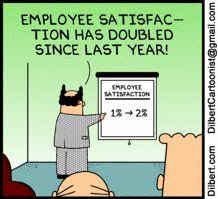
I view morale as a result of process and outcomes. Process involves day-to-day workplace routines that reinforce or strip away employee engagement. Outcomes involve the continuity or deadend at the culmination of a milestone, the reward or repudiation for the commitment of time, expertise, or passion. If your process is bad, morale will be bad. If your outcomes are bad, morale will be bad.

Suppose your company wildly missed earnings targets three quarters in a row. You’ve seen your second round of layoffs in less than two years. More than half of your VPs were fired and hired in the past ten months. The CEO, also rumored to be teetering, has said repeatedly everyone needs to “work smarter, not harder,” but no one is sure which product in the pipeline is going to carry the day. Employee morale as you would expect is rotten all around you. Your colleagues are irritable and nasty. Every week someone you like leaves the company for another gig.

Let’s look at some options for addressing this:

  1. The company hires a consultant to run a survey on employee satisfaction and weeks after you fill out your survey they find out what everyone knew before the survey: Morale stinks like a decaying carcass. The CEO announces Fridays will be half days, the company will be publishing a weekly newsletter celebrating its best employees, and all VPs and above will be taking classes in how to write better reviews and talk nicely to their teams. Everyone is told he or she is appreciated and reminded to work smarter, not harder.
  2. The company holds an executive offsite where all the VPs get to articulate everything that is wrong with the company. The VPs report back to their teams that the CEO agrees, there are not enough resources in the company to go around, the timelines for deliverable are insane, and the competition has an edge on the industry that is daunting. Starting today you will have realistic goals, more resources, flexible timelines, and as long as everyone is doing their best, then management will back off and be satisfied.
  3. The CEO pulls together a half-dozen of the best minds in the company to conduct an honest post-mortem of why the company’s strategy is failing. That team then strips away all the derivative efforts that are draining resources from the company’s true mission and recommits to a narrowed product strategy that capitalizes on the company’s identified competitive advantage. The CEO then directs the executive team to align the best talent in the company with key roles on the narrowed agenda and hire new talent where mediocrity is being tolerated, then communicates the new plan to the full company in verbal and written detail, not just in an inspiring kickoff speech but in regular progress updates that are candid and coherent.

You might think the answer is obvious, but sadly it is not — especially to less experienced management teams where too many influential individuals have achieved authority through battlefield promotions. Here we are talking the bedrock of directing process and refocusing outcomes. Good process takes a lifetime to learn. Steering through outcomes whether planned or unplanned requires a deft touch. There are no shortcuts. If you don’t have the energy or commitment to take apart process and outcomes one building block at a time, you have little shot at repairing morale.

I often ask people to share with me whether they have had a single good manager in their careers. You would be surprised how many say no. In fact these days it is the rare exception of people who actually rave about a boss from the past and talk about how they are putting that learning to work. The ones who are tend to have fewer morale problems on their hands. Too many leaders’ lives are filled with morale problems because they haven’t learned how to steer past them.

Now think about all those unicorns out there — you know, the 150 or so privately funded startup companies currently valued at $1B or more. Those should be some of the happiest places in the world for people to work, big idea places filled with promise and hope for future riches. Go take a random walk through those gardens on Glassdoor. You might be surprised at what you find. They have a lot of problems. When the majority of them are unable to achieve liquidity for their option holders, they will have even more. With that will come a wave of demoralization sweeping through employee workstations. How would you go about fixing that?

You can fix a product. You can’t fix a byproduct. Fix what’s wrong in your company, not the normal human emotional reaction to what’s wrong in your company.

You certainly can fix engagement. You fix engagement through authentic vision, brilliant product design, and a rallying cry around consistent execution. Fix engagement and morale fixes itself.

Align the finest talent you can identify with challenging projects that allow them to do the best work of their careers. Keep an eye on process. Celebrate outcomes and share the wealth. Be generous with people who are meaningfully contributing to company success. Morale will be swell and you’ll have bragging rights to let everyone around you know what a great environment you’ve created for the next wave of outcomes.

____________

Image: Dilbert.com ©Scott Adams