The Shame of Trump Soils Us All

trump-apologyIn this one man, Donald Trump, I see everything that is wrong with our nation and what some celebrate as success. This is not a man of substance. This is not a man of commendable accomplishment. This is not a complex thinker who can solve intricate global problems.

This is a self-serving egomaniac with a singular view of the world formed from his own narcissism. There is no “but Hillary” to offset his catalogue of maniacal life behaviors. He is beyond redemption and history will not be kind to his legacy. He brings shame on everyone who wants to believe in the pride of America.

Trump is so intellectually thin you wonder how he ever made a dime. Can you imagine working for this blowhard for a day? I can’t. All bluster and hyperbole. No substance of any kind. No humility. No manners. No humanity. Keep spewing, Donald. It shows us who you are. You are a nobody, which is your very worst fear. You are not important  sorry to confront you with the truth.

Every one of us is soiled by his sad, tragic, despicable, deplorable existence. He is not making America great again. He is single-handedly making a mockery of all we hold dear. He is taking us down. This is not who we are. He cannot be an emblem of anything but shame and humiliation.

It will take decades for our nation’s reputation to recover from this global embarrassment. If we want the healing to begin, we need to categorically distance ourselves from this useless monster. We can offer only a humble apology to the world for his tirades, explaining that this is an extreme of the democracy we embrace, not a reflection of the character to which we aspire.

The debates we have witnessed have not been comforting, but they have been revealing, mostly of character and preparedness. It was actually the final question of the vice-presidential debate between Tim Kaine and Mike Pence — asking how we as citizens enduring this noise can get past our immeasurable differences  that seemed to me the most telling. It is difficult to believe our nation will fully recover from the divisiveness of this campaign and the last twenty or so years of Congress in our lifetime. I don’t see big picture unity on the horizon no matter which party is in power.

Ultimately I think this bodes poorly for America a hundred or so years from now. Both sides are fully convinced the other has a catastrophic vision of the nation’s future. It is possible with that perpetual split both sides might be correct in their prediction. If we don’t fix that somehow, I wonder if it matters who holds power in the interim.

My own partisan leanings come not from a love of party but for a need for strength in numbers to stand up against oppression. I’m not a “joiner” by nature, but I am a minority and a product of immigrant culture. When I bond with others in a block vote it is to protect the social progressive agenda that I see as a moral imperative, despite the failings and manipulation of many on our side.

I don’t see Hillary Clinton as the lesser of two evils. I see her as a complex thinker who can lead no matter her flaws. I see Barack Obama as a hero who saved our nation from economic collapse and as an inspired legal scholar who thinks about justice and humanity with foresight and nuance. I am not a Democrat to be difficult. I am a Democrat because I have carefully taken stock of my values and need a voice much louder than my own to make the case for teaching tolerance and keeping hope alive.

In his own debate appearances and speaking engagements, Trump continues to demonstrate that he is largely incapable of expressing a single, coherent, on-point sentence. He rambles like a lazy school kid who won’t study before speech class. Imagine him in a cabinet meeting. Imagine him at a global summit. He is an emotional basket case, not a clear thinker. Take the word “disaster” out of his vocabulary and he becomes inarticulate. We see him pacing onstage with his back to the audience, looming like Frankenstein in a bad horror movie. We see him attack the debate moderators for doing their jobs. If this were a movie we’d have walked out on page 1 of the script.

Want to know what an unaccountable, menacing, totalitarian dictator looks and sounds like? Play back the second presidential debate and watch the man who seeks the United States presidency exhibit his version of democracy and visionary leadership.

I am ashamed that people abroad are seeing this. Will we ever regain their trust in our dream after we’ve shown them repeatedly that a signficant portion of our population considers Trump a viable commander-in-chief?

Vote in large numbers and send the global message that we abhor this lunatic.

_____

This article originally appeared on The Good Men Project.

3 Paths to Adulthood

Transitional Independent Living Program

I’d like you to think for a moment about the last homeless person you happened to encounter. Ask yourself: What was his or her story? Do you know?

Now I’d like you to think about the last 18 to 21 year-old you met in any walk of life — from a middle class or wealthy family, any high school grad will do. Ask yourself: Was this young adult ready to go out into the world completely on his or her own? Do you know?

Now consider that every year our foster care system emancipates thousands of 18 year-olds, presenting them with the rights and responsibilities of full independent adulthood. They are on their own to go to college, get a job, find an apartment, obtain credit, feed themselves, clothe themselves, seek medical care and insurance, all of the things that you and I learned to do over a period of time that likely transcended our 18th birthdays.

What do you think the chances are that a young adult released from the foster care system can sign a lease without credit, get a job without references, obtain medical insurance without an address, or attend college without a bank account? If you answered “not very good,” you’re starting to get the picture.

What happens if that 18 to 21 year-old goes out into the world without any support system of any kind? Imagine the worst because that’s what happens. Nowhere to live, no legal income, no reason to worry about the future because all that matters is surviving the present — will hungry, cold, isolated people do desperate and horrible things if the only thing that matters is surviving the present and no one cares if they make it through the day? You bet they will. You and I would, too.

Now I would like you to look at the faces in the picture at the top of this page. These are some of the participants and staff in the current cohort of the Transitional Independent Living Program (TILP) at Hathaway-Sycamores Child and Family Services. Yeah, that sometime city slicker in the cowboy hat on the right is yours truly hosting the 8th Annual Celebrating Children Gala we recently held at the Autry Museum of the American West. We raised about $200,000 to support this program. The rest of the smiling faces are young adults who will not be homeless and the staff who guide them to independence. With our love and assistance, these wonderful people will further their education, get their first apartment, find employment, and build a foundation that will keep them independent for a lifetime.

Need some further convincing? Watch the video below. You will see specifically how “3 Paths to Adulthood” helped three exemplary individuals navigate from negativity to optimism. Their stories are the narratives of three strong people who didn’t become homeless and never will. Their stories are unfolding like yours and mine. They are making their way through life on their own. They have dreams, they have families, and they have hope. They stand on their feet with pride and humility. They shake your hand and look you in the eye as a peer. One just bought a home!

They make me smile and they make me cry. If only we could help more people like them, we wouldn’t see nearly as many homeless people on the street. We could play a role in their lives and alter each story for the better. Their stories will always be their own, but we would be a small part of them and they would never forget us. We would never forget them.

We have a choice: Help bridge the gap between age 18 and 21 where government assistance is not available, or let these young adults tackle the immense difficulties of our world on their own and fail as any of us would. It’s not hard to understand why our TILP is vital and in the community’s interest. It makes economic sense. It makes human sense. It takes a story with an otherwise cruel outcome and turns it into a happy ending for everyone involved.

It doesn’t happen without a lot of hard work and commitment, but it happens. That’s why we held this year’s Celebrating Children to bolster this mission and attack homelessness through proactive guidance and direction. It’s much less expensive than getting someone off the street, and much more sustainable for an entire lifetime. It works. Watch the video! I promise you it works.

If you’d like to join in supporting our work please visit Hathaway-Sycamores.org.

And the next time you see a homeless person, take a moment and ask for his or her story. You might be surprised to learn they didn’t have to be on the street. Most of the time, they simply couldn’t find another path. We’ll help them as well, but let’s start by keeping them off the street. We know how to do that. Really, we do.

_____

This article originally appeared on The Good Men Project.

Politically Incorrect Is Harder Than You Think

Lenny BruceThere’s something eerie about the Facebook world-view, which challenges us to live publicly out loud, to reveal ourselves globally and without filters, as we communicate in real-time our every thought and action, trivial or serious.

Mark Zuckerberg, at a relatively young age, has suggested the world will be a better place if we live more open lives, if we have no fears about what is private and what is public about us.

That’s quite a counterintuitive notion given our past, and one that has made him enormously wealthy in its adoption at various levels among a billion or so human beings across every settled zone of Planet Earth. Curiously, I find the thundering rhetoric around the U.S. Presidential Election has taken some of that “openness ideal” into the still largely uncharted territory of political correctness.

Here are two opposing views in the argument:

Am I being unnaturally confined if I allow myself to be restricted by a set of language norms accepted broadly as being politically correct?

*** or ***

Am I a more authentic person for saying whatever is on my mind absent artificially imposed rules somehow intended to protect the feelings of others but violating my first amendment rights?

Now consider the underlying question: Are these two viewpoints in fact diametrically opposed? Is someone a hypocrite if in public he speaks politely and without offensive language, yet out of the public eye makes racist slurs among friendlies? Or is that individual living more candidly by saying whatever is on his mind via stream of consciousness as long as his expressions align with his actual belief sets?

Said another way, if someone isn’t particularly sympathetic to embracing social diversity, are we as a society better off with that potentially upsetting speech articulated or kept silent? Those trying to stomp out political correctness might suggest we all are better off saying whatever is on our minds, but I am going to suggest that this has nothing whatsoever to do with political correctness. Bigotry is bigotry. Political correctness does not ensure civility when it is unwillingly imposed; it simply masks a dangerous expression from public view in the name of conflict avoidance.

Of course all of us have the ultimate hypocritical alternative: to speak cordially in public bound by understood norms of political correctness but then go hog-wild and say what we want anonymously online no matter how vile it is, convincing ourselves that hiding in the shadows as we spew is further entitlement in our right to free speech. To his credit, Zuckerberg mostly solved this by requiring Facebook posts to be signed under true identities, but, as we know, if you want to spew, Facebook is not the only game in town.

If you believe a wall should be built between the U.S. and Mexico, then go ahead and say it, but don’t think you have beaten political correctness by blurting that out. I don’t think the wall should be built. I feel in no way restricted by political correctness. I am comfortable saying what’s on my mind and I also find it pretty easy not to be offensive or threatening in my remarks. If you think the wall should be built but are filtering your public opinion because of the chokehold political correctness has around your vocabulary, you are deceiving yourself. Political correctness is not your problem. Your unwillingness to come clean publicly on your controversial stance is your problem. No one can liberate you by removing the filter. You are what you stand for, no matter what you say, and when you say what you stand for, you are no better than what you are saying.

Perhaps we are we missing the point of why political correctness was challenged in the first place. Being politically incorrect and saying whatever flows from your lips no matter how hurtful it might be are not the same thing, not even close. It is critical that we put in context where the modern politically incorrect movement began, long before it was labeled. It was a reaction by comedians like Lenny Bruce, George Carlin, and Richard Pryor to exposing the hypocrisy of what was said behind your back, not in front of your face. To twist that into an intolerant free-for-all that justifies hurtful speech or even hate speech, is the opposite of what these language pioneers set out to accomplish.

There was a time in this nation, largely the second half of the 20th century, when it was brave to say the unsayable because someone was trying to discourage hate, not justify it. Here’s what Lenny said:

“Every group every system has a set of values and morals, and when you get outside those, then the alarms ring. I was politically incorrect to 95% of the country; luckily my 5% had the bread to come see me.”

Lenny also said:

“Freedom of speech is a two-way street, man. You have a right to say whatever you want and the Boss has a right to tell people to arrest you.”

Compare that to the recent words of Presidential candidate Trump:

“I don’t frankly have time for political correctness. And to be honest with you, this country doesn’t have time either. This country is in big trouble. We don’t win anymore. We lose to China. We lose to Mexico, both in trade and at the border. We lose to everybody.”

And more recently from Trump:

“And I ask you this, I ask you this — crime, all of the problems — to the African-Americans, who I employ so many, so many people, to the Hispanics, tremendous people: What the hell do you have to lose? Give me a chance. I’ll straighten it out. I’ll straighten it out. What do you have to lose?”

Is it fair to compare a groundbreaking stand-up comic from a half century ago with the current GOP candidate for President of the United States? Probably not, but if you don’t see a difference in how each of them applies the need to speak freely to make a point, we probably aren’t going to agree on when it is justified and makes sense. In Lenny’s case, he is embracing irony to open our eyes to self-awareness. In Trump’s case, he is playing to disenfranchisement to stir up resentment.

Bill Maher called his original show Politically Incorrect to make a point about the absurdities of covering up hypocrisy with language. He has offended many, and he is anything but always right in his opinions, but his intention is to make us think harder about what we say and do. If you have a point to make in the name of a lightning rod that takes us to better thinking  like Lenny, like George, like Richard — have at it, but be ready to suffer the consequences of being misunderstood if your point is not clear. Samantha Bee is doing an amazing job carrying the torch now. She is hugely politically incorrect and a beacon of light, afraid of nothing. All of these people carry a core message of love. If you carry a core message of love and have something to say that makes me work harder at understanding my failings, have at it, but don’t think you’re doing me any favors by calling me one name behind my back and being polite when we meet face to face. If that’s political correctness, we have failed at diversity. If you’re a bigot, we’ll know.

This year is the 50th anniversary of the death of Lenny Bruce. Let’s keep his torch burning brightly by proving we know the difference between stepping beyond the bounds of political correctness to make a point and blathering on insensitively about how we wish we could say what was on our mind but somehow feel repressed. If you have something to say, say it, then stand by it. If it makes the world a better place, you’ll have said the right thing no matter whom you may offend in the short-term. I’m guessing if what you have to say really matters, it won’t be offensive in the least.

_____

This article originally appeared on The Good Men Project.

The Rage Podcast: Voices All Around Us

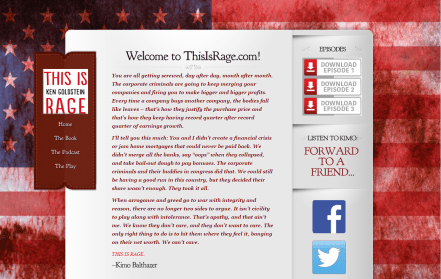
Visit ThisIsRage.comAbout three years ago I published my first novel, This Is Rage. It’s been an amazing journey, including creative development and four public readings of my stage adaptation. Now we have something additionally exciting to announce: the first three episodes of a podcast adaptation.

We made it easy for you to find either on iTunes or at the online home that saved Kimo Balthazer from irrelevance and started his movement:

ThisIsRage.com

Who is Kimo Balthazer, you may be asking? Well, if you haven’t read the book, I would hate to spoil it for you. Let me say in the form of a teaser that he is a 20th century old-school radio talk show host lost in a world of 21st century digital communications. Although he has lost everything, and that’s largely his own unrestrained shock-jock fault, he still has a few things to say about how the business workplace is no longer the same for the everyday hardworking person.

Kimo’s anger is his listeners’ anger, and when that anger collides with a nasty bit of corporate insider deal-making that is going to eliminate thousands of great jobs for no good reason except increased profits, he takes his tirade to the Internet. Pretty much all hell breaks loose.

I kept notes for this novel for over a decade, wrote it over a two-year period beginning in 2011, and then published it with The Story Plant in 2013. At that time, the social climate of the Occupy Wall Street movement was opening the dialogue around the 1% and the 99%, and the voices around me eerily echoed the voices in my story.

The political reception to my book was as heated as it was overwhelming. I began hearing from readers all over the world who had suffered personal losses similar to the employees of the fictional EnvisionInk Systems and Atom Heart Entertainment. They recognized the roaring rage of the main characters in the book plotting against and outmaneuvering each other, while also empathizing with the quiet rage they felt in themselves as victims of an economic system they no longer recognized. They didn’t recognize Kimo, he was purely fictional, but what he was shouting rang true. They were playing by the rules, and the rules were failing them. Income inequality was becoming much more than a story.

Then something happened that surprised me. The novel was optioned for the professional theater so it’s echoing story could be experienced live and in person. I worked with the producer, Mitchell Maxwell, and my editor/publisher, Lou Aronica, for two years delivering four different drafts, each culminating in a public reading that drew equal laughs and tears. It was an unpredictable experiment that often left me drained, but each time I listened to the audience dialogue following the show, I knew the seeds had been planted for something good to come of this, if only people saw themselves in the mirror of drama and refused to let it stand as the status quo.

Then something else happened that surprised me again. The Story Plant Media team called and asked how I felt about adapting the stage version to a podcast. In facing this challenge, I reminded myself of the daunting task of writing the novel, followed by the daunting task of the four stage drafts. With the podcast, the true voices of the characters could resonate in the listener’s imagination, much as Kimo’s voice resonated with his audience. An old-fashioned radio treatment for an ironic tale of Internet radio seemed like the prefect path to firing up the voices all around us.

Those voices now belong to you.

How about that; old-fashioned serialized radio drama, all new for the digital age? There are twists in this version of the story I am exploring anew, many quite different, and dare I suggest, the romantic elements have come a little forward. Of course since we are talking the immensely flawed Kimo Balthazer, we are talking a dysfunctional romance. Perhaps it’s even hard to call it that. War of the broken-hearted might be closer. It goes to some strangely dark places of the soul.

If you read the book, you might remember the hint at the end that Kimo asked for coffee with corporate attorney Sylvia Normandy? In this adaptation of This Is Rage, Kimo and Sylvia go way back. I mean WAY BACK, as in a personal history together. Sylvia is the narrator of the podcast. She is the storyteller. It’s told through her eyes, her point of view, her play-by-play commentary. I told you it was different.

Why revisit Rage now? If you’ve been following my blog, you won’t be surprised that certain candidates in this year’s elections have stirred raging emotions in me. Throughout the past year, we’ve seen all kinds of signs that Occupy was not an isolated affair, and the People’s Revolt is showing signs of resilience everywhere. We live in difficult times, and sometimes we forget we always have choices.

It’s been said by many that change happens when the pain of change is less than the pain of staying the same. The pain around us is not sustainable. Change has to happen. It remains my hope that this story of an amateur kidnapping in corporate America elevated out of control by thundering voices can be part of the narrative that leads us together toward change.

I’d like your voice to be a part of that change. I’d like my characters’ voices to be in your heads, and I think the actors in this podcast have delivered on that front. I want to keep hearing the voices of post-show conversation, and I’d like our collective voice to reach up and grab the attention of those in power not listening. Our shared voices can bring reform, human innovation, and make change happen.

A story is one voice. When we read and listen and hear and react, it can become way more than a manuscript. My voice is meant to be a catalyst. Yours is a conduit. Let’s put them together and share a little podcast drama, shall we?

You can download or stream the podcast, and it’s free. You can also use the social media buttons to “Forward to a Friend.” That would give Kimo great satisfaction. Me, too.

Download-on-iTunes

_____

This article originally appeared on The Good Men Project.