Stop Dropping the Ball

MittBallI get called frequently to help companies with their brands. Usually this involves helping identify the competitive advantages in products and services, articulating the unique selling proposition around innovations that constitute a customer promise, and then devising a sustainable communications strategy around that promise. That’s the hard part.

There is also an easy part. At the potential obviating of substantial advisory services going forward, here is an exceptionally simple way to solve half your problems. Ready? This applies equally to your personal life and your professional life. Copy and paste the following two words on the palms of your hands so you can see them every hour of every day:

Follow through.

Yes, it is that easy. A brand is a promise. There are three potential paths that follow a promise: (1) you fulfill the promise, wherein you satisfy and keep a customer, at least until someone leapfrogs you; (2) you exceed the promise, wherein you create an evangelist who markets for you; or (3) you violate the promise, wherein you create nasty noise in the marketplace that speaks ill of your offering at every possible turn.

When you break a business promise, you undermine the brand. When you break a personal promise, you undermine your own credibility. This is not negotiable. This is as hard-core real and irreversible as it gets. You need to follow through.

Here are several recent examples of broken brand promises:

  • My wife left her mobile phone on a plane. We went to baggage services. They couldn’t find it. They said they would call us the next day. They didn’t.
  • I went to pay my health insurance bill online as I do every month (I’m told recurring billing is for some reason not available on my plan). This time the system was broken. After on hour on the phone, I got a customer service representative who said she saw the problem in their system, that it would be fixed in 24 hours, and she would call me back. She didn’t call me back, and it wasn’t fixed. A week later I called again and began the process anew. This time another rep gave me entirely different instructions and said he had no idea why the previous rep had instructed me as she did.
  • We hired a contractor to do some work at the house. He didn’t show up. He didn’t call. When we rescheduled and he did show up the next time four hours late, my wife asked why he missed the previous appointment and was now four hours late. He said, “Well, I’m here.”
  • I filled out a time sensitive form online with a state agency. About a week later, I received a personalized letter via snail mail acknowledging my inquiry, conveying that the signer of the letter would get back to me promptly with an action plan. I never heard from him again.
  • A journalist for a high-profile financial periodical contacted me by email to conduct an interview about my book. I agreed and suggested a time. She asked if I could change that to a time that was more convenient for her and I agreed to that time. I gave her my mobile number. She did not call me at the appointed time. After 15 minutes I emailed her and asked if we were still on. Two hours later she emailed and apologized for missing the call because of an emergency. She asked if she could email me the questions. I said yes and she said she would send them. She never did.
  • A producer from a media company emailed me an inquiry to help his company launch a new venture. I said I would be happy to talk about it and suggested some times. I never heard from him again.

Yes, I know, everyone is busy. It’s completely normal to leave loose ends open in our fragmented, email overloaded lives. It can happen to anyone. It’s perfectly acceptable to leave people hanging if you have a good excuse. They will forgive you as soon as the words “I’m sorry” cross your lips.

Baloney! You’re living in a fantasy world if this is what you’ve convinced yourself, no matter if you are a rookie or a veteran. And you’re not as good as you think you are. Not even close. Otherwise you wouldn’t have left me blowing in the wind to be picked off by a competitor.

Winners say what they are going to do and then do it. I don’t care if you have to make lists of your lists. If you aren’t going to do something, don’t tell someone that you areand you’re scot-free off the hook. If you say you are going to do something and then you don’t do it, you lied. Yes, you lied. Or your company representative lied. And by transitive logic, your company lied. To a customer. That is the customer’s perception.

Think you can buy a big bubbly bag of advertising to win back the trust of that customer? Have fun calculating the ROI.

Think you can apologize and win back my trust? You can’t.

Maybe I have choices at the moment, maybe I don’t. If I don’t have choices now, I will soon. That’s what creative destruction is all about, old failed systems being replaced by better ones. Constraints on distribution are lifted from entrenchment every day. No matter what you have to offer, no matter how good you are at what you do, if you don’t show up as promised, you will be replaced. No one will feel sorry for you. No one will bat an eye when you crumble under your own incompetence or arrogance.

This really isn’t hard. In fact it’s as easy as it can possibly get. Make a promise, keep a promise. Follow through all the time. Do that and call me for the other half of your brand problems.

Brands in Memoriam 2013

Amazon CEO Jeff Bezos made a spectacular impact recently when he went on 60 Minutes the day before Cyber Monday and gave us a glimpse at the future—a fleet of small delivery drones he branded Prime Air. It was a bold statement, and whether intended or not an incomparable public relations move that got much of the nation talking about his online retail company at precisely the most important time of year for consumer purchasing.

Yet I might be in the minority thinking that was not the most interesting thing Bezos talked about on television and in the zillions of video clips that got sent around the digital world in the days that followed. What I latched onto in the Bezos appearance was this little exchange with Charlie Rose:

Jeff Bezos: Companies have short life spans, Charlie. And Amazon will be disrupted one day.

Charlie Rose: And you worry about that?

Jeff Bezos: I don’t worry about it ’cause I know it’s inevitable. Companies come and go. And the companies that are, you know, the shiniest and most important of any era, you wait a few decades and they’re gone.

Charlie Rose: And your job is to make sure that you delay that date?

Jeff Bezos: I would love for it to be after I’m dead.

Well, if Jeff Bezos who is currently sitting on top of the business world knows that sooner or later his company is toast, I think that is about as telling a tale of creative destruction as I can imagine! With that, here is this year’s short list of additions to the Dead Brand Graveyard:

BlockbusterBlockbuster: Aptly named for its status as the big bust of this year, Blockbuster is a sad loss for me. Harken back to the early days of video home rental and there were thousands of mom and pop stores in neighborhood strip malls. It seemed inevitable that these shops would fall victim to industry consolidation to achieve buying power and scale where margins were thin, and Blockbuster came to rule the day. My experience of Blockbuster was that it somehow held onto that mom and pop feel of a local video store, and at least where we rented they always were friendly, helpful, movie nuts, and the checkout line moved pretty quickly. Then as VHS gave way to DVD, along came the startup Netflix to reinvent the space, and Blockbuster went to sleep. By the time they woke up and decided that Netflix was onto sometime with their mail order subscription programs, Netflix was already reinventing itself as a digital distributor, and Redbox had figured out how to pick up the kiosk business with zero personnel vending machines. Blockbuster was two generations behind the innovation curve, and when Dish Network bought Blockbuster ostensibly as a storefront competitive tool in its battle with DirecTV, it was too little cavalry too late to justify the ongoing operating costs.

Current TV: It is hard to argue that Current TV ever acquired much momentum as a brand unto itself, although it’s hard not to draw a certain amount of attention when one of your masthead investors is former Vice President of the United States Al Gore, coming off a nail biter contested single state vote count that almost made him President of the United States. If you poke around the web for remnants of Current TV’s brand strategy, it was to be something like a news network for ages 18 – 34, where much of the content would be user-created, uploaded to a destination online site, and then curated for television cable audiences. I think the notion that I have to say something like denotes that the ill-formed brand strategy never got much resonance, which might have been reinforced when the strategy suddenly shifted to hiring high-profile former ESPN star turned MSNBC darling Keith Olbermann—at a big salary, with even bigger expectations. The concept of building a line-up around a tent pole Olbermann anchor also never resonated, so when Al Jazeera America came knocking with a monster payday for the founders of the 60 million subscriber reach network, it was an easy call for our former VP to call it a win and walk off the field. Not surprisingly, Olbermann went back to sports.

MetroPCS: Remember when we could look forward to airwaves of virtually unlimited choice and price competition due to the wonders of telecom deregulation? No, you forgot, too? MetroPCS is another brand that probably didn’t leave behind a lot of emotional longing with customers, but it is interesting to note that its founding dates back to 1996 and it came to position itself as a carrier with unlimited wireless communications for a flat fee and without an annual contract. The company was a pioneer in 4G LTE rich communication services, and with more than 9 million subscribers grew to become the fifth largest carrier in the United States—both good reasons for it to be acquired by T-Mobile which cemented its position as the fourth largest carrier in the nation. Still feeling good about all the many companies out there fighting hard for your smart phone bill?

What are the key takeaways from this year’s exit crop that might inform a Bezos-like objective of bolstering your brand to outlive your own era? First, speed is everything in the digital age, rest even a millisecond too long on your laurels and it will probably be too late to catch up with that company that leapfrogged you (Blockbuster). Second, a confused brand strategy results in a confused product strategy (and vice-versa) and swinging at that with pricey tactics doesn’t clear the confusion (Current TV). Third, an undifferentiated commodity without sufficient scale will not stand solo long in a consolidating market (MetroPCS).

Last year in my Brands in Memoriam post I went out on a limb and called Blackberry dead. I took a little heat for that, what I probably should have said was RIM (Research in Motion), the holding company for Blackberry was dead, and Blackberry was on deathwatch. Honestly, I feel okay about calling Blackberry dead, to me it’s spiritually dead, and while some loyals are still pounding thumbs on their mini-keyboards, it’s hard not to believe the clock is tick-tick-ticking to Final Jeopardy on this one. Slammed by creative destruction and inexcusably poor management—a very tough critique because it was a visionary company much beloved that lost vision—it is today a zombie brand at best.

Going out on less a limb this year, I don’t think I would be alone in calling for grave concern around the survival of Sears, J.C, Penney, and Radio Shack. I will climb out a little further and hope that Dell finds a fruitful path soon, as it is hard to believe the PC or laptop business is on the mend, or there is much room on the shelves for another flavor of tablets or tablet/keyboard combos. U S Airways is also likely to evaporate when its merger with American Airlines is completed. I hope I am wrong about all of these because we are talking an awful lot of jobs at risk in our too fragile economic recovery if we lose any let alone all of these. Let’s hope management is inspired with some leapfrog ideas for reinvention and revitalization.

Did I miss any for this year or in the near term gun sights of creative destruction? Feel free to chime in below and add your assessments, predictions, and prognostications. Just remember, if you tiptoe out on the limb, forward judgments of demise have an excellent history of being proven wrong!

How Fragile Is a Brand?

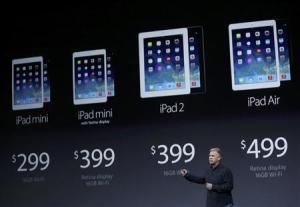
Philip W. Schiller, Senior Vice President of worldwide marketing at Apple Inc introduces the new iPads in San FranciscoApple unveiled a bunch of new products last week, including numerous options in shape, size, and price point for a fuller line of iPads.  Many of these products are desirable and will make great holiday gifts, but none comes close to pioneering a new category of experience.  These are known as brand extensions, variations on a theme for already desirable existing successes.  It’s good stuff, and good business, but not much to get excited about — nothing like the first Mac, the first iPod, the first iPhone, and the first iPad, all of which constituted innovations that created category-defining icons.

Steve Jobs used to talk a lot about brand deposits and brand withdrawals.  A brand deposit takes place when a company invests heavily in making an indelible mark with customers, akin to their very first experience with a point-and-click computer, or a sleek digital music player, or an easy-to-use smart phone, or an intuitive tablet.  Brand withdrawals are usually harvesting activities, like brand extensions, where a company takes some money off the table without over-investing to get it.  Extremely short upgrade cycles for modest improvements in a device or high margin accessories like a carrying case are notable examples of brand withdrawals.  Steve would say you have to maintain a balancing act to infuse a brand with life and a company with cash.  I don’t think I ever met anyone better at this balancing act than he was.

That’s why I am starting to feel some heartache for Apple.  I am seeing a lot of withdrawals and not a lot of deposits.  I am also starting to see sloppiness as an acceptable norm, rocky roads that get paved over later without heavily pushing the envelope to warrant the annoyance.

Recently I posed the following question on my Facebook page regarding Apple’s release of the highly touted iOS7:

Is it just me or is iOS7 woefully slow, bloated, and unstable on older devices, particularly on the iPad2? My hour-to-hour experience on my beloved tablet has gone from impossibly perfect to mediocre. Is this the same Apple?

The response was mind-blowing.  Here’s an extract from the thread, names removed to protect the honest:

  • I’m not having any problem with it except for user error with new features. I do see some slowness trying to connect to the internet but I assumed it was my wi-fi.
  • ME: I don’t think so because I am having the problem with wi-fi wherever I log in, it’s just sluggish, and apps that worked fine before crash at least once a day, and gasp, I have to reboot!
  • That’s not good. Wifi is definitely a problem. Apps don’t usually crash unless I stress them by doing things too fast. You have to reboot the device as opposed to relaunching the app?
  • ME: After a few apps crash it freezes, just like MSFT.
  • Ken, I am having the same problem on my iPhone 4S and MacBook. I regularly close apps on my phone, but that just saves battery life. It doesn’t help with speed.
  • Yep apple has confirmed with me that new software doesn’t perform well on old devices. Happen to me when I owned the iPhone 4.
  • It’s also bloated and annoying on newer devices as well.
  • 4S is now super unstable.
  • ME: Yep, no question that the loss of Steve Jobs is hardly being felt in Cupertino. Brand is in hunky-dory hands.
  • My wife hates it… I won’t upgrade….
  • try running it on an iPhone 4. I hate it.
  • Slow and crashes. I’m running it on an iPhone 4S and an IPad 2. Shame. Shame.
  • ME: Wow, I don’t think I’ve seen this much negative love toward Apple other than at a MSFT conference. I wonder if they know. Maybe I should extract these comments into a blog post to help them understand. But would they care? That’s the real question. If they did, they probably already would have done something about it.

Brands are not invincible.  They don’t fly with a safety net.  Customer loyalty has to be won anew at every touchpoint.  No company is safe from creative destruction, not even Apple.  That is why the average life of an enterprise company today is about half as long as a human life, around 40 years.

And you thought your own 40th birthday guiding you into middle age was scary, huh?

In my view, Apple remains a legendary company with three key competitive advantages at the moment:

  1. Brand: One of the most magnificent consumer brands of our time, expertly polished and full of lustre.
  2. People: An almost incomparable assembly of talent in its employment to create, innovate, Think Different, and change the world
  3. Cash: An unfathomable amount of reserves to invest as it deems wise and appropriate.

If they don’t protect the brand, the other two won’t matter in the long run.  While historic odds of longevity are no more on Apple’s side than any other modern corporation, the good news is that Apple has built up tremendous goodwill with customers and shareholders to ignite the future, and I would venture to guess they will protect their brand, but not without a lot of pain in the reinvention.  That’s perhaps the biggest problem of being at the top of the top, and why it is so easy to fall.  When customer expectations are at the level where Apple sets the bar, you have no choice but to outperform yourself time and again.  That’s an outrageous challenge.

Brands seldom shatter all at once.  It’s the little hairline fractures that get you.  Those are waved off as no big deal, normal ebb and flow in business.  Then a hairline fracture becomes a crack, and the crack ripples outward like a spider web, and then the ceramic whole flies apart.  Andy Grove calls it the Strategic Inflection Point, the change in market forces that happens and you miss it, and then it’s too late to course correct.  You can remainder, but you seldom get back to the top of the heap.

That’s because a brand is not a logo, it’s a promise.  And just like when a friend breaks a promise to you, you seldom fully forgive that person or fully trust them again.  Apple has always promised us humanity above technology, so when they even mildly violate that promise we feel it, because we have come to trust them so much. When a promise goes undelivered or long delayed, like a next-generation product leaked to the public zeitgeist, word of mouth can be savage.  Will we give them another chance on a bad release of iTunes or a map app?  On a rough system upgrade?  Of course we will.  Until the promise is broken one time too many, and then we won’t.

Business leadership is managing part for today, part for tomorrow.  It’s a plate spinning combination of the big picture and the small details.  Mostly it’s about listening to customers and loving your brand more than they do, protecting that promise with every resource at your command.  It’s very, very hard to do consistently, which is why the financial rewards are so immense when you get it right.

Curiously, the Facebook thread I extracted above went on a bit longer, and eventually someone pointed me to an online forum where I was directed to adjust a network setting and reboot.  From there things got a little better, but not entirely.  It was then suggested that I do a clean firmware install, which was way beyond my alloted time block for bettering the tool I needed to do my work — remember, these devices aren’t your work, they are the means to do your work.  We migrated to Apple devices precisely because competitors put us through the ropes with reinstalls, adjustments, and tip on settings that experts could swap.  Apple won the last few rounds because you didn’t have to be an expert at anything, you just opened the box and it worked.  That was a wow, and it was always worth the premium price to those who wished to pay it.  There were a lot of us!

Don’t break your promise.  Sweat the small stuff.  Love your brand.  Love your customers.

The $20 Brand Bond

Amazon LogoLet’s talk about lifetime value of a customer for a few seconds. I use the term “a few seconds” purposefully.

Recently I bought one of those discount vouchers for a neighborhood deli, where you pay something like half of face value and then cash in full value when you’re at the restaurant. This one wasn’t from Groupon or Living Social, but from Amazon Local. When I went to cash it in, the deli was out of business. Tough times always for restaurant retail. It happens. Went to another place for lunch. Oh well.

I got home that night, went to the customer service web page for Amazon Local, found the template under Contact Us, and submitted a one-sentence email notifying them of the event. How long did the response take? Less than a minute. Full credit.

Yep, Amazon Local “bought” this voluntary endorsement for a whole twenty bucks. Plus my ongoing loyalty. My lifetime value to Amazon the Brand just increased a good deal more than twenty bucks, perhaps a hundred times that, maybe more. Why? Well, first because they respected me and my time, but more so because they laid the pipe to assure me that if something bigger ever needed to be addressed, I could count on them.

What did they do right internally to cause this function to be enacted externally? For one, they fully empowered their staff, someone in a call center likely on the other side of the world. There is no way in that brief turnaround their staff person had to ask anyone for permission to do anything. They saw an issue, they jumped on it, case closed.

We look for WOW THE CUSTOMER moments in business all the time. We spend hundreds of millions of dollars on advertising to get someone to sample a new product or service, so that somehow a WOW THE CUSTOMER moment can occur. This one cost an entire twenty-dollar bill.

Compare this experience to another I wrote about earlier this year, where try as I might, I could not get one of the largest retailers in the world to help me locate a $5 replacement part for a thousand-dollar appliance I had purchased from them. That retailer competes with Amazon, probably does not know it, and will never get another dollar from me. If you have a moment, go read the transcript I shared from that interaction. Coincidentally, I happen to have shared that post with a rising star at Amazon back when it happened who was aghast when he read it. He had no idea of the contrast to come.

This is not meant to be a lionizing of Amazon. Full disclosure, they were a minority investor in my previous company and proved to be a formidable competitor, daunting in many respects, not the least of which was their near-rabid obsession with precision, time to market, and transaction perfection. They had vast resources to call on that were not available to me, but they used them wisely and never skimped when it came to the customer experience. That is a big part of how they got to be best in class, and consistently one of the top performers in the Internet Retailer Top 500.

Germane to Amazon’s perfection is a mandate of setting a customer service standard that is so extraordinary and so rare it can seem financially irresponsible to emulate—so much of net margin goes right back into the expense line to serve the customer. Market analysts often shiver when they report on Amazon, wondering how their eye-popping trading multiples can last, with so much volume but so little relative profit. Amazon seems to pay little mind to these analysts, instead worrying instead about customers. That leaves them no choice but to focus on lifetime value, calculating it in complex equations with net present value back to the reinvested capital that most others would probably harvest.

How tempting it is to consume the fruit of that harvest, but harvest has to come each year, and that is why we focus on brands. Here I lionize the customer service commitment as an essential and grounding component of the brand promise. It is the shortest business case study in the world, yet almost every company you encounter gets it wrong.

A service culture in the information economy puts the CEO at the bottom of the hierarchy and the customer at the top. The customer is the boss. The people closest to the customer, individual contributors like those in customer service, are the ones who interact with customers. They make or break your brand. How much discretion and authority are they usually granted? None. How much should they have? As much as you can pile on. They own the customer relationship, so they own your future.

Go on, hire the highest paid consulting firms and retain power player ad agencies. Hold multi-day off-sites for brainstorming retention strategies. Give motivational speeches about reframing your mission and vision.

Or just be really, really, really appreciative of your customers. Love your customers, every single one them, embrace them as strategic imperatives, bonds that build moats.

What’s the ROI on world-class handling of those who frequent your brand? You tell me.