The $20 Brand Bond

Amazon LogoLet’s talk about lifetime value of a customer for a few seconds. I use the term “a few seconds” purposefully.

Recently I bought one of those discount vouchers for a neighborhood deli, where you pay something like half of face value and then cash in full value when you’re at the restaurant. This one wasn’t from Groupon or Living Social, but from Amazon Local. When I went to cash it in, the deli was out of business. Tough times always for restaurant retail. It happens. Went to another place for lunch. Oh well.

I got home that night, went to the customer service web page for Amazon Local, found the template under Contact Us, and submitted a one-sentence email notifying them of the event. How long did the response take? Less than a minute. Full credit.

Yep, Amazon Local “bought” this voluntary endorsement for a whole twenty bucks. Plus my ongoing loyalty. My lifetime value to Amazon the Brand just increased a good deal more than twenty bucks, perhaps a hundred times that, maybe more. Why? Well, first because they respected me and my time, but more so because they laid the pipe to assure me that if something bigger ever needed to be addressed, I could count on them.

What did they do right internally to cause this function to be enacted externally? For one, they fully empowered their staff, someone in a call center likely on the other side of the world. There is no way in that brief turnaround their staff person had to ask anyone for permission to do anything. They saw an issue, they jumped on it, case closed.

We look for WOW THE CUSTOMER moments in business all the time. We spend hundreds of millions of dollars on advertising to get someone to sample a new product or service, so that somehow a WOW THE CUSTOMER moment can occur. This one cost an entire twenty-dollar bill.

Compare this experience to another I wrote about earlier this year, where try as I might, I could not get one of the largest retailers in the world to help me locate a $5 replacement part for a thousand-dollar appliance I had purchased from them. That retailer competes with Amazon, probably does not know it, and will never get another dollar from me. If you have a moment, go read the transcript I shared from that interaction. Coincidentally, I happen to have shared that post with a rising star at Amazon back when it happened who was aghast when he read it. He had no idea of the contrast to come.

This is not meant to be a lionizing of Amazon. Full disclosure, they were a minority investor in my previous company and proved to be a formidable competitor, daunting in many respects, not the least of which was their near-rabid obsession with precision, time to market, and transaction perfection. They had vast resources to call on that were not available to me, but they used them wisely and never skimped when it came to the customer experience. That is a big part of how they got to be best in class, and consistently one of the top performers in the Internet Retailer Top 500.

Germane to Amazon’s perfection is a mandate of setting a customer service standard that is so extraordinary and so rare it can seem financially irresponsible to emulate—so much of net margin goes right back into the expense line to serve the customer. Market analysts often shiver when they report on Amazon, wondering how their eye-popping trading multiples can last, with so much volume but so little relative profit. Amazon seems to pay little mind to these analysts, instead worrying instead about customers. That leaves them no choice but to focus on lifetime value, calculating it in complex equations with net present value back to the reinvested capital that most others would probably harvest.

How tempting it is to consume the fruit of that harvest, but harvest has to come each year, and that is why we focus on brands. Here I lionize the customer service commitment as an essential and grounding component of the brand promise. It is the shortest business case study in the world, yet almost every company you encounter gets it wrong.

A service culture in the information economy puts the CEO at the bottom of the hierarchy and the customer at the top. The customer is the boss. The people closest to the customer, individual contributors like those in customer service, are the ones who interact with customers. They make or break your brand. How much discretion and authority are they usually granted? None. How much should they have? As much as you can pile on. They own the customer relationship, so they own your future.

Go on, hire the highest paid consulting firms and retain power player ad agencies. Hold multi-day off-sites for brainstorming retention strategies. Give motivational speeches about reframing your mission and vision.

Or just be really, really, really appreciative of your customers. Love your customers, every single one them, embrace them as strategic imperatives, bonds that build moats.

What’s the ROI on world-class handling of those who frequent your brand? You tell me.

Brands In Memoriam 2012

Frequent readers of this blog know that I am obsessed with the concept of creative destruction, the intangible but daunting market force where an invention that is vital takes out that which has become defunct, and the nascent replaces the established. For those of you just stopping by, you will find any number of mentions of creative destruction as you page through my posts on innovation—it represents for me all that is true and real in deploying creativity to survive in business, perhaps best captured in the title of Andy Grove’s definitive book, “Only The Paranoid Survive.”

As a result of creative destruction, every year we add more once significant names to the Dead Brand Graveyard. Recent memory had us bid adieu to such iconic enterprises as Palm, Saab, Lehman Brothers, Zenith, Compaq, Borders, Circuit City, Ritz Camera, CompUSA, Mervyn’s, Friendster, Tower Records, Polaroid, and Kodak. I polled my network on Facebook for suggestions to include this year and got way more than I could include in a single blog post, many of which could be argued are still on the bubble; some have already quietly jumped the shark, others are still operating as near zombie brands, not yet coming to terms with their imminent vaporization. I invite those dear friends who offered their suggestions to include them in the comments below—as well as anyone else who can see what is certain to end badly—as internal politics and stagnating ideas cause those who should know better to obscure the mandate of leadership.

Here then are my top label farewells for the current calendar year:

Continental Airlines Logo Circa 1940sContinental Airlines: As a result of the merger between United and Continental, the marketing folks did the right thing and picked one brand to make it easier to find your tail logo on the runway. Was anything really lost if this was just a merger? Ask the people (like me) still stuck flying United—yeah, the customer experience did the impossible and took another plunge. If you aren’t 1K at this point in your frequent flyer status, melt down your Premier Card, there are so many top dogs in the system the rest of us matter not, kiss upgrades goodbye. Choice on routes? Funny how the routes and times keep getting de-duped. It’s ironic that an industry that flies you around in the sky at 500 mph and largely invented the modern loyalty program today can’t come up with more clever ways to achieve growth than eliminating its own competition—plus five extra inches of leg room, baggage checks, and those yummy inflight box lunches are now upsells. The parade of eliminated airline brands welcomes another, while customers fume with rising prices and deteriorating service. Hard to believe this is a path to long-term health and improved profits in a backbone industry our economy needs to thrive.

Fresh & Easy: This expansion into the USA didn’t go so well for UK grocery titan Tesco. Any ideas why? Been in one? Okay, that’s a good start. Here’s another—where was the segmentation analysis? Same prices and quality as the giant American supermarkets like Safeway, but a smaller footprint and thus fewer shelf offerings. Same footprint and attempted laid back environment as Whole Foods or Trader Joe’s, but no real upscale inventory warranting premium prices or nice people to kibitz with you at checkout. No meaningful differentiation to be found, and small parking lots, too. Ready made portions for young working professionals weren’t a home run in a market with as much choice and variety as ours. Head on competition with Wal-Mart—which can operate at scale near 3% net income while it’s strategically expanding in the grocery category—was a capital-intensive bet inclusive of acquiring real estate and building new stores, a tough play requiring far-ranging commitment and vision to warrant the pain. Without either, Tesco cut its losses and retreated.

Newsweek: This one is spiritually sad for us old school hard news and analysis junkies, except that I cannot remember when I last touched a copy of this magazine, even in a dentist’s office. Bought in 2010 from The Washington Post by audio magnate Sid Harman for $1 and assumption of the losses, ostensibly for sentimental reasons, it was then merged via IAC with The Daily Beast and put under the direction of star editor Tina Brown (there’s a cost saving measure, huh?). Circulation and ad rates for the print version of Newsweek never regained momentum sufficient to cover costs, so this year we heard announcement that the print edition is ceasing. Can Newsweek digital-only survive as a differentiated masthead next to The Daily Beast? Can you imagine a good reason to continue two separate editorial teams? Can you imagine the same editorial team producing two presumably different publications? Have you tried to sell display advertising lately for vertical online editorial products? And just what is a News-Weekly in the age of internet microsecond breaking info copy? At 79 years on the newsstands and in mailboxes, Newsweek had a good run, it just stopped evolving.

Hostess: It seems obvious to many that the sub-brands of 85-year-old Hostess will live on post the uber bankruptcy, and there will be some snack distributor out there continuing to put Twinkies, Ho-Hos, and Ding-Dongs on grocery store shelves everywhere (other than Fresh & Easy, see above). The master brand is likely to die with the corporate entity, as executive management was unable to make a deal with the labor union representing the workers who made the Twinkies, Ho-Hos, and Ding-Dongs. So 18,000 people lost their jobs because no deal could be reached between managers and workers? I don’t think that’s the whole story. Try a balance sheet too weak to support internal investment after emerging from a prior bankruptcy with private equity imposed debt and mounting unfunded pension obligations. The real culprit in my mind—you got it, thinner margins and declining market share due to lack of innovation. Hostess management—now asking for bonuses in liquidation—failed to bring relevant new products to market in a climate where obesity and diabetes became part of the vernacular. Wonder Bread may have been the greatest thing since… whatever came before it, but not in a world of seven grain all natural high fiber baked fresh daily, sliced thick and thin or not at all, your choice.

Blackberry: I am going out on a limb here, calling the magnificent former high-flier from Research in Motion dead even though launch of a new platform has been loaded into the cannons for ignition. Why do I say it’s gone with two new Blackberry’s rolling out as soon as next month? As noted in the Wall Street Journal last week, “Consulting firm IDC recently estimated that RIM’s share of the global smartphone market stands at 4.7%, down from 9.5% at this time last year and from more than 50% in 2009.” Sorry, but when a company has less than 10% of the market share it had three years ago, I am not sure how you could classify a recovery as anything more than a dangling lifeline. What went wrong? Ever try to use the Blackberry browser? There is no word in our language of which I am aware to adequately modify the word slow. With an extremely late to market touchscreen interface, where was the incentive for app developers to develop apps? Those of you who know me know my devotion to the thumb driven analog keyboard, but when I tossed it in for an iPhone 5, I knew the rest of the thumbers were coming too.

There were a number of brands suggested by my colleagues as sighted on death watch, but I’ll let those opinion makers chime in themselves and go out on their own limbs as I did with Blackberry. I have my suspicions about who might be on deck for next year’s list, but I will keep those sealed for now in a paper envelope so as not to publicly curse them or too soon embarrass myself for being wrong. Some in the soon to be gone circle I still like and am hoping for a comeback, though not many.

I think I may make this an annual feature. History would suggest I won’t have much trouble coming up with a list each year. Why chronicle the abdicated? Creative destruction is permanently embedded in our business culture, and even the greatest company can be gone in a single product cycle if customers aren’t understood to be our ultimate boss. With constraints on distribution forever less a moat and abundant technology a ceaseless path to increased consumer choice, business leadership requires nimble execution, unending responsiveness, and gracious humility to constantly win anew customer loyalty. It’s a lesson we all need front and center to do our jobs honestly and well: Innovate quickly or die.

Facebook After The IPO

I bought a small amount of Facebook in the IPO.  It was a flyer.  It was unscientific.  It was counter-scientific.  It wasn’t meant to be a life-changer either way.  It was kind of like a lottery ticket, with a long time until the ticket would be drawn, and at the worst some remainder value on my ticket if I lost.

I really like Facebook.  I’m addicted.  I confess to being one of the first “grown-ups” on the site with an account going back to 2005 using a .edu email, investigating for business purposes (yeah, right).  I love to write and I love to read so Facebook is made for someone like me.  I tremendously enjoy sharing ideas, give and take, so that works for me, text more than pictures, it’s all good.  I marvel at the ability to stay in touch with people from all phases of my life, kind of like sending Christmas cards all year round, and without obligation to respond when I don’t have the time.  It’s a great platform.  I have invested a significant amount of time in carefully building my friends list (100% known to me, so don’t friend me if we aren’t at least acquaintances) and my much too long list of Likes.  I tried Google+ and it’s fine, I have an account and I post my blog entries there, but I’m not going to rebuild my Facebook network somewhere else, too much work, the switching costs are real.  Facebook is doing the job for me.  Not sure if I am doing the job for them, but we’ll get to that.

A lot of people asked me what I think about the > $100B valuation.  Here is what I wrote as a comment on Facebook in response:

The question is whether you believe FB can grow into its valuation. The answer is, who knows, but the multiples are very tough on any kind of fundamentals. No one has ever had a proprietary audience of almost 1B, that’s unheard of. The questions are: 1) can they hold them, or at least the valuable ones, without alienating people on privacy or losing them to the next big thing; 2) can they attack TV ad budgets with innovative, targeted campaigns that are both effective and not off-putting; 3) can they diversify beyond display ad revenue into transactions, research, and virtual currency; and 4) how will they deploy their cash for accretive acquisitions, particularly in mobile. That’s a lot to do, but at least they know what not to do having studied those who came before and puttered out. History (AOL, Netscape, the portal wars, et. al.) would suggest no, but remember when the smart money bailed on Apple and called it for dead. Suppose FB triples profit this year and next — well, at this price they’d be trading at less than 10x income, which is still aggressive, but not out of reality for a high growth company (today’s price is “augmented reality”). You’re paying a huge risk premium, so you have to believe they can deliver against that — which is a question no one can answer, hence the risk premium. If you think FB will perform like MSFT, AAPL, GOOG, INTC, WMAT and be one of the greatest companies of the early 21st century it’s ground floor, if you think it’s a fad, it will be an expensive adventure. Gee, I think I just wrote a blog entry!

Let me add a few more comments about Facebook.  I think they are doing a good job pushing the envelope on new horizons, but like all great software companies, they hit and miss.  Facebook aims to build community, which is noble, but it really wins on narcissism, that’s their secret sauce, and it’s primal.  People like to talk about themselves.  And post pictures of themselves.  We really, really do.  Okay, maybe not everyone, some just want to stay in touch with their kids halfway across the country, or meet new people with common interests, or reconnect with a pal from elementary school, or keep tabs at their own risk on an old flame, or support a political cause.  There’s a haute blend of secret sauces, but most of the recipe involves a chance to make yourself seen or heard where this previously required a lot more effort and guts.

The Like Button was brilliant, in one smooth swipe adopting the Fax Machine Factor — with each individual instance being more valuable as the aggregate network expanded exponentially.

News Feed was seminal, the turning point which bought them a shot at Built to Last.  Initially resisted, it was bold and visionary, a finishing move against direct competitors.  The true genius of News Feed remains the simple control that lets you quietly code out anyone’s posts that don’t interest you without hurting their feelings or having to drop them as a friend.

Facebook Connect was audacious.  Imagine if any of the portals had tried this earlier, expanding global registration beyond their own confines to widen the walled garden, and having that embraced by would be competitors!  All the web surfer experiences is they don’t have to create another user name and password, but if they want to do that, they still have the option (this is of course a two-edged sword, noted below under privacy).

Creating a robust platform for third-party app integration with an accessible and broadly supported set of APIs was sheer genius.  Facebook knew they weren’t going to be great at everything, why not let others create games and tools that feel like Facebook without being Facebook?

How do we know these features were game-changers?  Look how widely adopted and copied they have been.  That’s the rest of the digital social world confirming you got something right, all to your benefit.  On the other hand, true innovation at lightning pace means any developer will get some things wrong, and not be afraid of that.  Facebook has proven it’s in the club, with some less than customer friendly features that need attention.

Timeline makes little sense as a consumer experience, perhaps it’s meant to be something else, a comprehensive framework to compile marketing data, I don’t know.  What I do know is that it took away something useful, our ability to quickly scan someone’s self organized profile for affinity, and redeployed it as a pastiche of artifacts.  It reminds me of what a resume is not — it’s not a memoir.  All they had to do to make Timeline great was make it an option for those who wanted it and let the rest of us just keep our profiles.

The Facebook mobile app is not very good.  It was late to market, and the user interface appears cobbled together.  Data I/O is slow and cumbersome.  It does not update predictably or stay current with alerts.  It is still not optimized for tablet displays.

Privacy Settings remain pretty rough, albeit less so than one or two years ago.  There was even a joke with Muppet stand-up comic Fozzie Bear going around Facebook on IPO day declaring the reason the company went public is, “They couldn’t figure out the privacy settings, either.”  Granted the surprises of late have been fewer, but the third-party stuff via FB Connect can be woefully weird to control — do you really want your friends to see every song you’re listening to on Spotify or every article you’re reading on HuffPo?

This past week I spent a full day with some twentysomethings reviewing technologies that were and weren’t appealing to them for e-commerce.  The discussion of Facebook was unlike anything I had ever heard, immensely contradictory.  They could not imagine a world at any time in the future without Facebook, it was as much a part of their lives as food, which they currently couldn’t afford.  Yet they admitted they were using Facebook less each year that went by since high school, and they expressed vast mistrust for the Facebook brand, terrified of what would happen to all the personal information they had unveiled and were becoming predisposed to hold back.  How’s that for twisted logic?  Can’t live without it, using it less, and minimal trust for the brand — some action items there for the development and marketing teams.

It’s barely the second inning for Facebook so there’s a lot of time to recover.  Here’s my advice: win the trust war and you will go from being Good to Great.  Edward R. Murrow and Walter Cronkite helped CBS get there — even when there was little question that what William S. Paley wanted was what the Man Men were selling.  The namesake founder of my beloved corporate alma mater went on TV every Sunday night and became Uncle Walt, which resulted in many millions of folks subsequently vacationing at highly developed former swampland in Central Florida.  Facebook can win a big piece of the ad game if trust is front and center, central and foremost, and transparency is not buzzword.

A motto like “making the world more open and connected” is cool, but be careful that these don’t just become words in your press kit, literally about 1/7 of the world is watching.  Do it, don’t say it, win us over and hold us forever so your name goes on the list with the unforgettable.  Miss that and the stock price will be the least of your concerns.  Now you’re playing for legacy, where Like has to become Love.

I am purposely publishing this after a single day’s trading and before the market opens again.  With the FB stock price a hair above the IPO price for a deal everyone desperately wanted, it’s now everyone’s deal on a level playing field.  The only thing that will hold or improve that stock price over time is consistent greatness.  It’s commencement.  It begins.

Like Is Not Enough

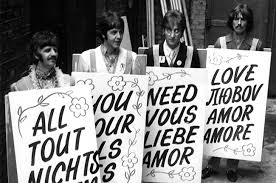
AllYouNeedAll You Need Is Love” — Lennon/McCartney, The Beatles

Facebook over the past several years has done the unexpected in creating exponentially vast usage of the noun/verb Like. This has been fun for those of us who indulge in broadly stamping our personal approvals on anything from a friend’s single syllable utterance to the launch of a new wave of flavored taco shells. Some argue the Like button has diluted the very significance it is meant to convey by spawning misguided promotions to increase click tallies, while others maintain it is the metaphysical fuel that rocketed Facebook into the stratosphere as the place advertisers have to be to mine explicit commendations. Regardless of the ultimate conviction it conveys, Like is an ultra easy way to express a soft high-five in public without any substantive commitment, and if you change your mind, you can Unlike something just as quickly.

While the full measure in a Like action remains on the light side of hand-waving, for marketers it can nonetheless provide an easy litmus test to note directionally if their intended messages are registering at all. Registering is not necessarily resonating, but it is a decent stride across the starting line. Getting someone to Like your brand for the long haul—on Facebook or along the purchase funnel—will never be a small task, but my sense is there is one constant in consistent success: For star marketers to get a Like, they must first Love.

I wrote about a similar topic not long ago in a post about eating your own dog food, where I suggested if you don’t use your own products, how could you expect anyone else to pay you for the privilege. This is a tangent to that thread, where of late I have observed entire marketing teams dogged by cynicism. They are charged with brand evangelism, but in their own minds, they are either not engaged in the true value proposition of their products and services or they have given up on their own futures, proclaiming themselves victims of an ice age they believe is imminent and unavoidable. I believe we often refer to this malady as the self-fulfilling prophecy.

Recently in a meeting with a team of executives who had invited me to help them with some seismic strategic planning issues, I noticed a through line where all of the many accomplished marketing executives in the room found a way to get on each other’s bandwagon, lamenting that their company’s future was not bright. I thought this was simply a down cycle in the conversation which is normal in brainstorming, but the negative energy was a contagion. Here we were, charged with helping reinvent the company, a blue sky path to infusing new levels of Like into brands that were already broadly embraced, but no consensus was emerging on how past Like could become new Like, or dare I say it, Love. As an outsider, I saw that their brands were certainly challenged in the market place, they had seen some decline, but they had in no way collapsed. Yet here the brand stewards being paid quite well for their presumed passion had convinced themselves their brands were dying—a sickness that was terminal and could not be reversed. Where I really got myself in trouble was asking the team how many of them still loved these brands. The rest of the assignment was awfully quiet.

If a brand steward does not start the day in Love with a brand, by the time that apathy translates and diffuses itself into a campaign of communication tactics, Like is not going to be there with the public. Better the executives hand in the baton and give the assignment to someone else who might find a way to convince themselves there is light ahead, yet throwing yourself on the sword for lack of conviction is not a road well-traveled in business. Instead it is likely that these brands will die, even though they could fight on, because no one behind them has the Love to fight. I wonder if the CEOs at the top of these companies know their chief lieutenants have already surrendered to creative destruction rather than rallied to next generation rebirth. Even if the beaten executives are right and the brand is destined to die, shouldn’t someone else who doesn’t believe that be given the chance to prove otherwise—to try with honest enthusiasm to wrestle imagination and go a different route that might just work despite the naysayers? Perhaps some of the CEOs are biding time as well, but my sense is most of those wouldn’t last too long in a board meeting. Love has to be real, and it has to start at the top.

Can someone in a marketing job walk away nobly from a lack of Love? Sometimes I think it is necessary and essential. A very successful friend recalled for me recently how early in her career she was working for a multi-national corporation on a vastly successful billion dollar brand that had of late stalled in its growth, years after it had gone wild and saturated market share. The team brainstormed and came to the conclusion that to reignite growth, marketing programs would have to implicitly suggest that the brand being marketed met the needs of a more healthful alternative already for sale, and that by shifting use from the believed healthful product to the growing brand, nothing would be lost and everything would be gained. Mind you, nothing illegal was being plotted and the campaign would by default have to meet truth in advertising laws, but the very idea that the only way to grow the brand was to pull attention from a more healthy alternative did not sit well with my friend. She understood the strategy, but she fell out of Love, and even out of Like. She did the right thing and left the company. Today she runs her own company and I can tell you this—she Loves her brand.

Remember this: a brand is not a logo or a trademark or a pithy name—a brand is a promise. You can stop loving a product line because it needs to change, indeed loving a product line too much can be a trap, but products are directed to evolve because loving the brand is a driving force. A brand is a set of choices that begins and ends with meeting customer needs. The branding process begins with ideation, continues through product development, then translates into communication (these days bidirectional feedback loops, like we see in social media, more than soap box broadcasting) and ultimately does or doesn’t result in customer loyalty. When you make a promise to your customers, you are obliged to make good on that promise. My sense is for that to happen repeatedly and predictably, if you are part of the creative cycle, you must Love, Love, Love your brands. If you don’t, no one else will.

If for some chronic reason you’re convinced a brand truly is at end of life, the right thing to do is protect working capital and advocate to take it out of commission mercifully. It is wrong to shovel high-priced coal into an engine you believe will no longer run because you’re pretending to believe a directive handed down that you knowingly disavow. Don’t try to fake it! If you don’t Love your brand, go find another that you can Love. If you are biding your time waiting to be found out, don’t worry, you will be found out. Your customers will do that for you. You need their Like. They deserve your Love.

Love, Love, Love.