Why Do We Do Difficult Things?

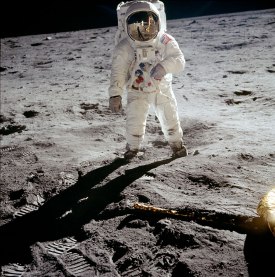
Apollo 11 - NASAI’ve been out on book tour for the launch of my new novel, From Nothing. At one of the early talks I began with a simple question: Why do we do difficult things?

I’m not talking about ordinary-difficult things like schlepping yourself to work every day or paying all your bills. I’m talking about really big stuff. Pick a career path. Marry someone. Divorce someone. Start a company. Write a book—without an advance check.

Why do we decide to tackle extraordinarily hard challenges? Why do we embark on the kinds of things that change our lives?

I’m going to give you the answer in just a few more carriage returns, but before I do, think about what your answer might be.

Why do you do exceptionally difficult things?

Is it for money?

Is it for status and ego?

Is it because someone else pressures you to do it?

I think those enticements can play a role, but I don’t think it’s why most of us do difficult things.

I think we do difficult things because we can’t not.

Try repeating that in your head. Read the words “Why do we do difficult things?” Then answer aloud: Because we can’t not.

If you’re not alone, say it rather quietly under your breath, but do say it aloud. If you are alone, shout it from your gut.

Why do we difficult things?

Because we can’t not.

Excellent, I think I heard you that time! You’ll note the purposeful application of a solid double negative. Don’t worry, the grammar police aren’t coming for us, at least not this time.

I want this message to encode in your mind: Because we can’t not.

The topic of my book talk was why I choose to write for what amounts to the tiniest part of my income given the full span of hours invested. The question at hand was why I didn’t spend more of my time on lucrative business projects instead of sitting alone in a room for half my waking hours banging out words without much promise of real financial upside no matter how well I write.

There are obstacles to book distribution at an enterprise scale that are beyond my ability to control. If I chose to write fiction solely for wealth creation, I would be repeatedly disappointed. I would like to be pleasantly surprised by financial reward largely because it meant more people would have read my stories, but I would be foolish to count on it.

To me, it doesn’t matter if I get paid a fortune or less than minimum wage. Most of the money I’ve made in my career was when I wasn’t thinking about money at all. The few times I was thinking primarily about money I made the least. Or none.

I follow the path I can’t ignore. I do what I need to do, and the rewards follow or they don’t.

Why do we do difficult things? Because we can’t not.

I have learned that this applies to business, to art, and to human relationships. The principle is always the same.

Certainly money is a part of the equation. For some people, it’s a very big part of the equation. In my experience, when it’s most of the equation, you’ll see in front of you a very unhappy person—whether he has a lot or a little.

When the reason for doing things is unbalanced, most everything begins to go haywire. That actually happens to the main character in my new book, Victor Selo. He sees people going for the money and only the money. The world falls apart.

Why do I sit in front of this grimy keyboard pounding out sentences when I could be helping start or buy or sell another company?

I like money. I just decided I knew how much I needed, and what I wasn’t willing to do in search of more. I needed to return to who I was when my wife met me: a guy who made up goofy stuff and told it to other people (I borrow that line liberally from George Carlin). Minimum wage or a bestseller, it didn’t matter. I couldn’t not write.

I want you to consider doing the same. I want you to do whatever it is that you cannot-not do. Ah, there’s that double negative again! This author will go far.

Please do what you cannot-not do.

Why not stick with the easy stuff? Isn’t it difficult enough to get through each day and week, pay the bills, avoid unnecessary conflict with your boss, co-workers, acquaintances, and family?

Yes, all of our routine tasks can be exhausting. It’s easy to let them take over our lives. Here’s what those debilitating punch lists obscure:

Time is precious. Time is perishable. Our lives are at last defined by how we play out the clock.

Self-definition is a choice. It happens to be a very hard choice. It takes place at those invisible forks in the road we too often only see in hindsight. When we force ourselves to look ahead, our choices become constructively active, not passive, even when ultimately deemed wrong.

The intrinsic rewards of courageously owning a cannot-not do agenda are unique to each of us. If we don’t own that choice, it is made for us. Some people call that one of life’s regrets. I think of it more as ignoring the call to unique opportunity.

Why do we do difficult things? Because we can’t not.

Another way to go astray and release control of the clock is to lose faith in our honest self-awareness or pure acknowledgment of our true abilities. Remember, I am not talking about the things we might want to do. I am talking about the things we cannot-not do. Those two forces might align, but not always. Self-deception can cloud our best choices.

Here’s a confession: I was a theater student in college. I was also a philosophy student so it wasn’t a total waste of time and money. I had a very Russian acting teacher one semester, who took me aside and said in a thick accent, “You know what, Kenneth G, this acting, you know why I do it?”

Okay, she didn’t say Kenneth G, that reference comes years later, but it kind of works in this context. Go with me.

“Because you’re good at it?” I answered her.

“That is beside the point,” she replied in English that could have been Russian. “I do it because there is nothing else I can do and still be me. The difference is, I think there are other things you can do and still be you, so do that, and you will spare yourself a life of misery.”

I thought about it and said: “Is this a nice way of telling me I’m not good at acting?”

She smiled and nodded with that Russian piercing insight. “You see, Kenneth G, you understand so well. Do something else that you cannot-not do. What we should do is what we must only do—because we can’t not.”

That’s when I knew I had to write.

What about you?

_______________

Phone: NASA (Apollo 11)

It’s a Hard Rock Life

From Nothing by Ken Goldstein
From Nothing, my third and most personal novel, has moved from my ownership to yours. I hope it will mean something to you. It certainly has been an odyssey for me. The book is rock and roll, the process of performing it no less so.

As I write these words, I am preparing a number of public book talks, thinking about what I want to say about this story beyond letting it speak for itself. That’s always hard, and particularly difficult this time because I did choose each word in the book carefully. My dear editor and publisher at The Story Plant might say I deliberated on them too carefully, which is why this one took so long, but hey, that’s who I am. Spontaneity for me is a highly composed orchestration that only sounds top of mind when recited.

Since the majority of my readers won’t hear me speak on this book, I wanted to share some of those thoughts with you. I also want to be extremely careful not to give away any spoilers, which is quite a task when I want to tell you everything. I will do my best to restrain myself.

I have an eclectic process I use to write a novel. It begins years before I write a single line of expository or dialogue. I usually have a protagonist identified and a very rough roadmap of a plot that will deliver that character’s arc, but even before I begin the detailed process of outlining, I start a page of ideas I call “collecting.” That can take a decade, or in the case of this book, several decades, because this book began as a long abandoned screenplay treatment I wrote in my 20s.

I share with you here some of the ideas and concepts I wanted to explore that landed over the years on that collecting page. Some of these have been transcribed directly from the many scraps of paper that got stuffed into my project folder.

It all started with the notion of the soundtrack of our livesto be fully confessional, the soundtrack of my life. I believe our music carries us through the bad times and encodes the good times. Each of us has a unique soundtrack depending on our years alive, but most of them overlap. I wanted to build a story sitting atop that premise.

That became the conflicted tale of Victor Selo, a onetime cover band guitarist become corporate refugee become cover band artist anew with remarkably higher stakes. Music both holds him together and tears him apart. His flight from the big bucks technology arena is meant to be an escape, where songs of the classic rock generation guide along the plot like a jukebox musical, but his personal history looms forever large. He trades one stage for another, large to small to ascending, not better, mostly different, equally pernicious.

I began framing his quest with a number of lyrical quotes, from The Beatles and The Who, and one special song from another band which would be a spoiler so I’ll have to let you discover that. The book’s title already hints at a giveaway. I wanted these lyrics to punch through the chapters, which you’ll discover are not chapters at all, but tracks from a concept album. Oops, another spoiler. I better quit while I’m ahead, or very soon thereafter.

I wanted to explore how we find the courage to do the right thing, especially when the choices are not clear, and the most obvious choice could easily have the most deleterious repercussions. We want what we think we want. We want what we think we deserve. We are usually wrong about both. We are not alone in enduring the consequences of what we bring on ourselves.

I wanted to explore the necessity of constantly starting over in life as a creative process. This might seem a bit counter-intuitive when applied to the building blocks of one’s personal growth, but it’s not really. We think a career is about piling one success upon another and hiding away the failures. Once you reach a certain age, you realize how wrong you were to think that’s how things work. Back to The Who in Quadrophenia (1973):

You were under the impression
That when you were walking forward
That you’d end up further onward
But things ain’t quite that simple.

When we begin from an empty palettefrom a hollow toolbox and an arsenal of absencewe have the unblemished opportunity to reassert our individuality and purpose. We sing the song of ourselves. We embrace the courage to risk exposure. We realize the comfort zone of complacency is the strangling curse of the zombie. We slay the zombie in ourselves before it forces us to wander the earth in purgatory sameness.

Good people can be corrupted under stealth compliance when they prioritize the essence of survival over the illusive ideal of needing to thrive. We all do it. We have to do it. There are hidden crossroads in our lives we can only see in hindsight. We have to choose at the fork in the road with the clock ticking, but we seldom see there is a real choice until after we have chosen. That’s when fate throws a party and the booze is bad.

I wanted to explore the full magilla of a Tyson-like knockout. You know Iron Mike’s saying, “Everyone has a plan until they get punched in the mouth.” When you’re lying on the mat looking up at the referee counting you out in a fog, how do you come back? How do you fight a different way?

It all circles back to creative destruction. We are dying to be reborn. It’s nearly impossible to figure out how until crisis strikes like a demon tornado on the bountiful plains.

If you peak too early, you can fall pretty far, pretty fast, and never find the net below the trapeze. When your dreams die, what do you do next?

While we’re at it, how do we combat the forces of mediocrity, the entrenched entitled protecting themselves from sharing the spotlight with a new voice? Can we courageously take on the sins of self-propelling governance, the greed and avarice of short-term thinking, the material byproducts of genuine innovation that create conflict where instead there should be celebration?

I wanted to wrap all that in the conceit of a song cycle, a hard rock concept album that holds together on theme. I wanted to pick an argument with eternity, crawling toward faith where it hides in our sorrowful fears.

In the end for a storyteller there is only relevance and irrelevance. Anne Lamott explained it in the simplest of all statements: “No once cares if you write, so you have to care.”

I care a lot. I hope you see that in this unusual trek through multiple backdrops and the obstacles we overcome in the search for ourselves. If you want to read a more detailed synopsis or a few brief excerpts from the text you can link to that here.

I’ll see you at the after-party. I’m told the top shelf will be pouring in the green room. I’ll be tuning Victor’s guitaror maybe carrying his practice amp to a late night no-cover lounge in Vegas.

Sam and Rosie: An Odd Couple

I can’t defend Samantha Bee because the harsh, offensive language she used this week was wrong. I have been a fan of her show since it launched, but I actually think it has gotten progressively worse as she has allowed her indignation to overcome her humor. My sense for some time is that she is not currently at her best.

Indignation is the call to fight. Humor is the sword that slays dragons.

A strong producer could steer her back on track. I don’t see a lot of evidence she has one, and I think her talent is taking a hit as a result. If she looks to some of her peers and mentors, she’ll see where she may be losing ground on that illusive concept of “crossing the line.” I’d like to see her rebound because she does have a unique, important voice in our nation’s dialogue.

When Roseanne Barr launched her latest damning tweet, I believe she was in an entirely different universe of free expression.

Here are a few points on the false equivalency:

1) There is no equivalency between a random racist tweet and a few unnecessary hateful words deployed in the context of making a point about the morality of separating parents from children. Lenny Bruce pretty much died for this point. Context is inseparable from language.

2) Complain all you want about who should get fired or cancelled, but the two performers have different employers. It’s the employer’s decision to exercise a response to the free speech exercise of an employee or contractor. Had it been the same employer, there might be an opening to hypocrisy, but even then, don’t mistake what happened. These were considered business decisions.

3) If you want to know the true horror of our nation, do a few internet searches and see what some of Roseanne’s supporters are saying about the underlying truth in her remarks. The defensive outcry over an alleged double-standard does little more than fuel the fire of racism as some kind of macabre social norm too many people can easily dismiss as overblown. Racism is institutionalized hatred bolstered on ignorance. Celebrities choosing to fan that flame know what they are doing. To the contrary, you might find a few people defending Samantha’s rotten choice of words, but for reasons of emphasis, not denigration of gender. Again, context matters, particularly as a rallying cry. There are degrees of invective. The hierarchy stems from purpose.

Far be it from me to defend Samantha, but I believe her intention was motivated by a positive force of social criticism. She threw away that timely opportunity with a few poorly chosen words. Roseanne was just being herself, using her humor to irresponsibly reinforce a longstanding platform of inciting the biases of her base.

The two incidents are not the same. Far from it.

_______________

Image: GQ

The Compartments We Devise


We never know the full story when we look into someone else’s eyes. It doesn’t matter who it is. Our spouses, our children, our friends, our business colleagues—we all have chapters in our stories that are as yet untold or never told. It will always be that way. The best we can do is get better at listening, remain open to compassion, and craft compartmentalization strategies to balance the myriad conflicts that attempt to overrun us even when we appear to be at our best.

Appearance is always deceptive. It’s why writers have something to write about. It’s why most of us like to read stories, see plays, and watch movies. We trust storytellers to reveal to us the points of backstory we need to piece together a coherent narrative. Sometimes we call that entertainment. Other times we call it the awakening inspired by a cautionary tale.

Life instruction is much harder. Think about the people you will encounter this week. Which of the following might they be experiencing and trying to integrate into the disjointed career demands of their workplace and the to-do lists filling their calendars:

  • Might they have a dear friend in the hospital with a terrible disease?
  • Might they have just learned one friend is getting divorced and another divorced a year ago in silence?
  • Might they be looking for ways to support people living far away whose lives are being devastated by a natural disaster?
  • Might they have bet heavily on a seemingly safe investment and lost enormously in its bankruptcy?
  • Might they have heard from the IRS that no matter how careful they were on their tax filings they are being audited?
  • Might they have recently discovered their retirement savings will not sustain them as they had planned for decades?
  • Might they have signed up for a critical deadline at work that is no longer achievable?

Don’t fret; odds are not all of this is likely to happen, at least not at the same time. Yet no matter how well things may be going or appear to be going for someone, you can be assured strife of some sort is lurking behind the curtain. None of us are invincible. None of us can entirely hide from adversity.

You never know any of this is happening to someone until it is revealed—and often it is never revealed, or revealed so long after it occurred you can be of no help. Other times it is you who are overwhelmed by the conflicts hidden from others. Life’s twists and turns find us all. We all have stories no different from tales we read, built on conflict, secrets, revelations, and resolutions.

Some people are better at maintaining the status quo no matter how hard they are being side-swiped in the dark. You know that person at work who seems superhuman, who just keeps delivering and never utters a peep about any kind of distraction or digression. You ask yourself how that person pulls it off. You wonder if such stoicism is sustainable.

Often these “superheroes” (or robots) are not as bulletproof as you think. They might just be very good at separating their life into components, ruling out clouding aspects of conflict to focus on the task at hand. That’s a skill, one that can be developed. Those who are particularly good at it know one thing for certain: it is not a magical power. It does not come with unlimited gas in the tank. It’s a bridge, and while it can be a long one, the beams supporting it are not infinite in strength.

Devising compartments is a coping strategy. Almost everyone figures out how to do this to survive, some better than others. When someone is too good at it, we might think them cold-hearted. That may seem an apt critique in the throes of emotional exhaustion, but it may not be a warranted conclusion.

When we segment our lives into compartments, we attempt to deal with difficult things separately, one at a time, one hour and one day at a time.

The problem with these compartments is that no matter how well we think we construct them, they all have not-so-secret wormholes connecting them. They send messages to each other through an impenetrable network. They shares walls of the same real estate. Those walls are thin by design.

Compartments are awkward. The storyteller knows this, which is why we listen to the storyteller. When the storyteller is ourself, there is all the more reason to listen.

Sometimes I think of song lyrics that have resonated with me and helped me develop perspectives on the compartments of my own life and those I observe in others. In his first solo album in 1984, Roger Waters of Pink Floyd wrote a very simple phrase that has stuck with me:

I recognize myself in every stranger’s eyes.

These simple words of reflection and contemplation put us all on the same playing field. When you take in the faces you pass along the street, each one constitutes a life that likely contains the same levels of success and failure, bonding and betrayal, health and illness, triumph and capitulation. The same holds true for school, for work, for community service, for the organizations you join for camaraderie and insight.

You don’t know the stories of the people around you any more than they know yours. Those stories are difficult and complex. The question is whether the obstacles in those stories will be overwhelming.

Sometimes you can help. More often you really can’t. When you integrate the compartments of your life with theirs, you can always move toward a path of shared understanding.

If you recognize the breakdown of artificial deconstruction in tales of fiction, you can recognize it in the real people around you. More important, you can trust yourself to see it in your own machinations. When you acknowledge the connections in your own compartments, they cease to be traps. That’s when compartments become shared spaces. That’s when real character building begins.

_______________

Photo: Pixabay