You Can’t Fix Morale

Here’s a phone call I sometimes receive, usually from someone senior in executive management or the investment team behind a once promising company:

Inquirer: Hey, we need your help with something. We have a situation and we’re not sure what to do about it.

Me: Sounds intriguing. What is the situation?

Inquirer: Well, we’re having… I’m not sure what you would call it exactly, I guess a problem with morale.

Me: What would you like me to do?

Inquirer: We would like you to help us fix morale.

Me: Oh, that. I’m sorry, I can’t help you.

Inquirer: We haven’t spoken two minutes and you already know that?

Me: Yes, I’m quite sure. I certainly would like to take your money because I’m sure you are willing to pay a lot to do something about this, but I only take on projects where I can actually help someone.

Inquirer: How can you be so sure?

Me: You can’t fix morale.

Inquirer: What do you mean? Morale gets fixed all the time.

Me: Yes, exactly. Morale gets fixed because whatever is causing it to deteriorate gets fixed, but that is where you need to look, at the disease, not a symptom.

Inquirer: Are you saying we need to fix something else in our company so that maybe it can have an impact on morale?

Me: Yes, that is what I am saying. In fact, you probably need to fix your company.

Inquirer: So a contract to fix morale is not big enough for you? You want a bigger contract to fix our company? But our company is not broken.

Me: Then you probably don’t have a morale problem and don’t need any help.

Inquirer: You’re not doing yourself any favors turning this down. It’s a big project. We have a sizeable budget for it.

Me: It’s tempting, but why don’t you have another look at the situation and maybe we can talk again.

The call usually ends there and we don’t talk again. Every once in a while we do talk again and then I tend to get involved in long stretches of dialogue with team members up and down the line. We talk about a lot of things: leadership talent, product quality, business model. We talk about creativity and innovation, passion for excellence, dedication to the customer experience. One of the things we never talk about is trying to fix morale.

Let me say it again: You can’t fix morale.

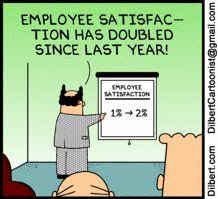
Bad morale is a byproduct, most often of poor direction, sometimes of impossible goals so ridiculous no one ever feels appreciated, other times of uneven credit and compensation in times of success. There are successful companies with good and bad morale, and struggling companies with good and bad morale. Good morale is also a byproduct — you achieve it by focusing on the right things.

I view morale as a result of process and outcomes. Process involves day-to-day workplace routines that reinforce or strip away employee engagement. Outcomes involve the continuity or deadend at the culmination of a milestone, the reward or repudiation for the commitment of time, expertise, or passion. If your process is bad, morale will be bad. If your outcomes are bad, morale will be bad.

Suppose your company wildly missed earnings targets three quarters in a row. You’ve seen your second round of layoffs in less than two years. More than half of your VPs were fired and hired in the past ten months. The CEO, also rumored to be teetering, has said repeatedly everyone needs to “work smarter, not harder,” but no one is sure which product in the pipeline is going to carry the day. Employee morale as you would expect is rotten all around you. Your colleagues are irritable and nasty. Every week someone you like leaves the company for another gig.

Let’s look at some options for addressing this:

  1. The company hires a consultant to run a survey on employee satisfaction and weeks after you fill out your survey they find out what everyone knew before the survey: Morale stinks like a decaying carcass. The CEO announces Fridays will be half days, the company will be publishing a weekly newsletter celebrating its best employees, and all VPs and above will be taking classes in how to write better reviews and talk nicely to their teams. Everyone is told he or she is appreciated and reminded to work smarter, not harder.
  2. The company holds an executive offsite where all the VPs get to articulate everything that is wrong with the company. The VPs report back to their teams that the CEO agrees, there are not enough resources in the company to go around, the timelines for deliverable are insane, and the competition has an edge on the industry that is daunting. Starting today you will have realistic goals, more resources, flexible timelines, and as long as everyone is doing their best, then management will back off and be satisfied.
  3. The CEO pulls together a half-dozen of the best minds in the company to conduct an honest post-mortem of why the company’s strategy is failing. That team then strips away all the derivative efforts that are draining resources from the company’s true mission and recommits to a narrowed product strategy that capitalizes on the company’s identified competitive advantage. The CEO then directs the executive team to align the best talent in the company with key roles on the narrowed agenda and hire new talent where mediocrity is being tolerated, then communicates the new plan to the full company in verbal and written detail, not just in an inspiring kickoff speech but in regular progress updates that are candid and coherent.

You might think the answer is obvious, but sadly it is not — especially to less experienced management teams where too many influential individuals have achieved authority through battlefield promotions. Here we are talking the bedrock of directing process and refocusing outcomes. Good process takes a lifetime to learn. Steering through outcomes whether planned or unplanned requires a deft touch. There are no shortcuts. If you don’t have the energy or commitment to take apart process and outcomes one building block at a time, you have little shot at repairing morale.

I often ask people to share with me whether they have had a single good manager in their careers. You would be surprised how many say no. In fact these days it is the rare exception of people who actually rave about a boss from the past and talk about how they are putting that learning to work. The ones who are tend to have fewer morale problems on their hands. Too many leaders’ lives are filled with morale problems because they haven’t learned how to steer past them.

Now think about all those unicorns out there — you know, the 150 or so privately funded startup companies currently valued at $1B or more. Those should be some of the happiest places in the world for people to work, big idea places filled with promise and hope for future riches. Go take a random walk through those gardens on Glassdoor. You might be surprised at what you find. They have a lot of problems. When the majority of them are unable to achieve liquidity for their option holders, they will have even more. With that will come a wave of demoralization sweeping through employee workstations. How would you go about fixing that?

You can fix a product. You can’t fix a byproduct. Fix what’s wrong in your company, not the normal human emotional reaction to what’s wrong in your company.

You certainly can fix engagement. You fix engagement through authentic vision, brilliant product design, and a rallying cry around consistent execution. Fix engagement and morale fixes itself.

Align the finest talent you can identify with challenging projects that allow them to do the best work of their careers. Keep an eye on process. Celebrate outcomes and share the wealth. Be generous with people who are meaningfully contributing to company success. Morale will be swell and you’ll have bragging rights to let everyone around you know what a great environment you’ve created for the next wave of outcomes.

____________

Image: Dilbert.com ©Scott Adams

Can We Talk?

Difficult topics, difficult times. It’s getting hotter out there. Is real conversation still possible?

A recent piece in the Wall Street Journal got me thinking about that. It’s by Amanda Ripley, entitled: America, Meet America: Getting Past Our Toxic Partisanship (6/30/17). The author offers a powerful viewpoint on making peace with each other through interaction, in essence, the widened use of “exchange programs” like some of us experienced in high school or college. In many ways the premise is optimistic, even idealistic. People who have direct relationships with each other tend to be kinder to each other and less likely to be outright dismissive of ideological differences.

I don’t think it is impossible for us tolerate each other’s differences in the abstract. The problem I see comes with the common allocation of shared resources. When we all pool our dollars into a fund, especially when we are compelled to do so by a tax system, we are likely to have ardent disagreements about how those dollars should be used. That’s when personal philosophy becomes policy, and policy as a matter of democracy is less about consensus than it is about majority opinion. That as we know can be ugly, messy, and leave seeds of resentment, because legislative action transpires on current majorities, but policies once adopted can be difficult to unwind.

The problem with compromise is that it does not bridge values. If some people think universal healthcare is a civil right and some don’t, and we all have to pay for it, I don’t think there is a common worldview that bridges our differences. Same with a woman’s right to choose. That means we all become subject to prevailing law, like it or not, unless we wish to break the bounds of prevailing law, which inordinately few would ever consider reasonable. Again this is the sausage making of nightmares. No one stays happy for long, and bitterness has a compounding effect that is exacerbated by social media shorthand and abrupt defensiveness.

Where does that leave us? Pragmatism suggests we need coping mechanisms or we become frozen. I think that means we will find comfort in our own circles and collectives. We will begin to ignore rather than constantly confront our opponents and try to sweep hostility under the rug in tending to our lives. What it also means is that the rage is likely to fester, and while it may be convenient to leave well enough alone, it probably means lost opportunity in real unity. Does that mean the U.S will lose global leadership economically and in championing democracy? Yes, I think that’s inevitable. We can’t do big, important things together if we hate each other. We can visit each other and learn to tolerate each other, but commonality of purpose has to be built upon a majority of shared values. It has to be authentic. It can’t be feigned.

We are making this choice implicitly by agreeing that noble compromise on certain issues of shared resources is simply not honest or acceptable. We can share roads and bridges across red and blue lines until they crumble, and it will take all the statesmanship we have just to keep noncontroversial initiates functional. To think we can continue to do more than that is not terribly sensible. Thus we all lose together, which is probably the proper outcome of this dialectic.

We have been doing some work of late at The Good Men Project that is perhaps itself idealistic. Over the past six months we have expended our subscription service, also known as our premium membership program, to include telephone conference calls on difficult topics. We bring together people of varying opinions into what we call Social Interest Groups, assign a moderator, and allow people to engage across geographic, demographic, and ideological lines to learn from each other. The beta test has been so successful our staff is deploying an Indiegogo campaign to see if they can double or even triple the number of subject offerings and group leaders who are paid a nominal fee for planning the discussions and keeping them on track week to week.

I think the project is notable if for no other reason than it celebrates excellent conversation. I’ve suggested on more than one occasion to GMP CEO Lisa Hickey that I think conversation is one of the few high value products we lose over time that is remarkably difficult to commercialize. You remember good conversation, right? Oh, how we miss those long talks with friends and acquaintances about our favorite book, the reasons we go to war, and on wild tangents the meaning of life. What if those conversations could continue in our lives, with new topics and new participants, scheduled periodically for easy attendance, each episode self-contained but the connecting episodes serialized for those who have the time? We thought that might be an interesting way to bridge the divide. Maybe we are optimists at heart.

Lisa calls The Good Men Project a “participatory media company” because the content is written by the community and personal interaction within the community is what makes it distinct. We tend not to think of online commenting as the be-all and end-all of social interaction, particularly when it is anonymous. Rather we like the idea of people talking and listening about a complex subject, then thinking about it for a week and returning to talk about it some more. The participation is authentic, and while a certain amount of curation is imposed to maintain editorial standards, we are happiest when we are surprised by learning something we didn’t know before the participatory moment.

We also like to think that civility is best achieved through respect, which occurs less through the editorial funnel than it does from exemplary human behavior. Okay, so it can function as a sort of student exchange program. Maybe real dialogue is possible. Maybe inspirational conversation isn’t completely dead. I’d be going overboard if I suggested there might be a big idea here that could circumvent the festering rage that is destroying us, but hey, a good verbal chat each week certainly can’t hurt things.

The product is conversation. The value is a bit of connection and a bit of joy through sharing and compassion. I hope this experiment is a beginning. If we don’t find some way to talk to each other, the dark consequences seem as obvious as they are unavoidable.

You Call This a Loyalty Program?

Try this episode on for size and tell me how it makes you feel about the brand:

I recently logged into one of my hotel loyalty accounts where I had amassed several hundred thousand points. That is, I thought I did. All my points were gone. Apparently this chain has a policy that deletes all your points if you don’t stay at one of their properties for a year. Did they send me a courtesy email reminding me I needed to stay there toward the end of the twelve-month lapse? They did not.

I called customer service and they recited the policy back to me, willing to say farewell to a customer who had paid the freight to accumulate several hundred thousand points in its loyalty program, just not in the past 14 months.

Then I tweeted my complaint about the forfeited points publicly. A few hours later whoever runs the company’s Twitter account tweeted back publicly that the company was very sorry for the situation and dedicated to my satisfaction. The Twit-master asked that I send a private tweet to follow up, which I did. Then we moved the correspondence to email.

I was then told that the company had a one-time exception to the policy where points could be reinstated, but that had already been done for me approximately 13 years ago. Silly how I could have forgotten their grace. However, they said that in an attempt to reinstate my customer satisfaction, they would restore half my forfeited points now and the other half if I agreed to stay at their properties at least three times in the next six months. I wrote back that it sounded a bit ridiculous to be playing Let’s Make a Deal – Loyalty Edition with them, but I would agree because, well, why not?

To their credit, they did return half my points upon receipt of our “written agreement” in that email thread, and I have booked one stay with them. I just wonder, is this what they really set out to accomplish in developing their loyalty program? Is it a loyalty program at all, or just a rewards program that effectively gives me a rebate on what I spend provided I do it on their timetable?

If you give me a reward for my business, then take it away because I didn’t precisely follow your rules, then give it back conditionally with an expectation that somehow I have become pleased by our interaction, how has this helped me as a customer or you as a business? It’s a quid pro quo. I don’t think a quid pro quo has anything to do with loyalty.

When I think about loyalty, I think about preference. When I think about preference, I think about what brand comes first to mind when I need a particular item or service. I choose that brand for a host of reasons, for the totality of my experience with the brand.

I prefer to fly Alaska Airlines because they tend to treat me better as a human being, so I am loyal to them. I am also a member of their loyalty program, but that has very little to do with my loyalty. The way we interact all the time has to do with my loyalty. There is a consistency in my interaction with their airline personnel whether I am flying in coach or upgraded to first class, whether I bought a discount or full-fare ticket. That consistency is what creates loyalty.

I prefer to shop at REI for sporting gear because they are patient with me when I come to their stores not knowing nearly as much about hiking or biking shoes as they do, and when I leave it is with the right pair of shoes. I am also a member of their co-op because that is required to shop in the store, and I get a member rebate every year, but that is not why I am loyal. I am loyal because when I am on a trail or in spin class and my shoes are comfortable, I remember how great they were about helping me get the exact fit and charging me nothing more for their time.

I don’t prefer the hotel chain that gave me back half my points now with a contingent promise for half my points later. We have a transactional relationship based on price and location. I wouldn’t seek them out. I could, but they have given me no reason. Now when I think of them I think of my Let’s Make a Deal experience rather than any experience staying under their roof. That’s sad.

Maybe the problem is terminology. Maybe there is no such thing as a loyalty program. Maybe they are all just rewards programs masquerading as loyalty programs. That’s kind of a punt when you think about it. We could design a loyalty program that involved every point of customer interaction to ensure your satisfaction, but heck, that would be hard, why don’t you just take these points instead and we’ll play like we’re loyal to each other even when we know, wink-wink, we couldn’t care less about each other. It’s a bed and bathroom and points if you follow our rules, so come here at least every twelve months and someday maybe you can cash in those points for a standard room on the house. Maybe, if we have availability, certain restrictions apply.

I recently attended an e-commerce industry conference where at more than one session I heard the phrase, “There is no customer loyalty, consumers only care about price.” If this cynical statement is true, then I wonder why we have marketing departments at all. Don’t believe it. All customers are not automatons who solely focus on what’s cheapest.

Brands are not dead. A brand is a promise. Brands compete on price, quality, and service. If a company wants my loyalty it is there to be won, like Alaska Air and REI. If a company wants to make it about points and rules, that’s something else, and yes, in that scenario why should there be customer loyalty?

You get what you give. Since you’re selling and I’m buying you get to go first. You want my loyalty, show me yours. You want my loyalty, enter into a brand-customer relationship with me. You want to make it about points, if you piss me off I’ll dump you at the next possible off-ramp.

Loyalty is hard to win. It should be, because it’s valuable. That’s why the great brands think in terms of lifetime value rather than rules. If I have to publicly embarrass you with a tweet to get your attention, you don’t care about me a hoot, especially when you just had me on the phone. Think about that the next time a company penalizes you for breaking its loyalty rules. Those are stupid rules. You don’t need the points that badly, and if you don’t prefer the brand, you sure don’t need its crappy rewards program.

_____

Image: Stefan Hatos – Monty Hall Productions

Tell Me About Your Day

Here’s something people often say in companies when you ask them what they accomplished last week, last month, or last year:

“A lot of time is taken up by everyday stuff.”

Let’s talk about that. What is the everyday stuff? Is the work being produced commensurate with the expense?

A few years ago I wrote a post called Too Busy To Save Your Company. I refer to this post often when I am asked to look at a company and comment on why it is not as productive as it should be. It can be a consulting or investment meeting, but when I see lots of people running around or pounding on keyboards but an income statement in decline, I usually start by asking a few key people in the company to describe their days to me.

They often tell me that they spend a lot of time going to meetings and responding to email. When I remind them that meetings and email are not tasks, they are tools for accomplishing tasks, there is often an “Aha Moment.” That’s when I know we can make some progress.

You are wasting time. It is inevitable. How do I know? Because I waste time. Everyone does. No one is 100% efficient. The question is one of scope. Do you own your priorities or do distractions own you? When you start there, you begin to take control of your destiny.

Time management is neither a touchy-feely topic nor a chokehold on creativity. It is how you allocate your most precious and perishable resource, the ways you choose to spend your hours. The portion of your time that is discretionary and how you choose to utilize it is the difference between having a shot at winning and losing for sure. Note that I say it is a choice, because even if you don’t make active decisions about how you spend your hours, the choice to squander time remains a choice.

Try this exercise for a week: Write down hour by hour what you do on the job. If you spend an hour on researching the cost of something, write that down. Log each of your phone calls and meetings chronologically. More importantly, note what you were talking about and if any key decisions were made. Be as detailed as you can. If you read an article on the internet write that down, including what you learned or didn’t learn. If you shopped for yourself, chuckled through laugh-inducing videos, or commented passionately on Facebook, account for these by collecting them into small blocks of time. Don’t worry about the confession, you can delete the audit later. Be brutally honest and exceptionally thorough. This is solely for you.

Now go back and look at your goals for the year. If you don’t have any goals, that’s a much bigger problem which you need to solve before this post will be relevant to your progress. I’m going to assume you have 4 – 6 overarching annual goals agreed upon with the people who pay you or your partners, stuff like “increase sales 25%” or “decrease customer complaints 10%” or “launch 2 new apps per quarter” or “hire 15 regional salespeople.” You get the idea, stuff that matters, the stuff that keeps you from falling into the trap of being too busy to save your company.

Color code each item on your time accounting to match one of your goals. Try green for sales or blue for product improvements, soothing colors of accomplishment. If a block of time doesn’t match up with a goal, use a different color for DOES NOT APPLY TO A GOAL. A good color for this is red because it should be a warning color.

If you see very little red and an even distribution of the other colors against your 4 – 6 goals, you’re doing fine and can stop reading here. Congratulations, you are in perfect harmony and have a well-balanced calendar. As long as your company is growing and generating a healthy profit, this post is not for you.

On the other hand, if what you see is a disproportionate allocation of color — say, 80% blue but you have 4 other goals with minimal color showing— you are out of whack. If what you see is a sea of red, either quickly finish this post and get back to work or find another good post about writing a resume.

Now on a clean calendar, I want you to block your time as you should be spending it. If cold calls are 25% of what you should be doing, block 10 hours per week; it can be 2 hours each business day or 5 hours twice per week, whatever you fancy. I know, you work way more than 40 hours, but for budgeting purposes use that as a baseline.

Now compare the calendars. Want to know why you are not making a bigger dent in your goals? That’s why.

Time management is a subject I address regularly with colleagues as a proactive tool. Each time I assemble a new team, I have this talk with the senior people about their own time management and how seriously they take it, manage it, and monitor it. Leadership by example, right? The people who take it seriously are usually much more successful than the ones who blow it off. At its core, it is active versus passive resource management. Time lost is unrecoverable.

Oh, one more thing: Please don’t forget to set aside time for brainstorming and dreaming. Sometimes we call that shooting the sh*t. If it’s about stuff you think doesn’t matter, it might be wasteful. If it leads one big idea in a year, it can transform your business. Leave time to shoot the sh*t productively. The 5% to 10% of your time you leave for dreaming is where real change starts to happen and companies begin to reinvent themselves. If every minute of your day is consumed with scheduled or forgettable tasks, big ideas are going undiscovered.

Don’t leave all your time to everyday stuff. Do stuff that matters. Then dream on.