Dynamic Duos

The Toughest “Soft Call” You’re Likely to Make
by Ken Goldstein
First in a Series of Ten

You’re going into the roughest, toughest, most ruthless, unending, dirty, nasty, few-rules-everything-at-risk, energy-consuming and only momentarily gladdening bash up fight of your life.  It’s called your career.

Who do you want in your corner?

You train, you study, you fight your way up the ranks, but somewhere along the way you make a choice that you don’t even realize is going to have significant impact and maybe determine your outcomes in those fights — your life partner.  Boyfriend, girlfriend, spouse, domestic partner, husband, wife, call him or her what you want.  You make this choice for romantic reasons, for family reasons, for selfless reasons, for religious reasons.  Do you make this choice for business reasons?

Well, I suppose there are people who are that calculating, in the olden days some folks talked about “marrying up” and such, but that’s not what I am talking about here.  I am not at all talking about making a political call to better your career by making business value part of your criteria of choice.  I am not even suggesting you must have someone in your corner, that may not be your style, and that might be a great choice.  My point here is if you have the wrong life partner on any number of levels, if you and your partner pick each other without enough thought and are not where you should be, it is going to be mighty difficult to fight the battles ahead.  I am sure fighters can go into a title match without anyone in their corner, but that certainly would be a lonely place to look each time the bell rang.

Successful business executives Sharon Meers and Joanna Strober (turned authors!) cover multiple aspects of this complex topic — practical and advisory — in their extraordinary book:
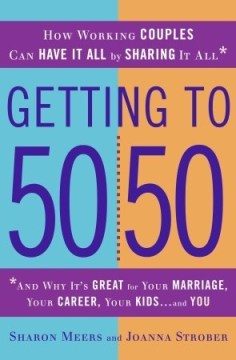
Getting to 50/50

Getting to 50-50 by Sharon Meers and Joanna StroberThey have conducted significant academic research with dual working couples and found unending common themes that lead to success and lack of such in personal and professional circumstances.  For me, the key takeaway was the concept of being mutually supportive on an ongoing basis.  This would seem like such a simple working premise, but think about it, how many couples do you know where both partners are equally supportive of the dreams, visions, hopes, challenges, and aspirations of the other, whatever they might be, and however they may evolve and change?  We may praise this activity when we see it and think how wonderful it is for making the happy home, but the equal observation is that it makes for the same success in the workplace.

You might believe in yourself at any given time, but when that sucker punch comes and you are on your back looking up at the little birdies going around your head and the referee getting close to 10 on the count, who is going to make sure you are back on your feet?  You?  Well, you are going to have to get the feet under you, surely that’s your problem.  But you’ve just taken a hard hit to the head, perhaps even a sneaky baseball bat.  Could be your confidence is shaken, your values are confused, or you’re just lost and dizzy and can’t find your way back to arena.  When someone believes in you more than you believe in yourself, you will go back, every single time, and the simple act of going back is an act of winning.  Likewise, when you offer the same selfless encouragement to someone day after day, you grow stronger, smarter, more focused, and better at what you do, no more what it is you do.  It absolutely must go both ways or it does not work.

Believe in someone 100% all the time, help them with their strengths and weaknesses, and receive the same encouragement in return and you have every chance at success.  Blow this off at your own peril.  Let in someone who doesn’t really believe in you and the chances of that being a self-fulfilling prophecy become frighteningly tangible.

Give and get, learn and teach, share the lessons and overcome the obstacles.  If someone is going to be in your corner and you in theirs, the fight will be a lot less scary.

Bosses Can’t Know Everything Because No One Tells Them Anything

From Character Counts — March 21, 2011

Seven Truths for Bosses” by Michael Josephson

Michael Josephson is a wonderful commentator who focuses on ethics through his Josephson Institute in Los Angeles.  He offers short radio blasts each day which you will see me quote from time to time.  I don’t agree with everything he says, but his heart is always in the right place, and with these snippets, he does a good job of bringing complex concepts down to one minute sermons.

Here he is talking as much to the managed as the manager, creating empathy for the manager’s dilemma while keeping the manager on point with some stark statements you might call clichés, but you can’t ignore their truth.  Without hitting all seven (which you should read in the link), here’s my takeaway:

* Good communication in the workplace is harder than you think it is; without it, there is no alignment.

* The boss rarely gets the whole truth, and that is everyone’s problem, not just the boss’s nightmare.

* You can teach job skills, but you can’t teach character.

* Hiring is everything; think Casting.

* Values have to be alive and well in the workplace; lead by example and remember, it’s a marathon, not a series of sprints.

Always remember, jobs are short, relationships are long… or not.  Trust and information exchange have to go both ways, or no one wins.

In April I will be covering a series of my own snippets, hard learned bits that I originally cobbled together for some aspiring high school entrepreneurs last year.

For Love or Money or Necessity

From The Wall Street Journal: April 23, 2008:

“Must I Bank” by Jonathan Knee

I’ve been thinking a good deal about my Engineering vs. Liberal Arts post earlier this week, and couldn’t help but remember this great column by Jonathan Knee from just about three years ago.  Harken back to 2008 and you will remember the first rumblings of approaching economic challenges, and the first waves of impact in the financial sector where life as it had been known was about to lose a lot of luster.  Careers were changing, some were ending.

The passage that leapt out at me, and why I committed Knee’s article to memory, is a cogent but quietly profound quote from the existentialist Rainer Maria Rilke which he cites.  In “Letters to a Young Poet” Rilke writes:

“This most of all: ask yourself in the stillest hour of your night: must I write?”

In Knee’s analysis that followed, he framed the business context with poignant clarity: “Rilke warned of the hardships of his chosen craft, arguing that if the poet could even imagine living without writing, he would be better off doing so.”

I remember this same discussion growing up time and again with musicians, comedians, authors, dancers, and actors.  Why did they do what they did, why would they choose a life where hardship was the norm?  The answer in every circumstance was quite clear, they did not choose the hardship at all, who would purposely be such a maniacal masochist?  They did what they did because they could not imagine doing anything else.  They did not choose their path, except in acknowledging that the discipline chose them.  If you could do any other thing for a living than follow the path of the gift and be happy, why wouldn’t you?  You would.

Knee applies this same rigor to the discussion of career choice, in this instance, the path of the investment banker.  Yet Knee’s thought pattern travels well beyond that of the investment banker, beyond financial services, to career at large.  Must You Do what it is you are doing?  If not, then can you make a choice that is a better or closer fit to what it is you are supposed to be doing or could be doing.  Knee is not impractical in what he suggests, he knows we all have bills to pay and responsibilities to meet, he simply asks us to consider the extreme case to make sure that we are thinking actively instead of passively, and at least considering if that which we are doing is by selection, momentum, or the well placed secret traps of the pigeon-hole.

We may choose to study liberal arts or engineering, and we may choose the path of a profession.  The choice to change is always present, but really, it is not much of a choice if we force ourselves to be honest and think about the concept of Must.

Can You Study Want You Want and Still Have a Career in Tech?

 From TechCrunch — March 21, 2011:

Engineering vs. Liberal Arts” by Vivek Wadhaw

So I ask myself, does it really have to be versus?

Increasingly the notion of the value of a liberal education comes under attack, particularly in a tough job market with economic pressure everywhere you look.  Many of our nation’s greatest universities still hold fast to the notion that they are not pre-professional academies, and that their job is to teach undergraduates “how to learn — how to learn.”  That might sound a bit abstract for the aspiring unemployed with bachelors degrees in art history, creative writing, or sociology — especially with a bag of student loans as a lovely parting gift — but consider the following:

1) It’s your life, you only get one, and no matter how healthy you are, it is going to be relatively short.  Why are you here?

2) What you do with that life cannot solely be guided by decisions around income, your earnings will only be one part of the greater picture known as potential fulfillment.

3) The four years (plus or minus) you spend in college is by definition impractical, unless you are pre-med or something similar, the NPV of four years spending without earning is going to be a tough pill to digest unless you Think Different.

4) If you have made the choice to go impractical and invest in a college degree, how can it not be in a subject you love?

5) If you learn to learn, and learn it well, you can probably teach yourself almost anything (ok, maybe not brain surgery).  The point is to love learning, sharpen your critical thinking skills, and pursue your passion.  Passionate people have a much better chance — though no guarantee — at happiness (see #2 above).

So I’m with Steve, follow your muse, study what matters to you.  You can always pick up the focus in graduate school or on the job training, and who knows, the insight you gain in the study of almost anything could just Change The World.  But remember, science and math are a subset of the liberal arts, a classical education includes broad exposure and experimentation, so if already love poetry, perhaps you can also learn to like physics, even if just a little bit — it’s good to stretch beyond your comfort zone and you always need to do that.  And as Steve says, when it comes time to innovate, it does take all disciplines working together at the table, so the more you know and appreciate what your neighbor knows, the more you can help each other win together as a team.