You Can’t Fix Morale

Here’s a phone call I sometimes receive, usually from someone senior in executive management or the investment team behind a once promising company:

Inquirer: Hey, we need your help with something. We have a situation and we’re not sure what to do about it.

Me: Sounds intriguing. What is the situation?

Inquirer: Well, we’re having… I’m not sure what you would call it exactly, I guess a problem with morale.

Me: What would you like me to do?

Inquirer: We would like you to help us fix morale.

Me: Oh, that. I’m sorry, I can’t help you.

Inquirer: We haven’t spoken two minutes and you already know that?

Me: Yes, I’m quite sure. I certainly would like to take your money because I’m sure you are willing to pay a lot to do something about this, but I only take on projects where I can actually help someone.

Inquirer: How can you be so sure?

Me: You can’t fix morale.

Inquirer: What do you mean? Morale gets fixed all the time.

Me: Yes, exactly. Morale gets fixed because whatever is causing it to deteriorate gets fixed, but that is where you need to look, at the disease, not a symptom.

Inquirer: Are you saying we need to fix something else in our company so that maybe it can have an impact on morale?

Me: Yes, that is what I am saying. In fact, you probably need to fix your company.

Inquirer: So a contract to fix morale is not big enough for you? You want a bigger contract to fix our company? But our company is not broken.

Me: Then you probably don’t have a morale problem and don’t need any help.

Inquirer: You’re not doing yourself any favors turning this down. It’s a big project. We have a sizeable budget for it.

Me: It’s tempting, but why don’t you have another look at the situation and maybe we can talk again.

The call usually ends there and we don’t talk again. Every once in a while we do talk again and then I tend to get involved in long stretches of dialogue with team members up and down the line. We talk about a lot of things: leadership talent, product quality, business model. We talk about creativity and innovation, passion for excellence, dedication to the customer experience. One of the things we never talk about is trying to fix morale.

Let me say it again: You can’t fix morale.

Bad morale is a byproduct, most often of poor direction, sometimes of impossible goals so ridiculous no one ever feels appreciated, other times of uneven credit and compensation in times of success. There are successful companies with good and bad morale, and struggling companies with good and bad morale. Good morale is also a byproduct — you achieve it by focusing on the right things.

I view morale as a result of process and outcomes. Process involves day-to-day workplace routines that reinforce or strip away employee engagement. Outcomes involve the continuity or deadend at the culmination of a milestone, the reward or repudiation for the commitment of time, expertise, or passion. If your process is bad, morale will be bad. If your outcomes are bad, morale will be bad.

Suppose your company wildly missed earnings targets three quarters in a row. You’ve seen your second round of layoffs in less than two years. More than half of your VPs were fired and hired in the past ten months. The CEO, also rumored to be teetering, has said repeatedly everyone needs to “work smarter, not harder,” but no one is sure which product in the pipeline is going to carry the day. Employee morale as you would expect is rotten all around you. Your colleagues are irritable and nasty. Every week someone you like leaves the company for another gig.

Let’s look at some options for addressing this:

  1. The company hires a consultant to run a survey on employee satisfaction and weeks after you fill out your survey they find out what everyone knew before the survey: Morale stinks like a decaying carcass. The CEO announces Fridays will be half days, the company will be publishing a weekly newsletter celebrating its best employees, and all VPs and above will be taking classes in how to write better reviews and talk nicely to their teams. Everyone is told he or she is appreciated and reminded to work smarter, not harder.
  2. The company holds an executive offsite where all the VPs get to articulate everything that is wrong with the company. The VPs report back to their teams that the CEO agrees, there are not enough resources in the company to go around, the timelines for deliverable are insane, and the competition has an edge on the industry that is daunting. Starting today you will have realistic goals, more resources, flexible timelines, and as long as everyone is doing their best, then management will back off and be satisfied.
  3. The CEO pulls together a half-dozen of the best minds in the company to conduct an honest post-mortem of why the company’s strategy is failing. That team then strips away all the derivative efforts that are draining resources from the company’s true mission and recommits to a narrowed product strategy that capitalizes on the company’s identified competitive advantage. The CEO then directs the executive team to align the best talent in the company with key roles on the narrowed agenda and hire new talent where mediocrity is being tolerated, then communicates the new plan to the full company in verbal and written detail, not just in an inspiring kickoff speech but in regular progress updates that are candid and coherent.

You might think the answer is obvious, but sadly it is not — especially to less experienced management teams where too many influential individuals have achieved authority through battlefield promotions. Here we are talking the bedrock of directing process and refocusing outcomes. Good process takes a lifetime to learn. Steering through outcomes whether planned or unplanned requires a deft touch. There are no shortcuts. If you don’t have the energy or commitment to take apart process and outcomes one building block at a time, you have little shot at repairing morale.

I often ask people to share with me whether they have had a single good manager in their careers. You would be surprised how many say no. In fact these days it is the rare exception of people who actually rave about a boss from the past and talk about how they are putting that learning to work. The ones who are tend to have fewer morale problems on their hands. Too many leaders’ lives are filled with morale problems because they haven’t learned how to steer past them.

Now think about all those unicorns out there — you know, the 150 or so privately funded startup companies currently valued at $1B or more. Those should be some of the happiest places in the world for people to work, big idea places filled with promise and hope for future riches. Go take a random walk through those gardens on Glassdoor. You might be surprised at what you find. They have a lot of problems. When the majority of them are unable to achieve liquidity for their option holders, they will have even more. With that will come a wave of demoralization sweeping through employee workstations. How would you go about fixing that?

You can fix a product. You can’t fix a byproduct. Fix what’s wrong in your company, not the normal human emotional reaction to what’s wrong in your company.

You certainly can fix engagement. You fix engagement through authentic vision, brilliant product design, and a rallying cry around consistent execution. Fix engagement and morale fixes itself.

Align the finest talent you can identify with challenging projects that allow them to do the best work of their careers. Keep an eye on process. Celebrate outcomes and share the wealth. Be generous with people who are meaningfully contributing to company success. Morale will be swell and you’ll have bragging rights to let everyone around you know what a great environment you’ve created for the next wave of outcomes.

____________

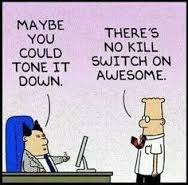
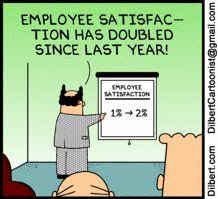
Image: Dilbert.com ©Scott Adams

Tell Me About Your Day

Here’s something people often say in companies when you ask them what they accomplished last week, last month, or last year:

“A lot of time is taken up by everyday stuff.”

Let’s talk about that. What is the everyday stuff? Is the work being produced commensurate with the expense?

A few years ago I wrote a post called Too Busy To Save Your Company. I refer to this post often when I am asked to look at a company and comment on why it is not as productive as it should be. It can be a consulting or investment meeting, but when I see lots of people running around or pounding on keyboards but an income statement in decline, I usually start by asking a few key people in the company to describe their days to me.

They often tell me that they spend a lot of time going to meetings and responding to email. When I remind them that meetings and email are not tasks, they are tools for accomplishing tasks, there is often an “Aha Moment.” That’s when I know we can make some progress.

You are wasting time. It is inevitable. How do I know? Because I waste time. Everyone does. No one is 100% efficient. The question is one of scope. Do you own your priorities or do distractions own you? When you start there, you begin to take control of your destiny.

Time management is neither a touchy-feely topic nor a chokehold on creativity. It is how you allocate your most precious and perishable resource, the ways you choose to spend your hours. The portion of your time that is discretionary and how you choose to utilize it is the difference between having a shot at winning and losing for sure. Note that I say it is a choice, because even if you don’t make active decisions about how you spend your hours, the choice to squander time remains a choice.

Try this exercise for a week: Write down hour by hour what you do on the job. If you spend an hour on researching the cost of something, write that down. Log each of your phone calls and meetings chronologically. More importantly, note what you were talking about and if any key decisions were made. Be as detailed as you can. If you read an article on the internet write that down, including what you learned or didn’t learn. If you shopped for yourself, chuckled through laugh-inducing videos, or commented passionately on Facebook, account for these by collecting them into small blocks of time. Don’t worry about the confession, you can delete the audit later. Be brutally honest and exceptionally thorough. This is solely for you.

Now go back and look at your goals for the year. If you don’t have any goals, that’s a much bigger problem which you need to solve before this post will be relevant to your progress. I’m going to assume you have 4 – 6 overarching annual goals agreed upon with the people who pay you or your partners, stuff like “increase sales 25%” or “decrease customer complaints 10%” or “launch 2 new apps per quarter” or “hire 15 regional salespeople.” You get the idea, stuff that matters, the stuff that keeps you from falling into the trap of being too busy to save your company.

Color code each item on your time accounting to match one of your goals. Try green for sales or blue for product improvements, soothing colors of accomplishment. If a block of time doesn’t match up with a goal, use a different color for DOES NOT APPLY TO A GOAL. A good color for this is red because it should be a warning color.

If you see very little red and an even distribution of the other colors against your 4 – 6 goals, you’re doing fine and can stop reading here. Congratulations, you are in perfect harmony and have a well-balanced calendar. As long as your company is growing and generating a healthy profit, this post is not for you.

On the other hand, if what you see is a disproportionate allocation of color — say, 80% blue but you have 4 other goals with minimal color showing— you are out of whack. If what you see is a sea of red, either quickly finish this post and get back to work or find another good post about writing a resume.

Now on a clean calendar, I want you to block your time as you should be spending it. If cold calls are 25% of what you should be doing, block 10 hours per week; it can be 2 hours each business day or 5 hours twice per week, whatever you fancy. I know, you work way more than 40 hours, but for budgeting purposes use that as a baseline.

Now compare the calendars. Want to know why you are not making a bigger dent in your goals? That’s why.

Time management is a subject I address regularly with colleagues as a proactive tool. Each time I assemble a new team, I have this talk with the senior people about their own time management and how seriously they take it, manage it, and monitor it. Leadership by example, right? The people who take it seriously are usually much more successful than the ones who blow it off. At its core, it is active versus passive resource management. Time lost is unrecoverable.

Oh, one more thing: Please don’t forget to set aside time for brainstorming and dreaming. Sometimes we call that shooting the sh*t. If it’s about stuff you think doesn’t matter, it might be wasteful. If it leads one big idea in a year, it can transform your business. Leave time to shoot the sh*t productively. The 5% to 10% of your time you leave for dreaming is where real change starts to happen and companies begin to reinvent themselves. If every minute of your day is consumed with scheduled or forgettable tasks, big ideas are going undiscovered.

Don’t leave all your time to everyday stuff. Do stuff that matters. Then dream on.

Do You Want My Opinion?

dilbert-feedbackIt’s a new year. With another trip around the sun completed and ahead, we mortals often go to our cabinets to withdraw the long-procrastinated projects we someday hope to deploy. In that revitalized spirit of invention, people often ask me for my opinion on this or that idea. Often it’s a start-up business idea. Sometimes it’s an investment opportunity. Occasionally it’s a request for feedback on a manuscript. I’m sure you’ve been asked to be a sounding board for similar notions and found yourself in a similarly awkward situation.

“Hey, mind if I bounce something off you?”

I usually respond, “Why do you ask?”

You may ask yourself, Why does he ask the question “Why do you ask?”

My question to your question is born of its own overarching question: Do you really want feedback, or do you just want me to tell you that what you are pitching is wonderful?

Yeah, you’ve been there. It’s a tough place to be, because it’s impossible to be sure what the other person is actually seeking. Is the seeker in need of a boost of self-esteem, where anything critical you offer is likely to triple that person’s therapy bills and end a rebound before it finds form? Is the pitch-person stealth-seeking your financial commitment, where any positive response on your behalf will be followed by a deal memo solicitation at a valuation that would make the Uber people blush? Is the ask truly heartfelt but the work so early and unedited that it could be more harmed than helped by a random response?

It’s not easy to offer an opinion on someone else’s work. Way more can go wrong than can go right.

I tend to find that most people who ask for my opinion don’t really want feedback. They want validation. If you’ve partaken in-depth of the creative process, you know they aren’t the same. Validation is net neutral. Feedback can save your ass.

What do I mean by that?

Validation is a bifurcated switch. If I say the work is good, you’ve heard all you need to hear. If I say I don’t think it’s good, you’ve heard exactly what you didn’t want to hear. The effect is net neutral because either way I have added no value to your project. If I say it’s good, so what? You already thought it was good or you wouldn’t have shown it to me, so I’ve done nothing but increased your standing bias. That takes you nowhere you couldn’t have gone without me. If I say it’s bad, we may no longer be friends, not because I don’t want to be friends but by being honest (even if diplomatic) I have likely hurt your feelings. There isn’t much positive energy that can follow.

If feedback is what you seek and I have any grounded expertise to offer, then perhaps we have a place to go together. That feedback is almost certainly going to be nuanced (“this part makes some sense, that part not so much”) but it has to come your way without consequence to me or expectation of a secondary agenda that involves me. If I want to get involved, I promise I will let you know, but the act of giving you feedback should be reward in itself. That means you have to enter into the feedback discussion with an openness to critique solely because you want your idea to improve, or perhaps decide instead you don’t want to waste any more time on it. There can be no ulterior motives or it’s not feedback, it’s evaluation. I don’t want to evaluate your work. That’s your job, not mine.

As an author, I seek feedback constantly. When I draft something, I always go out for feedback from a broad sample of demographics. When I get good feedback it can be life-changing, because anything that I have missed and you found I can fix. Is it painful? It’s horribly painful. Yet even worse than negative feedback is the silence of no feedback from someone who said they would offer it. That tells me with uncanny certainty that I have failed to connect with their voice. Do I regret asking? Never for a moment.

As much as we dread feedback, we actually should cherish it, because it is the only path from mediocrity to something that matters. The creative process is laden with setbacks, but each time we find a nugget of corrective action, we can improve. That’s what makes the creative process both daunting and healing. It is the reality of success quantified one fix at a time. It’s never fun to edit away what doesn’t work, but that’s how innovation at its finest evolves. There are no shortcuts. If you ask, be sure you want to listen for the answer. It may not be pleasant, like medicine, but hopefully it makes us better one way or another, if it’s the right medicine.

Most people don’t know how to give useful feedback, especially tough feedback that can help us improve our thinking or channel it to more productive ends. Words of validation or invalidation are relatively easy to render and equally useless. Offering consistently constructive feedback is an art. Be careful whom you ask to help you, or you can really go astray.

If you don’t want feedback, don’t ask for it. If you ask for it, don’t be defensive when you get it. If you don’t ask for it, you probably will never reach your potential. If you do embrace it, you can make a small idea become a big idea. A big idea becomes something tangible when we add the necessary recourses and fight past the objections readily available from amateurs. Those who embrace feedback are resilient by nature. There is power in vulnerability. Embrace it, and the sky is the limit.

Do you still want my opinion? I don’t mind if you say no, but if you ask carefully, I’ll try to answer in the same honest spirit.

# # #

Author’s End Note: It’s been hard to write about anything other than Trump the past year. I am still aghast at what has happened, but I am forcing myself back into more diverse subject matter as sanity demands. With my third book now in first draft and about to go into the editing process, I find my love of words never more pronounced, but never more conflicted. It’s hard to write about normal subjects in a world where nothing I once considered normal ever will be again. It is impossible to think about characters more outrageous than the strange ones emerging on the stage of reality. Regardless, I am committed to diversifying my output in continuing this creative journey we began together. I’ll still write about Trump when I must, but I promise you I will pursue more interesting material, if only to prove that he hasn’t won. Stay with me, and I’ll stay with you.

____________

This article originally appeared on The Good Men Project.

Image: Dilbert.com ©Scott Adams

How That Vicious Inner Critic Can Be Your Closest Ally

TMT1There’s something about optimism. Nothing in business is quite as powerful in motivating people to believe in a mission as a leader who undoubtedly believes. The energy that radiates from a passionate entrepreneur is engaging, uplifting, and inspiring. When we hear someone tell us he or she is following their muse, boldly pursuing a personal dream, we want to root for them. We want to become a part of it. We want to hitch our cart to their wagon. We want to step out of the ordinary and get onboard the outrageous.

A leader who won’t be deterred can bring purpose to a business enterprise.

A leader who rises above petty criticism and backstabbing naysayers can turn a hundred dollars into a hundred million dollars.

A leader who is “all-in” and won’t be dissuaded from a cohesive, organic vision can literally change the world.

Over and over we hear the speechifying that tells us never to give up, that resilience is all that matters, that we should forget the critics and ignore the naysayers.

Already doing that? Great. But there’s a catch.

Walt Disney was told he was no good as an illustrator, that his characters would never be popular. Steve Jobs got fired from his own company for being difficult, and refusing to compromise his ambitions. They were never dissuaded. They were resilient and persevered. They could not have cared less what their critics were saying.

Walt and Steve are held up as classic examples of rejecting rejection. They maintained an uncompromised vision and carved their place in history because of it. Detractors who called out “their folly” could do them no sustained harm. Walt and Steve evidenced a form of courage that set a new high water mark for leading teams beyond the fog to unbridled innovation. They remain heroes to those who aspire to transcend the ordinary.

So what’s the catch? You want to be That Leader, right? Or maybe you just want to sign on with That Leader? What’s the missing element that is most likely to take you down?

Is it that the odds against a startup succeeding are enormous?

Nope. Most entrepreneurs know this long before they quit their day jobs. Many are wacky, but few are stupid.

Is it that capital is very hard to raise, especially for a first time entrepreneur?

Nope. Most entrepreneurs discover this lesson the first time mom or dad says, “What!? Are you kidding me? You’re not a CEO… you can barely manage to get matching socks on your feet!” They secretly know that mom and dad are just negotiating their share of the deal for the seed round.

Is it that it’s nearly impossible to get super-talented people to work for deferred or limited pay for the long runway until a business is cash flow positive?

Nope. Most entrepreneurs are confident that if they articulate an exciting enough plan, the right people will get with the program no matter what, and the ones who said no just saved the entrepreneur the pain of having to fire them later for their mediocrity.

Then what is it? What is the Achilles Heel of the resilient? What is the repelling force that stands counter to the success of leaders brave enough to shake off a world that tells them No No No when all they hear in their heads is Yes Yes Yes?

Presume for a moment this entrepreneur is You. Get your highlighter ready. You’ll want to make note of this for the rest of your career.

The problem might be YOU.

Don’t highlight that. I haven’t gotten to the important part yet. The part you need to highlight is this:

If you’re not going to listen to the critics who will tell you every reason in the world why you are going to fail—and believe you absolutely must tune them out in order to be a renowned, world-class leader—you are going to have to be the hardest critic in the world on yourself.

Yes, in order to earn the privilege of ducking all the pessimists trying to steer you away from your dream, you must beat yourself up in ways they can’t even imagine. There is no luxury in resilience. There is only a level of self-critique so necessary that the pain it will cause you as a lone wolf makes child’s play of the third-party negativity you will never hear. What you hear in your head must be far more thundering—and far more impactful.

The real reason most startup leaders fail

It’s not because of a lack of devotion, or a lack of passion, or even because of a lack of talent.

They fail because of a lack of self-critique.

Does this apply to you? Have you actually established yourself as your own toughest critic? I don’t mean a little tough. I mean vicious, brutal, send yourself into a tailspin tough. Sorry to break the news, but that’s why Walt and Steve were often perceived as miserable. They were always very, very tough on themselves, an order of magnitude more thrashing than what any bleacher critic was or even could have been.

I have had the privilege to lead a handful of creative companies and I have had the privilege to be a published author. In all cases I was told innumerable times why I would not be successful. I didn’t hear a word of it. I didn’t need to hear a word of it. In all cases I was already way ahead of the peanut gallery, working and reworking the scenarios of why I wouldn’t be successful.

I study product features like I study word choices. I might tell you that no one on the market has anything like this, but before you’ll hear me utter those words, I have done the homework to assure myself this is worth defending. No one else can do that as stridently as I can. I say “no” to a sentence a hundred times before I let you see it. I edit it, erase it, rewrite it, rework it, change it, question it, then pick it apart word by word until I have exhausted all its failures. Same with a product. Same with a service.

I can only ignore the amateur naysayers because I am my own best professional naysayer.

Let’s take it deeper, to a place you may not want to go. Here’s another reason why startup leaders fail: they doggedly champion a product that is no good. It’s not because the naysayers are right. It’s because the startup leader doesn’t embrace the radical discipline to relentlessly question themselves and, by extension, their product.

If running out of time and money don’t apply as explanations, most entrepreneurs fail for a very simple reason: their idea was not good enough to create a category defining product or service. Too often we dupe ourselves into believing the ordinary is extraordinary. We fall in love with an idea because we gave birth to it, and rather than beating that idea into something exceptional—or dumping it, learning from it, and finding the fortitude to reinvent it into something else—we tell ourselves we will not be dissuaded and we go to market with mediocrity. That’s when we get walloped.

Once again, the tough love, get out the highlighter:

The only way you can defy the odds and ignore the critics is if you have a massive built-in crap filter. If you don’t want someone else to tell you your product is crap, you better be willing to tell yourself it’s crap or you’re going to blow a lot of time and money on nothing.

Artists and inventors have a crap filter no matter how successful they are. Walt did. So did Steve. Walt was told that audiences would never want to see a feature-length animated motion picture. He didn’t hear it, because Snow White and the Seven Dwarves was already worked out in his head, after he had rejected every possible way to make it something people would never want to see.

Steve was told there would never be a market for something as intimidating as home computing. He didn’t hear it, because the Apple II was already worked out in his head, after he had rejected every possible way that it would intimidate people.

Both of these visionaries agonized over perfection and were never satisfied. When they were starting out they were never satisfied. When they were at the bottom they were never satisfied. When they were at the top of their game they were never satisfied. The critics failed to resonate with them because they were lightweights in comparison to their own pounding criticism.

Are you embracing this burden of innovation?

Why do I need you to hear this? Why is this so desperately important to everyone who wants to make a difference and change the world? Because too many hopeful leaders are embracing the rhetoric of “going their own way” without embracing this burden of innovation. Every single day someone shows me a derivative app and begs me to believe in them. It’s a minimum viable product, they tell me, they will build on it and make it great later.

Right, after customers have yawned.

You really think they’ll give you another chance? So yours is 12% faster than your competition? So what? So yours addresses a tiny niche with a quirky set of differentiating features that matter mostly to you for pitching on demo day… So what? Get your eyes off the IPO listings and back on the shelf where the war for customers is lost or won. Don’t be Happy. Be Grumpy.

Incrementality is toxic. Don’t tell me how all your competitors have slightly weaker products than what you’re proposing. Convince yourself you can blow my mind with something that leapfrogs the entire market if not in one product cycle then over a generation. If you don’t want me to tell you that your app is crap then be sure you’ve asked yourself a hundred times before you ignore me. If you don’t know that your app is crap because you aren’t being honest with yourself then you haven’t earned the right to ignore the naysayers.

That’s the secret sauce—knowing when you are ready to play and when the cards you hold are not worth playing. Be that critic and you’ll never need another. When you stand up onstage and tell your story of success, it will undoubtedly be preceded by the chapters of failure that led you to your day in the sun. I want to come to that speech and applaud. I want to see you do it again and again. I want to see you tell the naysayers to jump off a peer.

Are you ready to take on the responsibility of being your own toughest critic? Wield your inner critic in such a way that it allows you to do the best work of your life. Then yeah, tell us all to bugger off and let’s get to work changing the world.

_____

This article originally appeared on The Modern Team.

Photo Image: Courtesy of Exclusive Collections Gallery (Fabio Napoleoni)