Do You Care?

I Don't CareHere are a few marvels of bad business practices I’ve experienced in the past month:

In the middle of a presentation pitching me for a strategic business services contract, the presenter nonchalantly said the words: “We don’t really need this business.” He didn’t get it.

I reviewed two proposals for a project: one a two-pager with one paragraph personalized and the balance consisting of the company’s credits; the other a five-pager all personalized around my project with a single paragraph at the end articulating the company’s vision. The five-pager won.

I received via snail mail a stock market overview newsletter from one of the largest financial services companies in the world. Inside was the business card of some guy I have never met. There was no note, no signed cover letter, not even a form letter. Does he think I’m going to read the newsletter, pick up the phone, call him, and move my portfolio to his firm so he can manage it? Straight into the shredder it went. Cost of printing and postage vaporized.

Our phone rings in the evening. Often. With no Caller ID recognizable on the little screen. Occasionally I pick it up. There’s a pause, handing off my call from the much-despised auto-dialer. Someone tells me he is a building contractor of some kind and he is going to be in my neighborhood tomorrow and can he stop by and offer me a free estimate on work around the house. No, you can’t have my address. You lost me at much despised auto-dialer.

Another contractor who was referred by a good friend actually came to the house, walked through the prospective project with us, took a copy of our site plans, and said she would get back to us with a proposal. A month later we hadn’t heard from her. My wife called and emailed, asking if she was still interested in the project. Still didn’t hear from her. The next email from my wife asked her to return the site plans. Coincidentally, we were subsequently asked for a reference on this contractor by another friend. You can surmise how that went.

What are the key takeaways here?

First, if you want a piece of business, care enough to go out and get it. If you don’t, don’t waste your time or mine.

Second, never confuse tonnage of time invested in vast outreach with proper, focused, caring effort. You can allot infinite hours to scouting the wild, but if your approach is lazy and lacking in detail, your results are likely to reflect your lack of innovation and thoughtful initiative.

Pitching is not perfunctory. Much like dating or interviewing for a job, it’s how you get to know someone before you decide if you want to pursue a more involved relationship. Don’t tell me in the Digital Age a sales call is somehow different from yesteryear. A sales call is still just that—it’s one of many steps in securing prosperous deal flow. It requires the art and science of selling. If you’re not going to bother preparing, being respectful, being responsive, or following through, just stay away. We’ll both be a lot happier—although you won’t have my business, my endorsement, or my goodwill.

Not a problem. You probably don’t care. But you should.

Here’s the thing: you may have enough business now, at this very moment, but you won’t always. No one does. What matters when you don’t have enough business is how wide your network has become—the glowing part of your network. You have no idea where one client can lead you, where one prospect can lead you, where one seemingly casual handshake can lead you. What you can know for sure is that a burned bridge leads nowhere, usually in perpetuity, and the swiftness with which a bridge can be burned forever pales in comparison to the time it takes to build a relationship.

Relationships are worth it. You need them. We all do.

Here’s the corollary: if you don’t have enough business right now, there are no real shortcuts to landing new work. You may think it’s a numbers game and you can just dial and smile, carpet bombing the business terrain with junk mail and door-knocking. What kind of clients do you think that is going to bring you? A crappy sales pitch that does lock in a piece of business is likely to land you a crappy piece of business. Think about who would respond to your unpolished approach. Now imagine their sophistication in carrying out the contract, paying their bill, and passing you along to another prospect. If a crappy pitch and a crappy client are the foundation of your business, I think you can fill in the blank with the adjective that best describes that business.

Imagine instead a well-researched approach to a narrower set of prospects. Imagine doing your homework, preparing a written, phone, or in-person pitch that speaks to your desire to do a job that will capture a client’s imagination. Imagine being sharp, creative, and personal in asking for the business. Imagine following through with a great job that exceeds customer expectations. Then imagine the reward of future business from that client (repeat business is the best of all, because your sales costs are so low), or the networking value that will come from future business you could otherwise never access. Is that what you want, or would you prefer to continue dialing and smiling—and generally soiling your name and reputation before you even get a chance to demonstrate what you can do?

When I get an email offer letter from Yosemite National Park, they refer to my last visit and craft a well-priced offer that speaks to me as a person. We recently were referred to another contractor, who showed up on time and had already had a look at the yard so he had ideas to share immediately after we said hello. One of the national non-profits I support calls once a year just to thank me for my donations and ask if they can send me any information about upcoming programs, without requesting an incremental dime. A market research vendor recently reached out to me on LinkedIn and invited me to a conference that was relevant to one of my business interests, spent time with me at the conference, and is now at the top of my list when I might need his services.

None of this is very hard to understand, but it is immensely hard to do consistently, which is why it gives those who do it a competitive advantage. What they all have in common is one simple thing: they care about my business. They convince me that they want my business, not just any business. They don’t take it for granted. I’m not lost in a carpet bombing campaign. I want to respond. I want to be an evangelist for them.

Before you formulate your next pitch, before you pick up the phone, before you hit send on that email, before you waste the money on postage, ask yourself the one simple question that will make your sales pitch better: Do you care?

Everyday Innovation

You don’t have to be an entrepreneur to be an innovator. Becoming a startup CEO may not be your thing, but changing the world is always within your reach.

There is a frenzy of late among those longing to lead business startups, and that is exciting. Entrepreneurs are a special breed, and while the successful ones are rare, no one really knows who is going to be successful in advance. Naysayers will tell you what you can’t do, and only you can prove them wrong.

When we talk about innovation, that undoubtedly points to entrepreneurs, but I’d like to think it not exclusive to them. Innovation is a process where creativity is harnessed, often galvanized through the building of momentum and the sharing of a vision. Often a new project or the reinvention of a product type begins with very few people involved, perhaps only one. The idea is refined and vetted, resources are added, more people get onboard, a consensus around a feature set emerges, and eventually it comes to be owned by a team. If you’ve ever been a part of this kind of team, you know how invigorating the process can be.

A subset of this process is the highly competitive world of funded startup companies, and that is a different beast entirely. In a quite insightful op-ed in the Wall Street Journal about the trials and tribulations of Uber, Andy Kessler recently noted the sometimes seething nature of a startup CEO who makes it through the hurdle of significant investment in their ambitions to excavate a gold mine:

Hubris becomes an asset. Startup CEOs are always saying the goal is to “suck the oxygen out of the room” of their competitors. Success requires a certain bravado. That should be encouraged, but most entrepreneurs have no idea when to turn it off.

There’s nothing wrong with being competitive, embracing ambition, and wanting to do the impossible. Does the goal of that have to be the annihilation of those who currently populate a market segment? Maybe because it’s the holidays, I wonder how that thinking aligns with Give Peace a Chance, but I think you can change the world without an ethos of leveling good chunks of it.

It is important to our economy and financial well-being that new companies are constantly born, that creative destruction replaces old opportunities with new ones. It is also limiting to evaluate innovation on this metric alone. If the only creativity that receives our highest praise is the moonshot IPO or breathtaking acquisition multiple, perhaps we send a difficult message to our colleagues and children that commercial success is the most important success. Do we really believe that it is somehow less noble to be part of reinvention that is not about clubbing a competitor over the head and walking away with his or her bounty?

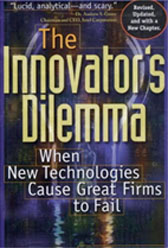
Innovator's DilemmaMuch has been written around the concept of disruption, where traditional ways of doing things are derailed in almost unbelievably short periods of time. We saw it happen with music and video, where digital media disrupted the business model of selling and renting physical media. We’re seeing it happen with the news business, most recently evidenced at The New Republic, where the economics of professional journalism are colliding with the realities of recovering its cost. Disruptors are a very real force as author Clayton Christensen so clearly taught us in his landmark book The Innovator’s Dilemma, but is it an end unto itself? What if someone doesn’t want to be a war-declaring disruptor?

There are all kinds of ways to define admirable innovation. Truth be told, very few of us are going to draft a business plan and schlep from angel to venture to institutional investors with an all-or-nothing mentality. If that’s not you but you still feel a hunger to join the reinvention movement, here are seven concrete ways you can embrace innovation right now:

  1. Give Yourself a Stealth Performance Review: Secretly write down exactly how you think you are doing at work. Be as candid as possible. Conclude with a set of recommendations for improvement. Pick one. Do it.
  2. Ask Your Boss for a Problem: Walk in and say, “How can I take a burden off your back? Give me something on your to-do list that is important but you don’t have time to do. Let’s brainstorm it together.” Always remember that every problem is an opportunity.
  3. Clarify Your Brand Promise: If you don’t know what your company stands for, ask someone in senior management for some evangelism around your company’s brand. Then look at the work you are doing every day. Does it align with the brand promise? If not, what tweaks can you make to your daily tasks to bring you personally more in line with your company’s expressed mission?
  4. Help a Non-Profit: Find an organization near you whose values and mission you embrace. Contact someone there in a leadership capacity. Tell them you want to help and what skills you have to offer. Ask them what is on their plate that isn’t being addressed. Address it.
  5. Fix Your Personal Budget: Develop a formal income statement for yourself or your family. Write down all sources of revenue and expenses. Look for areas where money is leaking out that needn’t be. Plug the holes. Get your credit under control. If you have longer-term needs, create a formal plan for getting there.
  6. Get a Hobby: Right, you don’t have the time. Yet a hobby allows you to abstract so many of your daily thoughts and tie back that problem solving to your everyday responsibilities. Plant a garden, bake, follow a sports team, adopt a pet. Don’t think of it as a diversion, think of it as a commitment to lifelong learning and self-improvement. Push yourself to approach it slightly differently from those already doing it.
  7. Coach a Friend: Look around your circle of acquaintances for someone who might be struggling a little. Offer to be a coach or mentor for the next six to twelve months. Ask nothing in return. I promise you the ideas that will emerge from your discussions will be as valuable to your personal growth as they are to the friend. Ideas and energy compound when shared. You may forget who is coaching whom.

Startups can be cool, but all innovation does not require a startup environment. Creativity is a process that leads to all kinds of new stuff, and it also exhausts dead ends around stuff not worth doing or not ready to be done. Instead of making a hollow new year’s resolution, pick a path to one of the above suggestions or come up with your own idea for reinventing the world around you. Everyday Innovation is there for the taking. Go make change happen, and I’ll see you at the starting gate!

Toons, Love, and Letting Go

Earlier this month the curtain finally fell on Toontown Online.  I am guessing that 90% of the people who read this post will have no idea what that is, was, or means.  I won’t spend a lot of time telling you what it is or was, but I do want to share a few words about what it means.

TTO End of the WorldToontown was a massively multiplayer online role-playing game, an MMORPG, if you can believe such an acronym exists.  It is more commonly referred to as an online world, or a virtual playground, where participants create a character, or avatar, that represents them among tens of thousands of others at any given time, in what is affectionately known as cyberspace, the intersection of computer networks, or the Cloud.  The most famous and successful MMORPG of all time is undoubtedly World of Warcraft, which was created ages ago by Blizzard Entertainment and has produced immense wealth for those behind it.  Toontown is kind of like the quirky second cousin of World of Warcraft, created by huge fans of WOW initially at Disney Imagineering R&D, seeking a key point of differentiation — Toontown was the first MMORPG for kids and families.  Yes, that’s right, kids and families.  It came from Disney, after all, where family entertainment is the brand promise.

Aside from appealing to a different demographic audience, Toontown accomplished a few other significant milestones.  For one, it lasted commercially over a decade, if not putting it in the wealth stamping mode of World of Warcraft, certainly getting it into the rare window of time warp triumph that few digital games enjoy.  It was certainly the longest living bit of software that I ever helped see the light of day, by an order of magnitude.  We started working on it in 1999, launched the free public beta at Disney Online in the Fall of 2002, and went live in full subscription model in mid-2003.  Earlier this year, Toontown Online celebrated a milestone of ten years active that very few libraries of compiled code ever have the occasion to note.

If you have never played an MMORPG or have no idea what the gameplay in Toontown Online encompassed, you can easily learn that by doing a few web searches or scanning the Toontown entry in Wikipedia.  Now that Toontown Online is over, I want to talk less about its being, and more about its resonance.  It was a turning point for those who worked on it in several capacities — proof that the Disney brand and Walt’s vision could be migrated to a new platform of which Walt never dreamed.  It galvanized a team to emerge from the DotBomb bubble years through a process of creative destruction and reinvention.  It bonded its developers to its customers in a true paradigm shift that redefined for all involved the notion of “community.”  I remember approving a job requisition for a position called “Community Manager,” and I swear I stared at the page for an hour wondering what that meant, whether we really needed one, and whether any person was superhuman enough to tackle such a role.  The truth was, we were all Community Managers, and residents, and participants, and young at heart immersives who knew something had changed.  We bonded with our customers, and we bonded with each other, and that bond proved to be something that will last in perpetuity.

World class work is contagious.  High performance teams willingly tackle shared dreams.  Achieving the improbable is a permanent bonding agent.  Copy and paste that in your signature file.

The bond of being part of doing something that hasn’t been done before with a team of impossibly talented individuals with whom you are unlikely to ever work again is both powerful and intangible.  The odds against Toontown lasting a year let alone a decade were incalculable.  It was so hard to describe the concept to people both inside and outside the company that building a consensus and maintaining funding was entirely improbable.  Yet because history told us Walt had faced the same struggle and challenge opening a branded family theme park — Walt’s Folly, as it was known — we just stuck to it and got it done.  We knew if we could get people to sample it — try it, touch it, be in it, share it — it would slowly catch on.  It did, like the Little Engine that Could, and those silly little Toon characters got stuck in our minds and our hearts.  We played in that world with each other, kids and adults, employees and customers, everyone an equal, everyone just looking for gags and Cogs to take down.

Years into it, Thomas Friedman wrote a critically important book called The World is Flat, but those of us making and playing Toontown already knew that.  The hierarchy had inverted, unrestricted except by carefully constructed parental controls, global in reach and appeal.  The Toons were in charge of this world, not us.  Our job was to be good stewards of the world, not run it, only to tend the expansive lands.  Yep, it was an online theme park that belonged to everyone there.  It was a community, a true virtual community, almost perfectly safe because the community kept it that way, alive and vital 24x7x365.  We discovered it then, and we feel it now.  The game might be gone, but our sense of belonging, no chance that can be dipped in solvents.  Belonging is eternal.

Therein lies the truest lesson of Toontown for me, a lesson I learned my very first years in the software business, years in which I rode the unruly swings of success and failure all at once.  Astonishingly few projects in media succeed commercially or critically, and even fewer achieve both, but the ones that do make up for all the ones that don’t, both financially and in life satisfaction.  An extraordinarily wise mentor taught me at the outset of my journey this simple but enduring lesson, that if I stayed in this racket and wanted a career instead of a job, I needed to learn and embrace the mantra that projects come and go, but it is the people with whom you work  you will remember way more than the projects.  He explained that anyone looking back on a creative career when it comes to an end — and they all do at some point because we are humans, not T0ons — is that a truly successful career will be built on the back of about a half-dozen successes you could never predict, mixed in with a landfill of failures.

The takeaway was that it would always be easy to forget projects magnificent and awful, but the people with whom you shared those projects could rise to the level of unforgettable if you made that a focus.  If process was as important as outcome — more important than outcome because it is the only path to sustainable outcome — then you might forget the rotten days, the missed milestones, the modules that wouldn’t compile, the costly customer service calls, all that junk — but the joyous memories of the people would stay with you.  The people were the gift then, and they would remain so forever.

The incomparably talented people who built and nurtured Toontown were many of the same people with whom I shared any number of initiatives that didn’t go right.  It would be impossible to acknowledge and commend all of them here, and to pick just a few would inevitably be read wrong by the many.  The ten-year run of Toontown didn’t make them good, they were good already and they are good still.  All of us shared this tiny bit of magic, and now like most forms of media it joins the destiny of the ephemeral.  Our bond with each other is unbreakable , and our bond with that community is impenetrable.  The memories of the cast endure, the value of the bond beyond price, the stories of each other ours forever.  We are a little geeky, a little playful, a little different, and a little older.  We are forever Toons.

Toons of the World Unite.