When Your Team Loses

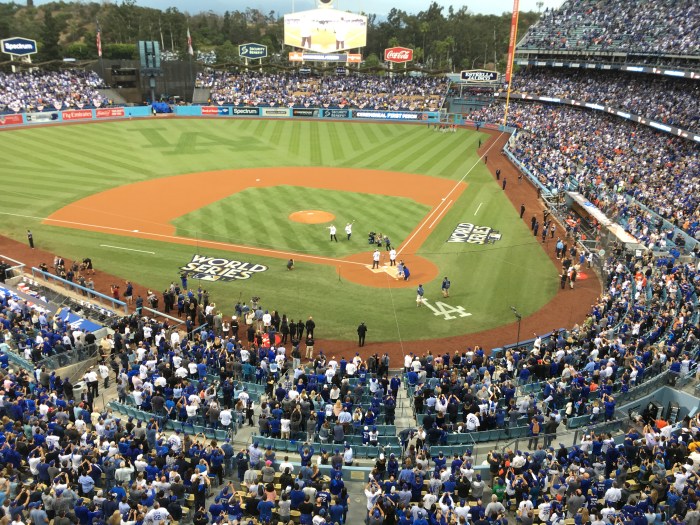
The Houston Astros won the 2017 World Series last week. The Los Angeles Dodgers lost. It was an epic contest. Many have observed it was one of the greatest World Series match-ups in the history of Major League Baseball. It lasted into the mythic and deciding Game 7, crossing tentatively into the month of November, creating the first-ever Game 7 at Dodger Stadium and the first-ever MLB game played in November at Dodger Stadium.

This year’s fall classic delivered all of the drama any fan could want from a World Series. There were come-from-behind victories one after another, larger-than-life villains and heroes caught in an explosive discussion of racism, more lazy walks and majestic home runs than most of us could imagine, and two world-class managers locked in a battle of wits. It was an endurance contest. It began in Game 1 at 103 degrees on the sweltering Chavez Ravine field and ended there eight days later some forty degrees cooler. It brought many viewers back to the game who had abandoned baseball for its slow pace in our ever-hectic world. It was the perfect collision of talent and human will emerging from an always imperfect playing season.

Then it was over.

Only one team could take home the Commissioner’s Trophy. One team did, in a stadium not their own but on a makeshift stage they made their own. The local contenders, who could win only three of seven games, looked on from the home team dugout and watched the award ceremony broadcast to the globe. Behind the blue-flagged dugout sat their fans, also staring vacantly beyond the bright television camera lights with sadness and acceptance. I was among those fans. I slumped in my hardwood seat and watched the grand on-field celebration to my right and the silence of humility to my left.

Bart Giamatti, former MLB Commissioner and President of Yale University, probably said it best in his acclaimed essay The Green Fields of the Mind:

It breaks your heart. It is designed to break your heart.

That is the game, where each preliminary round of the postseason always ends in an event called an elimination game, and then the World Series itself winds down to the final elimination game. When your team is eliminated from competition, your season is over. There are no appeals. At the final elimination game, one team is victorious. The other team retains the consolation prize of league champion, but it is increasingly less of a bragging right than it was in professional baseball’s beginnings over a century ago.

The eliminated team leaves the field with a broken heart shared with its fans. That is the design. It needs no improvement. A loss is as perfect in its ability to stir emotion as a win means to those who share a parade in the glorious days following the final pitch.

So why does any of this matter? Baseball is a business, a big-money enterprise where fans shell out enormous sums of money for ballpark visits, television and internet subscriptions, staggeringly high-margin junk food, proud but ridiculously overpriced authentic field wear, signed souvenirs, trading cards, collectors’ memorabilia, and tiny parking spots where door dings are as much a part of the game as the ceremonial first pitch. Players are traded back and forth late in the season as insurance for a playoff spot, and just because you call it your home team doesn’t mean many of the players on the payroll call it home.

Why does it matter? If you are a fan, you have to answer it in your own way. Let me try to answer it in mine.

Never mind that the Los Angeles Dodgers, a controversial transplant from Brooklyn today playing in the second-largest media market in the nation, haven’t even appeared in a World Series since 1988, the year ace Clayton Kershaw was born. Never mind that the Dodgers are the team of historic #42 Jackie Robinson, whose jersey number is the only one retired across both the National and American leagues. Never mind that Dodger Stadium, the model for modern stadiums when it opened in 1962, the year I was born, is now the third-oldest stadium among the 30 in MLB. All of that is nice context, but it doesn’t reasonably define why I would feel sorrowful over a loss in Game 7.

In fact, in a world plagued by continuing terrorism, nonstop acts of violence, social vitriol, political lunacy, global instability, and wildly unjust economic inequality, why do seven months of three-hour-plus games played day and night on well-manicured fields by young millionaire athletes directed by billionaire ownership groups matter at all? It shouldn’t, right? We’re adults, aren’t we? We’ve got important stuff to worry about, not the velocity of a breaking ball walloped by a carved piece of wood and sailing 400 feet into the bleachers of a 50,000-seat arena.

Well, let’s try it another way and go back to Bart Giamatti, a Renaissance scholar and baseball fanatic who left us much too early but was gracious enough to capture some meaning in all of it in his own temporal longing:

There are the truly tough among us, the ones who can live without illusion, or without even the hope of illusion. I am not that grown-up or up-to-date. I am a simpler creature, tied to more primitive patterns and cycles. I need to think something lasts forever, and it might as well be that state of being that is a game; it might as well be that, in a green field, in the sun.

That is why it matters to me. It matters because it lasts all our lives. It dies with the coming of winter and is reborn in the spring. I love the game because my father loved the game. It is essentially the same game, forget the bells and whistles and data analytics and all that newfangled scoreboard jazz. The game no matter what is fully unpredictable to the final out, the alchemy of athleticism, calculating strategy, and too often chance. It is consistent in its ritual routines, relentless in its aggregate simplicity, intoxicating in its repetitiveness. Forever it has broken hearts. We share that from generation to generation, from season to season. It is absolute in its constancy, absolute in its recurring challenge, absolute in its finality — until it comes again.

It always comes again. It has to come again. It is designed to break your heart.

When your team loses, you internalize the emotion, politely congratulate the winning opponent, and make no excuse for the silliness of the sadness in your obsession with constancy. We all like to win. We all want to win. We all want to be part of winning. Yet more than that, we all want to be part of something that matters because it holds us together with permanence solely because its vitality is assured in its unfailing renewal.

The Brooklyn Dodgers, who didn’t win a World Series until 1955, owned the nickname Dem Bums. Each year they lost, Dem Bums and the fans who followed them would finish the season with the same words: “Wait ’til next year.” Dem Bums knew the answer to what you do when your team loses.

I’ll see you at the green field next April. Opening Day is traditionally played in the early afternoon. With a little luck the sun will be shining on all of us.

______________________

Photo: By the author, Ken Goldstein (11/1/17)

Jerry’s Kids Forever

Labor Day weekend for me will always be connected to Jerry Lewis. His annual 21 ½ hour live telethon raised more than $2 billion over 45 years for the Muscular Dystrophy Association. He died last month at the age of 91. I miss him already.

Jerry meant a lot to me as a kid. I was an MDA volunteer from the age of 12. I used to help patients with mobility, assist with fundraising, and every year I would work the telethon in the local Honolulu studio. Satellite time in the 1970s was very expensive, so we didn’t get the national feed for most of the overnight hours. In those blackout periods our producers would put on a nonstop “telethon within a telethon” so we could stay on-air in synch with the east coast six hours ahead and the west coast three hours ahead. Pledges would come in all through the night. Jerry was with us in our hearts whether he was onstage in Vegas or we were broadcasting hula dancers. We did the show together no matter the separation of distance, and we loved the children at the heart of our mission.

I never met the man, but sometimes he would come on the non-broadcast feed between segments and talk to the remote volunteers, so I felt like I knew him. He would thank us for our help and tell us the telethon could not happen without us. I believe he truly loved the kids we served. He wanted to beat neuromuscular diseases in our lifetime. We haven’t done that yet, but we have come a long way. He gets credit for some of that, along with the dedicated doctors and visionary scientists whose groundbreaking work he helped fund. For a zany borscht belt comedian, that’s a long way to travel in a single visit to our planet.

Jerry took some heat for exploiting MDA patients in his depiction of their challenges. I never saw that. I saw a man devoted to curing a terrible, debilitating condition. He was a master of the stage, there is no question about that, but in the end I don’t believe the telethon was about him. It was about lending his name and global stardom to a cause that mattered. He didn’t have to do that. It was a choice. Of course it would come with some critique. He was pioneering new ground and taking creative risks that had no precedent. He might have said a few things wrong or missed the mark on occasion with a photo opportunity, but I believe he was committed to healing. He was a brave soul paving the way for a generation of viewers who learned how to turn their time into public service.

I learned a lot from Jerry and working with MDA. I learned how to work steadily through 36 hours of production from set-up to wrap. It’s hard to fathom what that meant in this age of digital media and 24-hour everything. Opportunities like that let you bond with strangers with enormous intensity that is over as quickly as it begins, yet can last a lifetime. Sometimes in the overnight hours, when I saw on the schedule board that our stage was about to go empty, I would gather some of the MDA kids and we would practice a few songs together, a Beatles tune or a Bob Dylan folk song. When the TV audience was at its smallest the producer would put us on the air. I played guitar and we would sing together in a half circle looking straight into the red light of the live camera.

The first time this happened was my first time on live TV. We were directly in front of the phone banks around 3:00 a.m. with maybe 100 people in the auditorium fighting sleepiness. I probably messed up some of the chords but the kids sang right over me. You forgot they were in wheelchairs. They were just kids singing like they were at a campfire. Afterward the kids asked me if Jerry would have been pleased with our performance. I took a chance and told them I thought he would. Today I know that for certain. They were Jerry’s Kids forever.

Jerry Lewis was an imperfect person as we all are, but he was an inspiration to me. He had no roadmap, no rule book, just a whole bunch of harebrained ideas and a ton of influence he put to work for something that mattered. He was dedicated, hard-working, wildly hard-minded about details, and a perfectionist. He gave of himself. He always made me laugh. Well, maybe not always, but most of the time. He was very funny, but of another time. I will never forget him. He was an original. Labor Day will always be his.

Jerry, dear Jerry, “You’ll Never Walk Alone.”

The Little We See

I discovered the NBC television series This Is Us in summer reruns this year and I have become obsessed with it. If you enjoyed shows like Thirtysomething and My So-Called Life, you’ll not only recognize the tone and structure in This Is Us, you’ll see familiar names pop up in the directing credits. It probably won’t surprise you that what has most attracted me to this show is the writing, both the quality of dialogue within episodes and the structural connections between episodes. Series creator Dan Fogelman has framed a milestone achievement in word-to-screen translation.

If you are a student of fiction you know that narrative has the highest emotional impact when story and character are revealed on equal footing, one reinforcing the other. Whether you attempt the craft professionally or as an avocation, you know how immensely difficult this is to do, particularly consistently. Characters matter more when the story advances as a result of their arcs. The depth of characters is more fully rendered when plot points drive their change. It’s enormously challenging. Try it sometime. Or you can just watch This Is Us.

I certainly don’t want to give away any spoilers surrounding this show in case you decide to binge on it after reading this post. At its core it is the story of three people born on the same day circa 1980 (the year I graduated from high school, go figure). The storyline follows them from infancy to adulthood with all of the many tangents in their lives around family, friends, loved ones lost and found, career highs and lows, and personal discoveries. The emotional complexity of the characters is what makes it powerful, yet surprise twists in their interwoven journeys jump out all the time, making it the kind of serial that leaves you both satisfied and wanting more.

What consistently blows my mind in this show is how character development is revealed in snippets that link forward and back in time, particularly replaying events with increased detail layered into the unveiling of previously hidden moments. It is these hidden moments that led me to write about the show. What continually strikes me as gripping drama is how little we know about any one character or event at any moment in time, and how adding onto the storyline sheds light on the “why” of every moment. I think about this in life every day as I encounter people, not so much in what I do see but in the stark reality of how little I see.

“The little we see” is the mystery of real-life human drama. Someone could be standing next to you in line at Starbucks with a thin smile, but she may have just come from the hospital visiting someone in critical condition. Someone could run into you on the freeway wildly distracted, when an hour ago he was turned down in his marriage proposal. The person next to you in a bar watching a baseball game might be ordering the beer that sends him tumbling off the wagon. We barely know what we see. We usually have little idea why it is happening, what meaning or consequence it may have, or what life fork in the road it may represent. Good storytelling fills in the blanks. Compounding life events don’t snap together as Lego blocks nearly that solidly.

Returning to my obsessions, in my early writing career when I was learning the craft and reading much more than I was writing, I found myself consumed with the question of what happens to characters when we don’t see them. I spent a lot of time immersed in stage-play texts and repeatedly asked myself purposefully unanswerable questions. What are these characters thinking and doing when they are offstage? What were they doing before the play began? What will they be doing after the final curtain? Certainly writers have to think about these things, but the time-limiting constraint that they never can fill in all the blanks is what can elevate a story from entertainment to a more lasting form of art. The elements of a character’s life that are left open-ended are the entry point where the reader’s imagination can come alive. It is in that synthesis that a work becomes both personalized and shared.

Why might this matter to you even if you aren’t particularly enamored with fiction? Perhaps you are like me and find yourself wondering throughout the day about the backstories and masked details in the lives of the people who walk into and out of your contact each day. When you are in a meeting and the presenter is struggling, what was he doing an hour ago, a day ago, a week ago, a year ago? When you hear a co-worker arguing on the phone in the hallway about something that sounds personal and know that you are about to review a business plan together, will that person be paying enough attention to make good decisions and what will happen to resolve the argument by the time you meet again tomorrow? When a co-worker’s child visits your office, what does she see and how will it possibly affect her future decisions about her career?

All of this fascinates me both as a writer and a businessperson, because the long and winding roads of our lives are filled with invisible forks where we choose a path and don’t necessarily know at the time that the decision was of immense consequence. I will be writing more about these invisible forks soon because I think the resonance of our decision-making becomes more consequential when we pay attention to the impact it has on those around us. We can never chart our own fate entirely, but we can think now and again about what might be going on offstage as well as onstage before we act.

One of the best pieces of advice my dad gave me in business was that unless you are in the room where a decision is made, you will never know why that decision was made. My trepidation has gone further, because too often I have been in that room and I still don’t know why many decisions are made. To me that signals what happened in the other room where I wasn’t present and didn’t even know there was a meeting, or what happened in someone’s living room that morning, or what might be happening in some hotel conference room that night. We see what we see and it’s never enough. We see too little, yet we still have to make decisions.

The little we see is a subset of any story. Think about it that way and you might make different choices when you are in the scene. Onstage or off, the story is part public, part private, part secret, part personal, and always conflicted. That is what makes a great television series like This Is Us. What it says about our lives and our business dealings is something else entirely.

____________

Photo: This Is Us Gallery, NBC.com

The Inaugural: A Modest Proposal

InauguralWord on the street is that entertainment options for the 2017 Presidential Inauguration are sparse, and that President-elect Donald Trump is not at all happy about being snubbed by Hollywood.

My initial thought was that they simply call it “An Intimate Evening with Ted Nugent” and sell off the master sponsorship to the NRA. Chachi could be the MC. Yahoo would probably still overpay for the streaming rights and Trump could declare it sensational. Easy breezy.

Then I got to thinking, if I’m not part of the solution, I am the problem. I probably am the problem and will be for at least the next four years, but that’s beside the point. Better that I be helpful. I want to be helpful to PEOTUS and the incoming administration pasted together from the cast of Doctor Faustus. It should be a celebration of, well, something. The new team should be happy. I want to be there for them. To quote Candidate Trump during the debates (insert condescending tone), “It’s very important to me.”

So here’s my pitch, and this will absolutely help the President-elect save face: I will agree to personally appear at the Inauguration Ceremony, the Inaugural Ball, and the Inaugural Parade — a package deal including all three major events — performing LIVE BAND KARAOKE.

Should the organizing committee wish to run a background check on my credentials, I came in 2nd Place in a Thai restaurant competition outside Sacramento two years ago on New Year’s Eve. Okay, that wasn’t exactly Live Band Karaoke, it was a machine, but I have performed Live Band Karaoke all over the Los Angeles basin in clubs so hip no one even knows they exist. I am eminently qualified, practically a shoe-in. I will be amazing. I will be fantastic. I will be spectacular. I will not be a disaster. I will not let down my nation.

Naturally I have a few conditions:

1) Following the swearing-in, I must get an offer to become the President’s head speech writer at market rate with full Congressional retirement benefits when I am fired. Since there is absolutely nothing I admire about the Trump administration and in fact would like it to be hamstrung or eliminated, I am the perfect candidate. I also have never been a political speech writer, which according to the peer group of appointees makes me even more qualified.

2) My inclusive package multi-event fee of $10 million will be donated and shared among all the homeless within the Washington D.C. region.

3) Kellyanne has to play tambourine in the band and no sitting down will be allowed. On select tracks of my choosing she will play cowbell.

4) Jared will buy me lox and bagels for morning brunch after the celebration and cannot leave the deli until I am done talking to him.

5) Donald absolutely cannot have the mic anytime during my gig.

6) Donald must live tweet after every song I sing that “This Ken Goldstein is a live band karaoke sensation and Kanye should give him a record deal.”

7) Donald’s inaugural remarks may not be longer than any of my songs.

8) Bannon must be on the dance floor the entire night but he must dance alone.

9) Ivanka agrees to hand make three separate designer outfits for my lovely wife to accompany me, subject to my lovely wife’s creative approval. Single-origin natural fabrics grown in the USA, please. An advanced consultation on a diverse color palette is recommended but not required. We have high hopes Ivanka is cut from a different cloth.

10) A bowl of coconut pretzel M&M’s must always be in reaching distance for me when I am performing and Reince must hand them to me with a clean white glove one by one, but I will be a mensch and not require the green ones be extracted.

That is one heck of a deal for a high-profile show in desperate need of a headliner — such a bargain, three shows for the price of one! No need to send Trump Force One for me. I’ll use frequent flier miles and sleep in the lobby of the renovated Old Post Office Hotel (I hear the atrium appointments are quite lush and I wouldn’t want to create a conflict of interest actually booking a room there at taxpayer expense).

This is a one-time offer that expires at midnight on the first night of Hanukkah (Jared can help with the deadline).

Okay, let’s see if a signed deal memo shows up on my desk and PEOTUS knows a real deal when he sees one!

# # #

Quick footnote:  I do not believe coconut pretzel M&M’s currently exist. Those will be a custom order, but that is not my problem. The organizing committee will have to use its manufacturing expertise to secure the necessary innovation. A mixed bowl of coconut M&M’s and pretzel M&M’s does not count.