Not Amused by the Dolled Up Wolf

As I have been out discussing my debut novel, This is Rage, over the past few months in bookstore readings and radio interviews, the question often comes up as to whether it is similar to the latest high-profile motion picture from Martin Scorsese, The Wolf of Wall Street. My answer is no for three reasons. First, my story is purely fiction, and Wolf is based on a memoir. Second, my story is exaggerated for the literary purpose of satire, and Wolf appears to be exaggerated (or not) for spectacle. Third, my story depicts a cast of amoral characters on a collision course with poetic justice and renders a series of life lessons and impacts offered for discussion, while Wolf has no moral center and crudely celebrates the life of a scumbag. Fair warning, more eye-opening spoilers ahead.

wolf-of-wall-streetI usually quite like Martin Scorsese pictures, but I really despise this one. I don’t think he set out to make a movie that glorified the inexcusable crimes of Jordan Belfort, but that’s what’s on the screen, and now that people are crying out against the film, Scorsese and his cast are left with few options but to defend their work as creative expression. I don’t dispute their right to produce the film or make money from the enterprise, I simply wonder why it was necessary, especially for such an accomplished company of actors led by no less than Leonardo DiCaprio. You see, while some of us see through the veneer of statements proclaiming the indictment of Belfort as a cautionary tale, the literature simply isn’t there to support the defense. An extremely simple fix would have gone a long way to offset the damage caused by this movie in showing the devastation caused to the victims of the penny scam swindling. We never, ever see anyone get hurt by the incessant wave of fraud that takes money from the pockets of innocents and hands it for abuse to criminals. Not once, anywhere in the film, do we see the pain created when a garbage stock is sold to an ignorant or unsuspecting victim at 50% markup. Would it have been that hard to show that white-collar crime is not victimless? Do people still not understand that when sycophants like Belfort (and Bernie Madoff) lie to clients and empty their pockets, entire livelihoods–and futures–are wiped out?

It’s not funny. It’s not the stuff of sardonic humor. It’s too real. Horrific acts need to be condemned without ambiguity, or at the very least illustrated through juxtaposition to depict thought-provoking irony. The justice system failed to cause Belfort to endure fair punishment; he did 22 months soft time and now he is a celebrity. How about that, a bona-fide celebrity for publicly exposing that he lived a putrid life and is now selling his salesmanship skills as legitimate in pay-to-attend seminars, further brought to visibility by a Hollywood movie deemed worthy of frothy awards. The movie shows everything that goes against the grain of humility and equality, but let’s send up flares and say it’s a tour de force.

You know what else isn’t funny?

Sniffing cocaine off the rear end of a hooker, all paid for with piles of your stolen cash. Nyuck nyuck.

Driving a Lamborghini on public streets under the severe influence of quaaludes and endangering the lives of people around you. Nyuck nyuck.

Getting oral sex in a glass elevator from a co-worker while the rest of your company watches from the trading floor. Nyuck nyuck.

Laughing yet? No, apology not accepted. How about when a crowd of Wall Street insiders gathered for a screening of the film in Battery Park and cheered at its most lascivious moments, essentially endorsing the behavior of Belfort and his punk posse, making it clear that generating big money was laudable, and spending it lavishly even more laudable. Yeah, it happened. You remember these guys, they were the ones our federal government bailed out when the great recession was at its worst. Now they are the same guys who think it is time for Washington to back off on regulation, since everything is “back to normal.” Yep, welcome to the new normal.

No, I’m not indicting all of Wall Street; quite the contrary. I believe in the fundamental strength of our economy, and that trust in investment is the backbone of financial advancement. We put our money into stocks and bonds long-term to see our free market assets grow collectively over time–capitalism for the long haul, compounding legitimately for the greater good. It’s not meant to be a con man’s game. It’s not meant to be a fixed casino. So why portray it that way, and why would anyone who makes his or her living off the public trust applaud such despicable behavior? Starting to wonder if the 1% and the 99% are separated by more than just wealth?

Here’s something else that’s not funny, and the core of what caused my emotional reaction to this vile portrayal of a pathetic American life: It’s an open letter from Christina McDowell published in the LA Weekly. Ms. McDowell’s father was one of the pukes that Belfort threw under the bus to arrange for his reduced sentence, and her life in the ashes that followed was emblematic of the very discord that Belfort created. Because her father was also a criminal, she does not make excuses for the suffering brought on her by the loss of her family’s affluence, after which she sank into poverty as a result of her father’s lying and conniving. Instead she writes with immense empathy for the victims of both her father and Belfort, wondering as I do why these victims show up nowhere in the film, instead remaining faceless and invisible, as if nothing tangible was really taken and incinerated. This passage the day after Christmas left me especially disturbed:

So here’s the deal. You people are dangerous. Your film is a reckless attempt at continuing to pretend that these sorts of schemes are entertaining, even as the country is reeling from yet another round of Wall Street scandals. We want to get lost in what? These phony financiers’ fun sexcapades and coke binges? Come on, we know the truth. This kind of behavior brought America to its knees.

Nope, not funny. Not entertaining. No moral center. No poetic justice. So as the actors and technicians and storytellers and creative journeyman who crafted this epic adaptation make their way to the stage to accept their trophies this season and deliver all sorts of silly speeches about the role of art in society, think about what they did and what they could have done. Art and entertainment can be a stylized mirror, or a refracting lens, or a pastiche of temporal mores, or a slice life that causes us to interpret the actions of characters and ideas of creators. Or it can just sit there like a lump and take our money for nothing, no different from the scoundrels depicted. Two stacked wrongs don’t make this right. Don’t get fooled again. Hold the Oscars, hose this one down with a power-steam cleaning and let it dribble down the gutter where it best can dissolve from future memory.

Wings: Remastered and Revisited

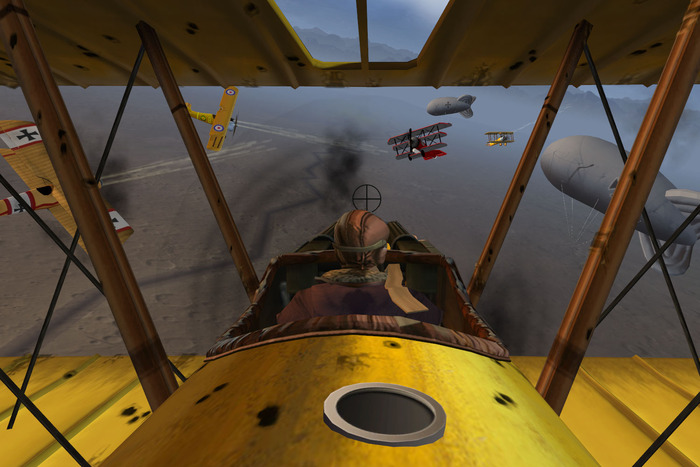
Wings_coverA few decades back, before I became a software and media executive and long before I returned to writing, I wrote the “screenplay” for a succesful computer game called Wings.  That “interactive movie” — as it was marketed — was a World War I flight simulation that followed the lives of the very first fighter pilots, trying to make combat sense of fragile biplanes curiously equipped with machine guns.  It was published by an early innovator in gaming known as Cinemaware, which set out to make games look, feel, and tell stories more like movies.  Recently the Cinemaware brand was resurrected via a Kickstarter campaign to fund a mobile version of Wings, that if successful will contain the entirety of the many pages of story and dialogue, plus a lot of new material.  I have no financial interest in the new Wings, but it does bring back fantastic memories, a slice of life from an earlier time.  The new team asked me to do a text interview to support their campaign, which I decided for nostalgia to publish here as well.  Enjoy!

Please provide a brief bio of yourself.

At the moment I’m a first time novelist, my book This is Rage: A Novel of Silicon Valley and Other Madness just released last month to good reviews.  I’m also an investor, a start-up board member, an executive coach instructor, a blogger, and former corporate executive.  I was CEO of SHOP.COM, Executive VP of Disney Online, and VP Entertainment and Education at Broderbund Software.  I read a lot, follow the L.A. Dodgers, study wine, and am active in children’s welfare issues as well as local government.  If that’s not brief enough, cut everything except the part about reading and the Dodgers.

How did you originally join Cinemaware and get to work on Wings?

I met some of the Cinemaware team at a UCLA conference called The Future of Television in the late 1980s.  They told me they were creating interactive movies.  I had just written a spec screenplay called Miniatures about radio controlled model aircraft that sort of predicted the U.S. drone program.  It was the first thing I had written on a computer, a monochrome XT.  They asked me if I ever thought about working on a computer game.  I said No.  They showed me Rocket Ranger and It Came from the Desert on the Amiga.  Then I said Yes.  Quickly.

How was it working with the Wings team on the Amiga?  What do you remember most about that time?

It was a magical time, a time of possibilities.  I had experienced five years in traditional media of hearing why we couldn’t do certain things, how everything had to be done a rigid way, and how little respect there seemed to be for the writer.  Everything at Cinemaware was, yeah, let’s try that and see if we can make it work, why not?  I also remember writing on a Mac SE/30 for the first time, and I couldn’t believe why anyone would use anything other than that — so much for my XT.  And I remember when our competitor, Origin Systems, leaked a demo of their outer space saga Wing Commander, and our team was like, hmm, that’s a pretty compelling 3D engine, but our story is way better, so back to the drawing board, and they completely rewrote our flight simulator in about 2 weeks to be more state of the art.  Oh, and I remember when someone brought in the first Amiga with a 20MB hard drive and we could install both floppy disks without having to play with disk swapping or a slow seeking second external floppy drive, and that just seemed like the best possible gaming experience you could ever have — until we heard rumor about something coming called a CD-ROM.

How did you go about doing research for the game?

John Cutter, the game’s visionary designer, and I got ourselves invited backstage at the Air & Space Archives in San Diego, where we discovered a lot of the old U.S. Army Air Corp files were stashed.  We were blown away by how welcomed we were there, the military librarians spent hours with us digging out old files, it was a smorgasbord of history, and they couldn’t have been more helpful.  They kept bringing out boxes and boxes of dusty old papers and black & white photographs and let us have at it.  It was a super find and let us dig deep into a very special time of innovation, courage, and pain.  We devoured stacks of books on World War I (we even included a bibliography in the Aviator’s Briefing Manual, I’m guessing the first bibliography for a computer game).  We watched the 1927 silent movie Wings — winner of the first Academy Award for Best Picture — and The Dawn Patrol (1930) so many times on VHS by our QA release date I think we could recite the storylines in realtime without anything on the monitor — then we chose to borrow only the atmosphere: the title, the sets, the costumes, font styles from the text cards, but none of the stories or characters.

What do you think makes Wings such a special gaming experience?

I think it really was the first computer game to try to tell an epic story that was more theater than shoot ’em up, but we kept plenty of shoot ’em up.  We tried extremely hard to make the character role-playing real, to get inside the head of a 19-year-old kid who probably had about as much chance coming home alive as he did surviving enough sorties to live long enough to become squadron commander.  We obsessed on details of the period, used every pixel wisely, created a true sense of responsiveness in the story, something that would set off endless discussions about the true nature of interactivity.  We also kept the game controls immensely simple.  It wasn’t a super complex gravity based simulation where you had to be an engineer to takeoff and land the plane or fight virtual physics to keep the contraption airborne.  We simply “cut to” you in the air and said Just Fly and Shoot.  We brought in a lot of non-gamers with that simplicity, but funny enough, the hard-core gamers praised us for it as well.

Can you tell us what the team wanted to implement in the game, but didn’t have the time or resources to do?  Any special hidden gems or trivia for Cinemaware fans?

First you have to remember what we were dealing with getting the game to ship on two 512K floppy disks, as if any big blockbuster developer today could comprehend how little data that is.  Our programmers were masters of compression, and kept squeezing and squeezing.  The music  was astonishingly intelligent, but the short redundant loops made our composers crazy, so I’m sure they will be delighted with the enhanced score on the remastered version.  Every screen shot was a big hit to storage, and I remember the artists begging to include more storyboards, but that wasn’t possible.  Luckily for me text was as economical to store then as it is now, so I didn’t feel the same thrashing.  I do remember the branching tree logic making me nuts and having to write multiple outcomes for every mission, wondering if it was humanly possible to cover every fork in the story and how many people would care that on a given pass through the game they would only see fractions of the screenplay (we positioned this as a customer benefit, creating replay value).  I remember when the marketing folks “requested” we cut from three floppy disks in beta down to two in order to improve gross margin on wholesale, which almost created a revolution in the hallways.  Our indefatigable producer, Jerry Albright, reminded us it was OK for them to ask, and that we had to respect them for trying, then emphatically told them not a chance.  Then somehow our miracle programmers pulled it off and we shipped the master on Reel 1 and Reel 2.  I also remember a few brainstorms we had after we realized what a unique product we had developed, one for a CD-ROM version with recorded spoken dialogue that of course never happened, and one for a Wings sequel that would have been set in WWII, and who knows where that would have taken us.

If Cinemaware had a chance to expand on Wings, what do you think could be better developed or explored?

That’s sort of like asking the creative team who made the original movie version of Wings how they would have made it a talkie.  The remastered version being funded on Kickstarter is doing all the right things — improved graphics, enhanced music, more missions, improved physics in the engine — all of that brings out the best in what we did so long ago.  The important thing is that we gave the game heart, layered grounding in reality staying true to the source material, emotional resonance woven through a role-playing experience.  As long as you remain true to heart, the polished production values will fully bring out the best.

Ken, you also pledged for this campaign, thank you so much for the support.  What made you do it?

It is a very small sum of money to let an entirely new generation of gamers see where we started as an industry, and maybe a few grown-up parents will get to share the experience with their kids.  Really, it’s not much money for a lot of game, and it is a fun game, part of what got us here.  It’s kind of like the silent movie version of Wings we watched over and over — what if someone hadn’t bothered to preserve it, can you imagine having lost a gem like that?  I can’t, no way.  We all come from somewhere, it’s important to remember that and even more important to share the memories.

Pilot Shot

Edutainment No More

About a year ago I wrote the following article at the request of ACM Computers in Entertainment for the debut of their redesigned site, which launched last week.  It is a bit longer than my usual posts, but for those interested in the topic, hopefully it will inspire good thoughts and discussion.  Here is a link to that article on the ACM site, which can also be found in the CIR Library, with the full text below:

“Why Did Edutainment Become a Bad Word?” by Ken Goldstein (ACM Computers in Entertainment: May 1, 2012)

“What have we here, laddie?  Mysterious scribblings?  A secret code?  No!  Poems, no less!  Poems, everybody!  The laddie reckons himself a poet… Absolute rubbish, laddie.”
— Pink Floyd – The Wall

Last year Amy Chua caused quite a stir with her polemic, Battle Hymn of the Tiger Mother.  The excerpt, “Why Chinese Mothers Are Superior,” published in the Wall Street Journal is said to have drawn the most individual responses to any article published to date on WSJ.com. The fact that a number of teens and tweens actually read and responded to a genuine WSJ article speaks to the silver lining in all free speech—that an idea expressed however outrageous is better than an idea suppressed for the very argument it inspires. John Stuart Mill was right, the marketplace of ideas only works when it is fully open for business; we rely on these sorts of diatribes as poorly considered advice that can be danced upon.

Here in my mind is the problem—we continue for some reason to want to draw a line between education and entertainment, between learning and playing, between rote study and inspired imagination. I don’t get it. We worry that the U.S. is falling behind the rest of the modern planet in math and science, we have a national epidemic on our hand with high school drop out rates, we live and work in a society where basic labor continues to be automated and the post industrial information economy is increasingly preeminent, and we are coming to accept the notion expressed by Thomas Friedman that The World is Flat. Largely for electorate exploitation, we continue to tout an ordained notion of exceptionalism, yet with refrains of “We’re No. 1” more often appropriate at football halftime shows than college commencement exercises. We have come to understand such grandeur is more a political mantra than shared aspiration. Budgets are under pressure at the state and federal levels, teachers are underpaid and exhausted, the Internet allows more information than ever to be readily available, yet we elect our candidates based on name recognition and image. What does all this mean? We are not as smart as we should be.

If we don’t think we are doing something wrong, perhaps we deserve what we get. That would be fatalistic, so maybe we should try it a different way. We know change occurs when the pain of change is less than the pain of staying the same. If we aren’t in enough pain now, then change is quite unlikely ever to be an option. We need to “Think Different” about education, and we need to do it now.

Professor Chua may have come to the conclusion that the elimination of play dates, disallowing her children to have a role in school theatrical productions, and psychological downgrading when a wrong note escapes the piano are the correct paths to discipline. Were we to take that path to its logical conclusion, what kind of society might we have? Certainly we might experience a landscape of accomplishment, complete with bragging rights, but would it be a place our children would want to live, either as kids or adults? It would likely lack rebellion, imagination, and most of all, fun. As I look around at kids on the playground, kids in the computer lab, kids on their iPhones, kids in garage bands, I don’t think those kids would call it fun. When the fun stops, the learning stops.

Tooling around Facebook recently I bumped into an old friend, Carmen Sandiego. I will tell you upfront, I have a deep and profound connection with the master thief; she and I shared a good many hours for a good many years. She also once pervaded just about every young classroom in this nation, and a fair number of households in the way back days before we all took connectivity for granted. I played a round of “Where in the World is Carmen Sandiego?” on Facebook and easily won my first case, the gimme we always intended it to be for encouragement and engagement, and then got blasted on my second case. Seems I could not quite remember my cities and landmarks as encoded memory was supposed to ensure, so I did the only thing any logical Aeron potato would do—I searched the locales on Wikipedia to get back on track. In the old days we used an almanac to do this, now that same almanac is about as relevant as the Yellow Pages we use as a booster seat for visiting nieces. The point is, the game was still fun, and it got me thinking. It did not replace the study of geography, nor was it a waste of time. It was a catalyst to make me want to do something—reinforce my weakened memory, by running some queries in a public database—that I am reasonably sure I would not have done otherwise. The game also made me chuckle, the puns were still clever and the animation cheerful, however dated. Years ago we built a business around this called “edutainment,” and while controversial at times with some leading academics, it was a good business that we enjoyed. When we sat with kids in the classroom and tested new versions, they seemed to enjoy the games as well; the games they didn’t enjoy, we mostly cancelled.

Did their test scores go up? I doubt it. Did a lot of them grow up to be detectives or geographers? Statistically speaking, I am guessing not more than usual. Was the introduction of computers to them at a young age a path to wanting to understand how the program code worked and how they could rip it apart? That I can promise you was my experience. A lot of those young folks grew up to be programmers and worked for me. Did we tell them anywhere, anyway, anyhow that we expected them to take apart the computer code? No, actually we begged them not to do this for copyright reasons. Yet here is a secret: When kids enjoy something, they often take it apart all on their own. I did it as a kid with music, poetry, written fiction, theatrical performance, cardboard models, solid fuel rockets, even my first bank account. Inquiry is natural when it is interesting, that’s how a lot of us are wired. Think about your work—when you are engaged, the time flies by and you complain a lot less about how terribly busy you are. When you are performing rote tasks for financial reward, the clock ticks by slowly…oh, so slowly.

My definition of fun is engagement. My definition of entertainment is engagement. My definition of learning is engagement. You don’t need a Ph.D. in advanced mathematics to see the transitive nature of the implied equation.

There needs to be more fun in learning, not less. There needs to be more entertainment in education, not less. If we want kids to stop dropping out of school, they need to want to be in school. If we want kids to do their homework, we have to make their homework worth doing. Somewhere along the way, a vast conspiracy of otherworldly forces decided that school was about getting a job to make money. Suppose it is. Is that fun, getting a job so you can make money, so kids can look into our eyes and say, yeah, I am gonna play by the rules so I can have what you have? And we wonder why kids are having a hard time with this?

Cut back to when you were toddler, where every day was a miracle, where the distinction between learning and playing did not exist. When you explored the world as your own adventure, every living second was learning, and the last thing you wanted to do was crawl back into the crib. Kids practically beg us to go to preschool, then kindergarten, even first and second and maybe third grade. Why? Because it is fun. It is social. Learning and playing are one and the same. The magic of math is one big puzzle to unravel. The cipher that is language is practically super-power in letting us open new doors, whole universes. The unraveling of science gives the knowledge once restricted to society elders to a five-year-old, as we come to grasp the physical riddles of fire, gravity, why our little teeth drop out of our mouths and are replaced without asking by big teeth. Every day we see our friends and share with them. We sing with them, we learn to play soccer together; we come to embrace simple rules of order and etiquette so that we can get along, even if it just means being polite when cookies and juice are served. We are in a peer group of our own, with an authority figure who temporarily replaces mom or dad called a teacher, and we know intuitively every day we are getting smarter because we are having more fun.

Then they start to measure our performance, and the jig is up. No more fun. Grades. Test scores. College prep. So we can learn something valuable enough to get a job and make money. Oh yeah, that sure is fun.

In his 2011 State of the Union address, President Obama said, “We need to teach our kids that it’s not just the winner of the Super Bowl who deserves to be celebrated, but the winner of the science fair.” If this is just rhetoric than we are bipartisan doomed. We absolutely must embrace the nerds just as much as we applaud the athletes, not because they will all grow up to be Bill Gates and Steve Jobs and Mark Zuckerberg, but because they probably will not. Unless it is cool just to be smart and “be in the band,” then why on earth should anyone stick with education? I buy that with every fiber of my conviction, probably because I was one of the nerds and an embarrassingly awful athlete—but I was never an outcast, because I knew learning qua learning is what mattered most and I was always on the inside with someone who shared that core value and called it fun.

Now let’s dig a little deeper into President Obama’s meaning. My personal sense is that he was saying until education returns to being a core value, we will remain a divided land. That division is what I suggest our well-intentioned but unedited antagonist, Professor Chua, is unintentionally supporting, not the least of which is by drawing ethnic association into a social landscape that continues to evolve appropriately to multiculturalism, tolerance, and shared embrace. If some of us are forced to learn in over structured traditions of education, then whether we like it or not, we probably will get through college and end up with a job that allows sustenance. Whether that is fulfilling and happy for us is not the point, we will participate in the economy and not be a burden to other taxpayers. What then do we do with the rest of us, is it just, oh well, we will get by the best we can? I don’t think so, because the currency of the new economy is not instilled knowledge, it is creativity. In President Obama’s own words: “The first step in winning the future is encouraging American innovation.” Innovation is a direct reflection of creativity, not recitation.  Larry Summers said as much in his response to Professor Chua, citing great minds that did not follow traditional paths, but embraced creativity and started companies instead. And here is another secret that almost no one seems to get—they started those companies not to make money, but to have fun. They chose to work hard at building those companies because they found it enjoyable. There was no separation of work and play, education and entertainment in their minds. They did what they wanted to do, they did it well, and they enjoyed more days than they did not. The fuel of innovation is creativity, and the fuel of creativity is fun.

Sound familiar? Like professional sports perhaps? Or young people who want to become musicians, actors, writers, or fashion designers? Well, we all know the bad news on statistics, we aren’t all going to be at the top of our game if our game is economically limited to a celebrity few. A tiny few of us will start companies that become empires, accidental or otherwise. Yet can we borrow from the motivations of the people who do make these inroads? Instead of fantasizing about playing in the Super Bowl or collecting an Academy Award, how about looking into the sheer drive that brought those “players” to the top of the top. Leave the frosting, eat the cake—the lesson is that the journey is the reward, so start learning the way you want to learn such that you learn what matters to you, and put it to work for intrinsic rather than extrinsic reasons. When you do that, education and entertainment are one and the same, it’s your world. Why don’t we get smart and start teaching kids that way?

If the currency of the new economy is creativity, then we need to celebrate creativity. If kids love entertainment, then we need entertainment to be the fabric of learning. Am I suggesting we do away with drills, practice, focused preparation, and the like? Does the football coach do away with drills, practice, focused preparation and the like? And does the football coach tell his players the reason they are running drills, practice, focused preparation, and the like is because he wants them to understand that this is how football will reward them with riches? The football coach is a teacher, and his game is one of learning. If you haven’t had the pleasure, check out the TV series “Friday Night Lights” and see how much heart it takes to escape the ordinary: “Clear Eyes, Full Hearts, Can’t Lose.” Let’s learn from that.

Luckily, my teachers took a different tack, keenly advising that I walk in the shoes of the masters so that when the time came to rebel, I would know precisely what I was rebelling against. I was one of the lucky ones; I had guidance first, instruction only as a conduit. There was plenty of welcomed discipline, unending study, invited volumes of dusty old books; all I wanted was more, because it was clear to me that a war chest of fully digested material was armor for the long and winding road. Most athletes don’t really like push-ups, but they do as many as they can, as often as they can. Most students don’t really like Hegel in the vernacular or translation, but oh, dialectic synthesis can sure come in handy when a modern Sophist plays fast and loose with history. We each only get one vote, the same value, but we both know if we earned it. In developing our own voices, we are able to see clearly that laughing is always part of learning. When we learn and laugh well, how can we not call it fun?
Dodging The Greatest Hits Graveyard

I’ve kept a frequent presence at rock concerts ever since I was a kid. Back in the day, live rock and roll shows were reasonably affordable—even if you did have to sleep on the street to get tickets—because bands toured in support of the latest record they had produced. Live shows were a catalyst for selling singles and albums, pushed local radio play, sold t-shirts and memorabilia, and paid for the road antics of the bands who could live and party on “permanent vacation.”

The concert world today is obviously different because the ecosystem is so drastically different. There are still monster arena tours like U2, Springsteen, or the Rolling Stones 50th (gasp!) corporate sponsored anniversary. There are small gatherings of devoted fans at venues around 5000 seats for tireless road warriors like Cheap Trick or Chicago. There are nostalgia plays in casino showrooms or destination bars with one or two surviving members of one-hit wonder acts. And there are tremendous new stars like Adele who play the old game a new way and can still fill amphitheaters at top prices, sell plenty of music downloads, and inspire faith that the CD has a tiny bit of life left for the bygone tribe.

What I have noticed over the course of this music evolution is the underlying key to longevity and not moving down the food chain hasn’t much changed—the survivors tend to deliver a healthy balance of old and new material. This is no small problem, as the fans who come out to concerts are no doubt screaming for an artist to play their big hits. It’s natural. It’s satisfying. It’s a trap.

TSO2005A few weeks ago my wife and I went to see one of our favorite groups, the still somewhat niche band Trans-Siberian Orchestra, best known for their annual Christmas shows and the ever-present holiday single, Christmas in Sarajevo. TSO blends heavy metal power chords with classical music and electric violins, usually with an interspersed layer of spoken storytelling. Several years ago they started branching out from Christmas themes, recording and touring a fantasy tale called Beethoven’s Last Night. This was the first time we had seen the show performed live, and while it was familiar to us, it was not well-known to much of the devoted audience. That was pretty brave, I thought, to tour a concept album that was not necessarily top of mind with their audience, but then they did something I found even more courageous. Toward the end of the show, when they had finished playing Beethoven and the audience expected they would play some oldies, they instead played several entirely new songs that had not even been released online. No one had heard these songs except those who had seen the tour, and the applause following was as you might suspect a bit tentative. The nervous quiet during these songs was not because they were bad, it was because they were new. If you are a regular on the live music scene, you know that awkwardness—but without it, there are no new hits.

New music has to be debuted at some point, that’s why it’s called a debut. Audiences can be very tough on new songs, they pay good money to hear hits and the survival of any act is contingent on meeting the expectations of fans. Yet long-term success is equally contingent on innovating, and facing an audience with the unknown or unfamiliar is always a daunting prospect. Who would willingly trade thunderous applause for quiet, polite clapping? The greatest acts know they have no choice.

Most of the hot Top 40 bands in the 1970s and 1980s would periodically release Greatest Hits albums, mechanical collections of their charting singles, usually pushed by their record labels for bankable cash acceleration. Some of these became all time bestsellers, notably The Eagles and Elton John. The question I always used to wonder when I handed over my cash for a dozen song vinyl collection was whether this was the end of the band or the beginning of a new chapter. For too many, we know how that played out, and we know where those bands are playing today, if at all. A Greatest Hits or “Best of…” album was easy money, the equivalent of predictable thunderous applause. Pushing out new work would remain the heart of risk, and the genesis of going to the next level.

Nothing about this cycle is unique to music. Business is the same, especially technology wrapped as consumer products. You need to play to your familiar success, the current incarnation of your brand, but the moment that catalogue is fixed, you’re doing dinner theater rather than headlining at Carnegie Hall. Think RIM with the standing ovation worthy Blackberry, Kodak and Polaroid with endless scrapbooks of silver snapshots, perhaps now Best Buy longing for a different curtain call than their former contender Circuit City. They all climbed the charts, but staying there remains a different story.

Steve Jobs liked to say that he never believed in focus groups, because it was not the job of customers to tell you what they wanted—how could they know what they wanted when it hadn’t yet been invented? No civilian could concretely describe iTunes, the iPod, the iPhone, or the iPad prior to their release. You can only imagine how many pundits prior to the success of these inventions could tell you of their impending doom solely on the basis of unfamiliarity. Of course Apple never stopped marketing its core line of computers during this unbelievable expansion of reach, they were still playing hits while composing new material and seeding it to the faithful, those with whom they had established profound affinity and could ask to trust them further with the unknown.

I also don’t think it is a coincidence that Steve Jobs was a huge fan of The Beatles, who in an active career that spanned all of about eight years never stopped putting out new material, took themselves off the road to focus on composition and the creative process, then reinvented their sound with almost every album, including a few radical pivots like Sgt. Pepper. Is it counter intuitive that the actual career of The Beatles was so short despite all that new material and no Greatest Hits collection until after their break-up? Possibly, but if impact is the name of the game, it is hard to dispute that The Beatles succeeded most of all at avoiding that most dreaded of dead-ends, The Greatest Hits Graveyard. Their incomparable legacy remains vibrant because they pushed themselves so hard to be innovating all the time while crowd pleasing.

Celebrated descriptors like “Built to Last” and “Good to Great” are hard-won praise tied to nimble companies for navigating the same difficult balance for so many years of reinvention. It’s a lesson in courage and vision that is as difficult to learn as it is to replicate, but it is that very bravery that can guide any individual career from ordinary to enviable. Facing the anxious reception of the untried might not be pleasant when a clear alternative is available, but it’s the only trail that bypasses the one-hit wonders.