The Lives We Touch

I’ve been thinking a lot this year about what we do. Receive Books. Sell books. Ship books. Process the accounting for receiving, selling, and shipping books.

Sounds rather straightforward, yet it’s only the stencil for a rich tapestry.

Behind the scenes, as a company we hire people, train people, pay people for the work they do. We help to build careers, share ideas with each other, learn from our mistakes, learn from each other, and together build a company we intend to last for decades.

We create a promise called a brand, which is about price, quality, service, selection, loyalty, and experience. We build relationships with customers who return to us repeatedly, first as hopeful young readers, then as devoted adult readers, and eventually as parents and grandparents bringing subsequent generations into the miraculous impact of printed words bound by covers and titles.

We build our business on the foundation of one of the oldest technologies in the history of humanity, the earliest modern examples of which were in evidence some 2000 years ago. Imagine that, a form of technology that has changed so little since ancient times. Compare that to your own experience of the phone’s evolution in just one lifetime. We carry the tradition of sharing the written word on scrolls, parchment, and eventually printed paper from our ancestors to those who aren’t yet born.

We deliver a relatively inexpensive form of media that may encompass storytelling, science, history, biography, education, law, religion, philosophy, poetry, art, music, recipes, instruction, or any other memorialization of human achievement. We deliver it in any number of languages across international borders. We deliver a book from one human hand to another over a hundred thousand times each day.

Yes, we do all that. We do all those things. I think we do it better than anyone in the world.

Yet given the emotional tenor of the past year, I think we do something even more important.

We touch lives.

We open minds.

We soften hearts.

We bring families together around the shared love of a classic tale.

We help the pages of an author’s creation inspire the thinking of a fellow traveler to consider a different point of view.

We bring to the door a proven tool to inspire personal growth through interpretation and resonance.

We join in the dialogue of exploring human purpose, to reveal the mysteries of the universe as they are discovered and conveyed.

We work hard to let ideas circulate, drive discussion, ignite important debate, and reinvent ideas that time suggests warrant revision.

There is nothing as powerful for me as seeing the moment when young non-readers suddenly take a book from the hands of their parents and demonstrate themselves to be a reader. Every time I see that light come on I see a path of enlightenment reoccur. It is reading that connects us from then to now, from now to the future, and forever to each other.

Books do that and will continue to do so as far into the future as I can imagine. ThriftBooks is harmoniously immersed in that continuum. We are a bridge on that road to enlightening minds.

That is what we do. That is the world we change.

It is said as we age our paths evolve from seeking success to seeking significance. In the more than two decades we have served our customers, we have become evangelists of reading and embarked on a legacy of significance. It is one part privilege, one part responsibility, and many parts celebration.

This holiday season, as we revisit our various notions of significance, as we think about the gift of kindness, let’s remember we do much more than the unending work of building a company together. 

My wife, a beloved ESL teacher, joyously affirms that our books are our treasures. We celebrate the people who read them as even more precious treasures. We bring one form of treasure to another. 

These are the lives we touch.

_______________

Photo: Pixabay

World Series Reflections: 2025 Edition

You might have noticed I’ve published fewer blog posts this year. The political climate has made it hard to write about things that seem trivial in comparison. I’ve found it difficult to comment on news of the day without adding divisiveness to the national dialogue, yet unsettling to try to ignore it with distanced topics. I suspect I’ll resume my regular cadence at some point. I’m not sure when, but I will remain at the keyboard infrequently as my DNA requires.

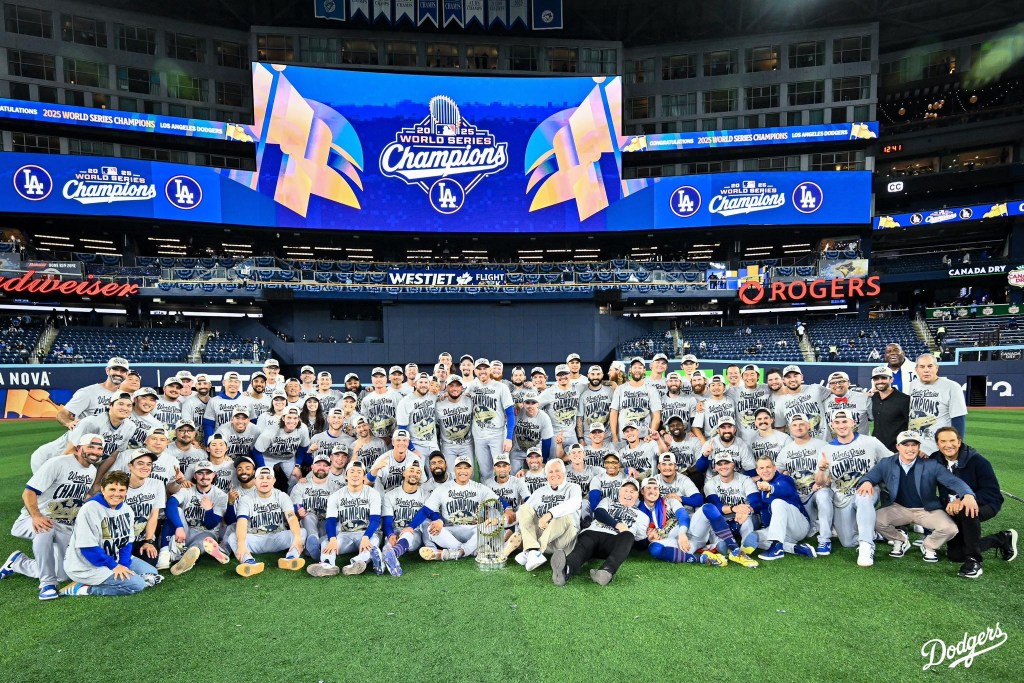
You might also have noticed that the Los Angeles Dodgers just won the World Series for the second year in a row. That is another infrequent happening, and while perhaps not life-changing, joyously worth a few comments from a devoted fan.

The entire MLB postseason this year was filled with unpredictability. The World Series was a fitting final act to that rollercoaster, with an 18-inning marathon Game 3 and a fought-to-the-finish Game 7 that went down to the last swing of the bat. I won’t recap the play-by-play, others have done that with endless detail, but I will say it was a game that turned on both the performances of superstars and journeymen.

That’s one of the things we love about baseball. Any team can beat any other team on any given day, no matter how good or bad. Chance is always at play. A ball can literally get stuck in a wall crevice and change the outcome of a game (it happened in Game 6). A series MVP like pitcher Yoshinobu Yamamoto can demonstrate consistent excellence on the mound in the clear sight of Sandy Koufax, or a little-known infielder with heart like Miguel Rojas can come off the bench and tie a game that seems all but lost.

Impact can happen at any moment from any player. The game can seldom be predicted.

What does this innocent children’s game played by highly trained adults teach us? We learn from the applied metaphor of baseball that you always play hard to the end. Resilience is your heartbeat. It pays to be indefatigable. You never give up. Never.

Baseball is so many things in the mirror of life. It is the ultimate combination of athleticism and strategy, training and statistics, physical readiness and endless number crunching. It is a game of mistakes — the only sport that counts them on the scoreboard. It is a game of overcoming failure, where a player who gets a hit 2 out of 10 times at bat usually gets dumped, and a player who hits 3 out of 10 often will be paid millions of dollars — crazy many millions of dollars. Unless you are a pro, you’ll never see a 100 mph fastball whip by inches from your body. In fact, the pros can’t see it either, but sometimes they time their swing right, make contact, and put it in the outfield stands.

I had hoped to see the Dodgers win the World Series at home for the first time since 1963. Not only didn’t that happen, but we lost both games I attended with my brother, who was quite the ballplayer in high school and college. So was my dad, who couldn’t attend this year, but texted me at every key moment with his coaching suggestions. I never had the talent, but curiously, I was pretty good with the numbers.

When we lost both those games, I thought of a marketing idea for the front office: how about they give us a 5% rebate for every run we lose by? So if we lose 6 to 1, we get 25% of our ticket price refunded. This would just be for the wildly overpriced World Series tickets. I’ll be sharing that concept free of charge on my annual season ticket feedback form. I don’t expect a response.

The two games we lost at home were more than offset by the final two games we won on the road. The drama of those two games would make for an Academy Award winning movie no matter who won. Note to Kevin Costner, Redford is unavailable — do you have one more baseball epic in you? And who would you like to play?

Hats off to the Toronto Blue Jays, who have waited since 1993 to get back to this big stage. Their ball club oozes talent, from the future Hall of Famer Vladimir Guerrero Jr to the wild ascent of pitcher Trey Yesavage from Single A minor league ball to triumph in the World Series seven months later.

The Dodgers magical starting lineup — Ohtani, Betts, Freeman, Smith, Muncy, Edman, Teoscar Hernandez, Kike Hernandez, Pages — will live in our imagination with most returning for another season. We also witnessed the impossible elegance of an unknown reliever in Game 3 named Will Klein, and in that same game the single inning bridge of the departing great Clayton Kershaw. Manager Dave Roberts made a number of gutsy, counterintuitive moves throughout the series that could have gone either way, but at last the risks played in his favor.

Maybe it will be enough for Costner to make a cameo, a lot of good picks there. AI can help with the aging thing.

It’s all one for the storybooks, but I’ll close with a quiet moment that summed it up for me. When I arrived at the entrance gate for Game 5, I said to the friendly parking attendant I see all the time, ”I’ll bet you’re sad it’s the last day of the season here at Dodger Stadium.”

”What do you mean it’s the last day?” he replied. “We have a parade next week. We’ll all be here for that.”

We had lost the game the night before and the series was tied at 2-2. There was no question in his mind there was going to be a parade. No question whatsoever.

Resilience to the end. Hope in the face of adversity. Optimism facing inescapable, ceaseless competitive resistance.

As Bart Giamatti wrote so eloquently about the game long ago, “It is designed to break your heart.”

Not this time.

Win or lose, this is the game we love.

________________________________________

Photo: TORONTO, ONTARIO – NOVEMBER 2: World Series Game 7 between the Los Angeles Dodgers and Toronto Blue Jays at Rogers Centre on Sunday, November 2, 2025 in Toronto, Ontario. (Jon SooHoo/Los Angeles Dodgers)

A Wright Brothers Moment

Like most business leaders these days, I am obsessed with the rapid evolution of artificial intelligence. Not a day goes by without the promise or threat of AI dominating the headlines. There is insurmountable prognostication from pundits on all sides of observation — thinkers, doers, computer scientists, investors, executives, academics, journalists, policy-makers, and just regular folks — about where AI will lead, with or without direct human control.

As always, my core belief is that technology advances faster than our ability to understand its social implications. This is also another one of those situations where it is impossible to say if anyone can paint a clear and true picture of what we’ll see on the road ahead, be it five, ten, or a hundred years from today.

This for me has become a Wright Brothers moment. What I mean by that is trying to imagine what the Wright Brothers might have thought about where their first powered flyer might lead in the ensuing hundred years. Although they understood the potential military applications of flight, they couldn’t have imagined the 37-hour round-trip path of the recent B2 intercontinental bombing mission. They couldn’t have imagined commercial flights filling up daily at relatively low cost with endless travelers. They couldn’t have envisioned space travel with or without humans to the moon, Mars, or beyond our own galaxy.

I’m familiar with the Wright Brothers story as it was foundational to the first storytelling project I joined to bring to life in technology, a very early computer game called Wings. That game followed the life of a young pilot in World War I, an extremely rudimentary military use of aeronautics long beyond the imagination of the innovators Wilbur and Orville Wright. The success of the Kitty Hawk biplane experiment in 1903 led to armed aircraft and pilots fighting each other in flight a decade later. That was an early twentieth-century sign of how fast technology would evolve from concept to unplanned implementation.

The more I study AI and approve early-stage projects where it is being applied to our business, the more I am convinced we are in a Wright Brothers moment. Virtually no one reading this blog will be around in a century to either say “I told you so” or gasp at the outcome of where machine learning, large language models, generative AI, or agentic adoption will take us. It would be like the Wright Brothers on that remote North Carolina beach envisioning a frequent flyer program and pre-ordering their inflight meal — or trying to picture an aircraft carrier at sea, or a massive rocket lifting into the air and landing again on its base.

Futurists may try to see through a crystal ball, but we all know that’s mostly a fool’s errand. What we may think the history of science will bring and what it actually delivers are almost impossible to reconcile within a lifetime, let alone beyond a lifetime.

I felt similarly when I bought my first personal computer in the mid-1980s at the beginning of my career, mostly to use as a word processor. That was a few years before a small team of collaborators built that WWI game called Wings. In those few years following the first monochrome monitor on my desktop, we created a brightly colored rendering of a three-dimensional flight simulator at extraordinarily low cost and sold at a similarly attractive consumer price point. I thought to myself, where will this exponential compounding take us in the tangible decades ahead of me?

The quantitative advances in processing instructions were already staggering. We had just bought new computers with 20mb hard drives and the Holy Grail of local storage appeared to be CD-ROM. That was before the commercial internet, before broadband, before widely available cellphones, and long before any kind of advanced mobile device in your hand that could access and display unlimited high-definition video. No one could have pictured an iPhone, not even Steve Jobs.

All of that pales in comparison to what I think AI will bring. I’m trying to envision the world in a decade, in two decades, which hopefully I will see. A hundred years from now, what will be the human experience? What is the equivalent of boarding a plane with 400 other passengers for a flight of several hours across an ocean and hoping to get upgraded versus waiting in line at a port hoping to find passage on a steamship for a week or two of unsteady seas?

Together we are sharing a Wright Brothers moment. We’re on a windy shoreline, staring in awe at an ingeniously designed, materially fragile, heavier-than-air, modestly motor-powered, fancy bit of kite architecture, equipped to carry a single passenger off the ground for about 12 seconds.

What this means is that we are about to fly.

_______________

Photo: Pixabay

Don’t Yell at the Pilot

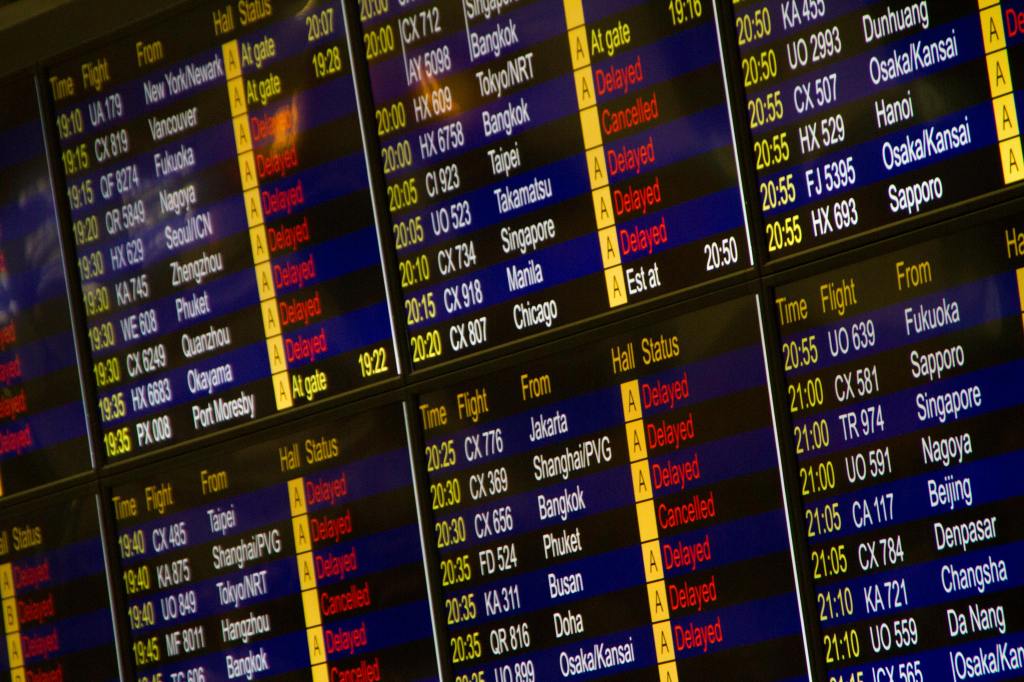
If you are a regular reader of this blog, you know I spend a lot of time on planes. When you fly a lot or spend a hunk of time at airports, you observe human behavior in many of its less magnificent expressions. There’s no way around it — the more you fly, the more likely things are to go wrong. It’s a numbers game. Take 100 flights, and if just 5% of them don’t go as planned, that’s five bad days of travel interrupted. That 5% is optimistic.

Frequent travelers know that getting angry at the people trying to help you with a canceled or rerouted flight is not likely to get you what you want. You may think yelling at the person on the other side of the computer will get their attention. What you don’t know is what they are typing, or would have typed if you had been a little kinder.

Last week I had one of those bad business travel days. Shortly after takeoff, we were notified by the captain that there was an unexpected rumbling we all heard in the retraction of the landing gear. Although he assured us we were safe, to be even safer he was going to make an unscheduled landing at the next major airport we were approaching.

You can imagine the groans from the cabin passengers. “There goes the day.” “So much for our plans.” Yep. That’s what happens. The captain makes the call and the plane goes where the captain says it goes. Twenty minutes later we were on a runway and at a gate two hours short of our destination.

Indeed there was confusion when we landed. We were asked to disembark and wait at the gate. Job 1 of course was to inspect the plane and see if it could be airborne again. If you have ever experienced this scenario, you know the chances were maybe 10% that plane was going back in the sky the same day, but you do what the crew advises and take it a step at a time.

Because we were an unexpected landing the gate was understaffed. While they tried to get the connecting passengers rerouted, they asked the single destination passengers to wait for a call on whether the plane was safe to fly again or we would need to be rebooked. Frequent travelers know not to wait — you get on the phone or internet, rebook while seats are available on other flights, and take whatever seat you can get to keep moving. Of course not everyone can be helped immediately with long lines and on-hold wait times, so there was reasonable angst in the gate area.

Reasonable, that is, until the captain came off the plane and visited with us while we waited. That’s when people became unreasonable. He told us the likelihood of that plane taking off again the same day was extremely low, and we should all be making other plans. He was honest and straightforward. He didn’t have to do that. He didn’t even have to talk to us. In exchange for his candor, a number of passengers started yelling at him. “This is unacceptable!” “Do you know how to run an airline or not?” “What compensation do we get for this inconvenience?”

There are a few cardinal rules frequent travelers embrace. Don’t make jokes when passing through security. Don’t step in front of small children or anyone in a wheelchair when boarding or deplaning. And don’t yell at anyone in uniform. Ever. Do not yell at a flight attendant. Absolutely never yell at a pilot.

For all these angry passengers knew, this pilot might have just saved their lives. Sure he said there was no danger in the air, but you don’t know if that’s really true. A captain would never create a panic in the cabin. This captain made a call and set the plane down. Now we’re calling family to tell them we’re going to be late and worrying about retrieving our luggage. Could it be worse? At 37,000 feet above the Earth?

I remember during Covid when passengers were complaining to flight attendants about wearing masks. Sometimes that exploded into yelling. I thought to myself, what makes people think that flight attendants have any discretion over enforcing federal policy? What can passengers possibly hope to accomplish by yelling at those making it possible to fly during the pandemic?

Airline inflight personnel are heroes who look after our safety first and foremost. They don’t run the airline. They aren’t in management or marketing. They are not jet manufacturers or maintenance crews. Their job is to get us where we are going safely. They do that with 99.99% accuracy, maybe more 9s. To yell at a pilot for the inconvenience someone might be suffering is beyond ignorant, beyond disrespectful, beyond lunatic. The pilot did his job. Applaud him, thank him, write a letter of commendation on his behalf.

Don’t yell at the pilot. Never. You’ll get where you’re going because a highly trained and experienced professional kept that option open for you. Their thousands of hours in the cockpit prepared them to make split-second decisions, perhaps a few consequential times in their careers, that allowed you to read these words. I’m in awe of their talent, commitment, dedication, and perfectionism. Yell at them and you’re going to get a different kind of feedback from passengers like me, their most devoted fans.

_______________

Photo: Pexels