A Little More, A Little Less

To help bring in the New Year, here is a quick punch list of what I would like to see a little more of and a little less of in 2012.  These are not meant to be far-reaching or prophetic ideals, just small steps we can choose to make concrete in and out of business to “advance the brand” ever so slightly each day.  Please feel free to stretch the list and add your “asks” in the comments section.

For starters…

A little more focus on sustainable job creation with decent paying gigs for those who want to work; a little less badgering of the unemployed who are nobly trying to spring themselves back into action.

A little more attention to world-class customer service that shows true respect for those who pay the bills; a little less maneuvering in the shadows to squeeze unwarranted improvements in margin by taking advantage of customer patience and goodwill with hidden garbage.

A little more good theater onstage; a little less awful theater everywhere else.

A little more listening to creative thinking before blurting out that it won’t work; a little less condemnation of those who are carrying the bag before questioning their character.

A little more pay down of available credit by all borrowers; a little less concern with things we don’t have and might like, but can live without no problem.

A little more conservation of the Earth’s precious and limited resources; a little less right to entitlement via purchase power.

A little more earnings from growth and investment in the enterprise; a little less cap on hiring while stockpiling cash reserves.

A little more commitment to making broad education a national priority; a little less earthquake type each time a professional athlete signs a seven-figure contract.

And then…

A little less spotlight on celebrities and their personal dramas; a little more celebration of everyday unsung heroes who quietly make our world better just doing what they do.

A little less fireworks around award shows for mediocre creative work; a little more visionary creative work worth celebrating.

A little less self-aggrandized noise and plotted invective in media placement; a little more interesting dialogue and engaging discussion in the public square.

A little less “them” where rhetoric is an intentional tactic of divisiveness; a little more “us” where national pride and humility are shared values.

A little less last-minute antics in Congress where critical deadlines loom; a little more thoughtful strategic planning around long-term solutions demanded by voters.

A little less concern around titles and press releases; a little more measurable goal achievement and personal job satisfaction.

A little less built to flip and business as usual; a little more built to last and Think Different.

A little less criticism of people who look, talk, and behave differently from our routine; a little more tolerance of diversity that opens the door to understanding — on that last one, maybe a lot more.

Okay, that’s my zapping of the spark plugs.  What’s yours?

Thank you for welcoming Corporate Intelligence Radio in its first year and all your great comments (private as well as public) in our shared exploration of how to make work matter more.  Together we can make 2012 a turning point.  Why not?

Eyes on HP

Hewlett-Packard is not just any company. It is iconic. Like Disney, Ford, General Electric, Apple, Microsoft, and a few others, it is not only part of business history, it is deeply wound into the fabric of American history. Modern Silicon Valley pretty much begins with Hewlett-Packard—the foundations of information technology as a new sector of productivity, the power of innovation, the hardware/software product life-cycle, the beginnings of west coast venture capital, and the splitting atom of employees spinning off from the mothership to become founders themselves. The Hewlett-Packard story until recently is a magnificent tale.

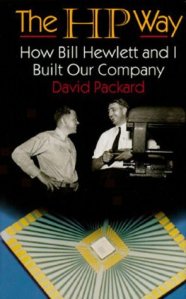
HP WayBill Hewlett and Dave Packard really did start in a garage. One of the very first products they sold was a precision audio oscillator, to of all people, Walt Disney. They captured their thoughts in a book, The HP Way, reinforcing the need for a company to have a mission and a vision. When we talk about a job being more than a paycheck, a lot of that comes from the work ethic and values of Hewlett and Packard. They set the stage for a generation of entrepreneurs. They made it okay to fail, as long as that failure contained learning that was honestly disseminated. HP on an engineer’s resume was gold. The sales and marketing team was second to none.

It is almost impossible to understand the impact of a global company with over $125B in annual revenue and 325,000 employees changing CEOs four times in six years, not including the interim CEOs between hires. Carly Fiorina, Mark Hurd, and Leo Apotheker each left the company for different reasons, and while the HP board is now taking a lot of heat for perhaps not scrutinizing their decisions around these leaders carefully enough, that is unfortunately water under the bridge. The company is now under the direction of former eBay CEO and recent California Gubernatorial candidate Meg Whitman, who will need to move quickly and definitively to steady the ship.

HP has seen numerous mergers, divestitures, and acquisitions throughout this period of seismic change, and each time one strategy replaces a previous version, the impact is costly. Whitman has said she believes the strategy in place at HP now is largely correct, so if the issues she is facing are managerial, perhaps we will see a positive impact sooner rather than later. My guess is she will dig into strategy a bit more in the coming months, and then move aggressively to make her mark. The sooner she can restore confidence with customers, employees, and shareholders, the better it will be for all those who do care deeply about the company’s future.

Why is HP so important in the scope of business enterprise? When you dig into exceptional business books like Built to Last and Good to Great, both by Jim Collins, you realize just how hard it is for even the strongest corporations to go the distance in an environment of creative destruction. As Collins points out so often in the data he cites, only 62 of the original Fortune 500 companies named on the original list in 1955 remain there in 2011.

The great former CEO of Intel, Andy Grove, talks at length about the “strategic inflection points” facing companies at every stage of their evolution—particularly technology companies—in his critical study Only the Paranoid Survive. Grove makes it all too clear how easy it is for a well established organization with vast resources and expansive markets to miss a fundamental change in the continuum of progress, only to catch its error to late to be fixed, having been lapped by any number of competitors.

Where Collins approaches the challenge largely from the aspect of defining and reinforcing a brand, Grove looks at it from the point of view of ceaseless innovation and refusal to accept the status quo as satisfying. Both approaches are vital, but neither has a chance in the face of organizational chaos. Products, features, and benefits must remain in constant flux, but ideals and values are their balancing counterparts. Remove the rudder from a very fast ship and it really doesn’t much matter what is powering the engine room.

It takes both leadership and strategy to steer one of these mammoth ships through the rough seas of business change, and simply taking those notions for granted is the easiest way for a company to fall from grace. Robert Burgelman, a colleague of Andy Grove who teaches strategy at the Stanford Graduate School of Business (and is also a former board member of mine), tells us that strategy becomes real when we apply resources to concepts. We see that very much in action now at HP, but we see those resource decisions changing too frequently in real-time. The leadership of the CEO drives that strategy from concept to action, from white board idea to investment cost center, and if strategic shifts are reversed before cost centers become profit centers, value can be destroyed at an astonishing pace.

No CEO or strategy is meant to last forever, but change them too often, and costs pile up without reward. The toll on staff morale is immeasurable, and the lost jobs from reversing decisions may never be recovered. Employees feel the impact in loss of income, shareholders get pummeled. Customers just move on.

It’s time now for HP to turn the corner. As I said, HP is iconic, it is Silicon Valley. We need it as an example in the tech sector of a company that is Built to Last and can continue to grow from Good to Great. HP dates to 1939. It is the standard-bearer for all the great companies that followed its mantra, were born in garages, and now have office space in the adjacent neighborhoods. If we want to believe companies like AOL and Yahoo can find new creative life through reinvention, we have to have models for long-term success. We need succession plans that show great companies can transcend their founders and achieve new levels of success by ensuring that values are more than words in the employee handbook, and that they are liberating, not confining, as long as the leaders who embrace them help guide their teams through increased commitment to innovation with coherent planning and rigorous evaluation. No shooting from the hip, but no fear of change.

On a pragmatic level, we also need the jobs, particularly in HP’s home state of California. Surely the majority of new jobs in our nation will come from small business and startups, but we can’t afford to lose the ones we have in the enterprise, not for the families who depend on them, not for the state budget that needs the payroll tax. Because of its deep history in the community and legend, HP leads the ethos in Silicon Valley in so many ways, its stability is a reflection of hope, its instability a drag on the headlines when we need a shot of optimism.

This is a once in a lifetime career and company defining opportunity for the new CEO at HP. It’s like getting the chance to manage the NY Yankees after three bad seasons no one saw coming. They might be on a losing streak, they might have made a bunch of bad trades, but they’re still the Yankees. Everyone knows they can win, that they have the resources to win and a history of winning. Meg Whitman just needs to ask herself, what kind of game does she want her team playing, who does she want in the line-up, and where does she need to better read the competitive landscape. A little consistency in management will go a long way.

Let’s hope Hewlett-Packard has it right this time. There is already new criticism of HP’s board that they acted too quickly in hiring Meg Whitman, that she should have first been named interim CEO, or that her background is not right for the job. Their decision has been made, so I am rooting for the new CEO. This isn’t politics, this is P&L. It is critical that Meg gets this right and succeeds. A win for her in this role is a win for all of us.

The Ins and Outs of Yahoo!

Shortly after it was announced that Yahoo CEO Carol Bartz was departing, the always funny Andy Borowitz tweeted:

“The CEO of Yahoo just resigned. I had never heard of her so I Googled her.”

What makes any great comic funny is the truth underlying a punchline.  I wonder if Andy knew just how close he got on this one, which was reported by the Los Angeles Times.  What Andy points to in far fewer words than I will use is precisely the problem of what went wrong at Yahoo.  Yahoo was one of the three great search engines still standing on the web as late as 2009, in fact it was #2 behind Google and ahead of Bing (a.k.a. Microsoft).  Search was in Yahoo’s DNA, it was a core competency, Yahoo was very good at Search and a tremendous amount of self-selected traffic still flowed through Yahoo Search (Microsoft noticed this, too).

Remember that Yahoo bought Overture in 2003, the pioneer of text-link keyword advertising, and honed paid search advertising as mainstream before Google took it to perfection.  Remember also that Yahoo helped put Google on the map when for a long period of time it outsourced Search to Google in exchange for “Powered By” credit and revenue sharing — a business development deal it later regretted because that little “Powered By” logo pretty much put the Google brand on the global map.  At the end of that deal in 2004, Yahoo took Search back and went on to be a respectable competitor to Google.  Sure its Panama search ad buying system upgrade was a little late to market, but it was also very good.

I have great misgivings about the notion of Monday morning quarterbacking any fellow CEO’s performance, since no one on the outside of any problem ever has enough detail or information to make a well-reasoned assessment of someone else’s decision-making. In the case of Yahoo, I offer this personal observation only for the lessons that I believe need to be evangelized.

Early in her tenure, Carol Bartz made a decision to outsource Search and the text ad auction platform to Microsoft. Her rationale seemed to make sense in the savings she would achieve, but that presumed there was no growth left in Search, which had become dominated by Google to the tune of 65% market share, the remaining share going to Yahoo and Bing.  We all know that Microsoft was spending heavily to gain share, up to and including offering to buy Yahoo for more than $44B.  This post is not about that decision, nor does it have anything to do with the circumstances or theatrics of Bartz’s departure.  It has to do with one and only one thing, my own opinion that the decision for Yahoo to exit Search was not a good decision.  Here is why:

In any company, you strike a balance between what you build and what you buy.  Every senior executive and management team struggles with this every day.  No company — not one of the Fortune 500 companies, not the one person startup in your garage — has all the resources to do everything it wants to do or needs to do.  Management must make tradeoffs, sometimes hourly.  Talent is not unlimited, access to capital is not unlimited, time is anything but unlimited.  Management has to decide what it will build and what it will buy.  Will a company hire talent, buy another company, or outsource a task?  These questions never go away, thus management always needs a framework for making these decisions without guesswork or emotion.  Here in a nutshell is that framework:

You in-source that which is strategic — that which is vital and essential and defining to a company’s success in the landscape of its peers.

You outsource that which is tactical — that which is non-essential to the company’s definition in its chosen competitive space

Let’ start with the basics: an intellectual property company — whether technology based, media based, or design based — is a creative company.  That means success begins with an assessment of one’s unique core competency, and that informs leadership through product strategy, not structural adjustment.  Applying unique core competency to product vision drives innovation, forcing a company to determine how it will always be as good as or better than its peer group or competitive circle.   Creative destruction — the continual reinvention of a product or service through ceaseless innovation — begins with the decision not to position one’s output as a commodity, where price rather than differentiation calls the shots.

When Steve Jobs returned to Apple in 1997, he applied a product vision to absolutely embrace the internet through leapfrog design, which was exactly the right move at the right time.  When Eisner and Wells took over management at Disney in 1984 when it was on the verge of a breakup, they applied a product vision to reinvent the company’s product lines through best in class storytelling, merchandising, and delivery mechanisms.  When Jack Welch took over General Electric in 1981 and decided he wanted to exit small appliances, he applied a product vision to become a market leader in industry leading medical equipment and aircraft engines.  In all three cases, it was product strategy — knowing what to keep, knowing what to dump, and knowing what to pioneer — that led to unparalleled success.  They did not outsource their winning moves, they owned them.

The turnaround at Yahoo after the refusal of the Microsoft buyout offer was positioned broadly as structural adjustment.  I am sure there were inefficiencies at Yahoo like there are in any big company, but if you solved all those and added no product vision, it really didn’t matter what you solved.  You would have a more efficient machine that produced less visionary work.  That is not a growth company with promise.  It is a factory.  A factory is not a creative company, it is a factory.

For any “portal” platform, Search is not tactical, it is strategic.  I have heard the argument against this for ten years and it just wrong.  How do I know that?  Look at Google.  Search is their core competency, it is their DNA.  So if Search is strategic for Google and you are competing against them, then how is it tactical?  You may choose to decide you can’t compete with them, which is fine, but if Yahoo was not competing with Google, then who was their competition?  Content companies with big editorial and production costs?  Ad networks?  Telecom?  The problem for the Yahoo employees has been that they were never sure, and the company’s valuation is a reflection of that ambiguity.

Imagine that instead of agreeing to the Microsoft partnership, Yahoo had fought with every fiber of its creativity and gained 3 or 4 points of market share from Google on product respect recognized by the public.  Imagine instead of the mass media branding campaign they did two years ago if they had put all of that money into engineering talent and led a battle cry inside the company to take Search share from Google by improving their algorithms, relevancy correlations, and keyword auction technology while mobile was still nascent.  Would the street have valued that commitment and its promise over the one time benefit of cost cutting and the ten-year forecast baked into their financials of the low delta Microsoft contribution?  Would the employees have given everything they had for the pride of winning, not to mention the potential payoff in their stock options?  Was the Search game so over in 2009, just 15 years into the commercial internet, that walking away from Search when you were still positioned as a top 3 player made sense?

And if you were going to exit Search, where was the company’s core creative focus to be redirected?  Long ago, Tandy got out of leather goods to become Radio Shack, a bold move for its time, but one with a rallying cry.  Yahoo got out of Search, so that people today ask, “What is Yahoo?”

Simple lessons replayed:

In-source that which is strategic, outsource that which is tactical. 

If you exit a strategic line of business, you better have a better one to champion as its replacement. 

A technology company is a creative company.

Creative people have a dire need to build that which is great.  That is what they do.  That is how innovation happens.  Creative destruction is how value creation in legendary companies is sustained.

Yahoo may or may not address this on the rebound, but all of us should take the opportunity to ditch the hyperbole and internalize the basics of identifying and sustaining core competencies that are lasting and cherished.  A brand is a promise.  That promise is delivered not by what you rent, but by what you own.

Thoughts About Steve

Steve Jobs 1955- 2011Everyone who has worked around technology the past few decades has a Steve Jobs story. Some have observed Jobs at a distance and felt the impact of his creativity and decisiveness, others have worked with him directly and more explicitly experienced his creativity and decisiveness. No meeting with Jobs is forgettable. Most meetings with him begin with a non-disclosure agreement, and since no one is quite sure of the statute of limitations he expects, I shall tread carefully through this post while still sharing some of my own observations.

So much has been said and written about Steve Jobs in the past week it is almost daunting to try to add to the collection without being redundant. In a recent profile on CNBC Titans, Jobs was portrayed in a balanced manner, fully celebrated as the Thomas Edison of our time, of course not without a few bumps in his long and winding road, personal and professional. The day after the announcement that Jobs would no longer be CEO of Apple, Walt Mossberg in the Wall Street Journal expertly assessed the legacy of Steve Jobs as someone who changed the way we live. Coverage and analysis have poured onto the web from professional and citizen journalists, the very volume of which speaks to the somewhat incomparable significance of his contributions.

My personal experiences with Jobs were mostly tied to the launch of the iMac, right after he returned to Apple in 1997. We had just launched a games label at Broderbund Software called Red Orb Entertainment, and Jobs invited us to be part of his new beginning. Riven: The Sequel to Myst, developed by Cyan Worlds, and The Journeyman Project 3: Legacy of Time, developed by Presto Studios, were both largely created on Macs by Mac devotees, so it was easy and natural for us to get onboard. Everything Jobs promised us happened, from the billboards to the print ads to inviting Cyan President Rand Miller to share in the keynote at the Macworld Expo. The iMac was unique, Jobs’s vision was unique, and he wanted unique products to be associated with its beauty. That was the beginning of Apple’s resurgence, and it was magical.

What was most impressive about the return of Jobs was how quickly he brought the core values back to the company that seemed to have evaporated with his initial departure. Meetings at Apple in the non-Jobs years had become, to say the least, painful. Apple had forgotten what was special about it, that its publishers and developers were a unique bunch, and that fully democratizing the Apple universe would serve no one customer well if the core values of Apple were not embraced. Upon Jobs’s return, those core values returned in real-time and included with stunning mandate:

• Intuitive user interface is not optional. If a customer needs a manual, something is wrong. I remember when we received very first prototype iPod, no one in the house knew what it was, but within five minutes of it landing on our doorstep we had it synched and working with iTunes. How much more intuitive does it get than getting a new high-end gadget that never previously existed and have it working flawlessly without instructions?

• Innovation is meant to leapfrog entrenched competitors. The iPod wasn’t a better MP3 player, it was a new vision of how music could be enjoyed. The iPhone wasn’t a better cell phone, it was a lifestyle device that put a computer in your pocket. The iPad wasn’t a better tablet, it was an all media delivery system that is light, fast, simple, and elegant. If Jobs was going to make incremental change, it would be on later versions of his own products. The products he introduced to market were to be leapfrog inventions.

• Think Different is much more than an advertising campaign. Think Different is an intellectual construct that begins by defying grammar and doesn’t end until we have exhausted elimination of the ordinary. It is sometime said the difference between a cult and a religion is how long a movement lasts, and for many devotees, Think Different is something of a religion. It forces us to challenge ourselves to achieve the impossible, and then when we achieve it, make it look simple to everyone else.

When I worked at Disney, I remember well the weekend we had a staff preview at our new theme park in Anaheim, Disney’s California Adventure. Disney had not yet bought Pixar, that was years away, so the relationship between the companies was quite separate. One of the attractions at the new theme park was a whimsical movie about the history of California hosted by Whoopi Goldberg that delved into what made California unique. That attraction no longer exists, but what I remember most about it was the section on Jobs, largely painting him not only as part of California’s history, but our nation’s economic advancement. The portrait was magnificent, because his contribution to the world through the Silicon Valley miracle was magnificent. It was more than California, it was more than technology, he was settling the new frontier. What felt weird to me was that what I was seeing was indeed history, but it was happening now, current events, a real man and a real life changing the lives of all of us with each new idea and grand leap forward. I never got to meet Walt Disney or Henry Ford or Sam Walton, they were more icons to me than tangible people. Steve Jobs had become part of our lore while he was still young and his legacy was unfolding in our time.

Yet of all the emblematic impact of Steve Jobs, what resonates most with me is what he means to the notion of reinvention. Here is a guy who was driven out of the very company he founded by the very fellow he had invited to help him run it. Had he done nothing else after that event he would have forever been part of the Silicon Valley story. Then he founds another company, then Apple falls on almost unrecoverable hard times because it has lost its way and he returns, embracing that new-new thing called the Internet and helping chart its hockey-stick future. As a sideline, he buys a small computer graphics company from George Lucas and helps guide it to become one of the most successful entertainment production studios of all time.

Like so many others, I am trying hard not to write a tribute, but instead capture the spirit of what the contributions of Steve Jobs can mean to every one of us, whether or not a devotee. The point is that reinvention is possible no matter how hard we fall on our face, and that is a lesson always worth re-learning. Reinvention is not the stuff of storybook fables and pep talks, but the stuff of necessary and vital resilience. We need concrete examples to see that reinvention is possible, that lives and devices and ideas can be reinvented if we have the will and commitment to Think Different.

For me, that is the legacy of Steve Jobs. All that he has accomplished in a lifetime is astonishing, but like his very small peer group of great visionaries who have led our economy forward, it is the abstract notion of reinvention that I see and feel whenever he is present, nearby, referenced, or invoked. No matter how many English teachers correct us, I hope we will never stop saying the words Think Different, attributing them appropriately, and giving all we can to reinvent the legacy.