Tell Me About Your Day

Here’s something people often say in companies when you ask them what they accomplished last week, last month, or last year:

“A lot of time is taken up by everyday stuff.”

Let’s talk about that. What is the everyday stuff? Is the work being produced commensurate with the expense?

A few years ago I wrote a post called Too Busy To Save Your Company. I refer to this post often when I am asked to look at a company and comment on why it is not as productive as it should be. It can be a consulting or investment meeting, but when I see lots of people running around or pounding on keyboards but an income statement in decline, I usually start by asking a few key people in the company to describe their days to me.

They often tell me that they spend a lot of time going to meetings and responding to email. When I remind them that meetings and email are not tasks, they are tools for accomplishing tasks, there is often an “Aha Moment.” That’s when I know we can make some progress.

You are wasting time. It is inevitable. How do I know? Because I waste time. Everyone does. No one is 100% efficient. The question is one of scope. Do you own your priorities or do distractions own you? When you start there, you begin to take control of your destiny.

Time management is neither a touchy-feely topic nor a chokehold on creativity. It is how you allocate your most precious and perishable resource, the ways you choose to spend your hours. The portion of your time that is discretionary and how you choose to utilize it is the difference between having a shot at winning and losing for sure. Note that I say it is a choice, because even if you don’t make active decisions about how you spend your hours, the choice to squander time remains a choice.

Try this exercise for a week: Write down hour by hour what you do on the job. If you spend an hour on researching the cost of something, write that down. Log each of your phone calls and meetings chronologically. More importantly, note what you were talking about and if any key decisions were made. Be as detailed as you can. If you read an article on the internet write that down, including what you learned or didn’t learn. If you shopped for yourself, chuckled through laugh-inducing videos, or commented passionately on Facebook, account for these by collecting them into small blocks of time. Don’t worry about the confession, you can delete the audit later. Be brutally honest and exceptionally thorough. This is solely for you.

Now go back and look at your goals for the year. If you don’t have any goals, that’s a much bigger problem which you need to solve before this post will be relevant to your progress. I’m going to assume you have 4 – 6 overarching annual goals agreed upon with the people who pay you or your partners, stuff like “increase sales 25%” or “decrease customer complaints 10%” or “launch 2 new apps per quarter” or “hire 15 regional salespeople.” You get the idea, stuff that matters, the stuff that keeps you from falling into the trap of being too busy to save your company.

Color code each item on your time accounting to match one of your goals. Try green for sales or blue for product improvements, soothing colors of accomplishment. If a block of time doesn’t match up with a goal, use a different color for DOES NOT APPLY TO A GOAL. A good color for this is red because it should be a warning color.

If you see very little red and an even distribution of the other colors against your 4 – 6 goals, you’re doing fine and can stop reading here. Congratulations, you are in perfect harmony and have a well-balanced calendar. As long as your company is growing and generating a healthy profit, this post is not for you.

On the other hand, if what you see is a disproportionate allocation of color — say, 80% blue but you have 4 other goals with minimal color showing— you are out of whack. If what you see is a sea of red, either quickly finish this post and get back to work or find another good post about writing a resume.

Now on a clean calendar, I want you to block your time as you should be spending it. If cold calls are 25% of what you should be doing, block 10 hours per week; it can be 2 hours each business day or 5 hours twice per week, whatever you fancy. I know, you work way more than 40 hours, but for budgeting purposes use that as a baseline.

Now compare the calendars. Want to know why you are not making a bigger dent in your goals? That’s why.

Time management is a subject I address regularly with colleagues as a proactive tool. Each time I assemble a new team, I have this talk with the senior people about their own time management and how seriously they take it, manage it, and monitor it. Leadership by example, right? The people who take it seriously are usually much more successful than the ones who blow it off. At its core, it is active versus passive resource management. Time lost is unrecoverable.

Oh, one more thing: Please don’t forget to set aside time for brainstorming and dreaming. Sometimes we call that shooting the sh*t. If it’s about stuff you think doesn’t matter, it might be wasteful. If it leads one big idea in a year, it can transform your business. Leave time to shoot the sh*t productively. The 5% to 10% of your time you leave for dreaming is where real change starts to happen and companies begin to reinvent themselves. If every minute of your day is consumed with scheduled or forgettable tasks, big ideas are going undiscovered.

Don’t leave all your time to everyday stuff. Do stuff that matters. Then dream on.

Do You Want My Opinion?

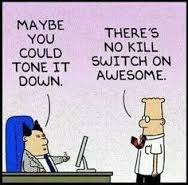
dilbert-feedbackIt’s a new year. With another trip around the sun completed and ahead, we mortals often go to our cabinets to withdraw the long-procrastinated projects we someday hope to deploy. In that revitalized spirit of invention, people often ask me for my opinion on this or that idea. Often it’s a start-up business idea. Sometimes it’s an investment opportunity. Occasionally it’s a request for feedback on a manuscript. I’m sure you’ve been asked to be a sounding board for similar notions and found yourself in a similarly awkward situation.

“Hey, mind if I bounce something off you?”

I usually respond, “Why do you ask?”

You may ask yourself, Why does he ask the question “Why do you ask?”

My question to your question is born of its own overarching question: Do you really want feedback, or do you just want me to tell you that what you are pitching is wonderful?

Yeah, you’ve been there. It’s a tough place to be, because it’s impossible to be sure what the other person is actually seeking. Is the seeker in need of a boost of self-esteem, where anything critical you offer is likely to triple that person’s therapy bills and end a rebound before it finds form? Is the pitch-person stealth-seeking your financial commitment, where any positive response on your behalf will be followed by a deal memo solicitation at a valuation that would make the Uber people blush? Is the ask truly heartfelt but the work so early and unedited that it could be more harmed than helped by a random response?

It’s not easy to offer an opinion on someone else’s work. Way more can go wrong than can go right.

I tend to find that most people who ask for my opinion don’t really want feedback. They want validation. If you’ve partaken in-depth of the creative process, you know they aren’t the same. Validation is net neutral. Feedback can save your ass.

What do I mean by that?

Validation is a bifurcated switch. If I say the work is good, you’ve heard all you need to hear. If I say I don’t think it’s good, you’ve heard exactly what you didn’t want to hear. The effect is net neutral because either way I have added no value to your project. If I say it’s good, so what? You already thought it was good or you wouldn’t have shown it to me, so I’ve done nothing but increased your standing bias. That takes you nowhere you couldn’t have gone without me. If I say it’s bad, we may no longer be friends, not because I don’t want to be friends but by being honest (even if diplomatic) I have likely hurt your feelings. There isn’t much positive energy that can follow.

If feedback is what you seek and I have any grounded expertise to offer, then perhaps we have a place to go together. That feedback is almost certainly going to be nuanced (“this part makes some sense, that part not so much”) but it has to come your way without consequence to me or expectation of a secondary agenda that involves me. If I want to get involved, I promise I will let you know, but the act of giving you feedback should be reward in itself. That means you have to enter into the feedback discussion with an openness to critique solely because you want your idea to improve, or perhaps decide instead you don’t want to waste any more time on it. There can be no ulterior motives or it’s not feedback, it’s evaluation. I don’t want to evaluate your work. That’s your job, not mine.

As an author, I seek feedback constantly. When I draft something, I always go out for feedback from a broad sample of demographics. When I get good feedback it can be life-changing, because anything that I have missed and you found I can fix. Is it painful? It’s horribly painful. Yet even worse than negative feedback is the silence of no feedback from someone who said they would offer it. That tells me with uncanny certainty that I have failed to connect with their voice. Do I regret asking? Never for a moment.

As much as we dread feedback, we actually should cherish it, because it is the only path from mediocrity to something that matters. The creative process is laden with setbacks, but each time we find a nugget of corrective action, we can improve. That’s what makes the creative process both daunting and healing. It is the reality of success quantified one fix at a time. It’s never fun to edit away what doesn’t work, but that’s how innovation at its finest evolves. There are no shortcuts. If you ask, be sure you want to listen for the answer. It may not be pleasant, like medicine, but hopefully it makes us better one way or another, if it’s the right medicine.

Most people don’t know how to give useful feedback, especially tough feedback that can help us improve our thinking or channel it to more productive ends. Words of validation or invalidation are relatively easy to render and equally useless. Offering consistently constructive feedback is an art. Be careful whom you ask to help you, or you can really go astray.

If you don’t want feedback, don’t ask for it. If you ask for it, don’t be defensive when you get it. If you don’t ask for it, you probably will never reach your potential. If you do embrace it, you can make a small idea become a big idea. A big idea becomes something tangible when we add the necessary recourses and fight past the objections readily available from amateurs. Those who embrace feedback are resilient by nature. There is power in vulnerability. Embrace it, and the sky is the limit.

Do you still want my opinion? I don’t mind if you say no, but if you ask carefully, I’ll try to answer in the same honest spirit.

# # #

Author’s End Note: It’s been hard to write about anything other than Trump the past year. I am still aghast at what has happened, but I am forcing myself back into more diverse subject matter as sanity demands. With my third book now in first draft and about to go into the editing process, I find my love of words never more pronounced, but never more conflicted. It’s hard to write about normal subjects in a world where nothing I once considered normal ever will be again. It is impossible to think about characters more outrageous than the strange ones emerging on the stage of reality. Regardless, I am committed to diversifying my output in continuing this creative journey we began together. I’ll still write about Trump when I must, but I promise you I will pursue more interesting material, if only to prove that he hasn’t won. Stay with me, and I’ll stay with you.

____________

This article originally appeared on The Good Men Project.

Image: Dilbert.com ©Scott Adams

3 Paths to Adulthood

Transitional Independent Living Program

I’d like you to think for a moment about the last homeless person you happened to encounter. Ask yourself: What was his or her story? Do you know?

Now I’d like you to think about the last 18 to 21 year-old you met in any walk of life — from a middle class or wealthy family, any high school grad will do. Ask yourself: Was this young adult ready to go out into the world completely on his or her own? Do you know?

Now consider that every year our foster care system emancipates thousands of 18 year-olds, presenting them with the rights and responsibilities of full independent adulthood. They are on their own to go to college, get a job, find an apartment, obtain credit, feed themselves, clothe themselves, seek medical care and insurance, all of the things that you and I learned to do over a period of time that likely transcended our 18th birthdays.

What do you think the chances are that a young adult released from the foster care system can sign a lease without credit, get a job without references, obtain medical insurance without an address, or attend college without a bank account? If you answered “not very good,” you’re starting to get the picture.

What happens if that 18 to 21 year-old goes out into the world without any support system of any kind? Imagine the worst because that’s what happens. Nowhere to live, no legal income, no reason to worry about the future because all that matters is surviving the present — will hungry, cold, isolated people do desperate and horrible things if the only thing that matters is surviving the present and no one cares if they make it through the day? You bet they will. You and I would, too.

Now I would like you to look at the faces in the picture at the top of this page. These are some of the participants and staff in the current cohort of the Transitional Independent Living Program (TILP) at Hathaway-Sycamores Child and Family Services. Yeah, that sometime city slicker in the cowboy hat on the right is yours truly hosting the 8th Annual Celebrating Children Gala we recently held at the Autry Museum of the American West. We raised about $200,000 to support this program. The rest of the smiling faces are young adults who will not be homeless and the staff who guide them to independence. With our love and assistance, these wonderful people will further their education, get their first apartment, find employment, and build a foundation that will keep them independent for a lifetime.

Need some further convincing? Watch the video below. You will see specifically how “3 Paths to Adulthood” helped three exemplary individuals navigate from negativity to optimism. Their stories are the narratives of three strong people who didn’t become homeless and never will. Their stories are unfolding like yours and mine. They are making their way through life on their own. They have dreams, they have families, and they have hope. They stand on their feet with pride and humility. They shake your hand and look you in the eye as a peer. One just bought a home!

They make me smile and they make me cry. If only we could help more people like them, we wouldn’t see nearly as many homeless people on the street. We could play a role in their lives and alter each story for the better. Their stories will always be their own, but we would be a small part of them and they would never forget us. We would never forget them.

We have a choice: Help bridge the gap between age 18 and 21 where government assistance is not available, or let these young adults tackle the immense difficulties of our world on their own and fail as any of us would. It’s not hard to understand why our TILP is vital and in the community’s interest. It makes economic sense. It makes human sense. It takes a story with an otherwise cruel outcome and turns it into a happy ending for everyone involved.

It doesn’t happen without a lot of hard work and commitment, but it happens. That’s why we held this year’s Celebrating Children to bolster this mission and attack homelessness through proactive guidance and direction. It’s much less expensive than getting someone off the street, and much more sustainable for an entire lifetime. It works. Watch the video! I promise you it works.

If you’d like to join in supporting our work please visit Hathaway-Sycamores.org.

And the next time you see a homeless person, take a moment and ask for his or her story. You might be surprised to learn they didn’t have to be on the street. Most of the time, they simply couldn’t find another path. We’ll help them as well, but let’s start by keeping them off the street. We know how to do that. Really, we do.

_____

This article originally appeared on The Good Men Project.

The Many Lessons of Andy Grove

Time 1997We lost a great business leader earlier this year. His name was Andrew S. Grove, known to many as Andy Grove.

He survived Nazi-occupied Hungary as a child, then Soviet-controlled Hungary, immigrating to the United States at the age of 20 in 1956.

He received a Ph.D. in chemical engineering from U.C. Berkeley and became a star engineer at Fairchild Semiconductor.

He left the stability of Fairchild Semiconductor with Silicon Valley legends Robert Noyce and Gordon Moore when they co-founded Intel. Together they later entirely reinvented Intel from a manufacturer of memory chips to the dominant producer of microprocessors.

He was Intel’s CEO from 1987 to 1998, the famous “Intel Inside” years when personal computing exploded from the hobby to the consumer market.

He wrote the legendary book Only the Paranoid Survive, published in 1996 and still a must-read for anyone who wants to understand innovation and the power of creative destruction.

For many years he co-taught a course in strategy with my dear friend Robert Burgelman at the Stanford Graduate School of Business.

If you think everyday people always had the internet, email, streaming video, and smart phones, you have a loose grasp on current events, let alone history. Andy’s leadership at Intel took us from the 8086 to the Pentium chip, from monochrome to color displays, from floppy to CD disks, from no hard drive to software that could be installed.  If you didn’t live through the transformation of the universe from analog to digital, from buying hardware and software at Computerland and Electronics Boutique to Best Buy and Costco, it’s hard to explain the magnitude of this growth cycle. Andy is one of those guys who really changed the world.

Okay, you get the point, about 0.001% of mortal beings have a resume close to his. You can read his full bio on Wikipedia. I want to share something more personal about him, the key takeaways from the few times I met him in person during roadmap briefings at Intel in the 1990s. Among the many lessons I learned from Andy Grove, here are five that continue to guide me daily:

  1. Creative Destruction Is Real – Whatever product you ship today is already obsolete, no matter how well it is selling. If you are not working on the replacement for it, someone else is. That is why you have to be paranoid. You will always be correct if you presume you are about to be outperformed in the marketplace of goods and service. Never get comfortable, never rest on your laurels, or you will be gone in a heartbeat, wiped off the map while you are collecting your awards for last year’s success. I learned from Andy that almost every startup that presumes it is built to last is almost certainly on a crash course with obsolescence, that the vast majority of even robust corporations today last about half as long as a human life. Companies don’t reinvent themselves, they are reinvented by courageous, visionary people.
  2. Beware the Strategic Inflection Point – By the time a market has fully morphed at scale, it’s way too late to react. You can’t see a strategic inflection point coming, you can only acknowledge it in hindsight while confessing your memoirs. Sorry, Monsieur Business Plan, the landscape changes in real time! Because you have learned to be paranoid, you are going to figure out one dreary morning that something you are doing in your company is hugely wrong. Some product you are readying for release is going to tank no matter how much you spend on marketing. Remember when Bill Gates discovered the internet? Remember when Mark Zuckerberg discovered mobile? Those were Intel-inspired moments. They turned their companies on a dime the same way Andy helped turn Intel on a dime when they realized the market for memory chips had commoditized and microprocessors were the way forward. I learned from Andy to always remain nimble, that sunk cost is always sunk cost, eat it and move on. Achieving competitive advantage before others see it coming is where your investments must be all the time.
  3. Science Is Inescapable – No matter what your market cap might be, you can’t fake math. Pithy slogans don’t make better computers, engineers do. For Moore’s Law to work (roughly twice the computing power will be available every 12 to 24 months for the same cost) staggering volumes of calculations have to take place on a tiny silicon chip without the transistors melting down. If you want to win at the engineering game, it takes the boldest and brightest team of advanced engineers you can assemble. They need the time to do the math, which is why Intel was already designing the 486 chip while shipping the 286. You can’t predict when the equations will be solved, you can only form a thesis and test your working models until they clear quality assurance. I learned from Andy that there are no sustainable shortcuts in quantifiable outcomes, the minimum viable product be damned! If you try to cheap your way through a poorly constructed algorithm, science will have its way with you and the result won’t be a proud moment.
  4. Constructive Confrontation Works – A lot of people who didn’t grow up in the Intel culture found it an impossible place to survive. Intel was a place where undisciplined, random conversation was never the norm. Almost anything anyone said could be challenged directly and aggressively by anyone in the hierarchy. Even when you were visiting Intel as a channel partner, anything you said could get shoved down your throat as instantly as you said it. Was this nice? It wasn’t meant to be nice. It was meant to improve products, driving ceaselessly toward unattainable perfection. That was how Intel maintained design and manufacturing leadership for a generation, by always challenging assumptions, never accepting compromise or forging an unholy consensus simply to move on. It isn’t the right culture for everyone, but at Intel, you bought into it or got your walking papers. I learned from Andy that in constructive confrontation, it’s always the idea that gets attacked and never the person. You might feel that you are being attacked, but you aren’t. Your ideas are being made better or mercifully eviscerated.
  5. Resilience Is a Mandate – Imagine a guy who made it from the Holocaust to the highest level of American thought leadership—all the obstacles, all the challenges, all the knock-downs, all the reinvention. To embrace the example of Andy Grove is to embrace the notion of resilience as the single greatest motivator available to anyone at any stage of emergence. You don’t give up, you don’t give in, you don’t quit. You always expect more from yourself. You learn from your mistakes, you study your failures, you learn from your adversaries. Want to survive? Want to triumph? Want to leave a legacy? There is no other way. I learned from Andy that you stay in the game, you look forward at opportunity, and you try again—only harder. Resilience isn’t a nice-to-have. Resilience is fuel for the soul.

Andy was a living example of realizing possibility through discipline. It is extremely rare to find an innovator with startup DNA who can personally evolve into the CEO of a multinational corporation. It is equally rare to find a top-notch engineer who embraces consumer marketing as a key strategic initiative. Andy championed the “Intel Inside” campaign as a branding mechanism that made an otherwise invisible component a necessity for personal computer manufactures to tout. When the consumer press seized upon an obscure failing in a sample of Intel microprocessors, Andy accepted the criticism as a byproduct of his brand promise. He insisted his team correct the deficiency with renewed quality assurance rather than defend the company’s position with arguments the consumer would never understand. He was book smart, business smart, and street smart all at the same time. He gave back way more than he ever took off the table in every way imaginable.

If you ever worked on one of my teams, I probably bought you a copy of Only the Paranoid Survive and quizzed you on it a week later. Andy’s words, thoughts, and ideas remain that important to me. He was an industry icon and a human being impossible for me to forget. I hope none of us ever forgets Andy. He remains a truly one-of-a-kind inspiration.

_____

This article originally appeared on The Good Men Project.

Photo: Time Inc.