Public Service Made Customer Service

Earlier this year on The Daily Show, Jon Stewart asked Nancy Pelosi a rather awkward question: In effect, can our government still do big things? She never really answered the question, which was also kind of awkward. I don’t think she saw it coming. He was really probing into the nature of government competence and our ability to trust elected, appointed, and civil service employees to be great at their jobs and exceed our expectations. It was not meant to be a partisan question, but somehow that’s where it went, which sort of ducked the broader concern, which sort of reinforced his critique.

Like I said, it was awkward, and it got me thinking, why should the output of government services–or public service–not be subject to the same expectations of for-profit customer service? I have been chewing on this for weeks, and I can’t come up with a decent response. I serve in a volunteer role in local government, so I guess that makes me part of the problem, but it also drives me to be part of the solution.

The obvious retort will be that absent the free market and competition, any single point option will more than likely descend into mediocrity as a result of monopoly and entrenchment. I don’t think it’s that simple, because for-profit and non-profit enterprises are both constantly under attack by creative destruction, which when ignored is an equally powerful remedy to mediocrity. Improved methods will obviate the obsolete; it is only a matter of time and catalyst.

Global EntryThis past month I experienced a pleasantly opposite case, where public service did exceed my expectations–with expedience, practicality, and cordial handling. I applied for Global Entry, the Trusted Traveler Network administered by the U.S. Customs and Border Protection Agency. I went to their website, filled out the form in less than half an hour, was promptly notified online of conditional approval, and asked to sign up for an in-person interview at LAX. I quickly discovered there was a three-month wait for an interview, but the site suggested I check back frequently online for a cancellation. I got one within 48 hours for an appointment the same month, went to the interview, was promptly welcomed upon arrival (I was early and they took me when I got there), and ten minutes later I was fingerprinted and done. I was approved online that afternoon. Perfect.

This was exemplary customer service in action. It was almost as if Border Patrol had set out to prove that customer service was still possible within our government where there is an expressed commitment to make it so. They have my applause. I don’t know if I can award them my future business or ongoing loyalty given their scope of offerings, but just like writing a positive restaurant review on Yelp, I am giving them the loudest shout-out I can in as public a forum as I can, which is how the customer service game pays back winners with referrals.

I couldn’t help but compare and contrast that with several other recent observations of public service that simply haven’t embraced that ethos:

HealthCare.Gov – I usually focus on the broader issues of healthcare, which matter more to me than a broken website, but like Jon Stewart in the Nancy Pelosi interview, let’s focus for a moment on the website fiasco. Not only didn’t it work, not only was it impossible to navigate even when it did work, those in charge of deploying it allowed themselves to get fleeced by private-sector contractors. When you run a business with customer service in mind, you are compelled to keep your costs low and be a subject-matter expert before you offer service paid for by your customers. We are the customers of HealthCare.gov. We overpaid and we got a poor experience. Not good customer service.

Jury Duty – It makes us shiver, but it should make us proud. Anyone who gets the notice in the mail immediately starts to hedge, not because they don’t want to perform public service, but because our historic experience of this form of public service is that it is wildly inefficient. How long ago was this antiquated system designed, where you sit in a room all day doing nothing, waiting to be called or released? Yes, it has improved modestly with online registration and log-in, but when I recently spent a full day in a room of 125 people doing nothing of value, and fewer than two dozen of us were used at all, I wondered how it was possible to justify the lost productivity of 100 people times 8 hours, or 800 person-hours gone up in smoke in just the room I sat. It’s so wrong that no sustainable business could ever tolerate it, nor pay for it. If you want me to provide public service, start by seeing me as your customer and commit to process engineering so that my participation is truly of value.

Governor Christie’s Off-the Ranch-Staff – There’s a reason the obscene obstruction of a New Jersey bridge continues to ride the headlines, and it’s not just politics as usual. I use the word obscene purposefully, because using any position of public authority to harm rather than help a constituency goes against everything our democracy represents. When a public servant forgets that his or her salary is paid by the people and not the political party, all bets are off. Maybe there should be a slightly tweaked Hippocratic Oath in government: “First do no malfeasance.” If you go to work with full acknowledgment that you are in public service and your job is to provide customer service to those forking over the dollars for your gig, you couldn’t pull the trigger on anything like this, look yourself in the mirror, and say. “I did what I was supposed to do today.” When you do harm for personal gain, you add no value. You make a mockery of the privilege of serving those who trusted you.

When I was kicking around some of the themes for this post on my Facebook page as I often do before writing a new article, someone posted on my news-feed that it was a silly use of my time to write about stuff like this, because it never changes. Private-sector contractors will fleece the government, no one in the court system cares if they waste our time, and politicians will always use their power to reinforce their authority. I don’t think that’s true, and my experience with Global Entry is proof that we can do better if we make it a goal.

If we refocus the orientation of public service to be around customer service, it de facto has to improve. Perhaps more importantly, if we don’t keep tabs on the kinds of small to medium items called out here, how can we possibly have faith in the really big stuff entrusted to government: national security, fiscal solvency, social justice, and the like. There has to be a service model underlying all these tasks, subject to scrutiny, objective benchmarking, and listening to the customer. No, we’re not going to vote on what constitutes a valid TSA safety post or police DUI checkpoint, but we should always expect to be treated with courtesy when authority is surrendered for the greater good. Authority should be enacted with reason, humility, and respect so that it wins our buy-in and loyalty. Our aim should be to inspire all contributors to do their finest work all the time, to demand it of themselves as an absolute, to seek constant improvement of systems, teams, and individuals.

Think about it: virtually every customer-facing business now asks you to rate every experience you have with them, and the smart ones deploy this feedback almost in real-time to win competitive advantage. Start rating your experiences with public-service agencies, whether they request it or not, and not just at election time. Demand better and we will get it, maybe not in real-time, but sooner or later creative destruction does its job and washes away the ancient with one flavor or another of much celebrated reform.

And don’t forget to say Thank You when you catch someone doing something right. Everyone likes to get a thumbs up when it’s earned!

On a Mission or Just Staying Awake

One of the themes I explore in my forthcoming debut novel, This is Rage, is the notion of motivation.  This is a subject I hold dear, and one I focus on a great deal in the executive coaching workshop I co-lead with John Vercelli.

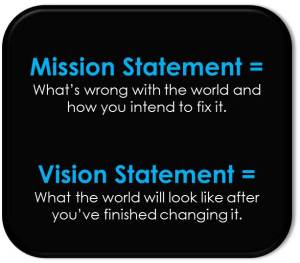
mission-statement-vs-vision-statementIf all a mission statement is meant to do is fill a half page in your human resources handbook, it is probably not worth the time to write it down.  One of my former teachers and board members used to say he had a vision of all the great mission statements in the world collected in a single volume, and there could be no possible better bedtime sleeping remedy than trying to force oneself through those pages with one’s eyelids open.  Again I agree, if a mission is just a string of words — Buzzword Bingo without a juicy prize — it will not motivate, but let’s consider a few potential examples of applying a personal leadership mission in attempting to inspire a team.

Here are three choices I offer participants in the workshop, all of which we’ve heard in some variation, from the absurdly failing to the boldly aspirational:

Choice 1:

To make this department much more efficient and profitable!

Choice 2:

To overcome market forces and prevail over our competition!

Choice 3:

To provide my team with the support and resources they need, to the very best of my ability, to collaborate and do the very best work of their careers.

My response to Choice 1:

Not gonna inspire, management by fear is so not cool.

My response to Choice 2:

You’re starting to get my attention, through an occasional yawn.

My response to Choice 3:

I’d build you a log cabin in the arctic if you asked me.

Call me an optimist; people like to be inspired.  It’s not a sleight of hand.  Real leadership means rallying people around a cause, to subordinate their own personal quirks to the shared agenda adopted.  The leader’s job is to create the environment for sharing.

Is it the business leader’s job to make her or his department more efficient and profitable?  Do we really need to ask?  It goes without saying, so don’t seek glory in the obvious.  Is it the business leader’s job to respond to market forces and win market share from the competition?  Once more I ask, where’s the question?  Any answer to this presupposes a complete lack of faith in the common sense of why we are employed by our company and not another.  Is it the business leader’s job to rally, help, support, test, and muster the collective wisdom of those assembled to form a team and work together?  That should be just as obvious, but try saying it aloud and look at the surprised gazing around you.  That’s what people want to hear.  Uttering the manifesto is the first step toward building trust and accomplishing the impossible.  True, it’s just the first step, and trust is easily shattered when actions upend words.  Yet it’s an important step, and it does fire up hearts and minds much in advance of a spreadsheet.

It also connotes vulnerability — to the very best of my ability — which again is all in fact you can ever do.  Not proclaiming more makes you human, perhaps a form of life other people are more willing to follow.  Be honest, not only about what you can do, but in admitting that you are not de facto possessive of superpowers.  Try it out, it just might give you superpowers.

In my novel, a few clever and powerful people are trying to make a whole lot of money.  That is not a bad thing, until they forget that how you make the money is the difference between taking along a deserving set of others and leaving almost all of them behind.  Most of the people in the story just want to do their jobs, to find a way to love their jobs, to shake off the demoralization that has come from the illogical separation between task and income.  When a job is a paycheck, you don’t need a mission statement or real leadership, you just keep your head low and get through the day.  When a job is about something more, it’s still a paycheck — we all need a paycheck — but the purpose of the work is a much more substantial driver, creating better outcomes and better paydays.  Improved business comes from more engaged employees, and getting those employees engaged is a soft skill that in the hands of a master can conquer most obstacles.  That’s when work is fun, when we believe in something, when we believe in the leaders and their values and their rallying cries and we choose to be a part of innovation’s path.

The promise of the start-up is to build something new with heartfelt values at its core, and in closely held companies at modest scale it is much easier for founders to maintain the kind of personal mission and creative culture that reflects this entrepreneurial DNA.  When an exceptional start-up enters a period of hyper growth, hands on sustenance of idealized culture becomes considerably more difficult.  Should the start-up go public, it too easily can take on the shape and form of the goliaths it sought not to be, and then the challenge of maintaining a mission grounded in shared values is often put on trial.  The disconnect between what was innocently envisioned and what inertia morphs can be terribly upsetting to the grasping loyals, who hold their idealism in longing, hoping at length for the pledge to retake honest meaning.

Still it is important to remember than the personal leadership mission can endure.  Indeed it might be less than a grand corporate mission statement, but I believe conviction is almost always within a business leader’s reach at all levels of an organization.  Committing to a personal leadership mission is a choice — a brave choice with its own risk — and while rare, a good one in the spirit of Choice 3 has a decent shot at creating significantly more employee engagement and long-term value than the other two slug lines.  It’s all a matter of executive style, setting a tone for the broadest possible positive, tangible outcomes.

It is too easy to check out, and once people check out, try getting them to check back in.  As my story compounds, an awful lot of people check out — because they don’t feel valued, because they don’t feel inspired, because they see what they do each day as separate and divorced from the actual process that creates income for the business and value for the shareholders.  Tie those pieces back together and real innovation comes a good deal more naturally.

Leadership is not so much a word as a behavior, a walking example of what it means to be intertwined with the enterprise.  It does begin with words, words that are grounded, words that do something.  Choose those words carefully, lead by example, motivate by inclusion, dole out support without reservation.

You want to keep things humming, make it a little less comfortable and a little more complicated — for yourself, not those you guide.  In the book, I take you to the extremes of this world view, heroic and cowardly and all that binds the spectrum.  The words did not come easily to me, but I committed myself to resilience and found them over time.  You can, too.

The 70% – Part 2

EngagementHierarchyIn the Executive Coaching Workshop I co-lead with John Vercelli for Coaches Training Institute, we discuss early in the curriculum the pervasive epidemic of Bad Boss Syndrome.  It is jaw-dropping how many employees reflect on the lack of leadership and vision they receive from those who manage them, how starved they are for inspiration, and how little it takes to turn a bad day into a good day.  When you think about the study published recently by Gallup noting that 70% of employees are disengaged — and that too many of them hate their jobs — boss improvement is a good place to start.

Another good place to start is the Dead Brand Graveyard, where we also focus in the workshop.  Surely some brands die purposefully in mergers and consolidations, but my observation is that many more die because they break their promise to their customers, who simply move on.  In a world of virtually unlimited customer choice, when a company fails to innovate or repeatedly breaks a brand promise, the Dead Brand Graveyard is soon to cement a new tombstone.  For the employees who are part of the letdown, the lost promise, and ultimately the job loss that follows, demoralization is readily understood.  Remember, a lot of these employees came to their companies with hope and passion and energy and ideas.  They may have had the solutions to their company’s death sentence on their desktops.  Perhaps no one was listening.  That takes us right back to Bad Boss Land.  It’s an infinite loop.

Let’s pull these two concepts together — bad bosses and dying brands — and then think about the twelve Gallup questions which you can find in last week’s post, Part 1 of this inquiry.  None of the questions involve compensation.  They ask things like whether individuals have the opportunity to do what they do best, whether their supervisor cares about them or their advancement, whether the mission or purpose of their company is understood and they are part of something that matters, whether there is a commitment to quality in the workplace, and whether there are peers or leaders in the environment who are supportive.

Human stuff, huh?  HR mush?  Not the stuff of hard-won profit and loss?  Garbage!  If companies have it so right, why are brands evaporating from the landscape in record time?  Why are fully capitalized companies lasting half as long as the average human lifespan?  Creative destruction, you say, the natural course of things business?  Well, sure, I’ll give you that.  So is top management willing to say the whole Circle of Life is out of their hands and the survival of the enterprise is entirely up to market forces, to fate rather than strategy, to a competitor’s campaign rather than a driven response to galvanizing the single most important asset in the company’s inventory, the intellectual capital that is allowed to rest idle and fester?

That’s not very optimistic.  And yet, optimism is the spirit that drives opportunity, and opportunity is the backbone of capitalist enterprise.

Why do we so often get this so completely wrong?  Why would we let 70% of employees churn in the ranks, angry and sad and defeated?  Why would anyone allow a brand to go stale, to break a promise to a customer, to fail to reinvent itself when invention is the lifeblood of all revenue and profit growth?  Borders, Circuit City, Kodak, Polaroid, Palm — all once admired companies, all with revered brands — what do you suspect the internal opinions were of management as repositioning opportunities were missed and tired product performance spiraled downward?

Much has been written about short-term versus long-term financial incentives as value destroying tactics, particularly among senior management at the top of the compensation bell curve.  That is only part of the problem.  Certainly if you set a sales target for a commission based or stocky savvy executive, she or he will chase that goal aggressively, often with widespread collateral damage.  Yet is it the incentive that is the time bomb, or the misperception on the individual’s part of the fundamental rewards that may or may not be at hand?  To that end, I mentioned that the Gallup poll does not reference compensation.  I would be willing to bet Big Money that the disengagement factor cuts across every salary band in the spectrum.  It is my own observation that once you get past basic human needs being met — housing, food, safety, decent educational opportunities for the kids and maybe a family vacation now and again — there is no guarantee whatsoever that financial reward brings vast job satisfaction.  I have met as many or more unhappy wealthy people as I have in the middle class.  The tendency to focus on the wrong motivation is not exclusive to the underpaid or overpaid, and the failure to align truly rewarding incentives with human performance is almost always the difference between long brand life and flash in pan cash register rings.

When I hear that 70% of employees are disengaged, and when I see brands and companies dying in record time, I experience one story.  We try hard to focus the executive coaching mission on revitalizing the human potential in an organization, to bring the executive’s focus back to the brand promise, and to evangelize that set of values broadly among the members of a team as a rallying cry.

I see three major factors that matter in a job — what you do, who you do it for and with, and the compensation you receive for what you give.  If the first two mandates of that string aren’t met, it seems ludicrous to believe that compensation is going to make up for the loss.  And if the only thing that people are focusing on is compensation, what real chance does that company have at longevity?  A brand will not be reinvented because it needs to be more profitable; it will be the magnet of innovation because people care about it and bond together to transform it into something it currently is not because it matters.  From that investment of idealism will flow vast improvements in continuing profitability.

Short-term harvesting of any cash cow is possible — if you want to squeeze profits, go ahead and squeeze the people who are producing them.  At the moment 70% of those people are telling you they don’t like what they are doing or who they are doing it for.  Want to make the Big Money that lasts the long run?  The Gallup survey tells you in the questions alone where we’re leaving the Big Money on the table.  Start Thinking Different!

Bosses must learn to listen.  Employees need to teach their bosses to listen so they can be heard and emerge.  Coaching can be implicit or explicit, but it has to be obvious that letting ideas flow not only improves morale, it is vital to sustaining the enterprise.  Companies that last do so because they apply long-term strategies, both in terms of bolstering their brands and employee engagement.  Everyone can win — especially customers — if that’s the walk that leadership walks, leadership by example.  It does not happen accidentally, but by commitment, and constant reminder of core values that can be shared.

For me, it will always be People, Products, Profits — In That Order.

The 70% – Part 1

Gallup Logo 2A Gallup study released last week on the State of the American Workplace reported that 70% of American workers are disengaged in their jobs. An extraordinary number of these people convey that they hate going to work for their employers. Here we are, ostensibly emerging at long last from The Great Recession, and yet, this is how a frightening majority of employed individuals are reported to feel.

Sound impossible?

Try it on yourself.

Here is the twelve question survey Gallup used to measure employee engagement, from Page 19 of the published report:

1) I know what is expected of me at work.

2) I have the materials and equipment I need to do my work right.

3) At work, I have the opportunity to do what I do best every day.

4) In the last seven days, I have received recognition or praise for doing good work.

5) My supervisor, or someone at work, seems to care about me as a person.

6) There is someone at work who encourages my development.

7) At work, my opinions seem to count.

8) The mission or purpose of my company makes me feel my job is important.

9) My associates or fellow employees are committed to doing quality work.

10) I have a best friend at work.

11) In the last six months, someone at work has talked to me about my progress.

12) This last year, I have had opportunities at work to learn and grow.

I will be writing a good deal more about my thoughts on this in the coming weeks. In fact, as mentioned often here I have written a novel on this theme that will be published this fall (October 2013) by The Story Plant. Before I offer some of my opinions on the topic in a subsequent post, I wanted you to have the opportunity to ask yourselves the Gallup poll questions. Be honest, internalize the answers over some quiet time, think about your own sense of employee morale, then draw your own conclusions.

Are you in the 70%? I sure hope not. If you are disengaged, try to boil it down to the essence of what is eating at you. I’m guessing you already know.

Wow, 70%. Imagine how much creativity, passion, energy, and enthusiasm is waiting to be unleashed in all that humanity. Now there’s a problem that’s worth solving. And you know what, it is completely solvable, if that becomes a shared value.

What’s the solution?

Start with the questions.