Dynamic Duos

The Toughest “Soft Call” You’re Likely to Make
by Ken Goldstein
First in a Series of Ten

You’re going into the roughest, toughest, most ruthless, unending, dirty, nasty, few-rules-everything-at-risk, energy-consuming and only momentarily gladdening bash up fight of your life.  It’s called your career.

Who do you want in your corner?

You train, you study, you fight your way up the ranks, but somewhere along the way you make a choice that you don’t even realize is going to have significant impact and maybe determine your outcomes in those fights — your life partner.  Boyfriend, girlfriend, spouse, domestic partner, husband, wife, call him or her what you want.  You make this choice for romantic reasons, for family reasons, for selfless reasons, for religious reasons.  Do you make this choice for business reasons?

Well, I suppose there are people who are that calculating, in the olden days some folks talked about “marrying up” and such, but that’s not what I am talking about here.  I am not at all talking about making a political call to better your career by making business value part of your criteria of choice.  I am not even suggesting you must have someone in your corner, that may not be your style, and that might be a great choice.  My point here is if you have the wrong life partner on any number of levels, if you and your partner pick each other without enough thought and are not where you should be, it is going to be mighty difficult to fight the battles ahead.  I am sure fighters can go into a title match without anyone in their corner, but that certainly would be a lonely place to look each time the bell rang.

Successful business executives Sharon Meers and Joanna Strober (turned authors!) cover multiple aspects of this complex topic — practical and advisory — in their extraordinary book:
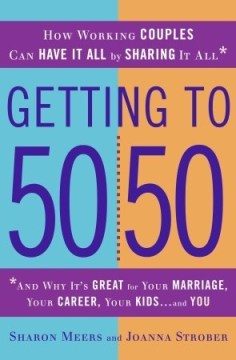
Getting to 50/50

Getting to 50-50 by Sharon Meers and Joanna StroberThey have conducted significant academic research with dual working couples and found unending common themes that lead to success and lack of such in personal and professional circumstances.  For me, the key takeaway was the concept of being mutually supportive on an ongoing basis.  This would seem like such a simple working premise, but think about it, how many couples do you know where both partners are equally supportive of the dreams, visions, hopes, challenges, and aspirations of the other, whatever they might be, and however they may evolve and change?  We may praise this activity when we see it and think how wonderful it is for making the happy home, but the equal observation is that it makes for the same success in the workplace.

You might believe in yourself at any given time, but when that sucker punch comes and you are on your back looking up at the little birdies going around your head and the referee getting close to 10 on the count, who is going to make sure you are back on your feet?  You?  Well, you are going to have to get the feet under you, surely that’s your problem.  But you’ve just taken a hard hit to the head, perhaps even a sneaky baseball bat.  Could be your confidence is shaken, your values are confused, or you’re just lost and dizzy and can’t find your way back to arena.  When someone believes in you more than you believe in yourself, you will go back, every single time, and the simple act of going back is an act of winning.  Likewise, when you offer the same selfless encouragement to someone day after day, you grow stronger, smarter, more focused, and better at what you do, no more what it is you do.  It absolutely must go both ways or it does not work.

Believe in someone 100% all the time, help them with their strengths and weaknesses, and receive the same encouragement in return and you have every chance at success.  Blow this off at your own peril.  Let in someone who doesn’t really believe in you and the chances of that being a self-fulfilling prophecy become frighteningly tangible.

Give and get, learn and teach, share the lessons and overcome the obstacles.  If someone is going to be in your corner and you in theirs, the fight will be a lot less scary.

What I’d Wish I’d Known

Ten Tips Now for Then
by Ken Goldstein

About a year ago I was asked to give a talk to a group of high school seniors with aspirations to pursue entrepreneurial careers.  I though at length about when I could tell a bunch of young men and women who hadn’t even left home yet, in a voice they might actually hear and not ignore.

The path I picked was a series of tidbits that I wish I had known at their age, that might have made the next thirty years a bit easier to navigate.  My thinking was that if they only remembered one of the ten for even the next few years of their lives, the talk would have been successful.  I invited them to contact me any time and let me know how it was going, and a few have been in touch.

I thought I would d share the summary of the those ten tidbits here, and then over the next few weeks riff on each with a bit of cake under the frosting.  Understand that these have been borrowed and adapted, cut and pasted from friends, writers, bosses, and colleagues over the years, so if you smell poetic theft, you smell correctly.  I promise attribution as best I can in the follow-on entries.  These are not necessarily in order of importance, but emotional resonance at this particular moment in time.

1) The most important career decision we make is who we choose as a life partner.

2) Talent is precious — and rare — revere it!

3) The world is filled with 90 percenters — a.k.a. good enough is not good.

4) Networking is not going to parties — it’s helping as many people as we can as often as we can.

5) Investing is not the same as speculating.

6) A plan is something you have,  until you get hit.

7) Our greatest strength are our greatest weaknesses.

8) The harder you work, the luckier you get.

9) Tell people what you are going to do, then do it.

10) The journey is the reward — it will take longer, cost more, and return less than you think, so you better enjoy it.

Stay tuned for a more detail on each individual theme…

Bosses Can’t Know Everything Because No One Tells Them Anything

From Character Counts — March 21, 2011

Seven Truths for Bosses” by Michael Josephson

Michael Josephson is a wonderful commentator who focuses on ethics through his Josephson Institute in Los Angeles.  He offers short radio blasts each day which you will see me quote from time to time.  I don’t agree with everything he says, but his heart is always in the right place, and with these snippets, he does a good job of bringing complex concepts down to one minute sermons.

Here he is talking as much to the managed as the manager, creating empathy for the manager’s dilemma while keeping the manager on point with some stark statements you might call clichés, but you can’t ignore their truth.  Without hitting all seven (which you should read in the link), here’s my takeaway:

* Good communication in the workplace is harder than you think it is; without it, there is no alignment.

* The boss rarely gets the whole truth, and that is everyone’s problem, not just the boss’s nightmare.

* You can teach job skills, but you can’t teach character.

* Hiring is everything; think Casting.

* Values have to be alive and well in the workplace; lead by example and remember, it’s a marathon, not a series of sprints.

Always remember, jobs are short, relationships are long… or not.  Trust and information exchange have to go both ways, or no one wins.

In April I will be covering a series of my own snippets, hard learned bits that I originally cobbled together for some aspiring high school entrepreneurs last year.

A Civil Right and a Civil Responsibility

From Newsweek — March 21, 2011:

“How Dumb Are We?” by Andrew Romano

Tina Brown of New Yorker and Daily Beast editorial fame is now making her provocative imprint felt on the “new” Newsweek, evidenced here by summary findings in asking our fellow citizens no more than what we ask aspiring citizens.  Since my wife helps prepare many of these aspiring citizens for the same test where the stakes are slightly higher, I have some modest insight into the scope and depth of empathy here.  In the Newsweek test given to 1000 already-Americans, apparently 38% failed.

Click through and take a look at the test before you jump to the conclusion that it is just a dose of unimportant trivial pursuit.  We have to take a basic written test to get a driver’s license, but our sacred one-person one-vote widely evangelized model for democracy comes with only an age restriction.  If you can buy a six-pack of beer at the corner grocery store, even if you can’t calculate the tax in your head, you can vote.

Does this matter?  Methinks it does.  Putting aside the issue of education’s role in bettering newly arrived and long-term citizen’s quality of life as it can apply to the job force, what about the quality of the dialogue (and yes, argument) we need to share with each other to assign executive, legislative, and judicial power to individuals to collectively make the decisions on our behalf that position our nation for solving its current problems, preventing its future conflicts, and making us proud on the world stage.  How can we possibly do our civic duty of discussion and debate if we don’t have any sort of level playing field of knowledge?  We all have to somehow evidence we know the rules of the road to shift out of reverse, at least most of them, but we don’t have to evidence anything to have an opinion on public policy, it shall remain in perpetuity by our Constitution an inalienable right.

So why one set of rules for those already in the club and one for those who so desperately want to join the club?  Are we perhaps asking too much of the newbies, is the test somehow a set of trick questions meant to create a litmus test of seriousness of intent or a number controlling hurdle?  Is it perfunctory?  Or is there wisdom in making people proud of achieving a shared platform of understanding before we welcome them to the permanent pride of  this fragile experiment we call democracy?

If the conclusion one draws from my commentary here is that already-Americans should have to pass the same test to vote, that would hardly be my thinking, that is settled law.  Equally I would not want to eliminate the test for new citizens, because I have personally observed their joy in passing this test and their newfound hope and faith in a future that begins with the reward.

What I am suggesting is that if we don’t start demanding broad, honest, serious, fact-based and critical thinking models of education for every single human being as an absolute, then we’ll get what we’ll get.  We’ll keep fighting with each other, we’ll let Congress keep fighting with each other (the wrestlers change costumes but the steel cage death match remains Groundhog Day), and we’ll keep making mistakes until one day we make one that is just too serious, and our relevancy on the planet will be reversed.

We need to get very, very pissed off.  Each of our votes is one, it counts the same.  We have to have faith that everyone around us has some shared basis of decision-making or our own contribution no longer works.  One generation ago our public education was the envy of the world, we were #1 because we made it a national priority.  Today depending on you who you ask, we are #17.  Is that okay for a nation that by decree gives all power to the people?

Education is not a luxury item, it is not an option, it comes with the territory of democracy.  Without education, we will destroy the environment, the whole landscape be it cash green or forest green, literally and spiritually, and there won’t be a subsequent generation with the resources to fix it.

If we can afford doctors and lawyers and bankers and movie stars, we can afford teachers and schools and educational tools provided in a setting of peace and safety.  If we don’t think that’s important and want to leave anecdotes about ignorance to the late night comedians and midday pundits, we get what we get.  I just can’t believe on a scale of goals and priorities that an uneducated populous is what any already educated individual would find acceptable and sustainable.