Comfortably Numb, Stupidly Unashamed

I have been agonizing for weeks whether to write about Rielle Hunter.  The notion of a single additional millisecond consumed by the public on this media danse macabre peels the skin from my typing fingers.  Still I need to share a few words, less about what’s happened, more about how troubled I am with our inability to look away from the body.

Rielle Hunter is not a celebrity, except that she is.  She had a sexual relationship with a married man.  She got pregnant.  She chose to have a baby.  In all sanity, it ends there.  Give the child the slimmest chance at a sane life.  Be with the child’s father, don’t be with the child’s father, just go away quietly and be a good mom.  How hard is that?

Apparently it’s hard because there’s money at stake.  As fate would have it, the father of her child was once a party primary candidate for President of the United States, and then the ticket’s Vice Presidential candidate in a national election.  How about that.  His wife happened to have cancer at the time of both the election and the affair.  Now she has passed away.  He happened to try to hide the affair from his wife and may have crossed a few lines in doing so, enough to get him hauled into court and tried, although not convicted.  Okay, it has to end there.  Give the child a shot at any kind of normal life.  Preserve any fragment of dignity left for mom and dad.  Separate your private life from public spectacle, at least so the public does not have to disgrace itself.

Nope, there’s real money at stake.  She cannot help herself, she is cashing in.  We are letting her cash in.  She didn’t take her fifteen minutes of fame, we are giving it to her.  We cannot seem to help ourselves any more than she can.

I am not reading the book.  I am not watching the television interviews.  Ms. Hunter has nothing important to say, not a word of value will cross her lips.  Yet I can’t miss her, she’s everywhere.  Why does anyone care?  Why do we feed Piers Morgan’s hunger for this flavor of anesthesia by subscribing to it?

It’s supply and demand, free-market capitalism, 100% free speech, no law against it.  Nope, don’t want to regulate it.  Nope, don’t want to restrict it.  Completely agree.

It’s still icky.

Criticize me if you wish for condemning a book I have not read, but if this is a book, we have forgotten what it means to read.  There are an infinite number of interesting topics to ponder and curious events to discuss — the mending of our nation’s polarization, Europe’s seesaw economic outlook, interest rate fixing scandals, Wall Street arbitrage incinerating millions of dollars on derivative trades, heartening private sector innovation at wondrous new companies like SpaceX, lower gas prices for summer, a new Aaron Sorkin show on HBO, and a new novel by Kurt Andersen.

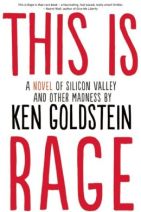
In 1992 Roger Waters produced his last solo album called Amused to Death, inspired by Neil Postman’s 1985 landmark book about the grinding impact of media on our critical thinking abilities.  It was dark, even for Roger, and it didn’t do too well.  It was about a monkey watching TV, just changing the channels on the TV, over and over, through an invasion of our planet by other-worldly creatures observing our demise, until the apocalyptic concluding refrain, “This species has amused itself to death.”  Both Postman’s book and Waters’ album preceded the commercial internet, and their observations were anything but unique.  But when I saw Rielle Hunter on her book cover staring at me from a display shelf, suggesting there could be any reason for me to buy and read her transcribed words, all I could hear was that refrain: This Species Has Amused Itself to Death.

Well, we’re still here, so not yet, right?  We can pay attention to more important things if we want, no shortage of free will to be entertained.  We all have our own ideas about what’s relevant.  News.  Politics.  Music.  Family.  Sports.  Pets.  Who’s to judge?  Does it matter that Entertainment Tonight fills a full hour following every 23 with fluff we used to dismiss as tabloid?  Is there any way that hour could be better used, perhaps to learn the name of a local candidate running for State Assembly or why Shakespeare wrote The Merchant of Venice?  Maybe not, but it’s bugging me, mostly because I once campaigned for John Edwards and believed he could have been a decent Vice President and/or President of the United States.  Now I feel ashamed — ashamed that I was ever on this bandwagon, ashamed that I was duped by lies, ashamed that he denied a child he fathered and can’t take that back, ashamed that we are still paying attention to the mother of that child.  I don’t like the way this feels, and I want it somehow, at some level, to stop.  That’s my problem.

This one notches beyond tabloid, because the clever maestro Ms. Hunter has made an active choice to compose opportunistically despite the requisite price.  She is fully aware of the stakes, the trade, the auction, and the orchestrated bait.  Still this compromise of judgment is not Rielle Hunter’s problem.  It’s not John Edwards’ problem.  This is our problem.  I am picking on them to make a point, an egregious case that is emblematic of serial apathy.  If we can’t help ourselves and just keep gobbling up this gunk,  then in an amiable daze we hand wealth to those who least deserve it, financial reward for nothing earned, nourishing amusement an abandoned aspiration.  Our thoughts turn to mush, and there we sit on the cold floor tile, trapped again in a Waters’ refrain, banging our hearts against The Wall until we are Comfortably Numb.

This species can do so much better than that.  Really, we can.

Do Books Matter Less?

Book TreasureThe pre-Socratic Greek philosopher Heraclitus was an early observer of the ever occurring change in our universe.  About the same time in the 5th Century BC, Parmenides pondered the notion of permanence, what we could presume in nature to be essential.  Between the two of them, we have a thesis and antithesis that have yet to reveal a synthesis beyond argument some 2500 years later.  We see change all around us in almost unfathomable complexity, while we wonder what we can hold onto as firm.  For me, it’s a good problem to have, as contemplation of the unsettled forces us to chew harder and argue better.

Then there are books.

In a recent Wall Street Journal piece with the header “Books That Are Never Done Being Written,” Nicholas Carr contemplates the far-ranging impact of digital distribution on long-established but fluid notions of traditional publishing:

An e-book, I realized, is far different from an old-fashioned printed one. The words in the latter stay put. In the former, the words can keep changing, at the whim of the author or anyone else with access to the source file. The endless malleability of digital writing promises to overturn a whole lot of our assumptions about publishing.

The realization that books are no more permanent than this year’s understanding of medical treatment is hardly shocking.  The very paradigm of printing on paper and binding a work has throughout its history adopted the notion of editions and revisions.  Where would the school textbook industry be without an excuse to update a classroom volume rather than allow you to feel comfortable buying a dog-eared half price two-year old version?  If we only needed one unabridged edition of the Complete Works of William Shakespeare, think of how many academic preface summaries we would have been denied annotating discovered corrections in the core text.

Yet in the worlds of literature and even political theory, we do seem to maintain an expectation that the version we read of Charles Dickens or John Stuart Mill is largely the same as the draft the author called final.  “A Tale of Two Cities” even when presented in its initial serialization was eventually finished, as was the essay “On Liberty,” and when we buy a copy of one of these today either in paperback or download, we do believe in the authenticity of replication representing if not a fully steady state, a pretty firm slice of life.  That is helpful not only in getting us all on the same page for discussion and critique, it offers us grounding in history and social evolution, the ceaseless churn emerging from deliberately placed bricks in the wall.

I have a hard time thinking today is much different, and no matter the short attention span theater that victimizes so much of our patience, my sense is our books have never been more important — no matter the brevity of their life-cycle, no matter their imposed truncation or expansion, no matter their delivery format or storage means on wood shelf or cloud server.  Our books will change as they must, but their timeliness and meditation as collective might be the primary permanence we retain, even if it is more spiritual and metaphorical than natural or physical.  The means of delivering the book does not define the book, it is largely irrelevant, itself a timely convenience worthy of disruption.  The material of delivery is subordinated to the material of substance, it is the content that matters, not the media.  The Platonic form is the ideal, and that cannot be taken from us by technology.

However we acknowledge its consumption mechanism, the book as ideal is a bridge among scattered coordinates.  We learn to read an organized set of drawn thoughts to see what is meant by change, and those who have the gift and discipline to construct a book add to the global library of permanence by carrying the torch that challenges all that came before.  Historic observation is clear and consistent: the buildings decay, the land can be conquered and utilized anew after wars and governments are gone, but the ideas underlying arts remain for examination.  The composed book is the codification of the idea however it is presented, that does not change.

My amazing wife, who is also an amazing teacher, enters her classroom on the first day with a simple statement:

“Our books are our treasures.”

Her specialty is English as a Second Language, and whether she is teaching adults or children, this mantra is always the same.  Books are precious.  If you look around our house, you might see why this is our chorus.  Books are everywhere.  That is what we want to be surrounded by.  We also have a Kindle and an iPad.  They are filled with books as well.

Another recent story in the Wall Street Journal discussed how the price of e-books was sometimes dropping below the price of “real” books which I guess means paper books, but to me, one is no less real than the other.  The broader question remaining is whether the great majority of people should still find the time for long-form written expression in a world cluttered with half-baked tidbit social media posts like this one.  The answer has to be yes, because if we are going to allow character count to trump in-depth inquiry, we condemn our more severe concerns to being adequately addressed by less than substantial narrative.  Our pace of change is only becoming more frantic, and the hope for some form of understandable permanence all the more desirable in addressing unending anxieties.  Committed writing and reading gets us a good deal of the way there, because the acts of reading and writing might be one of the few forms of permanence we can share.

I say this as someone who just spent the better part of a year writing my first book, which is now in first draft and undergoing edit.  I haven’t talked much about the book, and won’t until we get closer to publication, but let me just say that whether anyone reads it or it sells a single copy, it will remain one of my proudest achievements.  Right now it is a long book.  It will get shorter to accommodate marketing concerns, but hopefully it will still be a substantial book.  I couldn’t have said all I needed to say in a blog post or I would have.  Believe me, I would have!

In our world of constant and increasing hyper flux, books can be thought of as a noble but flawed exercise in establishing some sense of the enduring.  Now that digital publishing allows current authors easy access to further disturbing permanence, any foothold in establishing the concrete may remain even more illusive, but the stepping-stones of thought that bridge us from there to here can certainly maintain significance if we view thought as continuum, a timeline.  In that regard, as a roadmap or even a set of breadcrumbs, books for me have never been more relevant, nor the mission of authors any less permanent.  Some books are good and some are bad, some certainly more ephemeral than others, but the connectivity of books is ongoing.  Apps or facings, that is as it should be, as long as I can read.

A Great Teacher is a Gift for a Lifetime

Valerie Haas: Classically Remembered
by Ken Goldstein
Iolani School Bulletin, Fall 2010

Valerie Haas was a Master Teacher.  She was serious about her work, serious about her students, serious about the classics and their relevancy to our lives. She cared immensely about excellence, precision, continuity, and character. She was guarded, yes, but she was equally multidimensional. There was a lot to her, and if you wanted to know what that was, asking would have been a poor strategy. It was her job to teach, it was our job to learn, but it was everyone’s job to listen and care. If you got that, you got extra credit. And your life was richer for the epilogue.

Context is a variable of interpretation that is not terribly well understood or appreciated. To understand context is to put translation on par with circumstance. Surely even the most stubborn and uninterested recruits can be taught to decline a noun, but can they be taught to understand why otherwise rote memorization might one day save their curricula vitae? The simple answer is you can likely learn anything you want to learn, but the truth is, you must commit to deciphering the context of a subject or you are right back to recitation. A good teacher knows this, and lets you decide how to ascribe context to drill. A great teacher knows when you get it, and withholds just enough satisfaction that you are forced to bring reference to bear.

Just how good was Valerie Haas at this near brutal form of inspiration? My sense is that the football and basketball coaches quietly studied her classroom, but would never tell the tale. Let’s see, you have a roomful of 13 year olds who always raise their hands, enunciate clearly when called upon, share perfect tempo in choral reading, and don’t even bother to step into the classroom if late without an automatic side trip for a tardy slip. The rules are clear. And the scores? Fiftysomething years of gold, sliver, and bronze medals in national competitions, not a year missed without a student celebrated on a global scale with the words “Iolani” and “Hawaii” attached to their accolades. And remember, we are talking Latin.

But back to context. If you dared utter the words “dead language” in her second floor classroom, you were not going to have a good semester. Then again, if you asked her why it still made sense to study Latin in the late twentieth century, you would be readily introduced – for that matter metaphysically welcomed – to purposeful dialogue. Fully a third of all lessons and class discussions focused on etymology – what are the root words in English that we can track to their origins. If you wanted to survive the redlined grammatical assassination of an English or History paper, you were coming to a knife fight with a polished saber – provided of course you had mastered Latin sentence structure. If you thought poetry was tough, Cummings and Whitman had nothing on Ovid or Virgil. Connections from then to later became clear in no less than the texts of Caesar (Omnia Gallia in tres partes divisa est…”) while we also learned how Cicero laid much of the pipe necessary for Shakespeare to mold history into drama (Cicero even secured himself a bit part from The Bard). And once you’ve chewed through the back beat underlying dactylic hexameter, forever more the iambic pentameter of Elizabethan rhythm proves less surreal, more accessible, staggeringly fluid.

So she taught us Latin to make it easier for us to learn everything else?  Well, I suppose I would call that a byproduct, but not quite context.  Imagine for a moment the very notion of teaching Latin to 7th and 8th graders (and the lucky brave who went beyond) in the middle of the Pacific, in an emerging modern city welcoming refugees of the Vietnam airlift. Consider the local political climate of a proudly proclaimed melting pot seeking reconciliation of perspective within its own Polynesian heritage, and planted there an “old school” transitioning from didactic monologue and homilies on original sin to encouraged discussion and embrace of God’s absolute love – no personal computers yet, but the times they really were a changing. Consider the notion of order, structure, and the fundamental task of college readiness for students who knew they had been signed up without escape clause for a college preparatory contract not even knowing a wee bit what was in the deal. Consider on the radio The Beatles, The Stones, The Who, The Doors – all highly encouraging of mythic enlightenment, but nowhere including reference to the accusative or case. Now get up and teach Latin, and still turn out thinking honor students. The case for context is no longer shared; it is the teacher’s problem.

Or is it?  Did we really think fear alone – fear of challenge, fear of rigor – was trepidation enough to keep us in tow, let alone rope a dope with the arriving digital age? That was not my observation, intimidation was a style of schooling that lost purpose as expected reasoning replaced mandated conformity, as the daunting essay test really did demand a well supported opinion, and voices were meant to be expressive, not muted in programmed restraint. Could a traditionalist make that switch? She didn’t need to, because she was there from day one.  She never changed because her style was crafted in permanence – stepping in the same river was moot, the forms defined all. It was we who changed, she was the catalyst. The context was the contemporary, though as I later learned many times over, the root of contemporary is temporary. Valerie Haas was of The Day, every day – and it worked.

Am I telling you she was a rebel? Well, if insisting that heels still slam to the floor when other teachers are starting to let students wear their hair over their ears, then I suppose yes, she was a rebel in holding onto tradition. Not surprisingly that was hardly her aim.Her aim was purely to help us understand that the roots of all change rest warily in the past, and in order to effectively bring change one must digest and dissect the past. It is noble to bring reform, but sensible reform is virtually impossible without complete retrospection and intelligent cataloging. We embrace the classics for their beauty and resonance, for their structure and significance, but all creative destruction begins with that which we choose to change. To change an idea, a school, a society – to make the present better – is to embrace the legacies of the before not as perfect, but as accurate in the time of their origin, their context.  The great scientist and the great artist have this in common, before they dismiss the failings of misinformation they fully walk in the realm of the masters. You cannot bring change if you have no empathy for that which you are trying to change. So you study. And you study hard.  For long periods of time. And then when you see what is wrong you also see what is right, whether then or now, in order to come to terms with consequence. And it is the role of a Master Teacher to pass along this truism from generation to generation, whether the static around it is comprised of AM radio or digital streaming, it just does not matter.

The great mentors teach us to learn, and context is the documentary where and when of change, not the more glamorous and speculative why or how. The where and when are learned in our lessons, the why and how are exercises in creativity introduced through event and circumstance. Context remains a priori, the root of perspective, preamble to change. Context is truth serum, inescapable in argument, disarmingly complex, a detective story often without hero, yet always the set up, the amplification, the table setting for the menu to be.  Valerie Haas understood that every hour she was in the classroom, every minute of study hall, even in the fragments of hallway chatter, which I promise you she enjoyed more than she let on. She was studying you, because she wanted you to be ready to be better, to be courageous and take on necessary action. She would help you if you wanted help, she would drill you if you were up to the task, but mostly, she wanted all of us to make the world better by understanding language, poetics, chronology, and discipline. She knew we were just kids, and that we would grow to become adults, and perhaps when we stumbled on a word misused we would know how to find its real meaning. And then do something with it, something creative, something that mattered.

Valerie Haas was that good. We owe her our respect for a lifetime of context. Carpe diem, wrote Horace. At thy call we gather. Godspeed, Miss Haas.

# # #

For the original online version, please click-through the following link and scroll down to the bottom of the page:

A Latin Teacher: Classically Remembered

Time is the best teacher of all.  It causes us to rethink what we got wrong.  A teacher can offer perspective we never could have understood when it was offered.  If we are lucky, we live long enough to learn to rethink what was given.

National Latin Exam