The Last Word on This Election Year

All week I have been trying to devise a clean getaway post for the year 2012 and it has been a struggle.  Then performance on demand, Wall Street Journal columnist Peggy Noonan did the heavy lifting for me in this weekend’s edition of her column, Declarations.  Because I can’t say it any better than she does, here is an extended excerpt from her article on what she got correct and wrong in covering this year’s Presidential Election, in particular, what she got quite right:

In writing about what struck as the president’s essential aloofness, I said there were echoes of it even in his organization. I referred to a recent hiring notice from the Obama 2012 campaign. “It read like politics as done by Martians. The ‘Analytics Department’ is looking for ‘predictive Modeling/Data Mining’ specialists to join the campaign’s ‘multi-disciplinary team of statisticians,’ which will use ‘predictive modeling’ to anticipate the behavior of the electorate. ‘We will analyze millions of interactions a day, learning from terabytes of historical data, running thousands of experiments, to inform campaign strategy and critical decisions.’ “

This struck me as “high tech and bloodless.” I didn’t quite say it, but it all struck me as inhuman, unlike any politics I’d ever seen.

It was unlike any politics I’d ever seen. And it won the 2012 campaign. Those “Martians” were reinventing how national campaigns are done. They didn’t just write a new political chapter with their Internet outreach, vote-tracking data-mining and voter engagement, especially in the battleground states. They wrote a whole new book. And it was a masterpiece.

Hats off. In some presidential elections, something big changes, and if you’re watching close you can learn a lesson. This was mine: The national game itself has changed…

For those who followed the FiveThirtyEight blog by newly minted celebrity Nate Silver most of the year, the numbers were the story, and the importance of understanding the underlying truth to the numbers brought a new tone to political commentary.  Data tells a story, but the story is seldom obvious.  You have to dig through numbers to see what they are saying.  Statistics don’t create strategy, they inform it.  You try an unending number of contact experiments in outreach, measure tactical responses carefully against controls, see what is working and what is not, reevaluate and act.  The secret is, you must do this on a one to one basis, scale personal interaction without treating people as a mass, without using a blunt instrument to address pushback and slow acceptance.

Data can be aggregated and cut, but it comes from somewhere, individual people.  If you read the data in geographic and demographic segments, it can help guide both strategy and tactics, allowing you to be responsive in near real-time.  Your core remains your ideas — conviction, creativity, and vision — but how you express those ideas better to achieve consensus, how you improve your message, how you harness the power of a devoted following to add their deeply personal beliefs to the mix and build a unified voice with impact, that is where data is your friend.  Yet it’s critical to fully appreciate and understand that friend, with humility, with nuance.

There isn’t much commentary I recall from the endless talking heads covering the election, but one almost throwaway interchange I remember was led by longtime political analyst Jeff Greenfield.  He was admiring just how expert Nate Silver’s predictions had been across the board, calling the electoral votes in advance for all 50 states, when he sort of joked, and I paraphrase from memory, “Well, I guess those of us who got into journalism because we liked English in school so much we could use it as an excuse to avoid math, we can’t make that assumption anymore.”  That simple concept seemed profound to me.  In the same way we can no longer draw clear lines in organizations that identify and confine analog departments, the separation between language and numbers in our thinking has naturally blended.  They may appear to be separate areas of study, but our connected world of internet communication, social media, dramatic global speed, and authority transfer to communities has put words and mathematics on a collision course of unified discipline.  As integrated tools, they are perhaps becoming more the same than they are different, inseparable in decision-making.

The lesson here is hardly isolated to politics, it is a story of marketing at large.   If you have spent any time trying to understand e-commerce, you know well the power of data and the risk associated with ignoring it.  Great products and services have no substitute, but as a former boss taught me long ago, good marketing helps bad product fail faster, and bad marketing can undermine the best of innovation.  Both right and left brain are now requirements to win in business.  Fail to master either at your own peril.

My last word on this election year: Analytics.

Necessarily reflective of authentic, individual voice.

Thank you so much for continuing to share this journey with me.  Here’s to an informed and inspiring new year!

More Words Next Year!

Like Is Not Enough

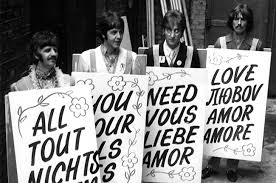
AllYouNeedAll You Need Is Love” — Lennon/McCartney, The Beatles

Facebook over the past several years has done the unexpected in creating exponentially vast usage of the noun/verb Like. This has been fun for those of us who indulge in broadly stamping our personal approvals on anything from a friend’s single syllable utterance to the launch of a new wave of flavored taco shells. Some argue the Like button has diluted the very significance it is meant to convey by spawning misguided promotions to increase click tallies, while others maintain it is the metaphysical fuel that rocketed Facebook into the stratosphere as the place advertisers have to be to mine explicit commendations. Regardless of the ultimate conviction it conveys, Like is an ultra easy way to express a soft high-five in public without any substantive commitment, and if you change your mind, you can Unlike something just as quickly.

While the full measure in a Like action remains on the light side of hand-waving, for marketers it can nonetheless provide an easy litmus test to note directionally if their intended messages are registering at all. Registering is not necessarily resonating, but it is a decent stride across the starting line. Getting someone to Like your brand for the long haul—on Facebook or along the purchase funnel—will never be a small task, but my sense is there is one constant in consistent success: For star marketers to get a Like, they must first Love.

I wrote about a similar topic not long ago in a post about eating your own dog food, where I suggested if you don’t use your own products, how could you expect anyone else to pay you for the privilege. This is a tangent to that thread, where of late I have observed entire marketing teams dogged by cynicism. They are charged with brand evangelism, but in their own minds, they are either not engaged in the true value proposition of their products and services or they have given up on their own futures, proclaiming themselves victims of an ice age they believe is imminent and unavoidable. I believe we often refer to this malady as the self-fulfilling prophecy.

Recently in a meeting with a team of executives who had invited me to help them with some seismic strategic planning issues, I noticed a through line where all of the many accomplished marketing executives in the room found a way to get on each other’s bandwagon, lamenting that their company’s future was not bright. I thought this was simply a down cycle in the conversation which is normal in brainstorming, but the negative energy was a contagion. Here we were, charged with helping reinvent the company, a blue sky path to infusing new levels of Like into brands that were already broadly embraced, but no consensus was emerging on how past Like could become new Like, or dare I say it, Love. As an outsider, I saw that their brands were certainly challenged in the market place, they had seen some decline, but they had in no way collapsed. Yet here the brand stewards being paid quite well for their presumed passion had convinced themselves their brands were dying—a sickness that was terminal and could not be reversed. Where I really got myself in trouble was asking the team how many of them still loved these brands. The rest of the assignment was awfully quiet.

If a brand steward does not start the day in Love with a brand, by the time that apathy translates and diffuses itself into a campaign of communication tactics, Like is not going to be there with the public. Better the executives hand in the baton and give the assignment to someone else who might find a way to convince themselves there is light ahead, yet throwing yourself on the sword for lack of conviction is not a road well-traveled in business. Instead it is likely that these brands will die, even though they could fight on, because no one behind them has the Love to fight. I wonder if the CEOs at the top of these companies know their chief lieutenants have already surrendered to creative destruction rather than rallied to next generation rebirth. Even if the beaten executives are right and the brand is destined to die, shouldn’t someone else who doesn’t believe that be given the chance to prove otherwise—to try with honest enthusiasm to wrestle imagination and go a different route that might just work despite the naysayers? Perhaps some of the CEOs are biding time as well, but my sense is most of those wouldn’t last too long in a board meeting. Love has to be real, and it has to start at the top.

Can someone in a marketing job walk away nobly from a lack of Love? Sometimes I think it is necessary and essential. A very successful friend recalled for me recently how early in her career she was working for a multi-national corporation on a vastly successful billion dollar brand that had of late stalled in its growth, years after it had gone wild and saturated market share. The team brainstormed and came to the conclusion that to reignite growth, marketing programs would have to implicitly suggest that the brand being marketed met the needs of a more healthful alternative already for sale, and that by shifting use from the believed healthful product to the growing brand, nothing would be lost and everything would be gained. Mind you, nothing illegal was being plotted and the campaign would by default have to meet truth in advertising laws, but the very idea that the only way to grow the brand was to pull attention from a more healthy alternative did not sit well with my friend. She understood the strategy, but she fell out of Love, and even out of Like. She did the right thing and left the company. Today she runs her own company and I can tell you this—she Loves her brand.

Remember this: a brand is not a logo or a trademark or a pithy name—a brand is a promise. You can stop loving a product line because it needs to change, indeed loving a product line too much can be a trap, but products are directed to evolve because loving the brand is a driving force. A brand is a set of choices that begins and ends with meeting customer needs. The branding process begins with ideation, continues through product development, then translates into communication (these days bidirectional feedback loops, like we see in social media, more than soap box broadcasting) and ultimately does or doesn’t result in customer loyalty. When you make a promise to your customers, you are obliged to make good on that promise. My sense is for that to happen repeatedly and predictably, if you are part of the creative cycle, you must Love, Love, Love your brands. If you don’t, no one else will.

If for some chronic reason you’re convinced a brand truly is at end of life, the right thing to do is protect working capital and advocate to take it out of commission mercifully. It is wrong to shovel high-priced coal into an engine you believe will no longer run because you’re pretending to believe a directive handed down that you knowingly disavow. Don’t try to fake it! If you don’t Love your brand, go find another that you can Love. If you are biding your time waiting to be found out, don’t worry, you will be found out. Your customers will do that for you. You need their Like. They deserve your Love.

Love, Love, Love.

Say It Loud

I like that people are speaking out.  I like that customers are letting corporations know what they think.  It’s good for democracy and free enterprise.  It’s great for business.

Bank Transfer DayLast week one individual, 27-year-old art gallery owner Kristen Christian, kicked off a true grass-roots movement that came to be known as Bank Transfer Day.  No one told her to do it, no giant entity or association formally backed her cause, she just did it and thousands of people got on board.  Since September 29, 2011 when Bank of America announced its $5.00 debit card fee, as many as 650,000 new credit union accounts have been opened.  This past week, Bank of America changed its mind about charging that fee.  You think they aren’t listening?  Maybe not as carefully as they should be, but it is clear some message got through.  This is how it should be.

Companies must never forget why they exist — to serve customers.  When they forget that, they are on a slippery slope.  Corporations can have a tendency to be inward thinking, they can focus with intense obsession on their internal issues, efficiencies, operations, politics, succession plans, and tactics for improved profitability.  Internal company struggles can become engrossing to the exclusion of more important matters, like creativity and customer focused quality.  When companies forget about customers, the other stuff ceases to matter.  They need to be reminded of that often and with passion.  Don’t feel bad when you complain or move your business, you are helping them.  They need to hear from us.  Our voice is vital to their survival.  If they don’t believe that and embrace it as a core value, creative destruction will do its job.

As I have written before, we are customers, we cannot allow ourselves to be reduced to the notion of being treated as consumers.  Customer service in a company needs to be both reactive and proactive:

Reactive customer service is when you call them to identify an issue or concern, the person on the phone or chat or responding to your email should do everything possible to solve your problem.  Great companies love these inbound calls, because each contact point is an opportunity to bond a customer for life.  If something goes wrong and a customer service person “makes the save,” your loyalty and lifetime value to that company can increase exponentially.  Conversely, if the customer service person manhandles the “win-back” moment, not only are you likely to be gone, you are likely to take a few dozen of your friends or the company’s future prospects from them, maybe more with the power of social media.  Again, you are doing the company a favor.  If you give them a chance to be helpful and they succeed, you have invested in their brand.  If they let you down, you teach them a lesson they need to learn quickly before their brand is permanently damaged.

Proactive customer service is the job of listening to customers before an action occurs, reading the trends and common themes that flow through the data bases of feedback systems.  Did banks know of the anger of the 650,000 customers who opened credit union accounts last month?  Some did and some didn’t.  Did they act in advance?  Did yours?  Why not?  If they are taking your business for granted, they deserve to lose it.  We all have options.  Proactive customer service focuses on retention activity in advance of crisis.  After crisis, it’s a public relations campaign, the spin doctors join the fray.  That may have worked a generation ago, but not so much today.  When we go, we are gone.

The Bank Transfer Day effort was careful to acknowledge that although it shared some inspiration from the activities of Occupy Wall Street, it was not part of that movement, it was its own thing.  Here again, the idea of customer voice is the key takeaway — what is being said, what is being heard, how can this help make systems function better?  Last week in the Wall Street Journal, Jeff Greene suggested the same basic idea, that “We Should Listen to the 99%” because they “are giving us a chance to address our problems before they grow worse.”  Neither Greene nor I are suggesting that every idea being articulated by OWS is necessarily actionable, but there is most certainly upside in listening and nothing but downside in ignoring the voices of passion.  If people have something to say, business is always well advised to listen.

And how about Congress, where the public approval rating dropped to 9%, are these elected officials not in need of working much harder at hearing?  Never has the need for the public’s voice been in more demand, and yet, as so many of us keep asking, is anyone listening?  The debt ceiling follow-up deadline for the Super Committee is November 23, just weeks away.  I don’t sense a consensus plan on the horizon or an amicable resolution, seems like business as usual in Washington to me.  Maybe we aren’t making enough phone calls or sending enough emails, we are much too polite.

It takes courage to speak out, to draw attention to oneself in a public forum and ask to be heard.  Likewise it takes courage in a corporation to align with the customer and advocate for improvements in the enterprise that cause customers to embrace goods and services along the lines of brand.  How much do banks spend on advertising to drive people through their doors?  What is the lifetime value of your business to a bank, to any company for that matter?  Can the banks not offer us valuable services over the course of a lifetime that produce reasonable profits?  Of course they can, or there would be no such sector.  While corporations worry about driving the value of their share prices, is there any better way to create value than to address customer needs and build lifelong customer relationships?  These are the backbone of profits, not much else that isn’t short-term financial engineering.  When innovation is applied to addressing real customer needs, good things happen for buyers and sellers.

It is so easy to give up and think that one individual cannot make a difference, but then someone like Kristen Christian comes along, fires up a Facebook page and shows us that there is power in the fabric of our nation.  That power of responsiveness is at the core of what can make a business great.  Our economic system can serve us well if we demand that it be responsive.  Don’t be quiet.  If you have something to say, say it and share it and drive the companies who need to earn your respect to work harder for the privilege to serve you.  When businesses listen they can only get better, help them to hear you by being brave and bold and honest.  A robust feedback loop makes good business sense, and everyone can have a say in that.  This is a business proposal with unlimited potential.

Brand vs. Direct: Must We Choose?

My distinguished colleague Gene Del Vecchio sent me some insightful follow-up thoughts to my post last week on advertising. Gene’s credentials in this area are much deeper than my own, with more than thirty years of advertising experiencing rising to the level of SVP at the renowned agency Ogilvy & Mather. He is an award-winning expert on advertising research, and also a successful author of non-fiction and fiction books, including the data-driven breakthrough Creating Blockbusters!

Gene’s point was that the distinction between brand and direct response advertising is a label, sometimes artificial and not necessarily useful except by executives managing ad budgets, often on the agency side. As simply stated as possible as handed down by legends like David Ogilvy and Leo Burnett—the individuals, not the agencies—all advertising has a single purpose: to sell products. Image is nice, awards are nice, clever memories are nice—but if the shirt doesn’t sell, it’s a cruddy shirt ad.

Gene summarized his point of view as follows:

The distinction between “branded” and “direct” is a red herring. If I advertise a movie on Thursday, I expect people in seats on Friday. Isn’t that direct? Sure it is. Simply because the time delay was 24 hours instead of 12 seconds, people are likely to say otherwise. These two disciplines need desperately to merge into ONE that both brands and sells. They are kept apart because many clients view them as silos. Adding to this is that agencies often hold these disciplines in two different groups with separate profit & loss responsibilities. Brand account managers at agencies don’t want to give up money to their counterparts in direct, and vice versa. Agencies also tend to have their highest profit margins in television ads, more than direct response campaigns, thus the agency business model with its higher overhead tends to favor the bucket called brand advertising. This is a battle on three fronts: 1) a philosophical battle of what is brand vs. direct; 2) a mechanical tracking battle regarding how to measure the effect of each; and 3) a business model battle regarding how agencies make their money.

Creating BlockbustersGene is a wise and honest fellow. I admire his candor which is firmly grounded in extensive experience. Surely an account executive would argue his or her job is always to do what is in the client’s best interest, but if they are doing what they believe is in the client’s best interest and it happens to be on the more profitable side of the agency’s business, one would have a hard time criticizing that as anything but a win-win. Rather than argue the potential conflict in an agency’s interest vs. that of the client, I find it more interesting to consider whether Gene’s suggestion that the distinction between brand and direct marketing has become anachronistic, and that this is yet another topic where we ought best to Think Different.

Few who have survived long careers in media would argue that brand advertising is meant to do anything other than sell products, and in that respect it has the same intention as direct response advertising. Long before the internet or digital platforms were available, long before the 1000 television channel universe, marketing budgets were allocated by clients as an acceptable percentage of total sales volume, invested in multi-platform campaigns that included TV, Print, Radio, and Outdoor. Sales expectations were set to evaluate Return on Ad Spend (ROAS). The concept of buying a carefully constructed and flexible campaign was investment driven, leading some forward-thinking corporate heads of marketing like Sergio Zyman at Coca-Cola to begin thinking of themselves as CMOs, or Chief Marketing Officers. If funds were invested and returns did not appear, they were accountable, and yes, these jobs have always been volatile. When CMOs turn over, ad agency accounts often come up for review, also a very volatile affair. While some agencies like Ogilvy and Burnett were well-known for keeping clients for ten, twenty, even thirty years, it was not because of Clio Awards, it was because of sales results. Anything less than accountability and ad business would be in jeopardy.

As more technologies became more available to CMOs and award-winning TV commercial directors found paths to becoming movie directors, a notion of image advertising entered the equation—as if to suggest that some advertising was meant to sell and some advertising was meant to make you feel good about a brand. Gene’s argument, with which I concur, is that makes no sense at all. If the advertising does not result in sales growth relatively soon—the car ad putting a perspective buyer in the showroom, a movie ad putting weekend butts in seats— it really doesn’t much matter how people feel about the Chevy brand or the Indiana Jones brand.

The job of an ad is to create action. A nice step in that direction might be a feel-good moment, but without action, no one paying for an ad cares a hoot about ” feel good.” Clients pay for an ad for a reason, and they don’t much care about trophies or “best-of round ups.” If the stuff they advertise is stuck in the warehouse, they are out of business. There are no more ads to buy next year, just burned creditors seeking liquidation crumbs.

At the same time advertising options became more creatively interesting and diverse, direct response mail and television infomercials touted their accountability. You mailed this many pieces, it cost you this much, you got this many orders, your cost per acquisition was at your target, live long and prosper. All of that may have been true, but with response rates worth celebrating at well under 5%, it was hard to argue the same kind of waste identified in TV epic brand spots wasn’t to be found in direct marketing initiatives—if you can get a 5% response rate, why can’t you get 10%, or 50%, or 100%? Why do we have to accept the old adage that in any campaign 50% of your ad dollars are always wasted, you just don’t know which 50% went up in smoke? And why can’t your direct response campaign have a residual brand effect, so that even if you don’t buy now, you might buy later, and if you do buy now, you might remember to buy again later? How do these urban legends become generally accepted principles, simply because they produce positive return on investment, however marginal?

Along comes perhaps the most important advancement in advertising since the thirty-second TV spot—the internet keyword ad generated by search engine marketing—and suddenly we begin touting 100% accountability in advertising. You pick the words you want to buy, you set your parameters for the auction, you pay your bill, and you get your orders. Perfect, right? Well, not exactly. You still pay for a lot of clicks that produce no value, factoring these as negative offsets to the profitable transactions of the campaign, and you feel a little better because you only pay for the clicks, not the impressions. The question is, can you or should you be getting residual brand or feel-good value for these unprofitable clicks, and if you aren’t, can you at least get some residual or byproduct brand value from the impressions that people are seeing even though the are costing you nothing? If you can, you have discovered advertising nirvana, which is precisely Gene’s point on bridging the applied and artificial distinction between brand and direct response marketing. Gene calls this finding the Golden Goose:

The key for both brand and direct response marketing has always been this: SELL IN A BRANDED WAY. TV, radio, print, and outdoor should create an image that sells. Internet clicks should create an image as they sell. That has been a rallying cry at agencies for years. Have they attained it? Sometimes yes and most times no. These two tools should also work in concert, together, as part of an overall strategy, and not thought of as mutually exclusive. The trick is to find the right balance of each, given each brand’s strategic objectives and its consumer’s decision-making process. The blend creates a consumer driven contact strategy, where you cannot tell where brand leaves off and direct begins, because they are part of the same whole.

I like the way Gene is thinking here. I find his approach to be liberating and aspirational. Will it be easy? No, but why should anyone in media get paid for what is easy? Can we get better at what we do and make our tools and platforms work harder for the people paying the bills? We better, or we ought not expect our invoices to continue getting paid. As the world becomes more flat, the notion of separate creative buckets becomes harder to defend. It’s time to be less defensive and get on offense, applying higher level creativity to more difficult problems of client advocacy, focused communication, and customer call to action.