Politically Incorrect Is Harder Than You Think

Lenny BruceThere’s something eerie about the Facebook world-view, which challenges us to live publicly out loud, to reveal ourselves globally and without filters, as we communicate in real-time our every thought and action, trivial or serious.

Mark Zuckerberg, at a relatively young age, has suggested the world will be a better place if we live more open lives, if we have no fears about what is private and what is public about us.

That’s quite a counterintuitive notion given our past, and one that has made him enormously wealthy in its adoption at various levels among a billion or so human beings across every settled zone of Planet Earth. Curiously, I find the thundering rhetoric around the U.S. Presidential Election has taken some of that “openness ideal” into the still largely uncharted territory of political correctness.

Here are two opposing views in the argument:

Am I being unnaturally confined if I allow myself to be restricted by a set of language norms accepted broadly as being politically correct?

*** or ***

Am I a more authentic person for saying whatever is on my mind absent artificially imposed rules somehow intended to protect the feelings of others but violating my first amendment rights?

Now consider the underlying question: Are these two viewpoints in fact diametrically opposed? Is someone a hypocrite if in public he speaks politely and without offensive language, yet out of the public eye makes racist slurs among friendlies? Or is that individual living more candidly by saying whatever is on his mind via stream of consciousness as long as his expressions align with his actual belief sets?

Said another way, if someone isn’t particularly sympathetic to embracing social diversity, are we as a society better off with that potentially upsetting speech articulated or kept silent? Those trying to stomp out political correctness might suggest we all are better off saying whatever is on our minds, but I am going to suggest that this has nothing whatsoever to do with political correctness. Bigotry is bigotry. Political correctness does not ensure civility when it is unwillingly imposed; it simply masks a dangerous expression from public view in the name of conflict avoidance.

Of course all of us have the ultimate hypocritical alternative: to speak cordially in public bound by understood norms of political correctness but then go hog-wild and say what we want anonymously online no matter how vile it is, convincing ourselves that hiding in the shadows as we spew is further entitlement in our right to free speech. To his credit, Zuckerberg mostly solved this by requiring Facebook posts to be signed under true identities, but, as we know, if you want to spew, Facebook is not the only game in town.

If you believe a wall should be built between the U.S. and Mexico, then go ahead and say it, but don’t think you have beaten political correctness by blurting that out. I don’t think the wall should be built. I feel in no way restricted by political correctness. I am comfortable saying what’s on my mind and I also find it pretty easy not to be offensive or threatening in my remarks. If you think the wall should be built but are filtering your public opinion because of the chokehold political correctness has around your vocabulary, you are deceiving yourself. Political correctness is not your problem. Your unwillingness to come clean publicly on your controversial stance is your problem. No one can liberate you by removing the filter. You are what you stand for, no matter what you say, and when you say what you stand for, you are no better than what you are saying.

Perhaps we are we missing the point of why political correctness was challenged in the first place. Being politically incorrect and saying whatever flows from your lips no matter how hurtful it might be are not the same thing, not even close. It is critical that we put in context where the modern politically incorrect movement began, long before it was labeled. It was a reaction by comedians like Lenny Bruce, George Carlin, and Richard Pryor to exposing the hypocrisy of what was said behind your back, not in front of your face. To twist that into an intolerant free-for-all that justifies hurtful speech or even hate speech, is the opposite of what these language pioneers set out to accomplish.

There was a time in this nation, largely the second half of the 20th century, when it was brave to say the unsayable because someone was trying to discourage hate, not justify it. Here’s what Lenny said:

“Every group every system has a set of values and morals, and when you get outside those, then the alarms ring. I was politically incorrect to 95% of the country; luckily my 5% had the bread to come see me.”

Lenny also said:

“Freedom of speech is a two-way street, man. You have a right to say whatever you want and the Boss has a right to tell people to arrest you.”

Compare that to the recent words of Presidential candidate Trump:

“I don’t frankly have time for political correctness. And to be honest with you, this country doesn’t have time either. This country is in big trouble. We don’t win anymore. We lose to China. We lose to Mexico, both in trade and at the border. We lose to everybody.”

And more recently from Trump:

“And I ask you this, I ask you this — crime, all of the problems — to the African-Americans, who I employ so many, so many people, to the Hispanics, tremendous people: What the hell do you have to lose? Give me a chance. I’ll straighten it out. I’ll straighten it out. What do you have to lose?”

Is it fair to compare a groundbreaking stand-up comic from a half century ago with the current GOP candidate for President of the United States? Probably not, but if you don’t see a difference in how each of them applies the need to speak freely to make a point, we probably aren’t going to agree on when it is justified and makes sense. In Lenny’s case, he is embracing irony to open our eyes to self-awareness. In Trump’s case, he is playing to disenfranchisement to stir up resentment.

Bill Maher called his original show Politically Incorrect to make a point about the absurdities of covering up hypocrisy with language. He has offended many, and he is anything but always right in his opinions, but his intention is to make us think harder about what we say and do. If you have a point to make in the name of a lightning rod that takes us to better thinking  like Lenny, like George, like Richard — have at it, but be ready to suffer the consequences of being misunderstood if your point is not clear. Samantha Bee is doing an amazing job carrying the torch now. She is hugely politically incorrect and a beacon of light, afraid of nothing. All of these people carry a core message of love. If you carry a core message of love and have something to say that makes me work harder at understanding my failings, have at it, but don’t think you’re doing me any favors by calling me one name behind my back and being polite when we meet face to face. If that’s political correctness, we have failed at diversity. If you’re a bigot, we’ll know.

This year is the 50th anniversary of the death of Lenny Bruce. Let’s keep his torch burning brightly by proving we know the difference between stepping beyond the bounds of political correctness to make a point and blathering on insensitively about how we wish we could say what was on our mind but somehow feel repressed. If you have something to say, say it, then stand by it. If it makes the world a better place, you’ll have said the right thing no matter whom you may offend in the short-term. I’m guessing if what you have to say really matters, it won’t be offensive in the least.

_____

This article originally appeared on The Good Men Project.

The Rage Podcast: Voices All Around Us

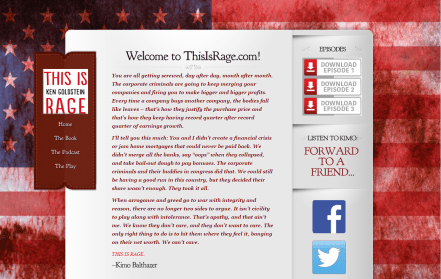
Visit ThisIsRage.comAbout three years ago I published my first novel, This Is Rage. It’s been an amazing journey, including creative development and four public readings of my stage adaptation. Now we have something additionally exciting to announce: the first three episodes of a podcast adaptation.

We made it easy for you to find either on iTunes or at the online home that saved Kimo Balthazer from irrelevance and started his movement:

ThisIsRage.com

Who is Kimo Balthazer, you may be asking? Well, if you haven’t read the book, I would hate to spoil it for you. Let me say in the form of a teaser that he is a 20th century old-school radio talk show host lost in a world of 21st century digital communications. Although he has lost everything, and that’s largely his own unrestrained shock-jock fault, he still has a few things to say about how the business workplace is no longer the same for the everyday hardworking person.

Kimo’s anger is his listeners’ anger, and when that anger collides with a nasty bit of corporate insider deal-making that is going to eliminate thousands of great jobs for no good reason except increased profits, he takes his tirade to the Internet. Pretty much all hell breaks loose.

I kept notes for this novel for over a decade, wrote it over a two-year period beginning in 2011, and then published it with The Story Plant in 2013. At that time, the social climate of the Occupy Wall Street movement was opening the dialogue around the 1% and the 99%, and the voices around me eerily echoed the voices in my story.

The political reception to my book was as heated as it was overwhelming. I began hearing from readers all over the world who had suffered personal losses similar to the employees of the fictional EnvisionInk Systems and Atom Heart Entertainment. They recognized the roaring rage of the main characters in the book plotting against and outmaneuvering each other, while also empathizing with the quiet rage they felt in themselves as victims of an economic system they no longer recognized. They didn’t recognize Kimo, he was purely fictional, but what he was shouting rang true. They were playing by the rules, and the rules were failing them. Income inequality was becoming much more than a story.

Then something happened that surprised me. The novel was optioned for the professional theater so it’s echoing story could be experienced live and in person. I worked with the producer, Mitchell Maxwell, and my editor/publisher, Lou Aronica, for two years delivering four different drafts, each culminating in a public reading that drew equal laughs and tears. It was an unpredictable experiment that often left me drained, but each time I listened to the audience dialogue following the show, I knew the seeds had been planted for something good to come of this, if only people saw themselves in the mirror of drama and refused to let it stand as the status quo.

Then something else happened that surprised me again. The Story Plant Media team called and asked how I felt about adapting the stage version to a podcast. In facing this challenge, I reminded myself of the daunting task of writing the novel, followed by the daunting task of the four stage drafts. With the podcast, the true voices of the characters could resonate in the listener’s imagination, much as Kimo’s voice resonated with his audience. An old-fashioned radio treatment for an ironic tale of Internet radio seemed like the prefect path to firing up the voices all around us.

Those voices now belong to you.

How about that; old-fashioned serialized radio drama, all new for the digital age? There are twists in this version of the story I am exploring anew, many quite different, and dare I suggest, the romantic elements have come a little forward. Of course since we are talking the immensely flawed Kimo Balthazer, we are talking a dysfunctional romance. Perhaps it’s even hard to call it that. War of the broken-hearted might be closer. It goes to some strangely dark places of the soul.

If you read the book, you might remember the hint at the end that Kimo asked for coffee with corporate attorney Sylvia Normandy? In this adaptation of This Is Rage, Kimo and Sylvia go way back. I mean WAY BACK, as in a personal history together. Sylvia is the narrator of the podcast. She is the storyteller. It’s told through her eyes, her point of view, her play-by-play commentary. I told you it was different.

Why revisit Rage now? If you’ve been following my blog, you won’t be surprised that certain candidates in this year’s elections have stirred raging emotions in me. Throughout the past year, we’ve seen all kinds of signs that Occupy was not an isolated affair, and the People’s Revolt is showing signs of resilience everywhere. We live in difficult times, and sometimes we forget we always have choices.

It’s been said by many that change happens when the pain of change is less than the pain of staying the same. The pain around us is not sustainable. Change has to happen. It remains my hope that this story of an amateur kidnapping in corporate America elevated out of control by thundering voices can be part of the narrative that leads us together toward change.

I’d like your voice to be a part of that change. I’d like my characters’ voices to be in your heads, and I think the actors in this podcast have delivered on that front. I want to keep hearing the voices of post-show conversation, and I’d like our collective voice to reach up and grab the attention of those in power not listening. Our shared voices can bring reform, human innovation, and make change happen.

A story is one voice. When we read and listen and hear and react, it can become way more than a manuscript. My voice is meant to be a catalyst. Yours is a conduit. Let’s put them together and share a little podcast drama, shall we?

You can download or stream the podcast, and it’s free. You can also use the social media buttons to “Forward to a Friend.” That would give Kimo great satisfaction. Me, too.

Download-on-iTunes

_____

This article originally appeared on The Good Men Project.
What’s Going On?

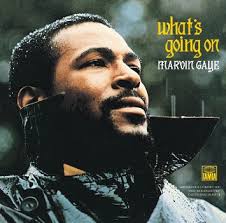
Marvin Gaye: What's Going On?We wake up to news that the prior night an innocent person was killed at point-blank range. We come back from lunch to news of a mass shooting in a public gathering place. We drive home from work but have to go around downtown because there’s a bomb scare. We sit down to dinner and try to dissect the political ramblings of where to plant the blame and why it’s someone else’s fault that nothing can be done about bloodshed. We go to bed trying to shut out the squabbling hysteria and another gunshot rings out. This time maybe it’s across the street.

Alton Sterling.

Philando Castile.

The slaughter of five police officers in Dallas.

That’s was in 72 hours, folks.

Last month we suffered Orlando. Last year it was San Bernardino. Two years ago it was Ferguson. Sandy Hook, Aurora, and Columbine might seem to some like ancient history. We can’t even keep an inventory or a timeline in our own minds —and that’s before we even toss in the endless acts of organized terrorism around the globe.

Some of the shooters are mentally ill, some are socially broken, sadly enough, some are cops. You try to tease them apart — it’s not the same thing when a psychopath fires into the crowd as it is when a jittery police officer kills a pleading African-American on the street — but under all of it you find the common theme: unrestrained hatred, reckless emotion taking power over determined action.

Violence, murder, death. Blame, finger-pointing, posturing. Every single day now. What vision of America is this? How did we get ourselves here? The victims fall pointlessly and then the rest of us argue to exhaustion. We have to be better than this. We just have to be better than this.

If the best minds speak out, will we hear them?

We are simultaneously irate and numb. How exactly can we be both of those at the same time?

Is it the 300 million cheap retail guns? The mass economic inequality? A sudden perceived freedom to express racist thoughts as “just saying candidly what’s on someone’s mind?” Too much pent-up anger in the institutions empowered to protect us from widespread chaos?

Marvin Gaye sang it the last time we rumbled nationally on the topic of civil rights. What’s Going On?

It’s more than we can see, hear, feel, or perceive. It’s not us and them. It’s not here and there. We are all in it all the time whether we want to be or not. Hello, Social Media, the untethered connectivity that weaves us together habitually and perpetually.

I am convinced the internet itself has to be at work here, although I see it as an equal plus and minus given the freedom it has already inspired in developing, previously autocratic countries. It’s not a coincidence that public violence and social media are exploding together.

Think about it. TV was the fuel of Vietnam protests and the Civil Rights Movement. We saw stuff everyday on analog television that we never saw before, and that made us mad, so we reacted. Now the internet lets us see and hear everything in realtime, it lasts a second in impact, and then a meme wipes that out with another. Nothing is edited, vicious words and horrific images fly around the globe at light speed. Regular folks like us gobble it up and talk about it like tallying statistics, while other “less regular” folks do who knows what because of it or maybe even try to make their own news for a few seconds.

Pretty soon we are on overload, frozen in inability to combat the madness.

Yes, the for-profit media is playing a role, but I don’t think it’s the big money professionals who are whipping up the frenzy as much as our addiction to social media. I don’t think any of us understands the impact the constant give-and-take-and-tackle-and-refute is having on us because we are devouring the scraps embedded in the platform simultaneously with its invention — without enough history, context, or perspective to make real sense of the role we are playing as nodes.

This is not a value judgment on our actions, mind you, it’s an observation. I am as guilty as anyone of living in the fray of exchange. I am more guilty because I am a writer and any good I try to do in getting you to think about this stuff can and will backfire and create more angst in its dismissal and rebuttal.

Sorry, I don’t have any brilliant answers. I’m a little frozen as well, a lot like you. I’m an observer and an interpreter, one voice trying to wrestle through the noise and rhetoric. I am convinced that it is not going to be a politician who leads us out of this muck. Martin Luther King wasn’t elected. He inspired his following. He paid the price, and he made a difference. We need that badly. I don’t have a clue what a Dr. King looks like in the 21st century or even if such a thing is possible anymore given our cynicism. I hope someone out there can figure out how to be one, the real deal.

Here’s one answer: Don’t let social media demoralize you. Don’t let the random ramblings of reactionary tirades spin you. Don’t be confused and don’t be manipulated by entrenched greed or opportunistic power grabs. Stay focused on ideas that resonate with your values, but listen thoughtfully when someone who looks or sounds different from you is making a compelling case for justice. Celebrate unsung heroes who are quietly making a difference. Catch someone in an act of compassion and sing their praises. The self-imposed noise around us can be divisive or unifying — it’s a rather important choice and always a choice.

Apathy and the status quo aren’t a solution. Terror can’t be a norm. We must find a way to unmake this mess. Don’t give up. Demand better. Demand sanity. Listen for the silenced voice in the room without an agenda. The better answers won’t be in obvious places. It is time to Think Different.

_____

This article originally appeared on The Good Men Project.

Another Good Year for The Good Men Project

CallForBloggersI have just finished my third full year on the board of directors and as strategic advisor to The Good Men Project. It’s hard to believe that much time went by so quickly. On the other hand, it is amazing to see how far we have come in such a short amount of time. Every day we publish no fewer than thirty new stories, and every day we learn something about ourselves and each other. It truly is a remarkable journey. If you haven’t joined us yet, please stop by the site for a read. I’m pretty convinced one visit will not be enough. Like the three to five million people we reach each month, you’ll be back.

If you’re not yet familiar with The Good Men Project, we are an editorial site that focuses on men’s issues in the 21st Century. We call our electronic publication, “The Conversation No One Else Is Having.” What sets us apart and makes us unique is that we are a site with the word “Men” in the title above the masthead, while only half our audience is male. Likewise, we are a site where half our writers are women. In the many comments that follow our stories, men and women discuss difficult issues about marriage, parenting, work-life balance, career stress, family stress, health, sex, romance, relationships, dating, splitting up, advice, confessions, sports, ethics, faith, discrimination in all its forms, justice, growing old, staying young, entertainment, the arts, and pretty much any other human issue you can imagine. We demand high quality writing, respectful commentary, and a firm commitment to dig a little deeper emotionally than you otherwise might expect in high volume editorial. Beyond that, we are an experiment in progress, and we welcome the creativity of every voice that joins us.

This past year has been particularly exciting for us, because our endlessly devoted CEO, Lisa Hickey, relocated to the west coast and set up shop in Pasadena, California. We are now in a fabulous shared workspace environment where any of our writers or editors can stop by and have a cup of coffee with Lisa. Our team of three executive editors, over thirty section editors, and more than 2000 regular contributors around the globe generate topical as well as perennial stories with precision teamwork. We have almost 500,000 Facebook fans, up from about 60,000 the last time I summarized our business for you in early 2014. Something is definitely going right at The Good Men Project. I get the sense you are all heavily into this conversation. Don’t worry, we’re still just getting started.

One of our editors recently asked me in a comment string on another site what I thought was working well at The Good Men Project, and what could be learned and applied to other endeavors similar in aspiration. Well, the number one thing that’s working here is the people — the readers, the writers, the commentors, the staff — all of you are what make this thing matter. Beyond that, I offered three themes that Lisa and I pledged way back would be core to our focus and that we try very hard to make real. Here is what I wrote:

1) Our platform is meant to be a dialogue, not a diatribe. The brand does not define what being a good man is, it poses that question to the community to sensibly discuss in a conversation that never ends. We don’t name a good man of the year, because if we did, the chances he would be unveiled as flawed a minute after we did are 99%. We discuss goodness, we don’t cement a model of good.

2) Diversity to us is air. Because good is so hard to understand, we see the whole of our contribution base as vastly more important than one dominating voice. We are The Good MEN project with half our writers women and half our readers women, so men and women can discuss important things with each other, not at each other. Ethnicity, sexual orientation, age, we cast the widest net we can, so we can learn from each other.

3) We demand good behavior without imposing political correctness. You can disagree with a point of view, but you can’t attack a contributor. We encourage articulate contribution over invective. Again, it’s meant to be a conversation, which means there are rules of civility, but not so many that they curtail free exchange of voice.

Lisa and I spend a lot of time thinking about our brand, the promise we make to all of you and to each other, and my sense is if we are true to these three core values, we will keep growing on a steady trajectory. Like I also say, because we tread on creatively dangerous terrain, it is inevitable that we will step in poo now in again. When we do, we go back to our values, and that’s how we hope to get unstuck.

In the coming year you will see some forward strides at The Good Men Project, where we are now investing the limited but stable financial resources we can forecast.

First, you are going to see a much-needed and long overdue redesign that prioritizes mobile in a way we haven’t before. We know you tolerate our templates with “pinch to expand” dexterity, and that’s not fair in a world gone mobile. Both a responsive site and an app are on the way. Both a responsive site and an app are on the way.

Second, we will be expanding our sponsorship model, where we work with relevant brands to produce content that helps tell their stories in ways that align with our values, but also lets us grow our business. We have always been careful about this, but we have also become quite good at it. When our phone rings with a great sponsorship opportunity, we want to connect the right writer with that message. That writer could be you!

Third, you will see more emphasis on our premium product, where we ask a modest annual membership fee to help support our efforts in a world where advertising can not be our only business model. By the way, if you write for us, you are entitled to a free bronze level subscription badge, so if you don’t have it, email lisa@goodmenproject.com and she will set you up.

Finally, we are going to be experimenting more with video, and we will have some production days in our office for pilot shorts we want to test. If you have ideas or original videos you want to share, don’t be a stranger.

We also plan to increase our coverage of the Presidential Election with unique perspectives on the meaning of campaign verbiage. We will continue to collect far-ranging points of view on movie favorites both current and classic. We will also stay on top of breaking news stories and events, not so much with added mainstream reporting, but with analysis and interpretation of the implications and underlying meaning in mainstream reporting. All in all, we have quite an ambitious agenda, as you would expect of us.

I personally want to thank you for embracing The Good Men Project, where I am not only a business guy, I am a regular contributor. Not surprisingly, I write mostly about business, where I try to focus on the human side of creativity, innovation, overcoming obstacles, and taking on big challenges. It is a joy to share my words with you, and it is a joy to share this space with you. Keep the good words coming, keep us honest and on our toes, and we promise to continue The Conversation No One Else Is Having.

_____

This article originally appeared on The Good Men Project.

Photo Image: Courtesy of Good Men Media, Inc.