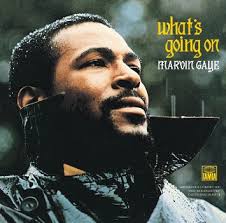
What’s Going On?

Marvin Gaye: What's Going On?We wake up to news that the prior night an innocent person was killed at point-blank range. We come back from lunch to news of a mass shooting in a public gathering place. We drive home from work but have to go around downtown because there’s a bomb scare. We sit down to dinner and try to dissect the political ramblings of where to plant the blame and why it’s someone else’s fault that nothing can be done about bloodshed. We go to bed trying to shut out the squabbling hysteria and another gunshot rings out. This time maybe it’s across the street.

Alton Sterling.

Philando Castile.

The slaughter of five police officers in Dallas.

That’s was in 72 hours, folks.

Last month we suffered Orlando. Last year it was San Bernardino. Two years ago it was Ferguson. Sandy Hook, Aurora, and Columbine might seem to some like ancient history. We can’t even keep an inventory or a timeline in our own minds —and that’s before we even toss in the endless acts of organized terrorism around the globe.

Some of the shooters are mentally ill, some are socially broken, sadly enough, some are cops. You try to tease them apart — it’s not the same thing when a psychopath fires into the crowd as it is when a jittery police officer kills a pleading African-American on the street — but under all of it you find the common theme: unrestrained hatred, reckless emotion taking power over determined action.

Violence, murder, death. Blame, finger-pointing, posturing. Every single day now. What vision of America is this? How did we get ourselves here? The victims fall pointlessly and then the rest of us argue to exhaustion. We have to be better than this. We just have to be better than this.

If the best minds speak out, will we hear them?

We are simultaneously irate and numb. How exactly can we be both of those at the same time?

Is it the 300 million cheap retail guns? The mass economic inequality? A sudden perceived freedom to express racist thoughts as “just saying candidly what’s on someone’s mind?” Too much pent-up anger in the institutions empowered to protect us from widespread chaos?

Marvin Gaye sang it the last time we rumbled nationally on the topic of civil rights. What’s Going On?

It’s more than we can see, hear, feel, or perceive. It’s not us and them. It’s not here and there. We are all in it all the time whether we want to be or not. Hello, Social Media, the untethered connectivity that weaves us together habitually and perpetually.

I am convinced the internet itself has to be at work here, although I see it as an equal plus and minus given the freedom it has already inspired in developing, previously autocratic countries. It’s not a coincidence that public violence and social media are exploding together.

Think about it. TV was the fuel of Vietnam protests and the Civil Rights Movement. We saw stuff everyday on analog television that we never saw before, and that made us mad, so we reacted. Now the internet lets us see and hear everything in realtime, it lasts a second in impact, and then a meme wipes that out with another. Nothing is edited, vicious words and horrific images fly around the globe at light speed. Regular folks like us gobble it up and talk about it like tallying statistics, while other “less regular” folks do who knows what because of it or maybe even try to make their own news for a few seconds.

Pretty soon we are on overload, frozen in inability to combat the madness.

Yes, the for-profit media is playing a role, but I don’t think it’s the big money professionals who are whipping up the frenzy as much as our addiction to social media. I don’t think any of us understands the impact the constant give-and-take-and-tackle-and-refute is having on us because we are devouring the scraps embedded in the platform simultaneously with its invention — without enough history, context, or perspective to make real sense of the role we are playing as nodes.

This is not a value judgment on our actions, mind you, it’s an observation. I am as guilty as anyone of living in the fray of exchange. I am more guilty because I am a writer and any good I try to do in getting you to think about this stuff can and will backfire and create more angst in its dismissal and rebuttal.

Sorry, I don’t have any brilliant answers. I’m a little frozen as well, a lot like you. I’m an observer and an interpreter, one voice trying to wrestle through the noise and rhetoric. I am convinced that it is not going to be a politician who leads us out of this muck. Martin Luther King wasn’t elected. He inspired his following. He paid the price, and he made a difference. We need that badly. I don’t have a clue what a Dr. King looks like in the 21st century or even if such a thing is possible anymore given our cynicism. I hope someone out there can figure out how to be one, the real deal.

Here’s one answer: Don’t let social media demoralize you. Don’t let the random ramblings of reactionary tirades spin you. Don’t be confused and don’t be manipulated by entrenched greed or opportunistic power grabs. Stay focused on ideas that resonate with your values, but listen thoughtfully when someone who looks or sounds different from you is making a compelling case for justice. Celebrate unsung heroes who are quietly making a difference. Catch someone in an act of compassion and sing their praises. The self-imposed noise around us can be divisive or unifying — it’s a rather important choice and always a choice.

Apathy and the status quo aren’t a solution. Terror can’t be a norm. We must find a way to unmake this mess. Don’t give up. Demand better. Demand sanity. Listen for the silenced voice in the room without an agenda. The better answers won’t be in obvious places. It is time to Think Different.

_____

This article originally appeared on The Good Men Project.

Harnessing The Bern!

Dear Bernie,

You did a great job.

You galvanized a young generation of voters.

You helped change the dialogue to one of fairness.

You helped us to Think Different.

Now it’s time to be a mensch.

What’s at stake is everything.

We all have to row together in the same canoe.

I’m With Her are winning words.

Please be a mensch.

Love,

Those who need you.

bernie-sanders-hillary-clinton-democratic-debate

Author’s Postscript:

If we step out of campaign mode, Bernie Sanders and Hillary Clinton really aren’t that far apart on the key issues that change our lives. They both share a core set of humanistic values and so do their constituents. Bringing us together will accomplish way more of the Progressive Agenda than an artificial wall.

We can continue to build upon the legacy of President Obama if we unite. Our commonality is way beyond our differences.

Bernie is going to join the Clinton campaign, I’m certain of that – the question is when and how ardently. None of his critical concerns will be ignored if he takes his seat at the table. He has earned that seat. It’s a good seat. He has to RSVP sooner rather than later because every minute counts now. He has to make that choice. I have faith he will do the right thing. Then Bernie can still be Bernie.

It begins. Onto November.

_____

Photo: DNC Presidential Debate, April 2016.

12 Reasons Why We Vilify

FlagFightA recent debate on my Facebook page raised the issue of whether there is a double standard among Progressives as to where and when indictment of political opponents is warranted. Taking this a step further, the discussion evolved into the appropriateness of vilification of someone’s opponent in an argument, and whether that vilification was one-sided with regard to political party leanings.

I have my opinions on this, but I want to set them aside for a moment and simply delve into the issue of vilification as the outcome of disagreement, and how we devolve to that extreme.

As a noble sidebar, let’s take a quick run down a philosophy bypass in summarizing the works of Soren Kierkegaard, a 19th-century Danish philosopher largely focused on making sense of his devout Christian faith in an increasingly modern and existential world. Kierkegaard suggested we live our lives in three realms: the aesthetic, where we act simply in our own interest and do whatever we enjoy; the ethical, where we act according to agreed laws to avoid punishment; and the religious, where we do what is right in an absolute sense because we see no other acceptable alternative. From the religious realm, comprehensively embracing the tale of Abraham’s test by God to sacrifice his own child, Kierkegaard describes faith ultimately as an absurdist paradox. You believe or you don’t. You don’t owe anyone an explanation because you decide in your heart what God believes is right.

You don’t have to buy Kierkegaard’s framework to apply it. You simply have to understand that our values are substantially derived from the religious realm as he describes it, regardless if we consider ourselves traditionally religious. They are belief sets we acquire however we acquire them, and we don’t feel we have to justify them to others. Returning to the realm of the politicalthe ethical set of laws we choose to accept in our Constitutionally defined secular societymy sense is that our act of vilification emerges with the full erosion of our shared values. If we don’t have enough places we agree on critical laws reflecting deeply held values, then the opposition to our views becomes moral and absolute vs. legal and relative.

Consider some examples: Whether taxes should be increased 2% or 4% is essentially an intellectual argument where we are unlikely to vilify someone who disagrees with us. Whether health care is a human right or an imposition of authority is less intellectual, so we become emotional. Whether a woman’s right to choose is absolute or controllable takes us to fundamental beliefs, where the opposition becomes the enemy. The more we disagree at the fundamental level, the less we have in common and the more we reject the opposing argument as an assault on our basic living principles.

Here’s the rub: Without a set of some shared values embodied in our ethical laws, we can’t be much of a unified, strong nation. This is a danger of our profound experiment in democracy, and at the moment I believe we are fully putting it to the test. If you extrapolate the tenor of our current discourse to the full extreme, where all we can do is vilify one another because we cannot find a set of shared values, we might indeed be one national crisis away from ending our time in the sunno matter how many nukes we have in our inventory, or how many gold bars we have in our repository. Call it the challenge of WWIII, or perhaps an economic meltdown without a reachable escape hatch. If we can’t find the shared values that lead us to an agreed solution with a clock ticking, everything we have accomplished together to date becomes a footnote.

How scary is it, and how much do we cross into each other’s most sacred space? Consider this starter list of how little we value in each other’s convictions:

  1. We don’t agree on a woman’s right to choose.
  2. We don’t agree on the universality of health care.
  3. We don’t agree on how to deploy military forces in the Middle East or otherwise around the world.
  4. We don’t agree on the basics of immigration reform, or for that matter, who can or can’t enter the United States, short or long-term.
  5. We don’t agree on gun control, with our interpretations of the Second Amendment light years apart.
  6. We don’t agree on how to address poverty and homelessness in our own nation, let alone abroad.
  7. We don’t agree on how to address controlled substances, or whether the war on drugs is worth continuing in anything resembling its current form.
  8. We don’t agree on where to set minimum wage, or if a minimum standard of living should be possible if minimum wage is what one earns working full-time.
  9. We don’t agree on who has the right to be married, even though the Supreme Court has ruled on it.
  10. We don’t agree on climate change, whether it is a scientifically proven global concern, and if it is, how much a priority it should be for U.S. business policy and financial attention.
  11. We don’t agree on what constitutes a basic education, or what we can hope to expect in the form of presumed literacy and interpretation skills by the time a person reaches adulthood and takes on the responsibilities of independent living.
  12. We don’t agree on an approach to reasonable tax reform or the proper tax structure for the rich, the middle class, or the poor.

That is an awful lot that drives us apart. All of those involve valuescurrently reflected in lawsthat we do not seem to share or want to share.

So my ultimate two questions are simple: What shared values do we maintain as a vast majority? And if we can’t find enough of them, where do we go from here?

Perhaps we still maintain shared values around the hope that our children will thrive, our government will remain in humble service to the people who select its leadership, that charitable activity will be lauded, and that criminal activity will be addressed with justice. Yet even as I form those thoughts, I am inevitably driven to the specifics of definition and implementation, and find us back at war among our various convictions about how we bring such affirmative notions into everyday reality.

I guess in the end there really aren’t 12 reasons we vilify. There’s just one: We vilify when we fear the imposition of someone else’s will on our own that crosses the bounds of our most cherished values. Daunting challenge to overcome, don’t you think? And as we let it get out of hand and don’t find a way to bridge the gap, the likelihood that we can find any unifying shared values at all diminishes in our anger and ultimate silence. That’s when we lose everything, and damn if we don’t seem to be hell-bent on flushing away almost 300 years of what we thought was shared progress.

Sometime when I listen to the anonymous, unfiltered invective swelling all around me, I wonder if we ever truly shared it at all.

_____

This article originally appeared on The Good Men Project.
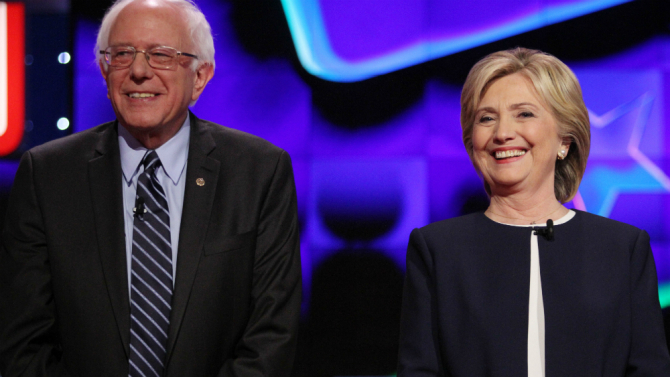
Photo: Luis Sinco / Los Angeles Times.

The Trump Thing

Are there any queers in the theater tonight?
Get them up against the wall!
There’s one in the spotlight, he don’t look right to me,
Get him up against the wall!
That one looks Jewish!
And that one’s a coon!
Who let all of this riff-raff into the room?

– Pink Floyd, The Wall

Pink Floyd The Wall

It is almost impossible to believe that a material segment of our population has grown so disaffected and so ignorant that they can cheer on the repugnant egomaniac that is Donald Trump. There are no two sides to this one, nothing to argue. Just go away if you think otherwise, we have no common ground.

Hate is winning. Candor is being confused for stream of conscious bigotry. Trump is a spoiled man-child with deeply psychotic tendencies. To support him is the antithesis of patriotism; it is an expression of self-victimization, nothing more.

This is not about whether Trump wins or loses his party’s nomination, or even the Presidency. It is about the reality that we live alongside an enormous segment of the population that finds him credible and inspiring. That takes our common ground to zero. Trump may lose, but his supporters have shown us who they are and what they believe. How do we reconnect as a nation with values that shattered?

It’s not really Trump himself that’s keeping me up nights. It’s all the public venom he is unleashing. He’s making it vogue to gather in the name of Us and Them. He has proven that our education system has utterly failed in establishing even a basic shared vocabulary and understanding of ethical purpose. He causes people to believe that “saying whatever’s on your mind” is the same as “telling it like it is.”

Expressing a foul thought unedited and unsupported, loudly and repeatedly, bears little resemblance to making it true. It is bad theatera poor stage performance without disciplinenot intelligent and useful discourse.

A hundred years of socially progressive advancement is going out the window in favor of simplistic notions of aggrandized superiority. The genie doesn’t go back in the bottle after November. Trump’s followers feel validated in their disaffection. There is nothing good that can come of that, and it will neither make their lives better, nor make America great again. It keeps us on a path to dangerous democratic decision-making regardless of the election results.

That’s what’s freaking me out. I’m sitting next to these people on planes and trains, and standing in the checkout aisle next to them at the grocery store. I don’t sense that I am part of their vision of American greatness, so perhaps I go on the hit list, too.

And you. And you. And you.

_____

This article originally appeared on The Good Men Project.

Image: Gerald Scarfe, Pink Floyd The Wall.