The Rage Podcast: Voices All Around Us

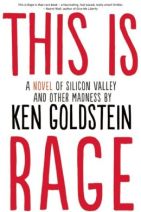
Visit ThisIsRage.comAbout three years ago I published my first novel, This Is Rage. It’s been an amazing journey, including creative development and four public readings of my stage adaptation. Now we have something additionally exciting to announce: the first three episodes of a podcast adaptation.

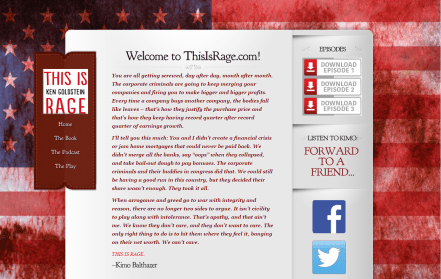
We made it easy for you to find either on iTunes or at the online home that saved Kimo Balthazer from irrelevance and started his movement:

ThisIsRage.com

Who is Kimo Balthazer, you may be asking? Well, if you haven’t read the book, I would hate to spoil it for you. Let me say in the form of a teaser that he is a 20th century old-school radio talk show host lost in a world of 21st century digital communications. Although he has lost everything, and that’s largely his own unrestrained shock-jock fault, he still has a few things to say about how the business workplace is no longer the same for the everyday hardworking person.

Kimo’s anger is his listeners’ anger, and when that anger collides with a nasty bit of corporate insider deal-making that is going to eliminate thousands of great jobs for no good reason except increased profits, he takes his tirade to the Internet. Pretty much all hell breaks loose.

I kept notes for this novel for over a decade, wrote it over a two-year period beginning in 2011, and then published it with The Story Plant in 2013. At that time, the social climate of the Occupy Wall Street movement was opening the dialogue around the 1% and the 99%, and the voices around me eerily echoed the voices in my story.

The political reception to my book was as heated as it was overwhelming. I began hearing from readers all over the world who had suffered personal losses similar to the employees of the fictional EnvisionInk Systems and Atom Heart Entertainment. They recognized the roaring rage of the main characters in the book plotting against and outmaneuvering each other, while also empathizing with the quiet rage they felt in themselves as victims of an economic system they no longer recognized. They didn’t recognize Kimo, he was purely fictional, but what he was shouting rang true. They were playing by the rules, and the rules were failing them. Income inequality was becoming much more than a story.

Then something happened that surprised me. The novel was optioned for the professional theater so it’s echoing story could be experienced live and in person. I worked with the producer, Mitchell Maxwell, and my editor/publisher, Lou Aronica, for two years delivering four different drafts, each culminating in a public reading that drew equal laughs and tears. It was an unpredictable experiment that often left me drained, but each time I listened to the audience dialogue following the show, I knew the seeds had been planted for something good to come of this, if only people saw themselves in the mirror of drama and refused to let it stand as the status quo.

Then something else happened that surprised me again. The Story Plant Media team called and asked how I felt about adapting the stage version to a podcast. In facing this challenge, I reminded myself of the daunting task of writing the novel, followed by the daunting task of the four stage drafts. With the podcast, the true voices of the characters could resonate in the listener’s imagination, much as Kimo’s voice resonated with his audience. An old-fashioned radio treatment for an ironic tale of Internet radio seemed like the prefect path to firing up the voices all around us.

Those voices now belong to you.

How about that; old-fashioned serialized radio drama, all new for the digital age? There are twists in this version of the story I am exploring anew, many quite different, and dare I suggest, the romantic elements have come a little forward. Of course since we are talking the immensely flawed Kimo Balthazer, we are talking a dysfunctional romance. Perhaps it’s even hard to call it that. War of the broken-hearted might be closer. It goes to some strangely dark places of the soul.

If you read the book, you might remember the hint at the end that Kimo asked for coffee with corporate attorney Sylvia Normandy? In this adaptation of This Is Rage, Kimo and Sylvia go way back. I mean WAY BACK, as in a personal history together. Sylvia is the narrator of the podcast. She is the storyteller. It’s told through her eyes, her point of view, her play-by-play commentary. I told you it was different.

Why revisit Rage now? If you’ve been following my blog, you won’t be surprised that certain candidates in this year’s elections have stirred raging emotions in me. Throughout the past year, we’ve seen all kinds of signs that Occupy was not an isolated affair, and the People’s Revolt is showing signs of resilience everywhere. We live in difficult times, and sometimes we forget we always have choices.

It’s been said by many that change happens when the pain of change is less than the pain of staying the same. The pain around us is not sustainable. Change has to happen. It remains my hope that this story of an amateur kidnapping in corporate America elevated out of control by thundering voices can be part of the narrative that leads us together toward change.

I’d like your voice to be a part of that change. I’d like my characters’ voices to be in your heads, and I think the actors in this podcast have delivered on that front. I want to keep hearing the voices of post-show conversation, and I’d like our collective voice to reach up and grab the attention of those in power not listening. Our shared voices can bring reform, human innovation, and make change happen.

A story is one voice. When we read and listen and hear and react, it can become way more than a manuscript. My voice is meant to be a catalyst. Yours is a conduit. Let’s put them together and share a little podcast drama, shall we?

You can download or stream the podcast, and it’s free. You can also use the social media buttons to “Forward to a Friend.” That would give Kimo great satisfaction. Me, too.

Download-on-iTunes

_____

This article originally appeared on The Good Men Project.

Records So Good We Bought Them Again (and Again)

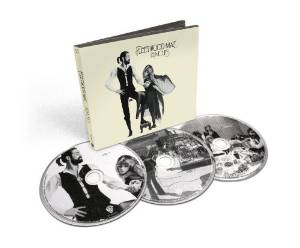
Fleetwood Mac - RumoursI guess for me this is turning into The Year of The List! Earlier this year, inspired by a Writers Guild initiative, I catalogued a suggested collection of the Funniest Screenplays of All Time. Right around that time, inspired by the Fleetwood Mac reunion tour, I found myself thinking about musical recordings so beloved I had purchased them multiple times on replacement platforms. While the records stayed largely the same (yes, I will keep calling them records as long as I am listening to them), a series of innovations in consumer technology offered us relatively inexpensive access to personal libraries of vinyl, 8-track tape, cassette, reel-to-reel, DAT, CD, DVD, and MP3-like digital hard drive storage along the lines of iTunes. Here I am considering what I would call three-buy and above purchases for personal use, which of course live alongside AM & FM radio broadcast, satellite play, streaming services like Pandora and Spotify, and any number of less legitimate ways to file-share.

While I was pondering all thatand readying myself to attend Fleetwood Mac’s current reunion tour at the recently refurbished concert-only Fabulous Forum in Los Angeles (remembering I had attended in 1990 what I believed was the final performance of the farewell Fleetwood Mac Word Tour)what should be playing in our living room but Rumours. Yep, at home in 5.1 Dolby Surround played an album so impossibly fantastic I had bought it at least five times with each subsequent technological improvement, including the remastered scratch tracks on the latest Expanded Edition, which chronicled the development of each song. I sat there listening again to this marvel, no regrets of any kind for the many dollars spent. I have extracted so much entertainment value from this record I would gladly purchase it again. And again.

Thus it occurred to me that Rumours was not alone, and that I was not alone in the three-buy, four-buy, and even five-buy serial record purchases. Rather than pencil out my own list, I went to my social network and asked friends where they had repeatedly dumped their dough buying the same thing over and over. Below you will see an unedited list of those records, some of which I also bought a bunch of times, others of which I have never heard but may sample now. Rather than allow this list to expire in the ephemeral Facebook news feed, I decided to recreate and share it here. I think it’s a cool list, one you should feel free to expand upon in broadening our spirit of sharing.

There is definitely a late Baby-Boomer Bias to these confessions of multiple repurchase, represented no doubt by my circle of social media friends, along with our age and taste. I think you will find the publishing dates stamped for the most part between the mid 1960s and the early 1980s, when the formative years of my contemporaries had disproportionate influence on our modest discretionary spending. Not surprisingly, in the “nifty fifty” albums reported here entirely unscientifically and in no particular order, multiple appearances are logged by the Beatles, Pink Floyd, the Rolling Stones, and Elton John.

If you’re looking for any connective tissue in all these, I think you’ll need more than the music to draw a speculative conclusion. Here is my one linking observation to the extent that I recognize most of the titles: they are in one way or another albums, curated collections or song cycles of various sorts that weave into and around themselves. Much has been written about the demise of the album in this day of pop streaming shuffles. For a while when we were younger, there was a wild notion that a record album could be something of its own as a form of, dare I say it, art.

I’m not sure I have the intellectual fortitude to plow through the art manifesto, but let me just say that when I play Abbey Road I don’t skip tracks, I play it through beginning to end. Okay, on The White Album I do skip “Revolution 9” most of the time, you got me there. But Dark Side is beginning to end, Hotel California is beginning to end, and Rumours is beginning to end. Remember, when these were vinyl, that meant getting up and switching to the flip side—yes, getting up physically to hear the rest!

There is a “something of substance” in these picks that a lot of us find missing in contemporary LP equivalents that don’t even try to compose, let alone somehow unite, a dozen or more flowing songs. I think that’s why a lot of us miss the days of AOR—album oriented rock—and why we’re willing to spend anew when landmark records with recurring motifs and thematic resonance repeatedly make their way back to the virtual shelves. These albums age well, a bit like fine wine, and seldom seem dated. Absent historical and social context, most of these carefully crafted works could just as well have been recorded today and simultaneously sound modern and classic. They were expertly written, performed, and engineered with creative courage that resulted in textured, lasting impact. Good is good, great is great, and unforgettable is, well, just what the word says.

So here is a compilation of fifty records my friends found so remarkable they bought them on three, four, or even more platforms (not to mention extended or remastered versions), and will probably continue to play until their last days on the planet in whatever form they may become available:

1) Abbey Road by The Beatles

2) Sergeant Pepper’s Lonely Hearts Club Band by The Beatles

3) The Beatles (The White Album) by The Beatles

4) McCartney by Paul McCartney

5) Band on the Run by Paul McCartney & Wings

6) All Things Must Pass by George Harrison

7) Imagine by John Lennon

8) Dark Side of the Moon by Pink Floyd

9) The Wall by Pink Floyd

10) Exile on Main Street by The Rolling Stones

11) Let It Bleed by The Rolling Stones

12) Madman Across the Water by Elton John

13) Goodbye Yellow Brick Road by Elton John

14) Hotel California by Eagles

15) Quadrophenia by The Who

16) Songs in the Key of Life by Stevie Wonder

17) Blonde on Blonde by Bob Dylan

18) Born to Run by Bruce Springsteen

19) What’s Going On by Marvin Gaye

20) London Calling by The Clash

21) The Rise and Fall of Ziggy Stardust and the Spiders from Mars by David Bowie

22) The Joshua Tree by U2

23) Led Zeppelin II by Led Zeppelin

24) Lady Soul by Aretha Franklin

25) Songs of Love and Hate by Leonard Cohen

26) Silk Degrees by Boz Scaggs

27) The Point by Harry Nilsson

28) After the Gold Rush by Neil Young

29) John Barleycorn Must Die by Traffic

30) Dr. Hook and the Medicine Show by Dr. Hook

31) Running on Empty by Jackson Browne

32) Cheap Trick at Budokan by Cheap Trick

33) Black Sabbath by Black Sabbath

34) Candide by Leonard Bernstein

35) The Lady and the Unicorn by John Renbourn

36) Nights in the Gardens of Spain by Manuel de Falla

37) The Remains of Tom Lehrer by Tom Lehrer

38) The Doors by The Doors

39) Tapestry by Carole King

40) Tom Petty and the Heartbreakers by Tom Petty and the Heartbreakers

41) Berlin by Lou Reed

42) Wheels of Fire by Cream

43) 21 by Adele

44) Crime of the Century by Supertramp

45) Bridge Over Troubled Water by Simon & Garfunkel

46) Graceland by Paul Simon

47) Dreamboat Annie by Heart

48) Pet Sounds by The Beach Boys

49) Something/Anything? by Todd Rundgren

50) Rumours by Fleetwood Mac

Which “greatest albums of all time” did we miss? Probably a lot. Add your favorites in the comments below and if there is anything you discover new in the suggestions provided, let us know what it sounds like no matter the player you choose as a conduit.

About This Book of Mine

Pre-Order on AmazonI have mentioned now and again that I have been working on a novel for a few years.  It’s time to share a few more details.

First of all the title: This Is Rage.  You will discover why I called it that if you read the sample excerpt on my teaser site and other fine channels we will be utilizing in the coming months, like Amazon or Barnes and Noble, where you can currently place your pre-order that will be shipped when the book is officially released on October 8, 2013.  Shameless, I know, but I am officially in the pull marketing business effective immediately.

There are two protagonists in the story, who are also both antagonists, at least to each other.  They are each hero and villain in the broader context of economic turmoil, which they aspire to improve, but not surprisingly mess up on high-octane, mostly by accident.  Kimo Balthazer is a disgraced radio talk show host, who seeks redemption in the obtuse netherworld of internet webcasting.  Daniel Steyer is a venture capitalist at the top of his game, looking to go out huge with the deal of a lifetime, but market forces have other plans.  That’s not the order in which you will meet them, and you’ll find out why.  At the outset they don’t know each other exists.  They don’t even know each other’s world exists.  But they soon do.  And they don’t like each other.  At all.

I am going to do the right thing and not toss out any spoilers, but I can say that you will spend some time in Silicon Valley, some time in Los Angeles, and some time in Washington D.C.  You will be introduced to the world of Investors, Bankers, and Operators, the three points of an ever-forming triangle that comes with its own hierarchy, rule set, chaos, and politics.  You will also meet a curious politician with a tangential agenda, a conflicted movie studio boss, the co-founders of one of the most successful tech-start-ups ever, and a pair of would-be entrepreneurs turned criminals whose interpretation of thinking different is not quite what their families had in mind.  You will be invited into board meetings and venture partner meetings.  You will hear the voice of Kimo in your head.  You will see what happens when ego and presumption run amok, and the notion of control spirals into hyper normalcy, where random boo-boos add up big time, and the consequences are strangely real and familiar.

My key influence for this book is Tom Wolfe, whose first novel Bonfire of the Vanities blew my mind in ways that still shake me to the core.  I didn’t know what a bond trader was the first two years I was in college.  Then I saw a bunch of guys my age lining up in blue suits to be interviewed to become one.  They went to Wall Street and became extraordinarily wealthy selling paper promises to their clients.  Then came the broad implosion of junk debt.  Michael Lewis, whom I also tremendously admire, made his debut as an author writing about this phenomenon.  I saw the impact on my friends, I saw the impact on New York, and I felt the impact on our economy.  What I admire to this day about Wolfe’s work was how he wove storytelling through the observational narrative, migrating the educational lesson to character development, and burying the polemic in a moral tale for the ages.  I was studying theater at the time, without notion of how I might fit into the business world, or even if I could make a living given what I valued.

A quarter century later we seem to have forgotten the fall of the junk bond kings.  The miracle of Silicon Valley has replaced the lustre of Wall Street and the allure of Hollywood.  I have played my whole career in this fantastic environment of innovation, the arranged marriage of technology and media brokered by the matchmaker financiers, and the output had been invigorating.  We have created jobs, opportunities, and a good deal of wealth — but not for everyone.  In the same way that Wolfe and his New Journalism looked beyond the restaurants and clubs and luxury high-rise suites, I have seen the scary trailing the good.  Where there is big money there are big personalities, and where there is a win-lose battle fought daily, often those who lose are the secondary foils who play by the rules without insight into the eccentric ecosystem.

That is the story I wanted to tell.  That’s why I wrote a business novel instead of a non-fiction set of adages.  This was something I needed to do, part of the continuum of my journey.  I started my career in storytelling, then helped bring storytelling into computer games, then found my way into profit and loss, and now I come full circle.  I needed a way to bring these elements together, to find a synthesis of my passions, which include the theatrical, the financial, the philosophical, the hope of justice, and a touch of dark humor (hopefully more than a touch!).

In the coming months I will tell you more about the publishing journey, but I cannot conclude this project announcement without a sincere thank you to my brilliant editor, Lou Aronica, under whose independent imprint The Story Plant my book is being published.  Lou is a Mensch in every sense of the word (Google it if that’s unfamiliar to you).  He has been a steadfast believer in This is Rage since we met each other last year on Twitter.  It’s not just the notes that he gives me, it’s the way he communicates his viewpoint that makes me want to rewrite a fourth time when he is only asking for the third.  I think Lou, a bestselling author himself, is at the forefront of New Publishing in the same way Wolfe wanted New Journalism to embrace the opportunities of Creative Destruction as a positive force for change.  Wherever this journey takes us, I am delighted to be paddling alongside a friend on this whitewater river of 21st century digital publishing — with a paperback to boot.

So that’s the introductory story of my novel.  It’s my first, I hope not my last, and I welcome you to come along and share the journey with us.  It’s for you, and it’s about you.  I hope to entertain, and maybe share an idea or two as the whitewater rises.

This is Rage.

Advertising Has To Be More Than A Numbers Game

BrandweekOld Wisdom for New Media
by Ken Goldstein
Brandweek, May 5, 2008

WHILE updating my profile on a certain social-networking site recently, I received a tower ad for a brand of acne medication. Truth be told, I was flattered. I mean, the last time I really had to worry about my skin breaking out was…

Well, let’s just say it was a while ago.

So, to the makers of the nifty benzoyl peroxide cream, thanks.  And thanks, too, for getting me thinking.  Because when it comes to the integration of technology, programming and advertising, this complex machinery clearly broke down in my case.  Nobody doubts that social networks and video-distribution sites are critical marketing tools—they’ve got tens of millions of users, nearly half of whom are over 35 and well past the zit zone—but many of them have yet to target effectively.  They still don’t allow advertisers to deliver relevant content that creates emotional resonance.

Is that a shortcoming?  Yes.  Does it surprise me?  No.  The lag time between the invention of a technology and the perfection of its market applications is well documented.  For example, radio technology emerged as early as 1895, but the first on-air commercial didn’t bounce off the ionosphere until 1922 (it was a spokesman for New York City’s Queensboro Corp. lauding new cooperative apartments in a lush, far-off paradise called Queens).  America had an early version of television back in 1927, but nobody saw a TV spot until 1941, when Bulova bought a 20-second ad to open a Dodgers-Phillies game.

Even after the development of on-air advertising, it took still longer for our marketing ancestors to awaken to specific audience targeting—specifically, using women in the TV studio to speak to women at home in the suburbs.  Betty Furness was advertising’s first celebrity endorser, delivering her inaugural pitch for Westinghouse appliances in 1949.  Procter & Gamble created the daytime TV serial drama in 1950 to sell cleaning products to women. Its series (called The First Hundred Years) lasted only two seasons; the name it coined—soap opera—lives on.

And so, much as it took early sponsors time to realize their era’s new media potential; today’s marketers are traveling the same learning curve.  In our digital age, advertising continues to focus on reach, efficiency and relevance—but Web-based advertising relies disproportionately on unimaginative spot and text ads that have changed little since Hotwire introduced banner ads in 1994.

Indeed, marketers have begun to recognize that ads on social networking sites yield click-through rates as low as 4 in 10,000, while the click-through rate for all ads is 20 in 10,000.  When social-networking sites have a 5-to-1 disparity in click-through, it’s clearly time to better capitalize on today’s digital innovations.

The basic truth revealed by the Queensboro co-op apartment radio spot still applies.  When advertising is part of the story (when you see the Lipstick Jungle ad on iVillage.com or a Ross-Simons promotion within a “Cart Me Away” game on my company’s site, shop.com) it defines the difference between advertising that people embrace and advertising people avoid.  Focused Web sites with a loyal audience controlling discretionary dollars still make the most efficient media buys when marketing content is entertaining rather than intrusive.  The cable TV industry taught the networks a great lesson on this point; my sense is digital media are on the verge of learning similar lessons.

Yes, technology can help an advertiser reach the rich audience, but whether you’re selling luxury real estate or acne cream, it’s still the audience—its attention span and the connections it makes with content—that matters most.  I like online social networks, but just because they pull down big numbers doesn’t mean they can pull off a sale.  Getting great products in front of great customers is both art and science; let’s embrace the art and science (and mostly the customers) and worry less about so-called “total media solutions” from pundits who have never made a sales call.  Maybe then we can have some fun really inventing that fabled digital media future.

PostScript for CIR blog post:

Targeting Is Only Part of the Solution

The fun of media is that it is equal parts art and science.  The challenge of media is whichever of those two sides of the brain is not your strong suit.  That’s why it takes a (small) village to get it right, no one has the whole story, but without the whole story, it usually is not a very good story.

History has a way of solving these problems, but it takes time, and it takes casualties.  Just because you can think it up and do it doesn’t mean it will work; but that doesn’t mean you shouldn’t try everything and respond to the feedback you get—quickly, honestly, and passionately.

Original Article Republished in China