The Miracle of 18 Years

This tribute to the life of David P. Coon was delivered live by the author on February 4, 2024 in St. Alban’s Chapel at ‘Iolani School in Honolulu.

I’m standing in his spot. I remember sitting in any number of locations in those pews starting at about age 12. When he stood here, my eyes were transfixed. This was his spot. The chaplains stood here. Many of our teachers stood here. Years later I even stood here a time or two. We were borrowing the space ever so briefly. He belonged here. This magnificent structure was all our home, but this spot was his.

Much can be said about presence. When that presence transcends the ordinary, everyone knows it. Whether speaking as the Revered David P. Coon, Headmaster Coon, Dr. Coon, Father Coon, even the impossible to say “Dave,” this beloved gentleman embodied presence. That baritone voice, that solid handshake, that unforgettable laugh – presence doesn’t even begin to describe him.

This is where I first learned about original sin. I didn’t even know what it was. He stood here and taught us that we had fallen and didn’t even know it. Redemption would be our lifelong mission. What in the world did he mean by that?

That’s heavy stuff I’m still digesting in my 60s. Imagine being 12 and trying to make sense of the homily. It made sense because he always made sense. It was like listening to an opera star. Could be Italian. Could be French. I just wanted to listen.

I loved coming to chapel. Really. For 5 of the 6 years I was a student here, I was the only Jewish kid on the roster. When we became co-ed my senior year, I was no longer solo in that regard, diversity was blossoming at every level. It had been every year prior. The women who joined this community as students and graduates did so in the culmination of this headmaster’s vision. He saw it as necessary before anyone else and he made equality reality.

This was a place of learning and truth. This was a place of inclusion This was a place of love. I’ve never felt more at home than I did on this campus.

Dave Coon insisted on that. Dave Coon made it so.

I’ve been awarded the honor of speaking today on behalf of the ‘Iolani alumni in tribute to a man we respected, admired, emulated, and loved. It’s an impossible task and I have been asked to keep it brief. If you know me, you know that’s even more of an impossible task.

Brevity is required so I will do my best to honor it. Representing the breadth and depth of alumni that walk up here each Spring and get a diploma? I’m just going to admit failure right now and try instead to tell you what I think Father Coon did better than anyone else in all my years and travels.

Ready?

He planted seeds.

Not ordinary seeds. Seeds of excellence. Seeds of change. Seeds of diversity. Seeds of integrity. Seeds of the impossible. Fragile, vital seeds that sprout in young minds and grow stronger and steadier for a lifetime.

I’m a grandparent now. It’s a bit eerie. It’s caused me to think about the arc of childhood in ways I never imagined. Those baby seeds take shape in enormously deep roots, inescapably revealing insights in the most unpredictable contexts. We all start out in the same place. Completely vulnerable. Non-conversant. Utterly dependent. Absent memory. Even Dave started that way. Hard to imagine.

What happens next, I’ve come to think of as The Miracle of 18 Years. This was a revelation for me, a daunting moment of transformation.

Years ago, I was interviewing an impressive high school senior for college. I do this each year as a volunteer. This particular young adult was blowing me away with knowledge, analysis, ambition, humility, graciousness, kindness – she even made me laugh.

So I’m sitting there marveling at this 18-year-old laying out a portfolio of observations eons beyond her years and a game plan to make the fast track to a Nobel prize, and I’m wondering, how did that happen? How did that barely cognizant infant compound knowledge over a period of just 18 years and come to utilize a vocabulary that sent me paging through the Oxford English Dictionary?

It seems impossible to believe that could happen. I’ve been trying to put that together for the better part of a decade, how that arc works, the impossibility of diapers to Dostoevsky in an 18-year sprint. 18 years, it’s nothing, it flies by, and suddenly you’re an adult human being. Who figured that out?

In that moment of clarity, all I saw was Father Coon. This was his gig. This was his normalcy. He never thought twice about it.

Each year another group of us would arrive, each of us a small lump of pizza dough. We could be 6-year-old pizza dough, 12-year-old pizza dough, it didn’t matter to Dave. This man knew how to turn pizza dough into pizza.

And here was the secret trick. He knew each of us was unique. No two of us would be the same. I think he loved that most of all. It wasn’t his job to mold us into what he wanted us to be. He wanted to mold us into the best version of ourselves that we could be. What mattered to Dave was that we would become what we wanted to be.

Were there a few values we should share? You bet. Did we have to know when a sentence ended where to place the period? Oh, yes. Did 2 + 2 equal five? No, it did not. The rest? Mostly up to us.

That’s where he planted the seeds. In our hearts. In our minds. In our souls. We were not finished goods. Those seeds needed to grow inside us for the rest of our lives. That’s what he understood better than anyone I’ve met. That was what he did better than anyone I’ve met. He helped us become who we needed to become, and he taught us to care for each other more than ourselves.

Parents do it. Of course, they do. Once, twice, in the extreme maybe six or eight times. He might pray for you if that were the case. He did it hundreds of times each year for decades. You want to talk about leverage and scale? You want to talk about consistency? Imagine creating that miracle of human development over and over again – never losing energy, never losing interest, never losing faith. Imagine the odds of that kind of repeat success.

There’s a word that comes to mind: indefatigable.

You know what else? He did it quickly. We didn’t see it coming. We didn’t even know it was happening. He knew The Miracle of 18 Years was a ticking clock. When we came up here in the Spring to shake his hand, that clock had mostly run its course. Another clock was starting. His day job was done, but its impact was only beginning.

Dave Coon led this astonishing institution from its storied past to its celebrated future. On this campus where we gather today, he made that miracle purely routine.

I had the good fortune at one point in my career to work at Disney where we talked a lot about magic. That dialogue dates back to Walt.

If you’re into science fiction, you know that Arthur C. Clarke wrote, “Any sufficiently advanced technology is indistinguishable from magic.”

Neither Walt Disney nor Arthur C. Clarke had anything on Dave Coon. Dave Coon worked his magic perfecting and normalizing The Miracle of 18 Years. They might have failed his class. He probably would have asked for more specificity.

Okay, we’re in the home stretch, I promised brevity, and this is not the kind of place to tell lies. Here is the most important part.

It didn’t stop when he left. The seeds were planted all around this place. There were teacher seeds who shared the magic with other teacher seeds. There were leadership seeds that in this room right now are evangelizing inspired leadership. There were math seeds and sports seeds and music seeds and poetry seeds. They all just keep growing.

Father Coon stepped off this lectern when he thought it was time to do other things, to nurture a church on the Big Island, to spend time with his family, to counsel another generation of educators. The seeds were deeply embedded. Their magic kept blossoming.

The Miracle of 18 Years continued. It continues to this day, while he watches and listens to us from a different place of presence.

We embark as youngsters naively on The Miracle of 18 Years with hopes of accomplishment, hungry to achieve goals, eager to find fulfillment in the relationships we traverse. When there are more years behind us than there are ahead of us, we may start to think instead about legacy.

Legacy is not something we can direct; it is left for others to decide. The legacy of Dave Coon is the perpetuation of his presence in this beautiful place where he lived and worked and touched each of our lives.

It is a legacy of love, which is the one lesson he taught repeatedly, sometimes in the classroom, sometimes on the lawn, sometimes standing in this place. He is still here and will be forever. This is still his place. I am a seed of his legacy as are we all. The love of this alumni for Father Coon is boundless. He taught us to love each other, to welcome the stranger, to honor every life we would be privileged to encounter.

How can any presence be more profound than that?

_______________

Photo: ‘Iolani School

The Uplifting Wisdom of Fred Smith

I recently enjoyed the privilege of participating in a small group online discussion with Frederick W, Smith, the founder and longtime CEO of Federal Express. Imagine being at the helm of a global disruptor like FedEx for an uncanny five decades. Think someone like that might have a few things to say about the life and times of business, society, and learning? You might be as surprised as I was about the big ideas he would most want us to embrace.

Legend has it that the initial business plan for FedEx emerged from an economics paper Smith wrote as an undergraduate at Yale University, describing the need for a reliable overnight delivery service. He best remembers receiving a grade of C on that composition. That idea grew out of his experiences as a young pilot, occasionally offering to deliver important packages for New England technology companies that he would carry in his personal travels.

Equally important in the formation of his character was a four-year stint in the U.S. Marine Corps commencing in 1966 where he received officer training and served in Vietnam. “Yale taught me to think, and the Marines taught me to do,” notes Smith in shaping his vision and leadership of FedEx, which he founded in 1971. The company began regular operations in 1973 and just celebrated its fiftieth anniversary. Smith has transitioned to executive chairman but is every bit as engaged in the company’s direction as he was at the outset.

Early market studies confirmed Smith’s thesis that there was an enormous opportunity for an integrated global delivery network that would be realized by harnessing the power of transportation machinery and sophisticated data systems. He took on the daunting task of merging the capabilities of technology with the mapping of logistics, bringing together physical assets and mathematical calculations on a vast scale. He knew that building this kind of network was a frontloaded bet, but that once established, the barriers to entry of challenging that network would create both a competitive advantage and a trusted brand among customers.

Today that network generates $90 billion in annual revenue, employs 550,000 people plus another 150,000 contractors, moves 16 million shipments each day, operates in 5000 locations in 220 countries, manages 650 planes, and coordinates 210,000 vehicles. FedEx accomplishes this through endless innovation, precision execution, and constant reinvention.

What can we learn from an incomparable entrepreneur, celebrated business leader, and caring philanthropist that might be even more exemplary than an indefatigable work ethic? My key takeaway from listening to his carefully chosen words is that humility is a choice, and Smith embraces humility not just as a core personal value, but as a motivating force that drives him to an always improving game. “The world does not begin with your birth,” he reminds us. “There is much to learn in studying the thinkers who came before you.”

Given the ceaseless advances in information technology, Smith believes it is the CEO’s job to stay immersed in the evolution of change management. In addition to the legally required standing committees of a public company’s board, he has found it essential to maintain a carefully identified technology advisory committee well versed in applied science beyond his company’s core competencies at any time to make sure those technical abilities become core competencies.

He also makes it a point to stay close to senior military leaders both formally and informally for their deep understanding of complex systems and human motivation in urgent circumstances. He has reciprocated over the years serving on key government panels and presidential commissions to help bridge the gap between private business and government, share emerging ideas, and offer his hard-won knowledge as a quiet contribution to public service.

Smith is now keenly focused on embracing the fast climb of artificial intelligence, yet another strategic inflection point both in the growth of his company and the world at large. The threat of cybersecurity has always loomed large on Smith’s short list of key concerns around systems risk, where he sees generative A.I. both exacerbating the problem and potentially forging a path to workable responses. “It will help remove the friction of international customs,” he suggests. He is also passionate about carbon capture, driving FedEx to a carbon-neutral future not just because it is the right thing to do for the environment, but because the companies that get there first will enjoy ongoing business advantages in proving models with measurable returns on investment.

The culture of FedEx remains focused on innovative practices as a competitive platform that is rooted in the company’s founding and ingrained in the necessity of proactive thought leadership. Not surprisingly, he is obsessed with teamwork and team accomplishment over individual ego and achievement. “You’re not the smartest person in the world, be humble,” he reminds us. His observations of multidisciplinary success in business, military, and government enterprises reinforce his championing of building and sustaining team dynamics.

Smith is concerned that people are now spending so much time behind video screens that their sense of reality is being distorted by inadequate forms of communication. “Thinking behind screens” does not bridge viewpoints or bring people together. He observes in social media that it creates “a place where outrage has found a business model.”

Now, about that lasting wisdom: Here’s where Smith brings down the house with his clarity of life’s lessons and unassuming purpose. Staying on the edge of technology and reinvention no matter one’s current success is more tactic than strategy for this highly accomplished individual. What is core to Smith is his embrace of mortality as a further reflection of humility. “Life is short and it ends, the clock is ticking,” he advises. “Don’t get all wrapped up in your personal self, that’s a very unhealthy thing to do.”

What is key to reminding us of our humanity in his worldview? “Maintain a sense of humor, because life in many ways is absurd, and you need to be able to laugh at yourself.” Smith clearly understands irony, has seen his share of farce, and with sporadic investments in the arts, knows a funny story when he hears one.

There you have it from one of the most successful innovators of our time: be humble, remember your mortality, and don’t lose your sense of humor. I would never have guessed that’s what I would take away from this conversation, but how delighted I am to have experienced such a treasure of actionable advice. Fred Smith understands leadership by example. Humility is evident in his journey, mortality is certainly at hand given these reflections, and if you listen at length he might just make you laugh.

_______________

Photos: Pexels and FedEx.com

A Childhood Friend Passes

I said a final goodbye to a longtime friend recently. He was intensely private and not at all a fan of social media so I won’t name him here. I do feel the need to write about him, so I hope I am in-bounds handling this in the abstract.

We actually lost him during Covid, but the logistics of his memorial had to wait for travel arrangements. He wasn’t a Covid victim, perhaps just the timing. He had other medical issues that lasted all his life. I have known this person since we were 11 years old, which I believe makes him the longest-standing friend I have maintained. I didn’t do a great job of maintaining that friendship, but luckily I did visit with him right before Covid. He gave me a reasonably rebellious book right in line with his lifelong wit and irritation with the unreasonable. I gave him a copy of my last book. We never got to discuss either.

The medical condition that haunted him dates back to our earliest conversations. He never wanted anyone to feel sorry for him, but if you were in his circle, he wasn’t afraid to talk about it. It was a neuromuscular disease and although his entire life would be linked by operations and treatments, he refused to let his life be defined by it. It was existential. He understood existential.

Several years ago I wrote a tribute to Jerry Lewis when he died. I had been involved as a supporter and volunteer of the Muscular Dystrophy Association since childhood and strangely always felt a connection to Jerry. I remember discussing this with my friend in childhood. He had a mixed reaction to MDA. He appreciated all the donations that Jerry inspired to invest in research, but he was troubled by all the photoshoots and poster children. This friend was sufficiently progressive but never woke. When I wrote my piece on Jerry he wrote to me after a very long stretch of absence, almost out of the blue, a brief email to me that began:

“So I don’t get a mention in the Jerry Lewis post? I cried when he died. Loved him as a funny man.”

He then went on to blast MDA, a very harsh critique. You see, this friend understood the nature of a mixed bag. He could see light and dark in the same moment. Dark was really dark but light was talent, accomplishment, connection, selfless commitment.

Yes, a mixed bag. Aren’t we all? Particularly a half-century past the day we meet a childhood friend.

There were phases to our friendship following our seven years together leading to high school graduation. When I arrived in Los Angeles, I had nowhere to live, no money, no job. Just a college degree and hope. My friend was still in college here and welcomed me to sleep on his sofa until I could establish credit and find a place (it was actually his sister’s apartment, although he deftly negotiated my path in the door). I used to comb through the L.A. Times each day looking for apartment rentals and employment. Soon enough those came together and I moved on. I don’t forget that sofa. It was a symbol of friendship. I drive by that apartment every once in a while. Yes, the proverbial launchpad.

Years later when I was immersed in a writing assignment and seeking his feedback, he told me that someday he might want to write a movie or book. He wasn’t completely sure what he wanted to write about, but he told me with certainty he knew what the last line would be: “Let’s go home.”

There is a lot of resonance in those three words. Home for him was not specifically a place or even a metaphor. It is an idea, an aspiration, a Platonic Form.

He enjoyed a celebrated career in architecture and co-founded his own firm. He was a master of sculpture and ceramic design. He cherished historic structures and the learning to be found in the history of art. The notion of home was alive and well in all his aesthetic constructs. He clearly saw the natural extension of people into the curious things they chose to build, not always successfully, but hopefully with conviction.

Sometimes when I am getting to know someone, I ask them what three words they would most hope someone else would use to describe them. I never asked this friend that question because when your connection reaches back to childhood, you have a lot of time to think about it.

He was resilient. He was uncompromising. He was nuanced.

Resilient—because no matter the physical or character challenge he faced, he never backed away from it, never let it be an excuse or obstacle, never complained that he wasn’t dealt a fair hand, never asked for a different set of rules.

Uncompromising—because if you were wrong, he would tell you so, and even when you argued coherently that you weren’t wrong, he’d explain what you were missing in your evaluation and help you see why a counterintuitive approach might create a bridge to his logic.

Nuanced—because he knew wherever light entered a prism, its refraction could not be contained, mixing light and darkness in most forms of thought, the beautiful and the sublime in most expressions of art, good and not-so-good outcomes in too many of our intentions, however noble our purpose.

Our touchpoints form a pastiche of separately evolving but forever interconnected lives. A love of the water, whether on the natural coastline, an inelegant water skiing loop, or a boat shared with friends at sea. Political fairness and equal justice in limitless dialogue. The intersection of historical philosophy and pragmatic psychology. A belief that the courage to choose honest words matters more than our ability to perfectly craft them under pressure. An ardent shared defense of Bachman-Turner Overdrive. These are bonds time cannot undermine.

Lives together and apart twist and weave. Our relationships with each other are fluid. We don’t realize that when we come together and separate, but it is the course of things.

This particular friend’s family had a vast impact on me. Counsel from his father set my life on a course that has let me be who I am today. I wouldn’t be the same otherwise. It’s not just your friends who transform you. It is their circles and the circles you cannot imagine are forming in the background of your journey. When you look back, it is all so clear. At the time, it seems like just hanging out.

Sometimes I think there is no such thing as just hanging out. Everything can be consequential. You don’t know that at the time. That’s the scary part. We’d best pay closer attention all the time.

There are few realities more absolute than mortality. It is the universal link that humbles us all. It translates directly to the impermanence of our time together. That can be hours, days, years, decades, or most of a lifetime. We seldom understand it that way, because time does not reveal itself that way. The passing of time is certain, but not our shared intervals.

When we lose someone, we are reminded both of our own insignificance in the continuum of earthly events and our enormous significance in the impact lives can have on each other. I am thinking about that now in the span of a half-century, about what I did right and wrong in this friendship, what I could have done better, and how I am changed and shaped by this remarkable individual’s authenticity.

He left us with the perfect ending.

Let’s go home.

_______________

Photo: Pexels

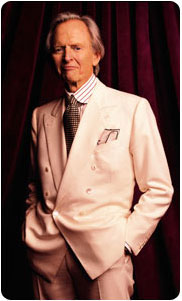
Why Tom Wolfe Matters

What more can I add to the multitude of tributes to literary legend Tom Wolfe? Certainly nothing unique, but given the inspiration he has provided me, it would seem irresponsible not to add a few personal notes.

Wolfe is one of my favorite authors of all time. He was a writer who changed my life. I never met him, but I always felt like I knew him. Now I will miss him, but the library of his life’s work will forever be near me.

It was his invention of New Journalism that changed the way we heard and told stories. He crafted a new set of norms meant to break all the rules that desperately needed to be broken. The storyteller belonged in the story, fact or fiction, a hard break from the false mandates of objective absolutes. He proved by example that a writer and his story are inseparable, no matter the subject matter. His biting critiques of hypocrisy are funny, eye-opening, and actionable. His characters are equally outrageous and believable. The unique style and consistent unpredictability of his prose are seldom short of stunning.

When I first read his 1989 manifesto in Harper’s, “Stalking the Billion-Footed Beast,” I knew the coming shift in literature was more than cosmetic. Allow me to borrow a passage from that essay on how the call to relevant storytelling so lit up my life with hope and gravitas:

By the early 1960s, the notion of the death of the realistic novel had caught on among young American writers with the force of revelation. This was an extraordinary turnabout. It had been only yesterday, in the 1930s, that the big realistic novel, with its broad social sweep, had put American literature up on the world stage for the first time. In 1930 Sinclair Lewis, a realistic novelist who used reporting techniques as thorough as Zola’s, became the first American writer to win the Nobel Prize. In his acceptance speech, he called on his fellow writers to give America “a literature worthy of her vastness,” and, indeed, four of the next five Americans to win the Nobel Prize in literature—Pearl Buck, William Faulkner, Ernest Hemingway, and John Steinbeck—were realistic novelists.

Wolfe reminded us of our American legacy and tradition in creating words that matter. To combine that public statement of reborn intent with a social novel as demonstrative as The Bonfire of the Vanities would have itself constituted a life achievement, but he was just getting started. Ironically, this was years after he wrote The Electric Kool-Aid Acid Test and The Right Stuff in his relative youth. Whether the narrative was reported, invented, or a combination of both, his voice exploded from every page he published and lifted us to reconsider the controlling norms crowding every corner of our lives.

He was already in the club when he dusted off the house rules. To be fair, it was less of an edit about purpose than it was a bold restatement of the rules of engagement. These were the kind of “new rules” that deeply appealed to young writers like me who weren’t sure if it was still okay to address the injustice of our surroundings with purely accessible plots and characters.

Could an author be both mainstream and thoughtful, both entertaining and aspirational? Wolfe told us yes, showed us how, and begged us to beat him at the game. Eleven years after Bonfire he proved he could tackle the social novel in different geography with A Man in Full, bringing realism and nuance to an equally vibrant cast of characters in the financial machinations of Atlanta. Again he beckoned all comers to rise to a more demanding creative standard. We couldn’t beat him, but we sure could take out pen and pad and play along as if the contest were open for anyone brave enough to enter.

What did I learn most from this erudite iconoclast?

Current events become history. Tell even the simplest stories with flair. What you chronicle for the present becomes a time capsule that can be unwrapped in ten years or a hundred. Reporting on contemporary events is a noble calling, but framing them within multiple prisms of context transforms ordinary happenings into perpetual discussions of culture and significance.

Story and storyteller are inseparable. Voice is alive whether you are writing fiction or non-fiction. To pretend otherwise, that there is somehow an ideal objectivist viewpoint, is to deny the reality of the music in your head and the muse speaking through you. Acknowledge it, confess it, embrace it.

Style is content. What you write and how you write it are also inseparable. So many of us studied his eclectic, eccentric style of phrasing to adopt his craftsmanship and tone. If you want to use nonsense syntax to land a point, to hell with copyeditors, be a writer, accentuate at will and rise to the iconic. Like this, from Bonfire: “On Wall Street he and a few others – how many? – three hundred, four hundred, five hundred? – had become precisely that … Masters of the Universe.”

How big a deal was Tom Wolfe? I can’t identify a single reductive adjective. Enormous is a good start. Unique is another. I’d toss in galvanizing as well. His writing changed the entire playing field for a churning generation. He showed us how words become possibility. Yes, he was that big a deal.

Important works of literary fiction that are fully absorbing may not be in the same demand today as they were a generation ago when readers of another time learned to love words as life inspirations. When we remember Tom Wolfe as author and provocateur, we remember what is possible when we demand as much of our artists as they demand of themselves.

Words matter. Stories matter. Storytellers matter.

Tom Wolfe matters.

_______________

Photo: TomWolfe.com