The Study of Philosophy

With all of the ways one could spend four years in college, why would anyone study philosophy?

It’s impractical.

It’s largely self-serving.

Given the vast syllabus of reading necessary to be even modestly well versed in both Eastern and Western thought, there is terribly little material one can cover in such a short amount of time.

It makes no sense to absorb oneself in such an esoteric endeavor with such thin coverage and so little quantifiable value.

It’s an expensive way to squander time, and even harder to explain to those helping pay for it.

Yet I did it, albeit about three and a half decades ago. Truth be told, I still spend unreasonable amounts of time delving into such curious texts as Kierkegaard’s Either/Or and Sartre’s Being and Nothingness.

Why?

Why Then and Why Now are two different things. Let me try to begin with a justification, and then tell you how it has helped me to be better in business, better in service, better in life.

Philosophy is mostly about reading literature, but not the fun stuff. It’s mostly non-fiction, and it’s mostly argued opinion, if not conjecture. There is some history and an occasional parable, but mostly it’s very dense expository in translation. Occasionally you get to drill into something quirky and theatrical like Beckett’s Waiting for Godot, but that’s a tangent, not core curriculum. I mostly focused on the Western canon, so that means works originally composed in Latin, Greek, German, French, and Russian. The translations are often as head-scratching as the source texts.

From the middle ages to the Renaissance in Western philosophy, there is little differentiation between theology and philosophy, so if you don’t want to read about God, this is probably not going to be your thing. You can reject faith later as is often the tradition in modern existentialism, but you have to read a lot about it to reject it comprehensively. Faith is a subject of mainstream devotion and much conflict in our culture. It’s worth learning about it, regardless of what you choose to believe.

The tension in philosophy between quantifying the physical world and attempting to explain metaphysics is persistent and unresolved. Logical argument as a discipline embraces mathematics until calculations outreach contemporary science, forcing abstraction onto problems that later generations will solve. Laws, ethics, psychological motivations, justification for conflict and its resolution, and even aesthetic judgment all prove evolutionary. What is certainty at one time is speculation in another.

Rejection, revision, and reform are the guiding constants of substantial ideas. It’s all quite messy, contradictory, and exhausting.

Philosophy for me as a young person became a passion of personal growth, self-realization, and academic inspiration. It was helpful to me that it was mostly non-emotional because I was also a student of the arts, which were emotional. I needed the balance. I needed the complementary discipline. I needed to be satisfied that hard questions were worth attempting to answer, even if those who answered them began by rejecting the last person who tried to reject them. Somehow that all seemed progressive and appealing to me.

I also managed to convince myself that the power of logic was broadly applicable in almost any field of inquiry. At the very least I would find the structure of articulating an idea useful in dramatic storytelling. While it might not have seemed obvious or even apparent to me how that could be put to use in purchasing food for consumption, I had faith I would figure it out at some point.

Ah, faith—it surfaces in the least likely of circumstances.

There was also this quintessential challenge from Socrates in Plato’s Apology:

“The unexamined life is not worth living.

Those words messed me up because I took them seriously. I even wrote and directed a short film in college specifically about the reincarnation of Socrates in modern times to make this point. It was called Apology. It was supposed to be funny. It wasn’t, but the dialogues of Plato became so ingrained in my consciousness that I had to give it a try.

Failure came early and often after that, but with much clearer reason.

That was Why Then. Let’s cut to Why Now. Yes, there actually is a timeliness to all this.

Our next presidential election is on the horizon. A lot of awful stuff has happened since our last presidential election. I’m upset. I’m more than upset. I’m baffled, befuddled, and out of sorts. Our nation may never heal. I doubt we will get over these scars in my lifetime.

Philosophy remains my comfort zone. It’s a place I go to make sense of things that do not, will not, and perhaps cannot make sense. I wrestle with this all the time. It does not immobilize me. I get things done. To my surprise, I have indeed learned how to apply logical argument to my work. I use it in storytelling and even find ways to wind ponderous floating into the plots of my novels. I also use logic to make arguments in business—in sales, in legal, in coaching. That’s become a byproduct of philosophical usefulness. The core practice is now about coming to terms with the absurd.

I’ve heard all the rhetoric about how our president got elected, about somehow appealing to a forgotten middle class. He has never acknowledged income inequality as one of the defining issues of our generation, never displayed any evidence of empathy or humility, yet he declared himself the champion of hard-working people authentically in need of a break. Those voters may have been duped, but he is an absurdity, as is their loyalty. Our embrace of ignorance and authoritarian mindlessness is absurdity. I use philosophy to live with the absurdity. As long as I am wrestling with difficult ideas, I am convinced the wrestling matters.

Where there are ideas, someday there will be solutions.

The unexamined life is not worth living.

Why are we here? Why is there consciousness?

To do this hard work.

To self-define in the name of combating the absurd.

To commit authentically to making that which is bad better.

Might there be such a thing as Applied Idealism? It’s a counterintuitive notion, difficult to contemplate certification, but spiritually tempting. Samantha Power grapples nobly with reaching for a more attainable abstract in her new book, The Education of an Idealist. It’s comforting to know we are not alone in our outlandish aspirations.

When I envision structures of evaluation, I often discover that the separation of thought and action is at best temporary, if not arbitrary. Logic does not exist outside a problem; it is embedded in the problem. Ethics aren’t distinct from rules and laws; they are expressed in the adoption of rules and laws. Pragmatism does not have to be isolated from hope. When I contemplate a model of assessment and apply it rigorously, I can be held in check by obstruction, but I can’t long be fooled.

As long as I can study, I can stay a fighter. As long as I can delve into the abstract, I will always have more stories to share with you. Once in a while I may even get you to chuckle. That’s when I know your mind is opening and perhaps ready to absorb something new.

In the end, is the study of philosophy a tragic waste of time? I guess for many that might be a fair conclusion. I’ll never see it that way. I see it as vital. I see it as necessary.

Stay tuned to this channel. There’s a lot more philosophy ahead. Considered yourself warned. Or alerted. Or ignited. Ideas are always free. What we do with them is seldom without cost.

_______________

Image: Pixabay

From Nothing: Reflections from the Road

One of the rare joys of being a writer is getting to talk about your work. One of the even rarer joys is getting to talk about the same work more than once because it is being published in a new format.

From Nothing, my third novel published by The Story Plant, allows me that joy with the paperback release on October 7, 2019.

It’s two generous bites of the apple, separated by over a year of contemplation, during which I got to hear from readers on how this story impacted their lives.

It’s a privilege to reflect on how I intended the troubled journey of Victor Selo to stir emotion, and how that was played back to me by my cherished readers. Perhaps an appropriate context for this is leaning on some of the lyrics I borrowed for inspiration and attempting to tie them back to many of the comments shared with me at readings, in reviews, and in letters sent my way.

Turn off your mind, relax, and float downstream …

That’s The Beatles, and they are everywhere in this tale. Probably the first thing people discover about Victor is that he is anything but relaxed. Life events don’t afford him that luxury. Yet readers clearly made the connection between the invisible forks in the road chosen by Victor and the intense downstream consequences or results of their own unpredictable resolutions to unseeable moments of fate.

I found that I am not alone in boiling down my life to five or six key choices that I wasn’t necessarily aware were determinations of my ultimate twists and turns until decades after those quiet tests were unmasked. I have found great moments of connection in hearing readers see the fickle outcomes of their paths in the eyes of a character who is a stranger to their circumstances while a mirror for the task of connecting their own dots.

We are stardust, we are golden …

That’s Joni Mitchell, celebrated forever by Crosby, Stills, Nash & Young. It has been hard to escape this refrain with all the milestone anniversary hoopla around Woodstock, but readers seemed to understand that nostalgia wasn’t a theme I wanted to explore. My devotion is to the miraculous artistry of the songs that stay with us, the melodies and harmonies that become attached to the events we navigate and reconstitute themselves during the many decades we interpret their significance.

Readers have joyfully acknowledged that context and relevance become inescapable in the songs that become their favorites. Think about your favorite song the first time you heard it and what was happening in your life then. Now think about the same song a decade later, and a decade after that. The song hasn’t changed, but you have. If it remains a favorite, there is a reason. Our favorite songs blossom as our lives expand. We may even have to abandon a song for a while when our history associates it with pain. Yet we can always return to a song, and it can return to us. That is the majesty of composition and the alchemy of our interactions with vibrant creative matter.

Guess it’s better to say goodbye to you …

That’s Scandal, one of the less famous bands covered in the Vegas clubs where Victor crawls his way back to self-confidence. Early in my thinking about the arc of this tour, I knew I wanted to include references to the biggest acts of our time alongside some of the voices that had equal impact on me even with fewer hits. I’ve enjoyed the engagement from readers asking me why I excerpted one song and not another, and whether I planned a sequel to fill out the playlist. I don’ think a sequel is possible, and the chorus sung here by Patty Smyth is a good reason why.

It is humbling to know that readers turned these pages to find out what Victor might learn from the corporate monsters pounding on him, and from the many misfortunes he believed he had overcome but never actually escaped. When I listen to people tell me about the past events that are holding them in place, I wonder if part of the glue that holds us together is the evasive hope that we can let go, that we can move on, that we can start again. Whether it’s business, invention, or love, the past is an obstacle we all understand. It is all too easy to suggest to another that letting go and moving on is usually our best bet, but how often do we courageously take our own advice?

If you haven’t yet had a chance to read From Nothing, I hope some of these thoughts may inspire you. If you do have occasion to pick it up in any of its releases and have your own interpretations to share, I would enjoy learning from you.

This is the soundtrack of our lives.

Why Do We Do Difficult Things?

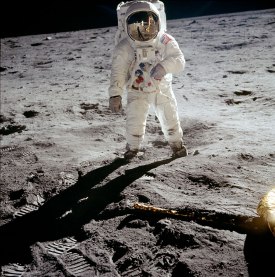
Apollo 11 - NASAI’ve been out on book tour for the launch of my new novel, From Nothing. At one of the early talks I began with a simple question: Why do we do difficult things?

I’m not talking about ordinary-difficult things like schlepping yourself to work every day or paying all your bills. I’m talking about really big stuff. Pick a career path. Marry someone. Divorce someone. Start a company. Write a book—without an advance check.

Why do we decide to tackle extraordinarily hard challenges? Why do we embark on the kinds of things that change our lives?

I’m going to give you the answer in just a few more carriage returns, but before I do, think about what your answer might be.

Why do you do exceptionally difficult things?

Is it for money?

Is it for status and ego?

Is it because someone else pressures you to do it?

I think those enticements can play a role, but I don’t think it’s why most of us do difficult things.

I think we do difficult things because we can’t not.

Try repeating that in your head. Read the words “Why do we do difficult things?” Then answer aloud: Because we can’t not.

If you’re not alone, say it rather quietly under your breath, but do say it aloud. If you are alone, shout it from your gut.

Why do we difficult things?

Because we can’t not.

Excellent, I think I heard you that time! You’ll note the purposeful application of a solid double negative. Don’t worry, the grammar police aren’t coming for us, at least not this time.

I want this message to encode in your mind: Because we can’t not.

The topic of my book talk was why I choose to write for what amounts to the tiniest part of my income given the full span of hours invested. The question at hand was why I didn’t spend more of my time on lucrative business projects instead of sitting alone in a room for half my waking hours banging out words without much promise of real financial upside no matter how well I write.

There are obstacles to book distribution at an enterprise scale that are beyond my ability to control. If I chose to write fiction solely for wealth creation, I would be repeatedly disappointed. I would like to be pleasantly surprised by financial reward largely because it meant more people would have read my stories, but I would be foolish to count on it.

To me, it doesn’t matter if I get paid a fortune or less than minimum wage. Most of the money I’ve made in my career was when I wasn’t thinking about money at all. The few times I was thinking primarily about money I made the least. Or none.

I follow the path I can’t ignore. I do what I need to do, and the rewards follow or they don’t.

Why do we do difficult things? Because we can’t not.

I have learned that this applies to business, to art, and to human relationships. The principle is always the same.

Certainly money is a part of the equation. For some people, it’s a very big part of the equation. In my experience, when it’s most of the equation, you’ll see in front of you a very unhappy person—whether he has a lot or a little.

When the reason for doing things is unbalanced, most everything begins to go haywire. That actually happens to the main character in my new book, Victor Selo. He sees people going for the money and only the money. The world falls apart.

Why do I sit in front of this grimy keyboard pounding out sentences when I could be helping start or buy or sell another company?

I like money. I just decided I knew how much I needed, and what I wasn’t willing to do in search of more. I needed to return to who I was when my wife met me: a guy who made up goofy stuff and told it to other people (I borrow that line liberally from George Carlin). Minimum wage or a bestseller, it didn’t matter. I couldn’t not write.

I want you to consider doing the same. I want you to do whatever it is that you cannot-not do. Ah, there’s that double negative again! This author will go far.

Please do what you cannot-not do.

Why not stick with the easy stuff? Isn’t it difficult enough to get through each day and week, pay the bills, avoid unnecessary conflict with your boss, co-workers, acquaintances, and family?

Yes, all of our routine tasks can be exhausting. It’s easy to let them take over our lives. Here’s what those debilitating punch lists obscure:

Time is precious. Time is perishable. Our lives are at last defined by how we play out the clock.

Self-definition is a choice. It happens to be a very hard choice. It takes place at those invisible forks in the road we too often only see in hindsight. When we force ourselves to look ahead, our choices become constructively active, not passive, even when ultimately deemed wrong.

The intrinsic rewards of courageously owning a cannot-not do agenda are unique to each of us. If we don’t own that choice, it is made for us. Some people call that one of life’s regrets. I think of it more as ignoring the call to unique opportunity.

Why do we do difficult things? Because we can’t not.

Another way to go astray and release control of the clock is to lose faith in our honest self-awareness or pure acknowledgment of our true abilities. Remember, I am not talking about the things we might want to do. I am talking about the things we cannot-not do. Those two forces might align, but not always. Self-deception can cloud our best choices.

Here’s a confession: I was a theater student in college. I was also a philosophy student so it wasn’t a total waste of time and money. I had a very Russian acting teacher one semester, who took me aside and said in a thick accent, “You know what, Kenneth G, this acting, you know why I do it?”

Okay, she didn’t say Kenneth G, that reference comes years later, but it kind of works in this context. Go with me.

“Because you’re good at it?” I answered her.

“That is beside the point,” she replied in English that could have been Russian. “I do it because there is nothing else I can do and still be me. The difference is, I think there are other things you can do and still be you, so do that, and you will spare yourself a life of misery.”

I thought about it and said: “Is this a nice way of telling me I’m not good at acting?”

She smiled and nodded with that Russian piercing insight. “You see, Kenneth G, you understand so well. Do something else that you cannot-not do. What we should do is what we must only do—because we can’t not.”

That’s when I knew I had to write.

What about you?

_______________

Phone: NASA (Apollo 11)

It’s a Hard Rock Life

From Nothing by Ken Goldstein
From Nothing, my third and most personal novel, has moved from my ownership to yours. I hope it will mean something to you. It certainly has been an odyssey for me. The book is rock and roll, the process of performing it no less so.

As I write these words, I am preparing a number of public book talks, thinking about what I want to say about this story beyond letting it speak for itself. That’s always hard, and particularly difficult this time because I did choose each word in the book carefully. My dear editor and publisher at The Story Plant might say I deliberated on them too carefully, which is why this one took so long, but hey, that’s who I am. Spontaneity for me is a highly composed orchestration that only sounds top of mind when recited.

Since the majority of my readers won’t hear me speak on this book, I wanted to share some of those thoughts with you. I also want to be extremely careful not to give away any spoilers, which is quite a task when I want to tell you everything. I will do my best to restrain myself.

I have an eclectic process I use to write a novel. It begins years before I write a single line of expository or dialogue. I usually have a protagonist identified and a very rough roadmap of a plot that will deliver that character’s arc, but even before I begin the detailed process of outlining, I start a page of ideas I call “collecting.” That can take a decade, or in the case of this book, several decades, because this book began as a long abandoned screenplay treatment I wrote in my 20s.

I share with you here some of the ideas and concepts I wanted to explore that landed over the years on that collecting page. Some of these have been transcribed directly from the many scraps of paper that got stuffed into my project folder.

It all started with the notion of the soundtrack of our livesto be fully confessional, the soundtrack of my life. I believe our music carries us through the bad times and encodes the good times. Each of us has a unique soundtrack depending on our years alive, but most of them overlap. I wanted to build a story sitting atop that premise.

That became the conflicted tale of Victor Selo, a onetime cover band guitarist become corporate refugee become cover band artist anew with remarkably higher stakes. Music both holds him together and tears him apart. His flight from the big bucks technology arena is meant to be an escape, where songs of the classic rock generation guide along the plot like a jukebox musical, but his personal history looms forever large. He trades one stage for another, large to small to ascending, not better, mostly different, equally pernicious.

I began framing his quest with a number of lyrical quotes, from The Beatles and The Who, and one special song from another band which would be a spoiler so I’ll have to let you discover that. The book’s title already hints at a giveaway. I wanted these lyrics to punch through the chapters, which you’ll discover are not chapters at all, but tracks from a concept album. Oops, another spoiler. I better quit while I’m ahead, or very soon thereafter.

I wanted to explore how we find the courage to do the right thing, especially when the choices are not clear, and the most obvious choice could easily have the most deleterious repercussions. We want what we think we want. We want what we think we deserve. We are usually wrong about both. We are not alone in enduring the consequences of what we bring on ourselves.

I wanted to explore the necessity of constantly starting over in life as a creative process. This might seem a bit counter-intuitive when applied to the building blocks of one’s personal growth, but it’s not really. We think a career is about piling one success upon another and hiding away the failures. Once you reach a certain age, you realize how wrong you were to think that’s how things work. Back to The Who in Quadrophenia (1973):

You were under the impression
That when you were walking forward
That you’d end up further onward
But things ain’t quite that simple.

When we begin from an empty palettefrom a hollow toolbox and an arsenal of absencewe have the unblemished opportunity to reassert our individuality and purpose. We sing the song of ourselves. We embrace the courage to risk exposure. We realize the comfort zone of complacency is the strangling curse of the zombie. We slay the zombie in ourselves before it forces us to wander the earth in purgatory sameness.

Good people can be corrupted under stealth compliance when they prioritize the essence of survival over the illusive ideal of needing to thrive. We all do it. We have to do it. There are hidden crossroads in our lives we can only see in hindsight. We have to choose at the fork in the road with the clock ticking, but we seldom see there is a real choice until after we have chosen. That’s when fate throws a party and the booze is bad.

I wanted to explore the full magilla of a Tyson-like knockout. You know Iron Mike’s saying, “Everyone has a plan until they get punched in the mouth.” When you’re lying on the mat looking up at the referee counting you out in a fog, how do you come back? How do you fight a different way?

It all circles back to creative destruction. We are dying to be reborn. It’s nearly impossible to figure out how until crisis strikes like a demon tornado on the bountiful plains.

If you peak too early, you can fall pretty far, pretty fast, and never find the net below the trapeze. When your dreams die, what do you do next?

While we’re at it, how do we combat the forces of mediocrity, the entrenched entitled protecting themselves from sharing the spotlight with a new voice? Can we courageously take on the sins of self-propelling governance, the greed and avarice of short-term thinking, the material byproducts of genuine innovation that create conflict where instead there should be celebration?

I wanted to wrap all that in the conceit of a song cycle, a hard rock concept album that holds together on theme. I wanted to pick an argument with eternity, crawling toward faith where it hides in our sorrowful fears.

In the end for a storyteller there is only relevance and irrelevance. Anne Lamott explained it in the simplest of all statements: “No once cares if you write, so you have to care.”

I care a lot. I hope you see that in this unusual trek through multiple backdrops and the obstacles we overcome in the search for ourselves. If you want to read a more detailed synopsis or a few brief excerpts from the text you can link to that here.

I’ll see you at the after-party. I’m told the top shelf will be pouring in the green room. I’ll be tuning Victor’s guitaror maybe carrying his practice amp to a late night no-cover lounge in Vegas.