The Little We See

I discovered the NBC television series This Is Us in summer reruns this year and I have become obsessed with it. If you enjoyed shows like Thirtysomething and My So-Called Life, you’ll not only recognize the tone and structure in This Is Us, you’ll see familiar names pop up in the directing credits. It probably won’t surprise you that what has most attracted me to this show is the writing, both the quality of dialogue within episodes and the structural connections between episodes. Series creator Dan Fogelman has framed a milestone achievement in word-to-screen translation.

If you are a student of fiction you know that narrative has the highest emotional impact when story and character are revealed on equal footing, one reinforcing the other. Whether you attempt the craft professionally or as an avocation, you know how immensely difficult this is to do, particularly consistently. Characters matter more when the story advances as a result of their arcs. The depth of characters is more fully rendered when plot points drive their change. It’s enormously challenging. Try it sometime. Or you can just watch This Is Us.

I certainly don’t want to give away any spoilers surrounding this show in case you decide to binge on it after reading this post. At its core it is the story of three people born on the same day circa 1980 (the year I graduated from high school, go figure). The storyline follows them from infancy to adulthood with all of the many tangents in their lives around family, friends, loved ones lost and found, career highs and lows, and personal discoveries. The emotional complexity of the characters is what makes it powerful, yet surprise twists in their interwoven journeys jump out all the time, making it the kind of serial that leaves you both satisfied and wanting more.

What consistently blows my mind in this show is how character development is revealed in snippets that link forward and back in time, particularly replaying events with increased detail layered into the unveiling of previously hidden moments. It is these hidden moments that led me to write about the show. What continually strikes me as gripping drama is how little we know about any one character or event at any moment in time, and how adding onto the storyline sheds light on the “why” of every moment. I think about this in life every day as I encounter people, not so much in what I do see but in the stark reality of how little I see.

“The little we see” is the mystery of real-life human drama. Someone could be standing next to you in line at Starbucks with a thin smile, but she may have just come from the hospital visiting someone in critical condition. Someone could run into you on the freeway wildly distracted, when an hour ago he was turned down in his marriage proposal. The person next to you in a bar watching a baseball game might be ordering the beer that sends him tumbling off the wagon. We barely know what we see. We usually have little idea why it is happening, what meaning or consequence it may have, or what life fork in the road it may represent. Good storytelling fills in the blanks. Compounding life events don’t snap together as Lego blocks nearly that solidly.

Returning to my obsessions, in my early writing career when I was learning the craft and reading much more than I was writing, I found myself consumed with the question of what happens to characters when we don’t see them. I spent a lot of time immersed in stage-play texts and repeatedly asked myself purposefully unanswerable questions. What are these characters thinking and doing when they are offstage? What were they doing before the play began? What will they be doing after the final curtain? Certainly writers have to think about these things, but the time-limiting constraint that they never can fill in all the blanks is what can elevate a story from entertainment to a more lasting form of art. The elements of a character’s life that are left open-ended are the entry point where the reader’s imagination can come alive. It is in that synthesis that a work becomes both personalized and shared.

Why might this matter to you even if you aren’t particularly enamored with fiction? Perhaps you are like me and find yourself wondering throughout the day about the backstories and masked details in the lives of the people who walk into and out of your contact each day. When you are in a meeting and the presenter is struggling, what was he doing an hour ago, a day ago, a week ago, a year ago? When you hear a co-worker arguing on the phone in the hallway about something that sounds personal and know that you are about to review a business plan together, will that person be paying enough attention to make good decisions and what will happen to resolve the argument by the time you meet again tomorrow? When a co-worker’s child visits your office, what does she see and how will it possibly affect her future decisions about her career?

All of this fascinates me both as a writer and a businessperson, because the long and winding roads of our lives are filled with invisible forks where we choose a path and don’t necessarily know at the time that the decision was of immense consequence. I will be writing more about these invisible forks soon because I think the resonance of our decision-making becomes more consequential when we pay attention to the impact it has on those around us. We can never chart our own fate entirely, but we can think now and again about what might be going on offstage as well as onstage before we act.

One of the best pieces of advice my dad gave me in business was that unless you are in the room where a decision is made, you will never know why that decision was made. My trepidation has gone further, because too often I have been in that room and I still don’t know why many decisions are made. To me that signals what happened in the other room where I wasn’t present and didn’t even know there was a meeting, or what happened in someone’s living room that morning, or what might be happening in some hotel conference room that night. We see what we see and it’s never enough. We see too little, yet we still have to make decisions.

The little we see is a subset of any story. Think about it that way and you might make different choices when you are in the scene. Onstage or off, the story is part public, part private, part secret, part personal, and always conflicted. That is what makes a great television series like This Is Us. What it says about our lives and our business dealings is something else entirely.

____________

Photo: This Is Us Gallery, NBC.com

Let’s Ask Dad

GMP DadsThis year at The Good Men Project, we have committed to a number of strategic initiatives developed to better engage our community. Original video programming where our distinct voice can be well-expressed continues to be a key focus for our creative team.

Our latest shoot which I helped produce got me thinking there’s a reason some things change while others stay the same. Our increased use of video may be new, but at its heart, it’s just another tool for telling the stories we so love to share. Many of those stories this month are about dads, not surprisingly with Father’s Day on the horizon.

We interviewed seven dads across a spectrum of different backgrounds. They were different ages, their children were different ages, some had one child, some had several. They came from different backgrounds, different income levels, different commitments to faith, and different hopes for the future. What they had in common was profound love for their children, deep reflection on the impact of their own fathers on their lives, humble concern about wanting to make consistently good choices for their children, and hope that their children would grow up resilient and caring in a world with unnerving obstacles at every stage of life.

As I sat in the studio and got to know each of these fine men through their detailed answers to our deceptively simple questions, I was struck by the commonality in their integrity, candor, introspection, and keen insights into the forever moments of parenting. Any single moment of a child’s development might or might not become a memory, but the memories each of these individuals recalled with resonance were as different as they were as human beings.

One father struggled to explain where a very young child’s grandparents “went” when their lives had come to an end. Another father lamented how the sad sarcasm his child learned to express was a direct result of the same sarcasm he wished he never expressed to that child in moments of exhaustion. Yet another wished that he could provide more material comforts to his children, yet hoped his child understood how hard he worked for what they did have.

There were so many emotions expressed in such a short time during the course of our interviews, I wondered how the clichés of men retreating to the silence of their insecurities ever became so widespread. The dads we met wanted to talk, wanted to share, wanted to explore, and most of all wanted to be the best dads they could ever be. They wanted to exchange ideas, hear what each other had to say, learn from each other, and find community in the complexity of fatherhood where definitive textbooks don’t exist and the future impact of their choices is as abstract as the roadmap that brought them to the present.

When you get a dose of honesty that concentrated and expressed with unlimited pathos, the mirror of your own life reflects vividly and without filter. We see ourselves in each other’s eyes, and we learn many of our lessons in seeing our own successes and setbacks in the similar acts of our peers.

It is very much our mission at The Good Men Project to further the conversation no one else is having, and while video in this form might be historical artifact, when placed in a give-and-take context it very much can inspire dialogue. That’s what we set out to do with this bit of storytelling, not just record the stories of those talking, but lay the groundwork for others to react to these truthful moments as starting points in diving into their own personal histories.

Dad relationships are complex, we all know that. One way to start making sense of the father-child bond is to listen carefully to expressions we might not otherwise hear, think about our own answers and actions, and then see where the conversation takes us. Empathy can be a strong force in course correction. Celebration can be an even stronger force in replacing strident self-critique with simple moments of approval and acknowledgment.

Fathers are not simple entities, there is no reason to pretend they are. We all may not have one active in our lives, but if we do, there’s no time like the present to celebrate the dialogue we can still enjoy. If that is not an option, then listening and sharing with others might be another path to awareness and bonding. Mistakes are plentiful, but forever moments matter more.

Enjoy the videos. Enjoy the conversation. It only works if this is a starting point, not an archive. Let us hear from you. Let your children hear from you. Listen to their prying questions and find their hearts in your heartfelt answers.

We’ll be adding more video to this page and our YouTube channel on an ongoing basis, so check back frequently as the story unfolds. The more we add, the better the conversation — but only if you become a part of it.

And hey, an extraordinarily Happy Father’s Day to our entire community from everyone at The Good Men Project!

_____

Here are the questions we asked in the interviews. Just click on the questions to launch the video answers.

How has the word “love” changed now that you are a dad?

Are your children more like you or more like their mom?

What’s the best advice your father ever gave you?

How would you describe your dad in a sentence or two?

What advice would you give to new dads?

In your family what are dad tasks and what are mom tasks?

What was expected and unexpected about fatherhood?

This article originally appeared on The Good Men Project.

TSO in the Front Row

TSO1

Christmas time
And the moment’s just beginning
From last night
When we’d wished upon a star

If our kindness
This day is just pretending
If we pretend long enough
Never giving up
It just might be who we are

  • From “Promises to Keep” by Paul O’Neill & Robert Kinkel

It’s getting late. Or early. Depends on where you are. Music of the Night.

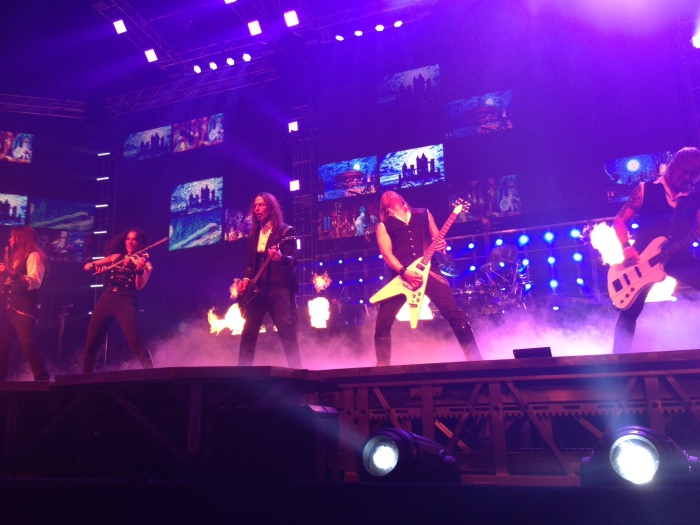
I’m just back from my almost annual two-and-a-half hours with Trans-Siberian Orchestra. It was different this year. For the first time ever my wife and I sat in the front row. I didn’t pay any special price and TSO does not sell VIP packages. We just got lucky ordering the millisecond tickets went on sale to fans. Incredibly lucky. Staggeringly lucky. Not an ordinary occurrence for yours truly.

Last night’s show at Citizens Business Bank Arena in Ontario, California was as good as any and every show we’ve seen TSO perform since we began following them around the turn of the Millennium. The difference was the intensity of, well, being in the front row. I’ve been going to rock concerts like this for over forty years now, and the few times I’ve found my way to the front row, there is nothing like it. When there is nothing between you and the musicians but a wee bit of inner space, you connect. It’s indescribable. It’s metaphysical. It’s what rock and roll is meant to be, the lines between audience and performers erased. You feel the experience in a different way. There is a pure intensity that sinks through your sensory inputs and temporarily commands possession of your emotional framework. Ideas become visceral. Passion becomes tangible. You wish it could last forever. At least I do.

Then reality returns. It has to return, so you can take the music with you and do something with it. Inspiration is a spark, not an engine. If you find a way for the spark to ignite, you carry the torch with a reason and do something with it. Moments like hanging in the front row keep me young, but my work is still my work. Part of that is sharing this stuff with you, to bring us together in the service of something productive, something that matters.

Seconds before the show began, in the dim light of pre-set, music director Al Pitrelli walked to center stage in the shadows. I was about ten feet from him. Pitrelli is a musician of such amazing talent I am humbled watching his fingers navigate the fret board at speeds I can barely imagine, let alone emulate. I looked at Pitrelli and made eye contact. I gave him the aviator’s thumbs up. He looked back at me and put his hand over his heart, a Roman Centurion salute of sorts, but kinder and more heartfelt as he often does when connecting with someone in the audience. In that moment I felt simultaneously like we had just met in person yet were old friends. I guess both of those readings are true. It is the illusion of knowingness that allows art to work. Ancient philosophers worried about the dangers of such false impressions. Old rock and rollers like me call it keeping the backbeat.

I have never met Al Pitrelli, or TSO founder/impresario Paul O’Neill, or anyone in Trans-Siberian Orchestra, despite the fact that they inspired me to write my second book, Endless Encores. I talk about the band in the book’s Preface, how brave they are to try out new material on every tour to keep moving forward, while still giving their fans the show they expect. They just give us more, music we don’t know is coming, and that lets us grow together rather than lock into a fixed expectation of the ordinary. Maybe someday I’ll get to meet these guys—who knows, what were the chances I’d end up in the front row of their show at retail?

What do I really want to share in this predawn realtime post, something I rarely do but at the moment feel compelled to publish unpolished? Is it to convince you that TSO offers a level of practiced musicianship, vibrant stagecraft, theatrical innovation, and storytelling significance that is much too rare in pop entertainment? Possibly. Is it simply to capture the moment for myself of front row showtime as a slice of life? I’d be lying if I told you otherwise. Yet here’s the real deal: Go back to the top of this post and have another look at the lyrics I excerpted.

There is a through line here. It is the holiday season, a time of pause, a time of reflection. In the ultimate irony, the venue where TSO played last night was not too far from San Bernardino, where violent tragedy again struck our nation only days ago. Families all around us are in pain. What we need to embrace is that every kind act in response to those in need is an act that restores humanity to humanity. Music, stories, and unforgettable performances can be our road back to the goodness that gives our life purpose. When art is a conduit that reminds us to act as we internalize, we are brought together toward a path that anticipates healing. We learn from the evocative, and we advance on the hard work that must be done to make sense of our brief time together.

TSO carries into my heart a sense of hope. It ties the holidays to a call of service, and it ties the years together in a continuum of incomplete measure. Sitting in the front row made it feel more real, more direct, more personal, and oh yes, more intense. We have a tremendous amount of work to do together and not much time to have an impact. Listen to the lyrics, feel the music, embrace the integration. Then do something with it.

Celebrate the holidays by doing something that really matters. And don’t forget to turn up the volume. I’ll see you in the front row, the cheap seats, or anywhere else we can make a real difference. Think hope, then make it happen.
TSO6

Endless Encores: A Brief Excerpt on Profits

EE CoverWith the September 22, 2015 publication of my second book, Endless Encores, I wanted to share a few excerpts to catch your interest. Published by The Story Plant, this is a business parable about People, Products, Profits—in that order. This excerpt is from the chapter about Profits.

♫ ♫ ♫

There was a modest rumble in the room. A flight had been called. It was not Daphne and Paul’s flight to Los Angeles, but both were heartened by the rustling of computer bags and rollaboards around them as fellow passengers-in-waiting began ambling to the door. It had been a long night, but now it appeared the delay would not go on forever, nor the conversation.

“We have hope,” proclaimed Paul. “We’re going to get out of here.”

“Hope is the strength that keeps us going,” said Daphne, watching people around her happily begin to leave the airport lounge. Since their flight wasn’t leaving, she had no reason to follow them, but she knew her remaining time with Paul would be limited.

“When you set out to determine strategy, how do you think about building the business so it keeps growing?” continued Paul. “No sane executive wants to lead a company into the Dead Brand Graveyard, yet so many end up there. Suppose they have the best people and the best products. How do they get their head around a business model that is going to both work now and expand into the future?”

“That’s the greatest enigma of all,” answered Daphne. “You have to think about recurring revenue alongside new revenue. Some transactions have to be there without your prodding, so you can add new transactions on top of them. If you’re going to spend money to acquire new customers, you have to balance that with what you’re spending to retain the ones you have. If all you do is spend to acquire new business, your margins will be perpetually squeezed. No fun, I assure you.”

“My boss says that all the time,” agreed Paul. “If every year you start the P&L from zero, it’s virtually impossible to grow. You have to know there is some business already on its way from your catalogue of products, and on top of that you add new product introductions.”

“Smart guy, your boss,” said Daphne. “He gets the mix a lot of us miss. Maybe he was at the same Paul McCartney concert I attended.”

“The same boss who isn’t going to can me for this lackluster sequel?”

“Yes, that clever fellow. Let me ask you something about that catalogue of products, the base of recurring revenue. Do you cannibalize your own markets before the competition does it for you?”

“Well, we don’t put out the same videogames, so it’s not exactly possible,” said Paul. “But if you’re asking do we sometimes leave one out there longer than we should to extract the last bit of profit from it, yeah, we do that sometimes.”

“How does it make you feel?”

“Queasy”

“Me, too,” winced Daphne. “I think we all do it to some extent, but the key to all of this is balance. Yes, you need a base of recurring revenue, but if you don’t give your customers something new and exciting before your competitors do, they will sweep your customers into their camp. You have to study and manage the ratios of evergreen and introductory endeavors at work in all your sales channels. Remember, constraints on distribution are low, choices are high.”

“It’s staggeringly hard to find the stamina to pull a product from the shelf when it’s still selling,” said Paul. “R&D costs are ridiculously high. We need all the sales we can muster for contribution margin to make sense.”

“One of the hardest choices in business is to pull a product while it’s still moving. Again, what we are talking about is strategy. Of course you don’t want to leave more money on the table than you should, but you’ll often find you need to leave some. If you don’t do it, your competitors will happily obviate your offerings. That can be the end of one brand and the birth of a new one that is no longer yours.”

♫ ♫ ♫

Endless Encores: Repeating Success Through People, Products, and Profits by Ken Goldstein is available in hardcover and as an e-book from Amazon, Barnes and Noble, iBooks, Kobo, IndieBound, Indigo, and at independent bookstores near you.

“Focus relentlessly on the extraordinary.” Pub Day