Blog Begets 100

It’s hard to believe this is my 100th post on Corporate Intelligence Radio.

I started this blog over two years ago, about the time I committed to writing my novel, which I announced last month.  Soon after I started the novel, it became clear that it was going to be a very long time before anyone read a word of it.  Initially I was okay with that.  Then it became overwhelming.  I needed to publish something, to start this dialogue, and I needed a way to warm up my fingers before filling blank pages with thousands of words.  The blog became part writing exercise, part wish-fulfillment, and part therapy.  It also caused me to talk less to our dog when I was having a particularly slow day on the word processor, which I am not sure she misses.

One of the questions I often get is why I called it Corporate Intelligence Radio.  My friend Mitch Dolan who used to run ABC Radio named it.  He likes to call me KennyG.  If you know me and you know my taste in music, KennyG is a tough fit other than the extrapolation of my name, but Mitch does like to come up with names where I’m concerned.  He knew my book was about a radio talk show host and that someday this blog would feed the story, and we have always talked about doing some kind of a show together, so he just said to me over dinner in New York, call it Corporate Intelligence.  I tried to get the URL for that but of course could not, so I added Radio and there you have it, a bit of nonsense referencing radio on the internet.  Maybe someday we will do that show together and it will make sense, or perhaps when you meet Kimo Balthazer, one of the main characters in This is Rage, you’ll understand.  Or maybe I’ll change it.  Who knows?  Another distinguished publisher I often cite has since started calling a section of their periodical Corporate Intelligence, but I predate them.  Plus I have my Twitter handle CorporateIntel, and that will always be mine.

There are a bunch of things I have learned since I began blogging.  They are the kinds of thing I really couldn’t have learned any way but doing it.  Here are a six (6) that come to mind:

1) STYLE IS CONTENT – For the first year, the hardest part was finding a voice.  I had lots of topics, things I wanted to write about, but finding the right conversational tone that could both be mine and yours was the hard part.  There were more things to write about than there was a clear way to express them.  The longer a post took to write, the less conversational it seemed.  I had to learn not to over rewrite, the opposite of the book, where there is no such thing.

2) CONTENT IS HARD – After the first year, coming up with a worthy topic became the hard part.  I had honed my blogging voice, but I didn’t want to bore you with things that didn’t matter.  To this day I would write more often if I could think up more interesting stuff to write about, but I have a newfound respect for journalists who write a weekly column.  For the old school guys who did it daily — Herb Caen (San Francisco Chronicle), Jack Smith (Los Angeles Times), and Mike Royko (Chicago Tribune) — I have no idea how they did it without going bonkers.  Sports writers and movie reviewers enjoy a steady stream of topics, news reporters get desk assignments, columnists just gaze until something comes to mind.  Pondering is weird, and makes you weirder.

3) THE FIX IS IN – Electronic publishing is really cool, because it lets you fix things and change your mind.  I have rewritten very little once I have published here, but every once in a while when I think of a better adverb, I can deploy it painlessly and not even tell you.  I can unceremoniously make a No a Yes and vice-versa after rethinking it.  I love the Update button on WordPress.  Sometimes I wish the rest of the world had an Update button — or the “recall” function on email actually worked, which we know it does not.

4) KEYWORDS RULE, DUDE – Keywords are the lifeblood of online traffic acquisition.  Learning to tag is an art and a science, brewed with a touch of alchemy.  It never ceases to amaze me how people get here, but other than regular readers, the best door remains random keyword searches, that in Google’s eyes aren’t random.  So many of my readers land here accidentally because I indexed well on some search term they queried,  and then they subscribe without my asking.  What Google sees matters, and what Google indexes is the whole shooting match (plus good writing, of course).

5) YOU NEVER KNOW WHAT STICKS – There is literally no way to know what will get people’s attention and inspire their imagination.  Little throwaway pieces I have done have become among my most read, and proclamations of vision and justice died in a few days.  You write, and then you set it free.  Words have a life of their own after you give them away, and the writer doesn’t get to decide their fate, only their intention, which matters increasingly little across the democratic digital world.

6) TALKING BACK CAN BE A QUIET AFFAIR – I get a lot more private than public comments.  No matter how much I encourage people to comment publicly, most people are shy, especially when they have to post under their own name.  I don’t blame people for this, who wants to say something in public and risk attack for no particular gain, but it does remind me how brave and vulnerable all writers are.  I have become increasingly brave and vulnerable each time I push the publish button, and that’s with a book of fiction on the horizon.  Oy, please come along with me, and hey, keep the comments coming, public or private.

So here we are together at my one hundredth blog post, and this is an especially ironic bit of timing because I have just submitted my pre-copy-edit draft of the book to my wonderful publisher, The Story Plant.  I promise you I didn’t time it this way, it just sort of happened.  I used the blog to pace writing the novel from the blank page through countless rewrites, and sure enough it all came together this year right before Memorial Day.  I will continue to blog on the topics I cherish — innovation, creativity, imagination, leadership, vision, business ethics, smart marketing, well-reasoned investment strategy, creative destruction, and every so often politics (say it ain’t so!) — and I will also keep you posted as we take my novel from manuscript to release date on October 8, 2013.

I have already begun discussion of a follow-up book and may bend your ear on that, and of course I want to include you in the sales and marketing journey as my first book comes to market in paperback and eBook.  Mostly I just want to thank you for being friends, listeners, readers, and clever people who tell me things I need to know.  I have learned way more from writing this blog then I ever imagined, and it is because of you.  Writers write surely to be true to themselves, but without an audience it is even more lonely an activity than good sense would suggest.  Knowing someone will read the words and share the ideas makes it a community, and hey, that’s intensely gratifying.

Again, my deepest and most sincere appreciation for sharing the journey with me!  We’re maybe in the second inning of the first game of a doubleheader, so grab a bag of peanuts and plan to stay awhile.  We still have a lot of ground to cover and it will be entirely more rewarding if we do it together.

100 Candles

About This Book of Mine

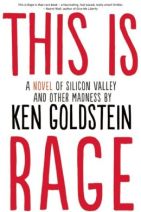
Pre-Order on AmazonI have mentioned now and again that I have been working on a novel for a few years.  It’s time to share a few more details.

First of all the title: This Is Rage.  You will discover why I called it that if you read the sample excerpt on my teaser site and other fine channels we will be utilizing in the coming months, like Amazon or Barnes and Noble, where you can currently place your pre-order that will be shipped when the book is officially released on October 8, 2013.  Shameless, I know, but I am officially in the pull marketing business effective immediately.

There are two protagonists in the story, who are also both antagonists, at least to each other.  They are each hero and villain in the broader context of economic turmoil, which they aspire to improve, but not surprisingly mess up on high-octane, mostly by accident.  Kimo Balthazer is a disgraced radio talk show host, who seeks redemption in the obtuse netherworld of internet webcasting.  Daniel Steyer is a venture capitalist at the top of his game, looking to go out huge with the deal of a lifetime, but market forces have other plans.  That’s not the order in which you will meet them, and you’ll find out why.  At the outset they don’t know each other exists.  They don’t even know each other’s world exists.  But they soon do.  And they don’t like each other.  At all.

I am going to do the right thing and not toss out any spoilers, but I can say that you will spend some time in Silicon Valley, some time in Los Angeles, and some time in Washington D.C.  You will be introduced to the world of Investors, Bankers, and Operators, the three points of an ever-forming triangle that comes with its own hierarchy, rule set, chaos, and politics.  You will also meet a curious politician with a tangential agenda, a conflicted movie studio boss, the co-founders of one of the most successful tech-start-ups ever, and a pair of would-be entrepreneurs turned criminals whose interpretation of thinking different is not quite what their families had in mind.  You will be invited into board meetings and venture partner meetings.  You will hear the voice of Kimo in your head.  You will see what happens when ego and presumption run amok, and the notion of control spirals into hyper normalcy, where random boo-boos add up big time, and the consequences are strangely real and familiar.

My key influence for this book is Tom Wolfe, whose first novel Bonfire of the Vanities blew my mind in ways that still shake me to the core.  I didn’t know what a bond trader was the first two years I was in college.  Then I saw a bunch of guys my age lining up in blue suits to be interviewed to become one.  They went to Wall Street and became extraordinarily wealthy selling paper promises to their clients.  Then came the broad implosion of junk debt.  Michael Lewis, whom I also tremendously admire, made his debut as an author writing about this phenomenon.  I saw the impact on my friends, I saw the impact on New York, and I felt the impact on our economy.  What I admire to this day about Wolfe’s work was how he wove storytelling through the observational narrative, migrating the educational lesson to character development, and burying the polemic in a moral tale for the ages.  I was studying theater at the time, without notion of how I might fit into the business world, or even if I could make a living given what I valued.

A quarter century later we seem to have forgotten the fall of the junk bond kings.  The miracle of Silicon Valley has replaced the lustre of Wall Street and the allure of Hollywood.  I have played my whole career in this fantastic environment of innovation, the arranged marriage of technology and media brokered by the matchmaker financiers, and the output had been invigorating.  We have created jobs, opportunities, and a good deal of wealth — but not for everyone.  In the same way that Wolfe and his New Journalism looked beyond the restaurants and clubs and luxury high-rise suites, I have seen the scary trailing the good.  Where there is big money there are big personalities, and where there is a win-lose battle fought daily, often those who lose are the secondary foils who play by the rules without insight into the eccentric ecosystem.

That is the story I wanted to tell.  That’s why I wrote a business novel instead of a non-fiction set of adages.  This was something I needed to do, part of the continuum of my journey.  I started my career in storytelling, then helped bring storytelling into computer games, then found my way into profit and loss, and now I come full circle.  I needed a way to bring these elements together, to find a synthesis of my passions, which include the theatrical, the financial, the philosophical, the hope of justice, and a touch of dark humor (hopefully more than a touch!).

In the coming months I will tell you more about the publishing journey, but I cannot conclude this project announcement without a sincere thank you to my brilliant editor, Lou Aronica, under whose independent imprint The Story Plant my book is being published.  Lou is a Mensch in every sense of the word (Google it if that’s unfamiliar to you).  He has been a steadfast believer in This is Rage since we met each other last year on Twitter.  It’s not just the notes that he gives me, it’s the way he communicates his viewpoint that makes me want to rewrite a fourth time when he is only asking for the third.  I think Lou, a bestselling author himself, is at the forefront of New Publishing in the same way Wolfe wanted New Journalism to embrace the opportunities of Creative Destruction as a positive force for change.  Wherever this journey takes us, I am delighted to be paddling alongside a friend on this whitewater river of 21st century digital publishing — with a paperback to boot.

So that’s the introductory story of my novel.  It’s my first, I hope not my last, and I welcome you to come along and share the journey with us.  It’s for you, and it’s about you.  I hope to entertain, and maybe share an idea or two as the whitewater rises.

This is Rage.

Bird by Bird

And now for something from the other side of the brain… I want to share with you a book I read this summer.  It was introduced to me by my good friend and classmate, Will Schwalbe, who among other things was Editor-in-Chief at Disney’s Hyperion books and has since founded Cookstr.com.

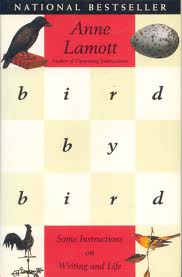
The book is called Bird by Bird: Some Instructions on Writing and Life.  It’s by Anne Lamott.  It was originally published in 1994.  I read it for the Instructions on Writing.  I’m sharing it for the Instructions on Life.

Lamott’s guidance was extremely helpful to me as a creative inspiration, but that is precisely when I realized the entire book can be read as a linked set of metaphors.  Even if you don’t have the least bit of interest in creative writing, I would still recommend this book.  Let’s start with the basic conceit, lifted from the back cover, quoting the author:

Thirty years ago my older brother, who was ten years old at the time, was trying to get a report on birds written that he’d had three months to write,  [It] was due the next day.  We were out at our family cabin in Bolinas, and he was at the kitchen table close to tears, surrounded by binder paper and pencils and unopened books on birds, immobilized by the hugeness of the task ahead.  Then my father sat down beside him, put his arm around my brother’s shoulder, and said, ‘Bird by bird, buddy.  Just take it bird by bird.’

Okay, if you don’t have a little goofy sentimentality in your outlook you can link off now and ignore the rest of this blog post, because that passage reflects the spirit of Lamott’s clear observations and confidence, encouragement without pretension, honesty and uplifting outlook.  It worked for me.

Anne Lamott is not a cheerleader, more like the Burgess Meredith with the water bottle and bucket in Rocky’s corner between rounds — I’m also guessing she wouldn’t wilt if she had to slash your eye open if like Rocky it got sealed shut.  She knows you are going to get hit hard, and she reminds you that you know it too.  She tells you not to get distracted by that which doesn’t matter to the process of writing.  Much of this she learned from her father, who was also a career writer.  He taught her it was the doing that mattered, not the surrounding mechanical functions that seem like they matter.

bird by bird 2What struck me repeatedly in Lamott’s mini-lessons was her deep understanding of process — that output of a work is not so much the full work itself, but an assembly of building blocks, one at a time, each a commitment, and only in totality something more.  She does not advocate bonehead process or ridiculous formulaic mandate — this is not a how-to manual — she just wants us to care about what we are doing and accomplish it in a series of heartfelt steps.  There are no shortcuts, it’s a little more each day, a continuum that adds up to a satisfying and cohesive whole.  This is not breakthrough thinking, but it’s a lesson we need to learn over and over, and it’s not just about writing.  Creative process is the heart of innovation.   Think of all the elements that make the iPad great.  If all the elements weren’t great, it would not be great.  Same with a restaurant menu and wine list.  Same with an office skyscraper or memorial monument.  Same with a short story, same with a novel.  Summary impression rests in the details, all the many tiny parts or moments — and all those details require hard thought and careful design.

Lamott is smart about this, she tells you that getting it right is not going to happen out of the gate and unnerving strides at perfection can be your worst enemy.  She has an excellent descriptor for the real quality of the first drafts to which we aspire.  I’ll let you discover that on your own so the word does not get scraped here.  Her point is, just get the words out, work on making them better later, a layer at a time.

She also allows us not to obsess unnecessarily with locking the full road map before we explore, because again that can impede our work.  How far do we need to see ahead?  “About two or three feet ahead of you” is plenty she tell us, quoting E.L. Doctorow: “..writing a novel is like driving a car at night.  You can only see as far as your headlights, but you can make the whole trip that way.”  She says this is “right up there with the best advice about writing, or life, I have ever heard.”  I tend to agree.

There is tremendous empathy in Lamott’s world view, she offers a sense of shared experience that is reinforcing and comforting.  Lamott talks about the imaginary radio station playing in your head — another colorful descriptor I will let you discover — that tells us over and over again why we can’t do something, why the work we are doing is neither good nor worth doing.  Learning to turn off that radio is our key to moving forward, we all hear it from time to time, but when it becomes perpetual, that is when our ability to create interesting work stops completely.

Lamott is just so honest and clear about all the factors that stop us from moving forward because she not only has experienced them, she continues to experience them.  She does not position herself as a guru or weekend seminar success evangelist, but simply as someone who can reflect on problems of creativity because she deals with problems of creativity endlessly in her own life.  She is even more honest in telling us that no one can make these problems go away once and for all, certainly not with any form of temporal success.  All we can do is know that these obstructions will always be there, so we must embrace confronting them.  Sometimes it really is good to know that none of us are experiencing roadblocks on our own, the fact that someone like Lamott tells you she is experiencing what you are experiencing is precisely the empathy that builds strength and resistance because the experiences are shared, bad and good.  Her humility is reinforcing and refreshing and uncompromisingly inspiring.

“Bird by Bird” is not a long book, it can be read if you wish initially in a single sitting, but it is the kind of book you will find yourself coming back to for this chapter or that, this phrase or that.  Lamott writes with good humor, even when she tackles very difficult and personal matters of her own life and those around her.  The more I think about her framework, the more I am convinced it is much more broadly applicable then perhaps she even considered.  I see the guidance as useful in company life, in financial life, in family life, in political life, and in government life.  All of these require effective process to get them right, there are no shortcuts, and the rewards can be the smallest where the challenges are the greatest.  That does not mean the rewards aren’t meaningful, but it is the context of those rewards and the expectations that one sets for success that truly inform us when we are steering toward a final draft.

How do you get from idea in your head to finished manuscript?  The same way you build a company.  The same way elegant software libraries become paradigm defining customer experiences.   The same way we fix the economy and replace our government leaders with people who want to work on behalf of the people instead of themselves.  Process.  Commitment.  Focus.  Humility.  Honesty.  Bird by bird by bird by bird…

Corporate Intelligence Radio is On The Air

Mario

Isn’t this where we came in…?

My Turn
by Ken Goldstein
Game Daily, January 2004

Happy New Year! Holiday 2003 is now handed off to accounting, winners and would-be winners for the key selling season are now largely known, and one thing becomes certain: the uncertainty of a platform shift looms menacingly ahead.  Details will begin to unfold, and together we lean forward to the next frontier… but if history tells the tale, not before one last great harvest.

Thus our beloved game industry is presented with a significant opportunity over the next few years.  The entertainment community is taking note that games are a meaningful business opportunity, no longer a niche play.  Mainstream press and consumer audiences are taking note as well.  Since the turn of the Millennium we have seen a huge uptick in consumer and business press devoted to games, not to mention dedicated cable TV channels now focusing on our universe.  My sense is that once again the challenge for our industry is one of creativity – how will we manage through the dip that so often precedes full acceptance of next-generation platform evolution?

My fear is that because we have done such a good job squeezing performance out of our current platforms, we may squander these precious years – a time when we have a ripe audience for the innovation of our field, our art form, and when we could be meaningfully broadening our core audience, surging into the mainstream and building our future.

More specifically, my fear is that because we’ve maxed out technology on current platforms – games are as realistic as they are going to be in the near term and you can’t throw more polygons at a game to leapfrog the competition until new machines arrive – we will wait around for technology to push us forward rather than showcase and advance the field while we have the world’s attention.  Current trends seem to support that.  More and more games seem to be relying on pure outrageousness to drive hype, and not surprisingly, exploiting those all too familiar lowest common denominators.  The wow factor of current platforms is behind us, so why not get headlines the easy way: shock and awe.

I’m taking “My Turn” to challenge us as an industry to resist the pull of this platform shift to lull us into creative laziness.  I am in no way puritanical, there is nothing I would not do to defend our First Amendment rights, and I am not saying there aren’t businesses to be built on more exploitative titles.  What I am saying is that there are very good businesses, as well as interesting, creative, and innovative games based on strong characters and storytelling, to be created if we make this a priority.  Examples already exist: Mario, The Sims, Oddworld, Animal Crossing, the Backyard Sports series.  But there are not enough.  Look at the past holiday release list and you won’t find a great deal of diversity – and for where our overall market stands, you might conclude we left money on the table as a result of a too-narrow focus.  You see it coming every year at E3, just walk around and you aren’t surprised by the tone we set for success.

I know what many of you are thinking.  You’re Disney, your brand compels you to pursue E-rated, non-violent games.   While that is indeed true, I continue to believe our industry as a whole will benefit if we begin to offer a broader array of games to consumers, and a much deeper selection of non-violent games.  I’m also not necessarily speaking of E-rated or children’s games.  The true market leaders of our industry, those who find repeat creative and financial success year after year, fully embrace the notion that it is smart business to make interesting games – even war games – without piling on gratuitous sex or violence.

If there is at last an underlying art and science to what we do that is a partner of commerce, then perhaps there is nobility in not letting our talent be exploited.  There is revenue, and plenty of it, to be found beyond the obvious.  The market will always decide what titles make it and while I am certain the young adult male audience always will support mature-rated games, I wonder who is not playing games, or not playing very often, because the options we have presented are limited.  Simply put, we are not going to increase female gamer counts with the current top ten.  Roughly speaking, that is one in two human beings we continue to choose not to serve.  And yet, I have seen our own Toontown Online take the MMORPG genre into this realm, where boys and girls, gamers and non-gamers, parents and children all play in the same virtual space.  If there is a more hardcore genre than MMORPG, I await the opportunity to play there as well.  Creative challenges are met by inspired individuals because they are driven by a muse, not seduced by easy money.  And by the way, in a platform shift, there is no easy money.  It will take every brain cycle we have to get our businesses to the other side.

Let’s not ride out the platform shift waiting for technology to push us creatively.  Let’s take the higher ground, take some risks, and do something interesting with our collective talents – and while we’re at it, let’s broaden the game market so that when we have more polygons connected through broadband networks, we have many, many more players who are waiting for us to deliver against our artistic potential.

_______________

Image: Pixabay