Big League Debuts

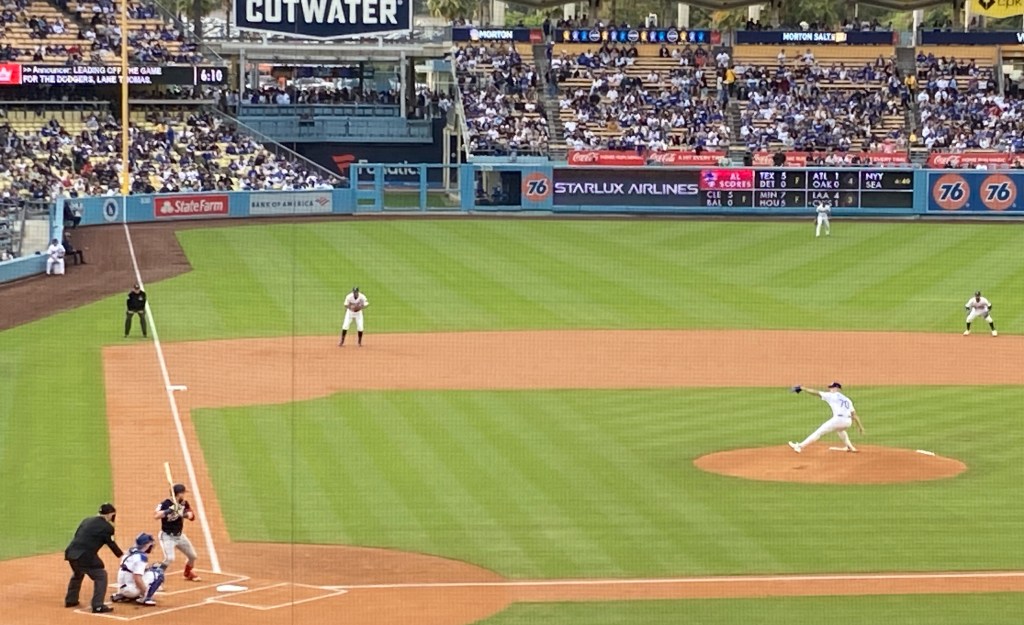
I get choked up when a baseball player makes his first official appearance in an MLB game. When I say choked up, I mean I viscerally feel what is taking place on the field. I was in Dodger Stadium when Dustin May first pitched. I recently watched Gavin Stone and Bobby Miller do the same on television with no less emotion running through me.

Those first starts are the culmination of endless sacrifice, physical preparation, and mental resets. There are so few positions available in professional sports it is almost ludicrous to bet one’s future on it. When I see young ballplayers walking onto an MLB field for the first time, usually with their families in the stands on very short notice, I feel a sense of awe and trepidation. A lifetime of dreams can continue for years after that debut, or possibly end right there on an underwhelming performance and a flight back to a playing field a tenth in size.

The power of hope and the threat of failure are all at once alive in a single and unrepeatable moment. I struggle to find the words to convey the meaning of that spotlight and the unknown future it presents as a test, but seeing that ballplayer suited up for the first time and given a spot on the roster by a manager is always in my eyes volcanic.

Then there are the veterans who perform even better late in their careers than they did when they first came up. Clayton Kershaw won his 200th game this season, becoming only the third Dodger to achieve that milestone, reaching an achievement shared with just 96 players in MLB history. I’d like to tell you Kershaw’s debut clearly foreshadowed the legendary career ahead of him, but five weeks after his first MLB game, he was sent back to the minors for fine-tuning. That’s when he recommitted to getting back in The Show and proving he belonged on a big league roster. Nothing could stop him from realizing his potential. He has worked hard every day of his career.

Why does talent reaching the launching point of potential bring me to stunned silence?

The why is as simple as I can say it: I revere talent.

You might have guessed, this isn’t just about baseball. All talent climbing to the apex of a focal point is forever for me an uncanny unveiling. A launch in the majors is not the real start of a career, that happened back in grade school, then again in high school, then again in the draft, and any number of games won or lost along the way in each leg of a player’s journey. Walking onto a big league stadium field for the first time in uniform and on the official roster is a moment of recognition, an entry in a time capsule that isolates a key reward point. It is real to the individual and a metaphor to all who are watching it in real time.

When talent sees the spotlight, when one person’s dream becomes reality, we all can look inside ourselves and see the shape of our dreams.

Talent is such an overused, even abused term. Talent is precious. It’s part nature and part nurture. When it reveals itself, the world breathes differently. At least I do.

There are all kinds of talent: sports talent, artistic talent, design talent, scientific talent, leadership talent, mentoring talent, teaching talent, parenting talent — you name something difficult to do, and if you see someone doing it better than a lot of others, it likely involves talent.

Some start with more natural ability than others but when we see talent at work it is seldom a lightning strike or an accident. Behind the realization of talent is a regimen of development that calls upon all the same forms of dedication and commitment evidenced in the training of athletes. I don’t believe it’s different for doctors, dancers, or poets, perhaps just less visible to the unsuspecting.

I often hear business people talk about the war for talent. That phrase troubles me. Filling jobs is not a war for talent. Creating an opportunity that attracts talent to unlock its potential is not a war at all. If your company is doing work of significance and someone with talent becomes aware of that opportunity, the fit will become natural. That is precisely the scenario where one plus one equals three, five, or ten.

Plug real talent into an ordinary opportunity and little exciting is likely to happen. Attempt the impossible with ordinary applicants and equally little is likely to happen. Marry real talent to real opportunity and the sky is the limit. That to me is the power of talent. That is why I revere talent.

I have been blessed over the past four decades to work beside a number of individuals who quietly changed the world through their talent. Some were gifted beyond imagination. Some just worked harder than all those who thought they wanted to compete with them. Most of their names you will never know, but they were game-changers in my life and the many seemingly impossible hurdles we crossed together. They weren’t just good. They were as good at what they do as Clayton Kershaw is at what he does.

When you are in the company of talent, almost nothing seems impossible.

Bobby Miller won his first three games and then encountered reality and lost a huge one. Gavin Stone at the moment is back in the minors. Their talent remains unquestionable, but how it will reveal itself fully won’t be known for a long time, Neither will debut again, but those debut dates will be memorialized on the scoreboard every time they appear in their active careers.

You had a debut and so did I, maybe not tied to a specific date, but close enough to remember the circumstances. We will watch others do the same. The inspiration of seeing talent emerge is unlimited in scope. When you see the next young ballplayer walk onto the field in that brilliant moment of emergence, remember the applause you offer is your own moment of celebration.

_______________

Photo: The Author at Dodger Stadium, Miller’s Home Debut

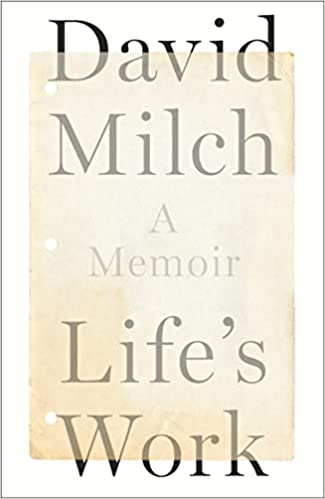
David Milch Pens a Curtain Call

It’s called Life’s Work. It’s anything but a simple title, as only to be expected from its incomparable author, David Milch. It’s not so much a play on words as it is an enunciation of intent, a spiritual aspiration. Yeah, let’s start there and see where it takes us. The rabbi is in.

There is a profound sadness that winds its way through these pages. Alzheimer’s is laying claim to David’s current challenge, and it permeates his thought process in this troubling memoir. He is assisted in committing the recallable memories to paper by his family, and even where confusion follows his path like a sine curve, it’s not just Alzheimer’s that elicits sorrow. It’s the entire path of intermittent regrets. If words are to make us feel, his words again succeed.

I hadn’t seen David in a very long time when I attended his book launch. I asked him if he remembered me. “Of course,” he said, “do either of us owe the other money?” I was 99% sure it was a joke, but just in case I assured him we did not.

In the broadest sense of its definition, rabbi means teacher. In the workplace, it means more than that. If you get one, your life is going to change. You might just be finding a path to Life’s Work.

When you’re a young writer, if you’re smart you seek teachers. They don’t teach you how to write. They teach you how difficult it is to write. They instill in you taste, fortitude, inhuman patience, proper doubt, and resilience.

The feedback is anything but pleasant. It’s not for the faint of heart. You learn that bad first drafts are a fact of process. They are necessary, but largely need to be deleted.

David Milch taught me these things, mostly by demonstrating them, but sometimes from the breakfast lectern. He taught me that subjecting others to unpolished work was amateur, lazy, and unfair. If you choose to tell stories, you must learn to craft them in ways that don’t waste an audience’s time or take advantage of their goodwill.

You learn discipline, like an athlete. You do it every day, again and again. The rabbi keeps you honest. Character comes first, then reveals plot, but plot is only a device to enhance the arc of character development. We think we love story, but what we really love are characters.

David taught me those characters are guests in people’s homes. Audiences will let them in on expectation, but will only keep them there if they grow. When a show dies, it’s not because you have run out of story; it’s because the characters have no more headroom to interpret and flourish.

Feedback becomes lifeblood. Then one day you’re on your own. When the teacher is no more, your filter is established to shield you from embarrassment. The work must pass your own sniff test as it would be blessed from further refinement by the teacher.

In this memoir, David writes of the mind’s decay. He didn’t ask for this denouement, but his choices are few. He accepts the path as inescapable. He turns to notions of faith that evaded him in his younger years, when his temperament was not tamable. I remember that David. That was the rabbi who first said to me: “If you want to make God laugh, tell him your plans.”

He wrote unforgettable, award-winning episodes of Hill Street Blues. He created the groundbreaking television series NYPD Blue and Deadwood. He left the craft of episodic television writing better than he found it. That is an understatement.

He battled substance abuse and gambling addiction, both almost crushing his existence. He raised a caring family and found his way back to their love. Surviving his demons to nurture love was a monumental achievement.

I came to David because my viewing experience of Hill Street Blues was TV that tore at the soul. I didn’t know that was possible, particularly because it broke for commercial every 12 minutes or so. David came to think of it as bourgeois. That’s a word you don’t often hear outside of college.

He wanted to go deeper, extract honesty from language despite the limitations imposed by presumed broadcast standards. Rules for David were goalposts that needed to be moved with concerted wit whenever a network executive forgot to interfere. All forms of writing are bound by some form of convention, but he wanted those boundaries to be in service to creativity, not obstacles to authentic expression.

He never stopped being a teacher. He saw the gift in his mentor, Robert Penn Warren, and paid it forward. He helped the careers of endless writers who learned from his example the poetic revelations in pure, gritty, messy, conflicted reality.

For many years I never believed I would achieve David’s standard. My aesthetic was too unformed, too quick to quip, too impatient to let a character breathe if it killed a laugh or shocking turn. I became despondent with my own attempts at composition. I worried words would fail me when I needed them most.

Yet I never gave up. The rabbi made that an untenable notion. Work was essential. Rewriting was essential. Craft was essential. I was on my own as David was. Every writer is alone. It takes a lifetime to learn that. The rabbi if abrupt saves you half your life denying this truth and readying you for being alone, determined, indefatigable.

A mentor is a subject matter master. A mentor is not meant to be kind in the present, only in the long arc of life. We learn this too late. The critique of the master is only meant to become self-critique in perpetuity. Like I said, apprenticeship is not for the faint of heart.

There is gravitas in the audacity of writing, absurdity in committing to an endeavor that consistently leaves you empty and unnaturally separates writer from the written. David understands that in a rabbinical sense. His ability to articulate the nature of output is simultaneously divine and existential. A brief, revealing excerpt early in the memoir captures the essence of that reduction:

There’s something about literature—poetry and prose, but particularly poetry—which disinfects the efforts of being. The effort itself is cleansing. It neutralizes what’s profane about the process, and just leaves the result.

If writing becomes your essence, the idea of not writing is about the same as the idea of not breathing. Neither is feasible. Both are equally necessary.

At the end of the reading, supplemented by famous friends sharing passages for reasons of pragmatism, David took the microphone. “Thank you so much for being here. I love you all. God bless you.”

I had never heard him say words like that. His arc had come with an unpredictable resolution. Story and character were again united in natural resonance.

The rabbi placed a small ribbon between chapters and closed the book. His eyes were clear and telling. Here ends the lesson.

_______________

Photo: The Author at Diesel Bookstore

The Thing About Vin

This month I suspect the nation is accidentally divided into two unsuspecting camps: Those hearing the beloved name Vin Scully for the first time, and those who feel the world has lost a soul whose voice permeated their imagination for what seems like forever. I probably don’t have to tell you, but my tent is in Camp Two.

I’ve been reading, watching, and listening to the touching tributes to Vin all month now, waiting for the words to come to me that might add something different to the mix. Like so many fans of baseball, I am finding it impossible to quantify the impact Vin has had on the game and my life. Let me try to get there by focusing on what Vin brought into our lives that exceeds anything to do with a child’s game played by adults for well over a century on our pastoral fields of dreams.

Vin was decent in a way that defines decency. Try to think of anyone in the public eye where you never hear a single bad word uttered about him. People like this about someone but not that, people argue about the talents and abilities of professionals, people offer pointed critiques of someone’s shortfalls despite their success. I’ve never heard anyone utter a cross comment about Vin. Never. It’s uncanny. I can’t think of anyone else who fits that bill.

Vin was a storyteller of the highest order. We frequently overuse the word storytelling to describe the sequencing of events that constitute an unfolding narrative, but Vin turned broadcasting into art and baseball into a series of real-time epics built from a foundation of plot and character. You never had to love the Dodgers to love the resonance of Vin’s unmistakable voice. You listened to the anecdotes excerpted from the lives of MLB players told gracefully between balls, strikes, hits, and runs. You never missed a play, and every chapter of the story added up to a portrait of an era.

Vin brought us together. Whether you were sitting in Dodger Stadium with a transistor radio earplug hanging below your ballcap, watching a big screen with rowdy strangers in a sports bar, or sitting at home texting friends and family while Vin did the play-by-play alone in the booth, everyone choosing to participate in the day’s game came together as part of the event. Vin was inclusive, and he made us inclusive. Our differences didn’t matter on game day when he had the mic. His friendship was our friendship. Vin made sure everyone felt welcome to be part of his 67 years of telling campfire stories while athletes performed them in stadiums linked to historic moments.

“Hi, everybody, and a very pleasant good evening to you.”

“If you have a sombrero, throw it to the sky.”

“A Black man is getting a standing ovation in the deep South for breaking the record of an all-time baseball idol.”

“In a year that has been so improbable, the impossible has happened.”

“I know in my heart that I’ve always needed you more than you’ve needed me.”

Vin turned simple words into profound statements, moments into musical notes, radio and television commentary into sound bites for the ages. Today that might seem corny, impossible to pull off without sounding dated or forced. I guess when you have the perspective of almost seven decades to evolve your act, whatever you say is instantly perfect. It’s jazz. You’ve rehearsed as much as anyone alive, so you can improvise without a worry. You also instinctively know when quiet beats loud.

The stories of Jackie Robinson, Sandy Koufax, Hank Aaron, Don Larsen, Fernando Valenzuela, Don Drysdale, Willie Mays, Roberto Clemente — they are each 100% their own, and Vin knew that more than anyone. Vin was forever the reporter, never the story, that was his inviolable commitment. Yet the stories were better because he told them. Everyone knew that. If you had a story in the game, you wanted Vin to tell it, to record it for the ages, to make it vital, enchanting, and historic. Doing the outlandish in a game that has never seen a moment like yours is one thing. Having Vin lock down the tale for all of time is quite another.

As I think about all the kind words I’ve read and heard about how deeply this one humble man touched so many lives, I am repeatedly left breathless by the stories the fans themselves have shared. Fathers and sons who couldn’t find the right words to say to each other turned on the radio and had a catch while Vin called the game. Families who couldn’t afford the price of tickets parked their cars in open spaces, opened the tailgate of an old station wagon, spread a picnic blanket and grilled hot dogs as Vin made them feel like they were at Chavez Ravine. Brooklyn loyalists who never forgave Walter O’Malley for moving the team west generations later got satellite TV and fell in love again with their Dodgers bridged by the same voice who loved the team as much as they always had.

So here’s the thing about Vin, where the legend of simpler times and radio days brings us to the less innocent evolution we’re all trying to navigate with fragments of heart and hope. Some of us are getting older, losing the icons that carried us from youth to adulthood while poignantly keeping us young at heart. Every April baseball season begins with enormous hope, and every October it ends with one World Series champion. We all know the beginning and end of that cycle come with a change in the cast. Some of our favorite players will be gone. Some of the most important people in our lives may be gone. That is the sad and precious reality of our time together. Our memories are both powerful and fragile. When we remember a common voice that triggers the goodness in those memories, biological age for an instant is no longer a thing.

Vin was there for so many of those memories. He had the seat of honor at so many of our tables. He will stay tied to those memories as long as we stay tied to those memories. The gift of his life was to enrich the lives of all those who carry forward those memories. He wanted that even more than to call a perfect game. For Vin, every game was a perfect game.

I’ll give the wind-up to Vin, because I cannot imagine any other way to set up the close and get off the air:

“When I was eight years old, I fell in love with the roar of the crowd coming out of the speaker of a four-legged radio. When you roar, when you cheer, when you are thrilled, for a brief moment I am eight years old again.”

Yep, so am I. Thank you, dear Vin Scully. Your gift of optimism and connection is once in a lifetime, once in a century, once in sports history. Your gift forever keeps us eight years old.

_______________

Photo: Library of Congress

More Than a Diversion

Psst, pass it on: After a 32-year intermission, the Los Angeles Dodgers won the World Series! After winning the National League West the previous seven years—this year will be the team’s eighth consecutive division title—and exiting the playoffs without the Commissioner’s Trophy, the 2020 postseason finally brought a championship banner back to Chavez Ravine.

The Tampa Bay Rays played with heart through the entire postseason. It takes untold athletic ability, strategy, and grit for any team to make it to the World Series, and while this year’s final prize went to the Dodgers, there is little question we will see the Rays again soon in October baseball. Both teams filled Globe Life Field with players of unquestionable excellence, and the six-game series came with all the unpredictability that makes baseball relentlessly nail-biting no matter your expectations.

The Dodgers simply had to get this done.

After so many failed attempts to full triumph over more than three decades, losing becomes an all-too-familiar feeling. It’s astonishing how quickly that feeling can be replaced by sheer glee. At this moment, I am experiencing glee. Devoted Dodger fans everywhere are experiencing glee. I’m finding it a different form of glee than it might have been any other year. This particular form of glee is a much-needed gulp of surely lasting but highly compartmentalized glee.

Let me try to share that qualified celebration, limited in practical application, boundless in idealistic resurgence.

So much that matters is going on in our world. We are approaching the end of one of the most difficult and painful years in our nation’s history. The year ahead of us is filled with anxiety and uncertainty no matter who is elected to lead the nation. It is only reasonable to ask ourselves why something as inconsequential as professional sports matters.

If you’re not on the team, employed by the team, or an owner of the team, does it really matter who wins the MLB World Series?

Does being a fan of any team matter?

I think it does, but only in a well-rounded, emotional context where we hold our priorities in balance.

Is the drama and endurance of a championship delivered by your home team a matter of life and death? No, in any mentally balanced sense, certainly not.

Is it a joyful diversion that can ease the burden of otherwise overwhelming demands on our time and attention? Yes, I think for many the game is just that. It has been for me.

I needed baseball this past summer. It was only a sixty-game season, but I needed all sixty of them. Even if I didn’t have time to watch them all, I needed to read about them the next day, to look at the box scores, to see who was healthy and getting the job done despite harrowing circumstances.

I needed the break from the political headlines, from the horrors of coronavirus, from the social injustices inflicted on those deserving better, from the inescapable racial bias tearing apart people’s lives, from the wildfires that came much too close to home while savaging the homes of others, and from the daily navigation of my own leadership responsibilities.

We all need things that are fun and fulfilling. Call them luxuries in perspective, but without something to capture the imagination in a time where so much focus is devoured by the absurd, our equilibrium can hang in the balance.

The Dodgers have given that to me when times were less stressful. They win, they lose, they lose when it matters most, but like every team, they reemerge every summer. This summer they mattered more.

It was more than a diversion. It was more than entertainment. It was psychological relief. It was a place I could go that really didn’t matter in the big picture of getting through 2020, but mattered enough to deflect a few minutes of serial stress each day.

I love baseball because my father loves baseball. It’s a way we discovered to connect. My dad was a talented ballplayer in high school and college. He loves to tell me if only he could have mastered hitting the curveball, he might have made a run at The Show. My brother is also an amazing ballplayer, a power hitter and respected star in high school and college. I never had the gift. I just couldn’t put the physical together with the mental. It wasn’t my thing, but it was a great way to talk to my dad.

I have no memory better than going with my dad to see the Detroit Tigers play downtown at the old Tiger Stadium. The Tigers were my first team. I collected all the baseball cards season after season. When the Tigers won the World Series in 1968, I was a little kid. I listened each night to Ernie Harwell call the game on an AM transistor radio under my pillow, with one of those really uncomfortable earplugs muffling the broadcast. To this day I can name the Tigers starting lineup in those days from memory.

There was an even more important bond I shared with my father as a child. We couldn’t afford to go to major league baseball games all the time, but he played softball every week and I loved to cheer on his team. I kept the scorebook in longhand, old school. After each game, I would calculate the updated batting average of every player on the team in longhand, old school.

I’d tag along for pizza with the softball team after their games and make the rounds telling everyone how they hit versus last week and last month. Some of them noted I was pretty good at math for a kid my age and thought I might be a decent student. I guess that was a learning moment for me. We can’t be good at everything, but maybe I’d be good at something.

Those are perennially restorative thoughts encoded in protective mode on my aging biological hard-drive. When I moved to Los Angeles in the early 1980s, I knew I was going to be here for a while, so it was time to adopt a new team. That was the team of Jackie Robinson. That was the team of Sandy Koufax. That was the right team for me.

In 1988 I had so little money the idea of going to a World Series game wasn’t a remote fantasy. When former Tiger Kirk Gibson helped the Dodgers win that series with that legendary walk-off swing in Game 1, I thought to myself the World Series would come again to Los Angeles, and then perhaps I’d have the money to see them win it all in person.

It’s been a bit of a wait.

And I still didn’t get to see it in person! With so many complications this year, traveling to Arlington, Texas, just wasn’t a viable option.

Dad and I were supposed to go to the All-Star Game this year at Dodger Stadium. Covid-19 also nixed that. We texted with ardor all through the postseason. Hey, it’s the 21st century. No more old school.

A diversion is not the same as a distraction. A distraction can be an annoyance, shifting our attention from determined contemplation. A diversion can be a gift, briefly capturing us with a complementary story thread that sheds light on our more serious obsessions.

When I am seriously focused on work or the ills of the world, I may think I want neither distraction nor diversion. The child in me may say otherwise, that I lose when I am too serious. You may not love baseball, but the child in you wants the same escape. I found mine this summer. I will again next summer.

It’s often said in various ways that baseball is a child’s game played by adults. Bart Giamatti also warned us that it will break your heart. In Field of Dreams, a father and a son mystically share a catch that was always meant to be. Not every diversion can open your mind and your heart. I was talking to a rabbi recently who assured me that anything that can open our hearts is essential to our well-being. He used the metaphor of baseball in his Yom Kippur sermon. Coincidence? Maybe.

Our trip around the baseball diamond begins and ends in childhood, where simple stories can last a lifetime. The Little Prince reminds us of the difference between childish and childlike. One undermines our maturity, the other ensures its sensible evolution. I hope your diversion may be as inspiring, uplifting, and rejuvenating as mine.

And psst, pass it on. For once after 32 seasons, our Blue Crew doesn’t have to repeat those mightily dispiriting words: Wait ‘til next year.

_______________

Photo: MLB