Elon Musk Blows My Mind

I don’t know Elon Musk. I wish I did. This guy knows stuff. He’s the real deal.

MuskIf there is a possible next Steve Jobs or Bill Gates, it could be him. He’s not goofing around with thin stuff that’s going to come and go. He already did consumer software engineering as his opening act as a cofounder of PayPal. With the massive payday he got from eBay for the sale of his companya company that continues to operate as such an important platform it could someday be spun off again as an independent entityhe could have taken the path of least resistance and become an elder statesman of the industry, a board member, an investor, a wise individual of counsel. Not Elon Musk. He started not one subsequent company, but twoTesla Motors and SpaceXand leads both as CEO. He is also the CTO of SpaceX and the chief product architect of Tesla. Not exactly a path to retirement. He’s really, really changing the world.

I don’t know if he’s a nice guy. Like I said, I have never met him. But he is truly impressive and worth studying. Here are some perhaps not so obvious reasons why:

A real track record of repeat innovation.

A lot of people talk about being serial entrepreneurs. Elon Musk has pioneered three immensely important companies. The ability for an innovator to find repeat success in entirely new ventures is perhaps the rarest of proven attributes. Edison did it. So did Walt Disney and Steve Jobs. Musk made a mark in digital payment systems, then battery-powered automobiles and low-cost rocket propulsion. He didn’t start life as a rocket scientist, but he challenged himself to become one. Try to find a resume like his anywhere. I don’t think you can. He not only articulates a clear, bold vision, he leads from the front lines as a player-coach. He is simultaneously a thinker, a doer, and a peer-respected personal risk-taker with real skin in the game. He makes disruption make sense. That’s how you fire up a team and get results.

The work he does is important.

It was not clear to everyone in the first dot-com bubble that digital payments would be essential to our economy. Heck, most of us were lucky if we had a phone that could do email back then. PayPal opened our eyes. People have been betting against alternatives to fossil-fuel powered automobiles since the first suggestion of battery power on our roads. No matter how many failures it takes, we know that we can’t rely on the limited resource of petroleum forever. Space travel has been massively expensive, the province of federal bureaucracy and a very few goliath government contractors to date. We no longer have the luxury to spend endlessly on going into orbit and beyond, yet we know it is human destiny to explore our universe. All of this matters big time. Musk is actively pursuing a broad but selective set of challenges that he decides warrant his time and focus. This is real turf with lasting impact. It creates sustainable, well-paying jobs. Even when it fails, it moves the ball forward.

He is courageous and daring, but not reckless.

Earlier this year when Elon Musk was profiled on 60 Minutes, he said he was an engineer first. I do think he believes that, which is part of what makes him great, but even more than an engineer, even more than innovator, he is a pioneer. To be a pioneer in technology doesn’t just mean you have interesting ideas. It means you stand by your ideas and will them into being. Musk said in the 60 Minutes piece that with SpaceX he went “past strike 3 to strike 4,” not just betting the farm in failure, but staying with his conviction to the last test he could fund, even if it meant losing everything. He knew he was right, and if he wasn’t right, he needed to exhaust every resource at his disposal to make the case that he should have been right. When Musk recently faced a roadblock in submitting a competitive bid for a government contract controlled by Lockheed Martin and Boeing, he sued the federal government for the right to compete at substantially lower cost. Imagine the guts, to take on his own customer in a public forum, risking financial ruin for a principle. He won an injunction from a federal judge. Whether he ultimately prevails in winning the contract (and I think he will), there is little question that the price of that contract is coming down. Want to know how to get the government to think smarter about our tax money? I like this way.

He walks the walk, with standards that matter.

So much of what I write about on this blogideas like “good enough is not good” and “eat your own dog food”are very hard to understand unless you have lived them. If you’re lucky in your career, you get to work for someone for a while who grinds this stuff into your brain until you literally cannot act any other way, no matter the stakes, no matter the challenges. If you don’t get a boss who inserts that chip into the back of your spinal cord, study Elon Musk. You can’t cut corners on quality with the work he tackles, or people die. Of course you’re going to say, Well, in automobiles and rockets, people do die. Sadly in the march of progress where new machinery does fail, there is no way around that no matter the commitment to extraordinary quality, but the question is, what is the ethos at the core of an enterprise? Is it profit first, a love letter to Wall Street with lip service to safety and excellence? Or is it a standard of safety and excellence that exists a priori to all other decision-making that of itself creates value? When I see Musk discuss failure or success in any public setting after something has gone wrong or right, I don’t worry that his statement has been pureed by a publicist. I see an engineer who knows winning means perfection, and as elusive as perfection remains, he is never self-satisfied, never standing on his laurels. What do you really need to say about a reusable rocket that leaps sideways and then lands on its launchpad? The Grasshopper speaks for itself.

Why write about Elon Musk?

In this never-ending discussion of whether we are in a tech bubble, I have grown weary of broad generalizations. If all we are worried about is whether the stock market is due for a correction, then we are wasting brain cycles on an inevitable head fake we cannot control, so why bother? Our world has an abundance of trendy apps, head-bobbing diversions, and flavor-of-the-month prognostications of what at the moment constitutes cool. You know what’s cool? Stuff that lasts, stuff that can have a lasting impact on growing our economy, stuff that makes scientific dreams into tangible realities, and stuff that in doing so makes investment capital make sense. Musk is doing that, which to me looks like real leadership, and it feels good to applaud him. I don’t care that he is a billionaire. I care that he is a creative leader, with half his life likely still ahead of him to teach us things we don’t know and take us places we couldn’t otherwise find.

As Andy Grove taught us decades ago, Only the Paranoid Survive. Somewhere along the ride, Elon Musk must have gotten the memo. He is probably rewriting it with some form of ink yet to be discovered.

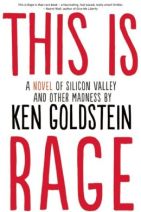
About This Book of Mine

Pre-Order on AmazonI have mentioned now and again that I have been working on a novel for a few years.  It’s time to share a few more details.

First of all the title: This Is Rage.  You will discover why I called it that if you read the sample excerpt on my teaser site and other fine channels we will be utilizing in the coming months, like Amazon or Barnes and Noble, where you can currently place your pre-order that will be shipped when the book is officially released on October 8, 2013.  Shameless, I know, but I am officially in the pull marketing business effective immediately.

There are two protagonists in the story, who are also both antagonists, at least to each other.  They are each hero and villain in the broader context of economic turmoil, which they aspire to improve, but not surprisingly mess up on high-octane, mostly by accident.  Kimo Balthazer is a disgraced radio talk show host, who seeks redemption in the obtuse netherworld of internet webcasting.  Daniel Steyer is a venture capitalist at the top of his game, looking to go out huge with the deal of a lifetime, but market forces have other plans.  That’s not the order in which you will meet them, and you’ll find out why.  At the outset they don’t know each other exists.  They don’t even know each other’s world exists.  But they soon do.  And they don’t like each other.  At all.

I am going to do the right thing and not toss out any spoilers, but I can say that you will spend some time in Silicon Valley, some time in Los Angeles, and some time in Washington D.C.  You will be introduced to the world of Investors, Bankers, and Operators, the three points of an ever-forming triangle that comes with its own hierarchy, rule set, chaos, and politics.  You will also meet a curious politician with a tangential agenda, a conflicted movie studio boss, the co-founders of one of the most successful tech-start-ups ever, and a pair of would-be entrepreneurs turned criminals whose interpretation of thinking different is not quite what their families had in mind.  You will be invited into board meetings and venture partner meetings.  You will hear the voice of Kimo in your head.  You will see what happens when ego and presumption run amok, and the notion of control spirals into hyper normalcy, where random boo-boos add up big time, and the consequences are strangely real and familiar.

My key influence for this book is Tom Wolfe, whose first novel Bonfire of the Vanities blew my mind in ways that still shake me to the core.  I didn’t know what a bond trader was the first two years I was in college.  Then I saw a bunch of guys my age lining up in blue suits to be interviewed to become one.  They went to Wall Street and became extraordinarily wealthy selling paper promises to their clients.  Then came the broad implosion of junk debt.  Michael Lewis, whom I also tremendously admire, made his debut as an author writing about this phenomenon.  I saw the impact on my friends, I saw the impact on New York, and I felt the impact on our economy.  What I admire to this day about Wolfe’s work was how he wove storytelling through the observational narrative, migrating the educational lesson to character development, and burying the polemic in a moral tale for the ages.  I was studying theater at the time, without notion of how I might fit into the business world, or even if I could make a living given what I valued.

A quarter century later we seem to have forgotten the fall of the junk bond kings.  The miracle of Silicon Valley has replaced the lustre of Wall Street and the allure of Hollywood.  I have played my whole career in this fantastic environment of innovation, the arranged marriage of technology and media brokered by the matchmaker financiers, and the output had been invigorating.  We have created jobs, opportunities, and a good deal of wealth — but not for everyone.  In the same way that Wolfe and his New Journalism looked beyond the restaurants and clubs and luxury high-rise suites, I have seen the scary trailing the good.  Where there is big money there are big personalities, and where there is a win-lose battle fought daily, often those who lose are the secondary foils who play by the rules without insight into the eccentric ecosystem.

That is the story I wanted to tell.  That’s why I wrote a business novel instead of a non-fiction set of adages.  This was something I needed to do, part of the continuum of my journey.  I started my career in storytelling, then helped bring storytelling into computer games, then found my way into profit and loss, and now I come full circle.  I needed a way to bring these elements together, to find a synthesis of my passions, which include the theatrical, the financial, the philosophical, the hope of justice, and a touch of dark humor (hopefully more than a touch!).

In the coming months I will tell you more about the publishing journey, but I cannot conclude this project announcement without a sincere thank you to my brilliant editor, Lou Aronica, under whose independent imprint The Story Plant my book is being published.  Lou is a Mensch in every sense of the word (Google it if that’s unfamiliar to you).  He has been a steadfast believer in This is Rage since we met each other last year on Twitter.  It’s not just the notes that he gives me, it’s the way he communicates his viewpoint that makes me want to rewrite a fourth time when he is only asking for the third.  I think Lou, a bestselling author himself, is at the forefront of New Publishing in the same way Wolfe wanted New Journalism to embrace the opportunities of Creative Destruction as a positive force for change.  Wherever this journey takes us, I am delighted to be paddling alongside a friend on this whitewater river of 21st century digital publishing — with a paperback to boot.

So that’s the introductory story of my novel.  It’s my first, I hope not my last, and I welcome you to come along and share the journey with us.  It’s for you, and it’s about you.  I hope to entertain, and maybe share an idea or two as the whitewater rises.

This is Rage.

Too Busy To Save Your Company

One of my final posts of 2012 memorialized the brands we lost last year, and inspired the question, how do so many companies so often and so badly miss the boat? It’s even more perplexing when they know where it’s docked, what time it leaves, and who the captain of that departing ship is. Seems they are just too busy to make their way to the boarding gate.

Yep, you could have found your way out, met the challenge of Creative Destruction, and banked the opportunity by reallocating resources from historic enterprises to future growth, but you didn’t. How does that keep happening?

In a recent Wall Street Journal profile, longtime media executive Strauss Zelnick, who has worked his way through several platform shifts, summarized it perfectly:

One of the problems with some of the diversified media conglomerates is you get the benefit of the cash flow of legacy assets and the burden of owning legacy assets. You own a motion-picture company and you should be thinking about what digital technology will do to your business. But when you wake up in the morning you’ve got to be on the phone with the folks in your studio, talking about a $200 million picture that’s going to cost $300 million and the star who’s not showing up at work and the marketing plan that’s going to cost you $100 million world-wide.

When someone says to you, “I think you should meet with this guy, he’s 26 years old, he graduated from MIT, he’s in Brooklyn doing a really interesting social media startup,” you say, “It does sound interesting but I’m too busy to do that.”

That happens a lot, way too often. People are so busy in their jobs, ensconced in the past, they have no time to breathe the future. Then the future becomes the present, and it’s too late.

Busy, busy, busy. But is busy the same as productive? Not quite. Sometimes, not at all. Companies intend to keep you busy. If you aren’t busy, or if you at least don’t look busy, you’re probably at risk. But do you add real value, especially in light of constant change?

How we prioritize our time says a great deal about what we value. In leadership positions, we have to manage available time carefully, our “to-do” lists are rewritten each day, week, month, and year as a series of choices. In the simplest examples, we have to decide which emails and calls to answer, which reports to read, which employees and customers to see. On a more grand scale, we have to develop a strategic plan and manage the component tactics that are meant to create value for all stakeholders in that plan.

Exhaustion does not look forwardWe have an awful lot of choices to make short-term and long-term. There are things we can change and some we cannot. One thing human beings have yet to do is create more time on the clock. We think we do this by multi-tasking (or foregoing sleep, family, and fun), but we are just borrowing against a fixed asset. The choices we make about priorities have much more impact on the far-ranging output of our ventures than any hour we steal back, the memo we draft during the meeting we’ve decided we can ignore while sitting in it.

Which brings us back to the most important question—are we not only busy, but productive? Are the choices we are making that comprise that busy state truly adding value commensurate with our position and expectation? Surely meeting with every young entrepreneur or technologist who fires off a business plan would be impractical, in fact irresponsible! Think of all the wasted time given the low the hit rate for unproven initiatives. Many executives choose to delegate this kind of responsibility to a new box on the org chart—for a while it was vogue to have a Chief Innovation Officer. I was sourced on what I thought of that several times over the past few years, to which I replied, isn’t the CEO always the Chief Innovation Officer? And if she or he is, doesn’t everyone on the leader’s team, up and down the line, know immediately they are a de facto part of the solution by virtue of the reporting structure? Remember the old maxim—what my boss finds interesting, I find fascinating.

Carving out discretionary time might be the most important thing an executive can do—thinking time, learning time, creative time—and yet, where does it get prioritized? Too often somewhere between doing an expense report and tidying up your desk, after hours when you’re exhausted. What if you scheduled an hour at the beginning of each day specifically for exploratory purpose? Or if not at the beginning of the day, as a respite sometime during the day? You could block it on your calendar like an appointment with your boss, inviolable, as important as anything else you are doing. You could make it clear to those around you that you want them to help you fill that hour with introductions to out-of-the-ordinary people, invitations to exhibits, maybe just an obscure white paper on a tangential topic. Your hour could then become their hour, and the exploration could cascade. Would you catch every single opportunity that might have eluded you? Doubtful. But would you instill a culture of openness where meaningful resources were clearly dedicated to the unknown? It couldn’t hurt.

Just walking that walk, talking often about your natural curiosity, leading by example to set the tone for the mandate and institutional respect of creativity, yeah, I think that would help. There is a good deal of room between having to ingest every new idea that comes your way and fully delegating innovation to an isolated “special projects” department. Balance in leadership is critical, making good on today’s commitments while preparing for tomorrow, and it would be hard to maintain respect in an organization for a boss who neglected contractual obligations that paid the bills to wander aimlessly in dreamland.

Clearly there is no textbook approach on getting this right or fewer companies would fail, but leaders who strive to find a workable balance between maintaining focus on existing lines of business while bridging access to the unknown—even if only by maintaining an honest open-door policy—seem to have a better shot at extended shelf life. Whenever I worked for someone who did this, who asked me to bring them interesting stuff to look at that may not have mattered to everything else we were doing, that made me think harder about everything we weren’t doing to deflect the attackers quietly sneaking up on our castle. It also led to a few projects over the years I never would have conceived could make a difference in our business.

Fostering a culture of openness is much more promising than insisting on a culture of busy-ness. And there you have it, that strange root word that compels us to activity often in abstraction of thought. We need both to survive, don’t you think? If you have a moment, get back to me on that—although I will understand if your dance card is full. In fact I expect just that.

Learning from Mars

If you went to elementary school circa the 1960s, you remember that one of the few times TV was brought into the classroom—likely a dusty, early model, enormous 21-inch Zenith B&W CRT with bent rabbit ears, strapped to a prison issue, grey steel rolling wheel cart—was for the Apollo lift offs, splash downs, and moon walks. During those turbulent years of hard-won civil rights and compounding economic expansion, you might have dreamed about growing up to be the next Mick Jagger, but it is equally possible you aspired to have The Right Stuff and be the next Neil Armstrong.

The Space Race captured our imaginations. We watched in awe as the first boot imprint and an American flag were planted in the Sea of Tranquility. We lost sleep with the good people at Houston who had “a problem” bringing home Apollo 13. It was all so captivating, the science in our textbooks was made real, technology was cool, and the Warp Factors of Star Trek seemed someday plausible. I’m glad I got to experience that as a child—it made childhood more childlike and less childish. The Little Prince would have been proud.

Much has been written about the fall off in public enthusiasm for the space program after the tapering Apollo missions and the less grandiose but still near miraculous Space Shuttle missions. As we left The Cold War behind with the collapse of the Soviet Union, we came to worry less about controlling our Solar System. Satellites became our path to better television and radio entertainment, not so much a magic portal to the future as a manufactured bridge to enhanced convenience. It all became ordinary, and then expensive, a difficult pair to keep at the high-end of federal funding without public enthusiasm. We moved on, to the information age, to the PC revolution, to the wildly lucrative internet. NASA was scaled back year after year, and although we knew that wasn’t optimal, we were largely okay with it.

Too often we forget all the ancillary learning that occurred as part of space exploration—not just the nifty consumer products like cordless power tools and vastly improved athletic shoes, but the processes of working together in high function teams. Getting tonnage into and out of space safely has never been a job for individual heroes as much as it sets the tone for working together in groups, combining scientific work methods that emphasize cooperation, breaking down gigantic projects into manageable tasks. Engineering is a profession of shared ideas, where the accuracy of each single contribution matters immensely, but the compiled knowledge of all participants matters even more. We take so much of that kind of process for granted now when we bite off big chunks. I wonder if we take appropriate time to digest just what the process of doing the incredible really means.

As we took a brief intermission from the Games of the 30th Olympiad these past few weeks to observe the otherworldly, never before tried jet-softened hard landing on Mars, I was left pondering if perhaps we were being a bit too casual about the successful parachuting of the Curiosity Rover. No, there were no astronauts on board, and yes, we had landed on Mars before—but not this way, and not with a nuclear powered craft of such immense size and scale. I think everything that involves operating with precision at distances of this magnitude is astonishing, and no matter how clear the physics, we should celebrate with the geniuses at JPL and NASA anytime they pull off the near impossible. Getting to Mars and sending back data to Earth is not a little thing no matter how many times we do it.

This one left me thinking even further. In the midst of a floundering economy and awful recession, precisely the opposite of the Apollo climate, our national tech teams did more with less and made us proud. What were the business lessons, I wondered—more ancillary byproducts of this adventure in science—from which we can additionally benefit in learning by example? I am sure there are many, but three leap out for me:

  1. Difficult is Good.  Paraphrasing President Kennedy’s challenge to set an arbitrary deadline without a known roadmap, the Curiosity team chose their path not because it was easy, but because it was hard. This was wide-eyed enthusiasm for a mission about something other than personal gain. Want people to rally around a task? Give them something where they need each other, where failure is acceptable in concept, but not in approach. Big problems are always worth solving.
  2. Resilience is Rebound.  Here was a team that had just put the Shuttle in mothballs, experienced colossal layoffs, and had no choice but to accept for the immediate future that our astronauts would have to hitchhike across the galaxy in the form of renting seats from former competitors. They put this behind them by committing to the project at hand.
  3. Sharing Triumph is Personal.  How do you get a team fired up and motivated? Bypassing cynicism is a decent route. This mission was about proving what was possible, about intrinsic meaning as much as the survival of equipment. The Curiosity team built pride because they did something together they will forever share, advancing progress, continuing exploration. Often you forget the details of a project, but you don’t forget people who matter. This is where emotion has a clear role in that which is otherwise objective.

I hope enough people at home were paying attention, partly because the landing was worthy of our attention, but more because when you think about it in the abstract, there is more application than meets the eye. Getting out of this recession is no small task, and it won’t be our government who gets the job done. It will be teamwork, commitment, creativity, motivation, and entrepreneurial spirit. Our move forward will be economic, but satisfaction has come from more than that. It will be of the human spirit, with celebration in the process of innovation as well as getting some problems solved.

I like that they named the rover Curiosity. It’s a good, real world metaphor. It sings aspiration. It’s worthy of our attention, a form of pedagogy that really does come from another planet.