Staying Forever Young

May you build a ladder to the stars

And climb on every rung

May you stay forever young

Those lyrics were written by Bob Dylan around 1973. I was in the sixth grade when it was released, so hey, I fit the bill. If I could quote the entire song here without violating copyright, I wouldn’t have to write the rest of this blog post. There you go, blame the copyright laws for making me try to find the words to reflect on the inspiration of a Nobel laureate.

I’m experiencing a moment of sentimentality, but allow me to position that as a positive. Last weekend my wife and I saw the musical Girl from the North Country, which is a collection of more than twenty Dylan songs wrapped around a rather grim story of a boarding house full of exhausted souls during the Great Depression. It’s a a curious pastiche, but from what I can tell Dylan endorsed it. The penultimate number is Forever Young. You don’t need to know more than that — just that this song landed a powerful blow on me at an opportune moment, which is what an impossibly eternal song never ceases to do.

Dylan wrote the song for his children. It has popped up in every context imaginable over the ensuing decades. Google it, the impact is vast and varied. This month it is speaking to me.

A few weeks ago my niece got married on a beach in the rain. She and her fiance looked every bit the part of a couple starting on the next phase of their journey. You can’t help but see the light in the eyes of young love and remember when you stood where they stood. Your youth is your superpower. It is filled with hope, promise, aspiration, and authenticity. The older generations invited to share in the celebration see themselves in the eyes of the betrothed. We are aware of our age, but that isn’t what runs through our minds when vows are exchanged. We try to connect the now to then. In that moment, we remain forever young.

I happen to be on my way to a college reunion. It is a milestone that can be divided evenly by too many integers. The decades behind can’t help but denote age, it’s the underlying purpose of the occasion, to bring together in the present people who learned from each other in the past. Recently my classmates started posting photos of themselves from that time long ago, before mobile phones, digital cameras, and electronic image archives in the cloud. Mama don’t take my Kodachrome away! That’s borrowed from Paul Simon for anyone not of a certain age. Yep, those photos have been sitting in envelopes from mail-in film processing, pasted up in laminated albums stashed under beds, now succumbing to scanning technology and <gasp> social media. I look into the bright eyes of students I knew when Reagan was president and I am convinced they remain forever young.

I look at the conflict in our nation and as hard as I try I barely recognize the place I thought it would become. I talk to my dad about living through World War II as a child and his dreams as a third-generation American for the broadening perspective he believed was ahead for all of us. I’m not sure he realized how idealistic he was as a young man, not fully comprehending the scope of the Civil Rights movement as it emerged all around him, but certainly not expecting to hear so many of the angry expressions currently creeping back into the vernacular. When we sit together now at baseball games, I remember being a young boy also sitting with him at baseball games wondering if the world could be any more perfect than watching Al Kaline catch a deep fly ball to right field on the warning track to end an inning. Today at the games we share, I wonder if my dad in his mind sees himself the way I see myself, not our current age, but with the idea that the life then ahead of us would always be driven by imagination over conflict. In those shared moments of retained dreams, we remain forever young.

Age is real. None of us escapes it. Some of us navigate its trials better than others. It can be genetics. It can be lifestyle. I’d like to say it can also be attitude but like so many my age I’ve seen too much to crawl under that blanket. What I do know is that inside each of us is that very wish Dylan asked us to preserve. It’s there for as long as we remember it, revitalize it, rekindle it. Our bodies will slow, maybe even our minds will slow, but our vision of what we can be is ours to infuse with resonance, To see ourselves in those earlier years can carry us into a more profound, more hopeful, more caring, and more empathetic present for as long as it lasts.

That is the song I am hearing right now and it’s blasting on all channels in stereo.

May your heart always be joyful

May your song always be sung

May you stay forever young.

_______________

Image: Pixabay

The Rage Podcast: Voices All Around Us

Visit ThisIsRage.comAbout three years ago I published my first novel, This Is Rage. It’s been an amazing journey, including creative development and four public readings of my stage adaptation. Now we have something additionally exciting to announce: the first three episodes of a podcast adaptation.

We made it easy for you to find either on iTunes or at the online home that saved Kimo Balthazer from irrelevance and started his movement:

ThisIsRage.com

Who is Kimo Balthazer, you may be asking? Well, if you haven’t read the book, I would hate to spoil it for you. Let me say in the form of a teaser that he is a 20th century old-school radio talk show host lost in a world of 21st century digital communications. Although he has lost everything, and that’s largely his own unrestrained shock-jock fault, he still has a few things to say about how the business workplace is no longer the same for the everyday hardworking person.

Kimo’s anger is his listeners’ anger, and when that anger collides with a nasty bit of corporate insider deal-making that is going to eliminate thousands of great jobs for no good reason except increased profits, he takes his tirade to the Internet. Pretty much all hell breaks loose.

I kept notes for this novel for over a decade, wrote it over a two-year period beginning in 2011, and then published it with The Story Plant in 2013. At that time, the social climate of the Occupy Wall Street movement was opening the dialogue around the 1% and the 99%, and the voices around me eerily echoed the voices in my story.

The political reception to my book was as heated as it was overwhelming. I began hearing from readers all over the world who had suffered personal losses similar to the employees of the fictional EnvisionInk Systems and Atom Heart Entertainment. They recognized the roaring rage of the main characters in the book plotting against and outmaneuvering each other, while also empathizing with the quiet rage they felt in themselves as victims of an economic system they no longer recognized. They didn’t recognize Kimo, he was purely fictional, but what he was shouting rang true. They were playing by the rules, and the rules were failing them. Income inequality was becoming much more than a story.

Then something happened that surprised me. The novel was optioned for the professional theater so it’s echoing story could be experienced live and in person. I worked with the producer, Mitchell Maxwell, and my editor/publisher, Lou Aronica, for two years delivering four different drafts, each culminating in a public reading that drew equal laughs and tears. It was an unpredictable experiment that often left me drained, but each time I listened to the audience dialogue following the show, I knew the seeds had been planted for something good to come of this, if only people saw themselves in the mirror of drama and refused to let it stand as the status quo.

Then something else happened that surprised me again. The Story Plant Media team called and asked how I felt about adapting the stage version to a podcast. In facing this challenge, I reminded myself of the daunting task of writing the novel, followed by the daunting task of the four stage drafts. With the podcast, the true voices of the characters could resonate in the listener’s imagination, much as Kimo’s voice resonated with his audience. An old-fashioned radio treatment for an ironic tale of Internet radio seemed like the prefect path to firing up the voices all around us.

Those voices now belong to you.

How about that; old-fashioned serialized radio drama, all new for the digital age? There are twists in this version of the story I am exploring anew, many quite different, and dare I suggest, the romantic elements have come a little forward. Of course since we are talking the immensely flawed Kimo Balthazer, we are talking a dysfunctional romance. Perhaps it’s even hard to call it that. War of the broken-hearted might be closer. It goes to some strangely dark places of the soul.

If you read the book, you might remember the hint at the end that Kimo asked for coffee with corporate attorney Sylvia Normandy? In this adaptation of This Is Rage, Kimo and Sylvia go way back. I mean WAY BACK, as in a personal history together. Sylvia is the narrator of the podcast. She is the storyteller. It’s told through her eyes, her point of view, her play-by-play commentary. I told you it was different.

Why revisit Rage now? If you’ve been following my blog, you won’t be surprised that certain candidates in this year’s elections have stirred raging emotions in me. Throughout the past year, we’ve seen all kinds of signs that Occupy was not an isolated affair, and the People’s Revolt is showing signs of resilience everywhere. We live in difficult times, and sometimes we forget we always have choices.

It’s been said by many that change happens when the pain of change is less than the pain of staying the same. The pain around us is not sustainable. Change has to happen. It remains my hope that this story of an amateur kidnapping in corporate America elevated out of control by thundering voices can be part of the narrative that leads us together toward change.

I’d like your voice to be a part of that change. I’d like my characters’ voices to be in your heads, and I think the actors in this podcast have delivered on that front. I want to keep hearing the voices of post-show conversation, and I’d like our collective voice to reach up and grab the attention of those in power not listening. Our shared voices can bring reform, human innovation, and make change happen.

A story is one voice. When we read and listen and hear and react, it can become way more than a manuscript. My voice is meant to be a catalyst. Yours is a conduit. Let’s put them together and share a little podcast drama, shall we?

You can download or stream the podcast, and it’s free. You can also use the social media buttons to “Forward to a Friend.” That would give Kimo great satisfaction. Me, too.

Download-on-iTunes

_____

This article originally appeared on The Good Men Project.

TSO in the Front Row

TSO1

Christmas time
And the moment’s just beginning
From last night
When we’d wished upon a star

If our kindness
This day is just pretending
If we pretend long enough
Never giving up
It just might be who we are

  • From “Promises to Keep” by Paul O’Neill & Robert Kinkel

It’s getting late. Or early. Depends on where you are. Music of the Night.

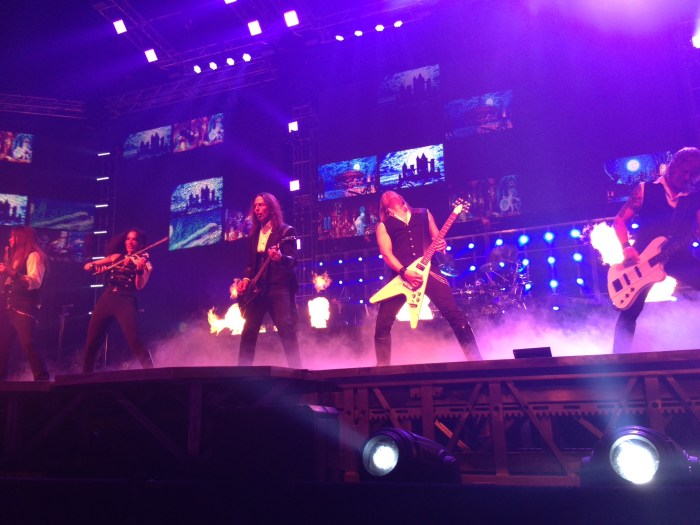
I’m just back from my almost annual two-and-a-half hours with Trans-Siberian Orchestra. It was different this year. For the first time ever my wife and I sat in the front row. I didn’t pay any special price and TSO does not sell VIP packages. We just got lucky ordering the millisecond tickets went on sale to fans. Incredibly lucky. Staggeringly lucky. Not an ordinary occurrence for yours truly.

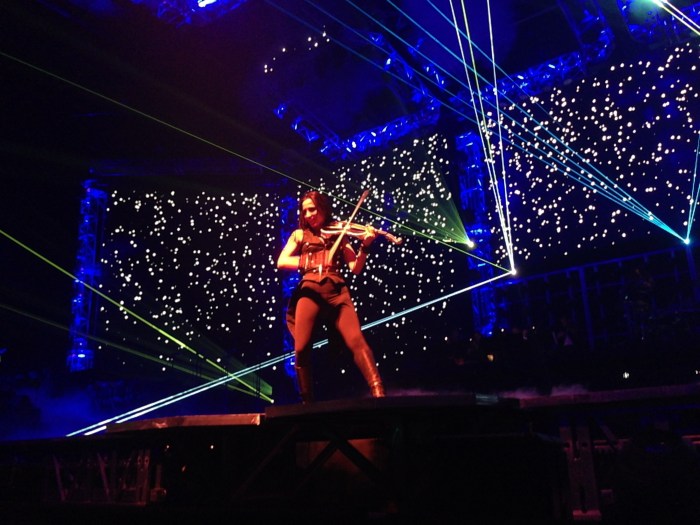
Last night’s show at Citizens Business Bank Arena in Ontario, California was as good as any and every show we’ve seen TSO perform since we began following them around the turn of the Millennium. The difference was the intensity of, well, being in the front row. I’ve been going to rock concerts like this for over forty years now, and the few times I’ve found my way to the front row, there is nothing like it. When there is nothing between you and the musicians but a wee bit of inner space, you connect. It’s indescribable. It’s metaphysical. It’s what rock and roll is meant to be, the lines between audience and performers erased. You feel the experience in a different way. There is a pure intensity that sinks through your sensory inputs and temporarily commands possession of your emotional framework. Ideas become visceral. Passion becomes tangible. You wish it could last forever. At least I do.

Then reality returns. It has to return, so you can take the music with you and do something with it. Inspiration is a spark, not an engine. If you find a way for the spark to ignite, you carry the torch with a reason and do something with it. Moments like hanging in the front row keep me young, but my work is still my work. Part of that is sharing this stuff with you, to bring us together in the service of something productive, something that matters.

Seconds before the show began, in the dim light of pre-set, music director Al Pitrelli walked to center stage in the shadows. I was about ten feet from him. Pitrelli is a musician of such amazing talent I am humbled watching his fingers navigate the fret board at speeds I can barely imagine, let alone emulate. I looked at Pitrelli and made eye contact. I gave him the aviator’s thumbs up. He looked back at me and put his hand over his heart, a Roman Centurion salute of sorts, but kinder and more heartfelt as he often does when connecting with someone in the audience. In that moment I felt simultaneously like we had just met in person yet were old friends. I guess both of those readings are true. It is the illusion of knowingness that allows art to work. Ancient philosophers worried about the dangers of such false impressions. Old rock and rollers like me call it keeping the backbeat.

I have never met Al Pitrelli, or TSO founder/impresario Paul O’Neill, or anyone in Trans-Siberian Orchestra, despite the fact that they inspired me to write my second book, Endless Encores. I talk about the band in the book’s Preface, how brave they are to try out new material on every tour to keep moving forward, while still giving their fans the show they expect. They just give us more, music we don’t know is coming, and that lets us grow together rather than lock into a fixed expectation of the ordinary. Maybe someday I’ll get to meet these guys—who knows, what were the chances I’d end up in the front row of their show at retail?

What do I really want to share in this predawn realtime post, something I rarely do but at the moment feel compelled to publish unpolished? Is it to convince you that TSO offers a level of practiced musicianship, vibrant stagecraft, theatrical innovation, and storytelling significance that is much too rare in pop entertainment? Possibly. Is it simply to capture the moment for myself of front row showtime as a slice of life? I’d be lying if I told you otherwise. Yet here’s the real deal: Go back to the top of this post and have another look at the lyrics I excerpted.

There is a through line here. It is the holiday season, a time of pause, a time of reflection. In the ultimate irony, the venue where TSO played last night was not too far from San Bernardino, where violent tragedy again struck our nation only days ago. Families all around us are in pain. What we need to embrace is that every kind act in response to those in need is an act that restores humanity to humanity. Music, stories, and unforgettable performances can be our road back to the goodness that gives our life purpose. When art is a conduit that reminds us to act as we internalize, we are brought together toward a path that anticipates healing. We learn from the evocative, and we advance on the hard work that must be done to make sense of our brief time together.

TSO carries into my heart a sense of hope. It ties the holidays to a call of service, and it ties the years together in a continuum of incomplete measure. Sitting in the front row made it feel more real, more direct, more personal, and oh yes, more intense. We have a tremendous amount of work to do together and not much time to have an impact. Listen to the lyrics, feel the music, embrace the integration. Then do something with it.

Celebrate the holidays by doing something that really matters. And don’t forget to turn up the volume. I’ll see you in the front row, the cheap seats, or anywhere else we can make a real difference. Think hope, then make it happen.
TSO6

Let It Be

I write this evening from London on the last day of a short business trip. I am pounding this out on an iPad so it may be a bit less polished then some of my posts, but I want to share the passion with you somewhat unedited, while it is still fresh and resonating.

While here I enjoyed the tremendous experience of seeing the new Beatles revue, Let It Be, at the Savoy Theatre. The experience was full of wonder and magic, precisely the way music and theatre can touch your heart when you least expect it. The Savoy Theatre is an especially magical venue, one of the oldest working stages in London and the first public building in the world to be lit entirely by electricity in the late 19th century.

imageYes, it’s another Beatles cover show, like Beatlemania, like Rain, like so many appearances of The Fab Four. The lads appear in multiple costumes from the Beatles era, but are not allowed to call themselves The Beatles, nor use the names John, Paul, George, or Ringo. They refer to each other as The Bass Player or The Singer or The Drummer, and of course Billy Shears gets an appropriate shout out since he is a character of fiction. They start in black suits and thin ties, then put on Nehru jackets, then some colorful hippy fabrics, then the Sgt. Pepper Uniforms, then wilder hippy fabrics, then the John character in the white suit and long hair followed by the John character in the shoulder length hair, military shirt and sunglasses. You know the drill.

We open with I Saw Her Standing There, She Loves You, I Want to Hold Your Hand, then we’re off to Shea Stadium, then the Rubber Soul period, then Pepper, Magical Mystery Tour, Abbey Road, and we round it out with Get Back, the title number, and Jude. They don’t exactly go in order, more a thematic pastiche. There are television bits in the background showing black and white commercials of the nice lady in awe dropping the pearl in the Prell shampoo bottle, occasional blasts of Jimi Hendrix over Vietnam bombings, the marches, the flower posters, the peace signs, the weeping teens falling over each other in the stadium crowds—all of the familiar nostalgia that we have seen so often but still celebrate as boomers. No creative breakthroughs, no big picture inventions, no stagecraft of staggering originality. It was a concert of Beatles songs, two and a half hours with a break, four guys who didn’t look like The Beatles absent the various wigs, and the Paul character even played a right-handed (gasp!) Hofner bass.

So why was this show so different, so memorable, so moving, so unforgettable, so touching?

Two reasons.

For one, at half a century I might have been the youngest person in the audience.

The other, the audience was almost entirely British.

You might expect at a West End Beatles revue in London-town the show goers at a Saturday matinee might be mostly tourists. They were not. They were locals. They came to relive their youth, if only for an afternoon, and they loved every second of it. They were on their feet, they were twisting and shouting, they were dancing in the aisles, they clapped and sang along word for word, they echoed the chant: “All we are saying, is give peace a chance.”

No one in that room felt they were 60, or 70, or 80. You could not tell anyone in that room that this was a 50th celebration of anything. This was real, this was vital, this was now.

And this was British. Very, very British. Lovely, as they say. Brilliant.

Yes, the image of John in Central Park is literally chiseled in Strawberry Fields. Memories of George in Los Angeles recording studios are etched in our minds. Ringo and Paul sightings in the Hollywood Hills have become as natural as any other celebrity on the west coast. We share the music with the world, but somehow we came to sense that The Beatles adopted America, and Americans unofficially adopted The Beatles.

Yet they are British, beloved here in a way I never before fully understood or felt until I spent this joyous time with their countrymen. Their fans here are perpetual, like those who have shared Shakespeare and Dickens and even Lloyd Webber with the entire world. The creativity and inspiration that has flowed generation after generation from this island in the North Atlantic never ceases to blow my mind. The impact is astonishing, the consistency in trendsetting almost baffling.

The people here are exceptionally proud that so much of what has touched them has touched so many others all over the world. The Beatles are a part of them and carry their love to us in ways that words cannot convey. You simply have to be on your feet in the crowded room feeling the music penetrate your bone mass to get it.

You say you want a revolution? That’s a revolution.

Now back to a few words on age, which I think is what really brought that tear to the corner of my eye. When that Yellow Submarine on the scrim behind the band sails through the Sea of Holes and past the Sea of Time to the Sea of Green, something enduring becomes clear, almost too real. John was taken from us, and hasn’t been here since I was a freshman in college. I still feel that loss. George has left us, and my guitar still gently weeps. We graciously do have Paul and Ringo—Ringo is even opening an exhibit this summer at the Grammy Museum in Los Angeles. Two Beatles no longer living, but all four Beatles somehow alive.

And the fans, The Baby Boomers born between 1945 and 1964, each day a few more slip away. At the end of that tail, I have the least gray hair, some have all gray hair, some have no hair at all. When the Paul character sings, “When I’m Sixty-Four,” it’s the midrange of the audience. He was in his 20s when he wrote it. They were all in their 20s when they created that vast catalog of songs—not a bad one to boot—all in less than a working decade. Those songs remain as vibrant and relevant today as they were when we bought the singles on vinyl 45s.

How does that work?

The music keeps us young. The music compels us to stay young. When we hear and feel the music we have no ailments, no doctors to see, no life letdowns or shortcomings or missed opportunities. We are optimists with our lives entirely ahead of us, just as we were when we first heard the needle hit the record, pops and hisses, mono and stereo.

We remember all the lyrics, every guitar riff, where the drumsticks hit the cymbals, and when it’s time to harmonize on the refrains. We hold onto this because it keeps our youth, our joy, our hope. When you see an aging couple set aside their walking canes, swaying their hands in the air left to right and right to left on the final chords of Hey Jude, you know magic is happening.

Time travel is indeed possible. You are transported in mind and in toe-tapping body. The music is that perfect, that potent, that mystical, that important. It just feels that good.

We boomers didn’t get everything right. We know that. We know that peace and love and world harmony are still elusive dreams. The Beatles make it possible for us to feel those dreams anew, to be young in a way that is transformational, a dream as only it can be, a perpetual time to Imagine.

You can always see the clock ticking. You can always know what time it is. You can’t take away youth.