Blog Begets 100

It’s hard to believe this is my 100th post on Corporate Intelligence Radio.

I started this blog over two years ago, about the time I committed to writing my novel, which I announced last month.  Soon after I started the novel, it became clear that it was going to be a very long time before anyone read a word of it.  Initially I was okay with that.  Then it became overwhelming.  I needed to publish something, to start this dialogue, and I needed a way to warm up my fingers before filling blank pages with thousands of words.  The blog became part writing exercise, part wish-fulfillment, and part therapy.  It also caused me to talk less to our dog when I was having a particularly slow day on the word processor, which I am not sure she misses.

One of the questions I often get is why I called it Corporate Intelligence Radio.  My friend Mitch Dolan who used to run ABC Radio named it.  He likes to call me KennyG.  If you know me and you know my taste in music, KennyG is a tough fit other than the extrapolation of my name, but Mitch does like to come up with names where I’m concerned.  He knew my book was about a radio talk show host and that someday this blog would feed the story, and we have always talked about doing some kind of a show together, so he just said to me over dinner in New York, call it Corporate Intelligence.  I tried to get the URL for that but of course could not, so I added Radio and there you have it, a bit of nonsense referencing radio on the internet.  Maybe someday we will do that show together and it will make sense, or perhaps when you meet Kimo Balthazer, one of the main characters in This is Rage, you’ll understand.  Or maybe I’ll change it.  Who knows?  Another distinguished publisher I often cite has since started calling a section of their periodical Corporate Intelligence, but I predate them.  Plus I have my Twitter handle CorporateIntel, and that will always be mine.

There are a bunch of things I have learned since I began blogging.  They are the kinds of thing I really couldn’t have learned any way but doing it.  Here are a six (6) that come to mind:

1) STYLE IS CONTENT – For the first year, the hardest part was finding a voice.  I had lots of topics, things I wanted to write about, but finding the right conversational tone that could both be mine and yours was the hard part.  There were more things to write about than there was a clear way to express them.  The longer a post took to write, the less conversational it seemed.  I had to learn not to over rewrite, the opposite of the book, where there is no such thing.

2) CONTENT IS HARD – After the first year, coming up with a worthy topic became the hard part.  I had honed my blogging voice, but I didn’t want to bore you with things that didn’t matter.  To this day I would write more often if I could think up more interesting stuff to write about, but I have a newfound respect for journalists who write a weekly column.  For the old school guys who did it daily — Herb Caen (San Francisco Chronicle), Jack Smith (Los Angeles Times), and Mike Royko (Chicago Tribune) — I have no idea how they did it without going bonkers.  Sports writers and movie reviewers enjoy a steady stream of topics, news reporters get desk assignments, columnists just gaze until something comes to mind.  Pondering is weird, and makes you weirder.

3) THE FIX IS IN – Electronic publishing is really cool, because it lets you fix things and change your mind.  I have rewritten very little once I have published here, but every once in a while when I think of a better adverb, I can deploy it painlessly and not even tell you.  I can unceremoniously make a No a Yes and vice-versa after rethinking it.  I love the Update button on WordPress.  Sometimes I wish the rest of the world had an Update button — or the “recall” function on email actually worked, which we know it does not.

4) KEYWORDS RULE, DUDE – Keywords are the lifeblood of online traffic acquisition.  Learning to tag is an art and a science, brewed with a touch of alchemy.  It never ceases to amaze me how people get here, but other than regular readers, the best door remains random keyword searches, that in Google’s eyes aren’t random.  So many of my readers land here accidentally because I indexed well on some search term they queried,  and then they subscribe without my asking.  What Google sees matters, and what Google indexes is the whole shooting match (plus good writing, of course).

5) YOU NEVER KNOW WHAT STICKS – There is literally no way to know what will get people’s attention and inspire their imagination.  Little throwaway pieces I have done have become among my most read, and proclamations of vision and justice died in a few days.  You write, and then you set it free.  Words have a life of their own after you give them away, and the writer doesn’t get to decide their fate, only their intention, which matters increasingly little across the democratic digital world.

6) TALKING BACK CAN BE A QUIET AFFAIR – I get a lot more private than public comments.  No matter how much I encourage people to comment publicly, most people are shy, especially when they have to post under their own name.  I don’t blame people for this, who wants to say something in public and risk attack for no particular gain, but it does remind me how brave and vulnerable all writers are.  I have become increasingly brave and vulnerable each time I push the publish button, and that’s with a book of fiction on the horizon.  Oy, please come along with me, and hey, keep the comments coming, public or private.

So here we are together at my one hundredth blog post, and this is an especially ironic bit of timing because I have just submitted my pre-copy-edit draft of the book to my wonderful publisher, The Story Plant.  I promise you I didn’t time it this way, it just sort of happened.  I used the blog to pace writing the novel from the blank page through countless rewrites, and sure enough it all came together this year right before Memorial Day.  I will continue to blog on the topics I cherish — innovation, creativity, imagination, leadership, vision, business ethics, smart marketing, well-reasoned investment strategy, creative destruction, and every so often politics (say it ain’t so!) — and I will also keep you posted as we take my novel from manuscript to release date on October 8, 2013.

I have already begun discussion of a follow-up book and may bend your ear on that, and of course I want to include you in the sales and marketing journey as my first book comes to market in paperback and eBook.  Mostly I just want to thank you for being friends, listeners, readers, and clever people who tell me things I need to know.  I have learned way more from writing this blog then I ever imagined, and it is because of you.  Writers write surely to be true to themselves, but without an audience it is even more lonely an activity than good sense would suggest.  Knowing someone will read the words and share the ideas makes it a community, and hey, that’s intensely gratifying.

Again, my deepest and most sincere appreciation for sharing the journey with me!  We’re maybe in the second inning of the first game of a doubleheader, so grab a bag of peanuts and plan to stay awhile.  We still have a lot of ground to cover and it will be entirely more rewarding if we do it together.

100 Candles

About This Book of Mine

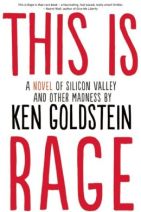
Pre-Order on AmazonI have mentioned now and again that I have been working on a novel for a few years.  It’s time to share a few more details.

First of all the title: This Is Rage.  You will discover why I called it that if you read the sample excerpt on my teaser site and other fine channels we will be utilizing in the coming months, like Amazon or Barnes and Noble, where you can currently place your pre-order that will be shipped when the book is officially released on October 8, 2013.  Shameless, I know, but I am officially in the pull marketing business effective immediately.

There are two protagonists in the story, who are also both antagonists, at least to each other.  They are each hero and villain in the broader context of economic turmoil, which they aspire to improve, but not surprisingly mess up on high-octane, mostly by accident.  Kimo Balthazer is a disgraced radio talk show host, who seeks redemption in the obtuse netherworld of internet webcasting.  Daniel Steyer is a venture capitalist at the top of his game, looking to go out huge with the deal of a lifetime, but market forces have other plans.  That’s not the order in which you will meet them, and you’ll find out why.  At the outset they don’t know each other exists.  They don’t even know each other’s world exists.  But they soon do.  And they don’t like each other.  At all.

I am going to do the right thing and not toss out any spoilers, but I can say that you will spend some time in Silicon Valley, some time in Los Angeles, and some time in Washington D.C.  You will be introduced to the world of Investors, Bankers, and Operators, the three points of an ever-forming triangle that comes with its own hierarchy, rule set, chaos, and politics.  You will also meet a curious politician with a tangential agenda, a conflicted movie studio boss, the co-founders of one of the most successful tech-start-ups ever, and a pair of would-be entrepreneurs turned criminals whose interpretation of thinking different is not quite what their families had in mind.  You will be invited into board meetings and venture partner meetings.  You will hear the voice of Kimo in your head.  You will see what happens when ego and presumption run amok, and the notion of control spirals into hyper normalcy, where random boo-boos add up big time, and the consequences are strangely real and familiar.

My key influence for this book is Tom Wolfe, whose first novel Bonfire of the Vanities blew my mind in ways that still shake me to the core.  I didn’t know what a bond trader was the first two years I was in college.  Then I saw a bunch of guys my age lining up in blue suits to be interviewed to become one.  They went to Wall Street and became extraordinarily wealthy selling paper promises to their clients.  Then came the broad implosion of junk debt.  Michael Lewis, whom I also tremendously admire, made his debut as an author writing about this phenomenon.  I saw the impact on my friends, I saw the impact on New York, and I felt the impact on our economy.  What I admire to this day about Wolfe’s work was how he wove storytelling through the observational narrative, migrating the educational lesson to character development, and burying the polemic in a moral tale for the ages.  I was studying theater at the time, without notion of how I might fit into the business world, or even if I could make a living given what I valued.

A quarter century later we seem to have forgotten the fall of the junk bond kings.  The miracle of Silicon Valley has replaced the lustre of Wall Street and the allure of Hollywood.  I have played my whole career in this fantastic environment of innovation, the arranged marriage of technology and media brokered by the matchmaker financiers, and the output had been invigorating.  We have created jobs, opportunities, and a good deal of wealth — but not for everyone.  In the same way that Wolfe and his New Journalism looked beyond the restaurants and clubs and luxury high-rise suites, I have seen the scary trailing the good.  Where there is big money there are big personalities, and where there is a win-lose battle fought daily, often those who lose are the secondary foils who play by the rules without insight into the eccentric ecosystem.

That is the story I wanted to tell.  That’s why I wrote a business novel instead of a non-fiction set of adages.  This was something I needed to do, part of the continuum of my journey.  I started my career in storytelling, then helped bring storytelling into computer games, then found my way into profit and loss, and now I come full circle.  I needed a way to bring these elements together, to find a synthesis of my passions, which include the theatrical, the financial, the philosophical, the hope of justice, and a touch of dark humor (hopefully more than a touch!).

In the coming months I will tell you more about the publishing journey, but I cannot conclude this project announcement without a sincere thank you to my brilliant editor, Lou Aronica, under whose independent imprint The Story Plant my book is being published.  Lou is a Mensch in every sense of the word (Google it if that’s unfamiliar to you).  He has been a steadfast believer in This is Rage since we met each other last year on Twitter.  It’s not just the notes that he gives me, it’s the way he communicates his viewpoint that makes me want to rewrite a fourth time when he is only asking for the third.  I think Lou, a bestselling author himself, is at the forefront of New Publishing in the same way Wolfe wanted New Journalism to embrace the opportunities of Creative Destruction as a positive force for change.  Wherever this journey takes us, I am delighted to be paddling alongside a friend on this whitewater river of 21st century digital publishing — with a paperback to boot.

So that’s the introductory story of my novel.  It’s my first, I hope not my last, and I welcome you to come along and share the journey with us.  It’s for you, and it’s about you.  I hope to entertain, and maybe share an idea or two as the whitewater rises.

This is Rage.

Best Written TV Series of All Time

This is not a “normal” blog entry for me, but it seemed fun and worth sharing.  Earlier this month, I received the following announcement from the Writers Guild:

In 2006, the Writers Guilds of America, West and East presented the 101 Greatest Screenplays, honoring the best screenwriting of all time as chosen by WGA members. The final list and tribute event garnered major media and industry attention.

Now in 2012, the WGA turns its attention to the small screen with plans to unveil the 101 Best Written TV Series, honoring the most outstanding television writing of the past seven decades and spotlighting the writers who crafted the acclaimed TV shows that helped shape our lives.

If you would like to take a trip with the Ghost of TV’s Past through an extensive but still incomplete list of WGA acclaimed television series, they have provided the link included here.

The request was to vote for my own Top 20 in no particular order, which I found so interesting, enjoyable and difficult, I offer it here.  I share this not because it is definitive or I think my choices are in any way the correct ones, but to offer a perspective of what gets me jazzed about good commercial writing for the media.  This is highly subjective ground and potentially controversial, but what it says to me is that our choices of what we find to be good writing help define our own unique place in the world by nudging us to articulate a personal sense of aesthetic.  Storytelling in any compelling form can offer a window into interpreting our own motivations.  What we like is what we like, and that helps make each of us who we are.  No doubt you will think I am wrong for both what I included and did not, but hey, that’s the fun of it.  Maybe you’ll talk me in or out of a title.  Vive la difference!

Some of these lasted a single season, a few more than a generation.  Clearly the ones that went on longest had the most ups and downs, but even where they may have been inconsistent, the fact that they held my attention to stay connected kept me from penalizing the rough patches.  I tried with each to think about writing specifically as the key element in my selection, although too often it is hard to tease apart the written word from acting, directing, and even show design.  Television is known to be the writer’s medium, but there are times when a featured actor creates a character so defining it can carry the show beyond the craft of the teleplay.  Although outstanding writing is a critical component in what I enjoy, I did not approach this as a “favorites” list per se — otherwise as many as a half-dozen of these picks might have been switched.

The shows noted all had an impact on me for all kinds of reasons, personal, professional, in work and play, writing and non-writing professional work.  In no particular order, with a touch of bias toward recency, here is what I came up with for my best written 20:

1) Hill Street Blues

2) NYPD Blue

3) Friday Night Lights

4) Roots

5) thirtysomething

6) My So-Called Life

7) Man Men

8) Sopranos

9) Lost

10) The West Wing

11) Boardwalk Empire

12) The Dick Van Dyke Show

13) Mary Tyler Moore

14) All in the Family

15) Modern Family

16) M*A*S*H

17) Cheers

18) Married with Children

19) Daily Show with Jon Stewart

20) Saturday Night Live

If you want to know why or why not, please feel free to comment, but make sure you suggest at least a few of your own!  We’ll see how all our tastes aligned with the compiled WGA ballot tabulation when the 101 Best Written are announced later this fall.

# # #

If you found this article engaging, you can sign-up for email updates of future posts in the subscription box in the right column of this page (check your spam folder for a confirmation email if you don’t receive it, you will need to verify your email address with a simple click on the confirmation email).  You can also “Like” Corporate Intelligence Radio on Facebook and get regular updates of new posts in your news feed by clicking the following link and then clicking the “Like” button on the landing page:

http://www.facebook.com/CorporateIntelligence