Do Books Matter Less?

The pre-Socratic Greek philosopher Heraclitus was an early observer of the ever-occurring change in our universe. About the same time in the 5th Century BC, Parmenides pondered the notion of permanence, what we could presume in nature to be essential. Between the two of them, we have a thesis and an antithesis that have yet to reveal a synthesis beyond argument some 2500 years later. We see change all around us in almost unfathomable complexity, while we wonder what we can hold onto as firm. For me, it’s a good problem to have, as contemplation of the unsettled forces us to chew harder and argue better.

Then there are books.

In a recent Wall Street Journal piece with the header “Books That Are Never Done Being Written,” Nicholas Carr contemplates the far-ranging impact of digital distribution on long-established but fluid notions of traditional publishing:

An e-book, I realized, is far different from an old-fashioned printed one. The words in the latter stay put. In the former, the words can keep changing, at the whim of the author or anyone else with access to the source file. The endless malleability of digital writing promises to overturn a whole lot of our assumptions about publishing.

The realization that books are no more permanent than this year’s understanding of medical treatment is hardly shocking. The very paradigm of printing on paper and binding a work has throughout its history adopted the notion of editions and revisions. Where would the school textbook industry be without an excuse to update a classroom volume rather than allow you to feel comfortable buying a dog-eared half price two-year old version? If we only needed one unabridged edition of the Complete Works of William Shakespeare, think of how many academic preface summaries we would have been denied annotating discovered corrections in the core text.

Yet in the worlds of literature and even political theory, we do seem to maintain an expectation that the version we read of Charles Dickens or John Stuart Mill is largely the same as the draft the author called final. “A Tale of Two Cities” even when presented in its initial serialization was eventually finished, as was the essay “On Liberty,” and when we buy a copy of one of these today, either in paperback or download, we do believe in the authenticity of replication representing if not a fully steady state, a pretty firm slice of life. That is helpful not only in getting us all on the same page for discussion and critique; it also offers us grounding in history and social evolution, the ceaseless churn emerging from deliberately placed bricks in the wall.

I have a hard time thinking today is much different, and no matter the short attention span theater that victimizes so much of our patience, my sense is our books have never been more important — no matter the brevity of their life-cycle, no matter their imposed truncation or expansion, no matter their delivery format or storage means on a wooden shelf or cloud server. Our books will change as they must, but their timeliness and meditation as a collective might be the primary permanence we retain, even if it is more spiritual and metaphorical than natural or physical. The means of delivering the book does not define the book; it is largely irrelevant, a timely convenience worthy of disruption. The material of delivery is subordinated to the material of substance. It is the content that matters, not the media. The Platonic Form is the ideal, and that cannot be taken from us by technology.

However we acknowledge its consumption mechanism, the book as ideal is a bridge among scattered coordinates. We learn to read an organized set of drawn thoughts to see what is meant by change, and those who have the gift and discipline to construct a book add to the global library of permanence by carrying the torch that challenges all that came before. Historic observation is clear and consistent: the buildings decay, the land can be conquered and utilized anew after wars and governments are gone, but the ideas underlying arts remain for examination. The composed book is the codification of the idea however it is presented — that does not change.

My amazing wife, who is also an amazing teacher, enters her classroom on the first day with a simple statement:

“Our books are our treasures.”

Her specialty is English as a Second Language, and whether she is teaching adults or children, this mantra is always the same. Books are precious. If you look around our house, you might see why this is our chorus. Books are everywhere. That is what we want to be surrounded by. We also have a Kindle and an iPad.  They are filled with books as well.

Another recent story in the Wall Street Journal discussed how the price of e-books was sometimes dropping below the price of “real” books, which I guess means paper books. To me, one is no less real than the other. The broader question is whether the great majority of people should still find the time for long-form written expression in a world cluttered with half-baked tidbit social media posts like this one. The answer has to be yes, because if we are going to allow character count to trump in-depth inquiry, we condemn our more severe concerns to being adequately addressed by less than substantial narrative. Our pace of change is only becoming more frantic, and the hope for some form of understandable permanence is all the more desirable in addressing unending anxieties. Committed writing and reading get us a good deal of the way there, because the acts of reading and writing might be one of the few forms of permanence we can share.

I say this as someone who just spent the better part of a year writing my first book, which is now in first draft and undergoing edit. I haven’t talked much about the book, and won’t until we get closer to publication, but let me say that whether anyone reads it or it sells a single copy, it will remain one of my proudest achievements. Right now it is a long book. It will get shorter to accommodate marketing concerns, but hopefully it will still be a substantial book. I couldn’t have said all I needed to say in a blog post or I would have. Believe me, I would have!

In our world of constant and increasing hyper flux, books can be thought of as a noble but flawed exercise in establishing some sense of the enduring. Now that digital publishing allows current authors easy access to further disturbing permanence, any foothold in establishing the concrete may remain even more illusive, but the stepping-stones of thought that bridge us from there to here can certainly maintain significance if we view thought as continuum, a timeline. In that regard, as a roadmap or even a set of breadcrumbs, books for me have never been more relevant, nor the mission of authors any less permanent. Some books are good and some are bad, some certainly more ephemeral than others, but the connectivity of books is ongoing. Apps or facings, that is as it should be, as long as I can read.

_______________

Photo: Pixabay

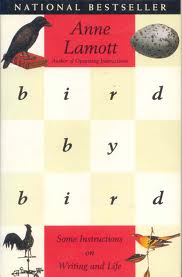
Bird by Bird

And now for something from the other side of the brain… I want to share with you a book I read this summer.  It was introduced to me by my good friend and classmate, Will Schwalbe, who among other things was Editor-in-Chief at Disney’s Hyperion books and has since founded Cookstr.com.

The book is called Bird by Bird: Some Instructions on Writing and Life.  It’s by Anne Lamott.  It was originally published in 1994.  I read it for the Instructions on Writing.  I’m sharing it for the Instructions on Life.

Lamott’s guidance was extremely helpful to me as a creative inspiration, but that is precisely when I realized the entire book can be read as a linked set of metaphors.  Even if you don’t have the least bit of interest in creative writing, I would still recommend this book.  Let’s start with the basic conceit, lifted from the back cover, quoting the author:

Thirty years ago my older brother, who was ten years old at the time, was trying to get a report on birds written that he’d had three months to write,  [It] was due the next day.  We were out at our family cabin in Bolinas, and he was at the kitchen table close to tears, surrounded by binder paper and pencils and unopened books on birds, immobilized by the hugeness of the task ahead.  Then my father sat down beside him, put his arm around my brother’s shoulder, and said, ‘Bird by bird, buddy.  Just take it bird by bird.’

Okay, if you don’t have a little goofy sentimentality in your outlook you can link off now and ignore the rest of this blog post, because that passage reflects the spirit of Lamott’s clear observations and confidence, encouragement without pretension, honesty and uplifting outlook.  It worked for me.

Anne Lamott is not a cheerleader, more like the Burgess Meredith with the water bottle and bucket in Rocky’s corner between rounds — I’m also guessing she wouldn’t wilt if she had to slash your eye open if like Rocky it got sealed shut.  She knows you are going to get hit hard, and she reminds you that you know it too.  She tells you not to get distracted by that which doesn’t matter to the process of writing.  Much of this she learned from her father, who was also a career writer.  He taught her it was the doing that mattered, not the surrounding mechanical functions that seem like they matter.

bird by bird 2What struck me repeatedly in Lamott’s mini-lessons was her deep understanding of process — that output of a work is not so much the full work itself, but an assembly of building blocks, one at a time, each a commitment, and only in totality something more.  She does not advocate bonehead process or ridiculous formulaic mandate — this is not a how-to manual — she just wants us to care about what we are doing and accomplish it in a series of heartfelt steps.  There are no shortcuts, it’s a little more each day, a continuum that adds up to a satisfying and cohesive whole.  This is not breakthrough thinking, but it’s a lesson we need to learn over and over, and it’s not just about writing.  Creative process is the heart of innovation.   Think of all the elements that make the iPad great.  If all the elements weren’t great, it would not be great.  Same with a restaurant menu and wine list.  Same with an office skyscraper or memorial monument.  Same with a short story, same with a novel.  Summary impression rests in the details, all the many tiny parts or moments — and all those details require hard thought and careful design.

Lamott is smart about this, she tells you that getting it right is not going to happen out of the gate and unnerving strides at perfection can be your worst enemy.  She has an excellent descriptor for the real quality of the first drafts to which we aspire.  I’ll let you discover that on your own so the word does not get scraped here.  Her point is, just get the words out, work on making them better later, a layer at a time.

She also allows us not to obsess unnecessarily with locking the full road map before we explore, because again that can impede our work.  How far do we need to see ahead?  “About two or three feet ahead of you” is plenty she tell us, quoting E.L. Doctorow: “..writing a novel is like driving a car at night.  You can only see as far as your headlights, but you can make the whole trip that way.”  She says this is “right up there with the best advice about writing, or life, I have ever heard.”  I tend to agree.

There is tremendous empathy in Lamott’s world view, she offers a sense of shared experience that is reinforcing and comforting.  Lamott talks about the imaginary radio station playing in your head — another colorful descriptor I will let you discover — that tells us over and over again why we can’t do something, why the work we are doing is neither good nor worth doing.  Learning to turn off that radio is our key to moving forward, we all hear it from time to time, but when it becomes perpetual, that is when our ability to create interesting work stops completely.

Lamott is just so honest and clear about all the factors that stop us from moving forward because she not only has experienced them, she continues to experience them.  She does not position herself as a guru or weekend seminar success evangelist, but simply as someone who can reflect on problems of creativity because she deals with problems of creativity endlessly in her own life.  She is even more honest in telling us that no one can make these problems go away once and for all, certainly not with any form of temporal success.  All we can do is know that these obstructions will always be there, so we must embrace confronting them.  Sometimes it really is good to know that none of us are experiencing roadblocks on our own, the fact that someone like Lamott tells you she is experiencing what you are experiencing is precisely the empathy that builds strength and resistance because the experiences are shared, bad and good.  Her humility is reinforcing and refreshing and uncompromisingly inspiring.

“Bird by Bird” is not a long book, it can be read if you wish initially in a single sitting, but it is the kind of book you will find yourself coming back to for this chapter or that, this phrase or that.  Lamott writes with good humor, even when she tackles very difficult and personal matters of her own life and those around her.  The more I think about her framework, the more I am convinced it is much more broadly applicable then perhaps she even considered.  I see the guidance as useful in company life, in financial life, in family life, in political life, and in government life.  All of these require effective process to get them right, there are no shortcuts, and the rewards can be the smallest where the challenges are the greatest.  That does not mean the rewards aren’t meaningful, but it is the context of those rewards and the expectations that one sets for success that truly inform us when we are steering toward a final draft.

How do you get from idea in your head to finished manuscript?  The same way you build a company.  The same way elegant software libraries become paradigm defining customer experiences.   The same way we fix the economy and replace our government leaders with people who want to work on behalf of the people instead of themselves.  Process.  Commitment.  Focus.  Humility.  Honesty.  Bird by bird by bird by bird…

CliffsNotes as Long Form

Neal Gabler always makes me think; last week he made me think a little harder.  His op-ed piece in the New York Times on August 13, 2011 “The Elusive Big Idea” (which I added to the Corporate Intelligence Radio Library) caused me once again to reflect on our spiritual respect for the technological achievements that too commonly enter our lives without enough awe.  Thousands of years of civilization and learning have taken us through The Renaissance, The Industrial Revolution, and now Digital Transformation, putting on our desks and in our hands more MIPS (millions of instructions per second) than humanity ever could have envisioned just a half century ago, with Moore’s Law in little jeopardy of compromise anytime soon.  And the question remains: what are we doing with it?

Gabler is a prolific author and senior fellow at the Annenberg Norman Lear Center at USC who suggests in his recent essay that in this post-Enlightenment Age, we may for the first time be going backward intellectually, and that as “information narcissists,” we are allowing our brain cycles to be consumed by endless temporal factoids at the cost of more thoughtful inquiry.  I can’t do a better job of making the point than Gabler, so I invite you to read the full piece which is linked above, but his concern stems from the impact of the parade of dribbling tidbits from the internet that distract us from the harder work of digesting and discussing what were previously known to us as Big Ideas, the most recent of which were summarized in The Atlantic and didn’t seem so big to Gabler (me either!).  We store and remember these media snacks for their brief life cycles, failing to reserve more extensive internal processing power for the ambiguous and abstract.

Since I have spent almost my entire career as part of the problem and never the solution it would be hard for me to get on this bandwagon without impeaching a life’s work, but I have to say, I am sympathetic to Gabler’s critique.  I remember well our teachers’ fears when we were growing up, watching and memorizing ceaseless half hour episodes of Gilligan’s Island and The Brady Bunch, that our fragile attention spans were being decimated by the power of television.  Every sitcom with its full 22 minutes of content has a beginning, middle and end, it tells a story with resolution that is mostly satisfying and even has three laughs per script page.  Prior to that you’d need an hour of dramatic TV for story, prior to that a 2 hour movie, prior to that a 3 to 4 hour stage play, and prior to that a novel that might be as brief as Huck Finn but could be as long as Moby Dick.  Indeed, our generation was the beneficiary of staggering efficiency.  We welcomed those little yellow books then called Cliff’s Notes covering a novel with about 90% compacting — but then again, that still left a thirty or so page pamphlet that had to be read.  The second year I was in college something crawled out of cable called MTV, and that took storytelling down to just about three minutes, even more efficiency, and many of these micro video operas were created by TV commercial directors, who could tell a story in 30 seconds.  When YouTube gets the job done in under 8 seconds, I say that’s nice, but that was the easy part of the optimization, that just knocked out the last 22 seconds, the hard work of leaving Herman Melville in the dust was already diced and strained long ago.

How about that, an entire moral tale bypassing hundreds of reading pages, fully consumable in 22 minutes with two breaks for bathroom and pantry runs — O Brave New World (that’s a line from The Tempest, which is a play that was written by Shakespeare, who was a kinda like Steven Spielberg, back when Queen Elizabeth I would have had her mobile tapped if phones had been invented)!  So if our attention spans are now down to 140 characters because that’s the Twitter standard adopted from mobile texting, how do we keep “longer forms” viable and where do we get into trouble when we don’t?  I don’t have a solution anymore than Gabler does, because efficiency really is attractive for anyone who does not know what they are missing in the nuances of polysyllabic adjectives and adverbs, but I do worry about the ramifications.  Because so many stories are now reported in sound bites, those featured in stories have learned to communicate with directed outcomes in sound bites.  I am not too worried about this for entertainment purposes, if someone enjoys an 8 second tree squirrel ballet on YouTube and doesn’t wish to sit through The Mahabharata, I see it as their loss, but the sun will come out tomorrow.  Eventually all culture could be destroyed, but after a few generations no one will remember.

What I do worry about is news and government leadership.  Currently we seem satisfied to be internalizing critical issues in sound bites, and that is why we are being treated like idiots by our incumbent and aspiring leaders.  They are taking for granted that we don’t have the patience to get in the weeds, so they are feeding us unsprouted seed fragments.  They are failing at devising levels of substance because it is not required of them, we are accepting their failure, and the cycle repeats.  We must make this stop.

The first decisive media sound bite I can remember was the Ronald Reagan game winning “There you go again” to Jimmy Carter in their 1980 debate, halting then President Carter from launching back into a long form malaise of more pedantic matters.  I sense that much of Reagan’s future success was defined real-time in that smack down, and we learned to like him for style whether or not he followed through with substance.  It seemed quite unscripted and endearing, and it worked.  Today we listen to endlessly planned runs at sound bites, poor imitators of extemporaneous reduction, not even extracting them from context because they are context.  We must make this stop.

How can we obstruct the content obstructionists?  Again, Gabler is much more eloquent on the problem than I am, but I fear neither of us has a good solution.  Here is what I can tell you — gadgets and efficiencies are going to continue to accelerate, and even if we could break free of needing to interpret consequential texts and tweets and posts, our kids are in it for the short haul.  All I can suggest is that we do everything we can to teach them an appreciation for reading, help them to understand that multitasking while useful is the antithesis of focus, and lead by example by not letting any leader off the hook with a chorus of sound bites and no carefully composed libretto.  The information is there if we want to read it or hear it or debate it, more than has ever been available is now being ignored, but we have to be willing to invest the time.  Just like you won’t accept second-rate technology, stop accepting second-rate garbage in the form of info morsels where substance is required.

Feel free to still enjoy YouTube and reruns of Gilligan’s Island.  Society will survive the culture shock, but where brevity is meant to mask laziness among issues that are critical to our sustenance, that has to be called out.

Your Gun, Your Badge, Your Honor

Last week I attended a panel discussion at the LA Film Festival called Your Gun and Your Badge whose participants included:

Robert Crais (Writer, Cagney & Lacey, Baretta; author of the Elvis Cole mysteries)
David Milch (Writer, Hill Street Blues; creator NYPD Blue)
José Padilha (Director, Elite Squad, Elite Squad: The Enemy Within)
Gerald Petievich (ex-Secret Service agent and author, To Live and Die in L.A.)
Moderated by Los Angeles Times contributor Mark Olsen

Full disclosure, I worked for David Milch more than 20 years ago and consider him not only one of the finest working writers today, but an immensely impactful teacher.  I hadn’t heard him speak on the writing craft since I worked for him so long ago and arranged a series of lectures he gave, which carried forward the ethos he previously established when he taught creative writing at the university level.

Mark Olsen of the Los Angeles Times set the tone for the panel by noting our location downtown, the heart of so many noir tales and a reality base for police activity that defines many episodes from which fiction is derived.  All of the writers shared varying perspectives from successful careers as storytellers, but what struck me most about the discussion was its common theme focusing on authenticity.  This notion of establishing the set of norms that constitute a world view and then remaining true to them transcended police work in my mind, it even transcended the procedural staging of those norms in the form of entertainment.  In approaching their craft, the writers universally noted the mandate for extensive research as a requirement of their approach, and a bottom line almost moral responsibility to understand the details of the world they would portray before they could begin interpreting it.

Gerald Petievich, a 20 year Secret Service agent turned novelist and later screenwriter, repeatedly used the term “verisimilitude” to describe the requirements of his characters.  Jose Padilha, who was sued in Brazil for his portrayal of violence as commonality in the Elite Squad, referenced the suit as evidence he had achieved the authenticity he sought.  Robert Crais, attempting to define process in his approach to character development, quoted the renowned author Joseph Wambaugh who wondered, “Does the cop work the case, or does the case work the cop?”  David Milch talked in detail of how we watch characters struggle to overcome their failings, summing up his reflection with the powerful descriptor: “If there is a God he wants us to be honest; if there isn’t, it’s even more important.”

As I kept hearing these words become almost the foundations of a chorus — authenticity, verisimilitude, honesty — it occurred to me that so much of what we consume as popular showmanship is experienced in the form of escapism.  Our hunger for Super Hero movies seems insatiable, and with occasional exceptions, the documentary film as a form of commercial entertainment has seen better days.  Yet authenticity is a broader construct than a simple portrayal of reality — as was noted by the panel, Ziegfield was as committed to getting every stitch in every costume right, not because the audience could necessarily see it, but because whoever was wearing the costume had to know it was correct to convey the same notion of authenticity under that banner.

The consistency of this message of the artist’s commitment to authenticity was inspiring and thought-provoking.  Anyone can pay lip service to the notion of honesty, but an audience can feel the writer’s dedication in the work when presented.  But what about in the workplace, is our commitment to verisimilitude as profound as that of the author?  Is it as pronounced as it should be?  Is there a relevancy in this ethos to how we approach day to day business, the seriousness of our research, the authenticity of our value propositions and commitments to colleagues and customers?

It occurred to me that I had never heard a panel discussion at any business conference I ever attended even remotely like this one, certainly not with top dogs of equivalent stature in their respective fields who have earned the permission to delve in such expression.  Thinking about the headlines of late — of homes with mortgages underwater, of securities backed by worthless collateral, of for profit schools leaving students in debt without marketable skills, of a once trusted giant of personal financial management now behind bars — I wonder where is the verisimilitude in all that.  Surely a scam is born every few minutes, without them there would be much less to write about, but the creators of products and services might do well to see intrinsic value in the pride of authenticity, the self-knowledge and reflection that it is expected of us no differently from the creators of books, television shows, and movies.  Just as we can abandon any form of media if the hard work of noble construction is not present, so can a brand be abandoned by customers in a world of choice.

The applicability of authentic commitment seems less metaphorical than an actual model of success, where the judge is first oneself, followed then by making the offer available to others.  A scene depicted without requisite deliberation is a skit.  A brand evangelized without a consistent promise is a logo.  It’s not hard to see the distance, but it takes more than words to close the gap.

We all crave authenticity. We all crave verisimilitude. We all crave honesty.  Imagine the power of unlocking the value in that inspiration in everything we do.  The storyteller may lead, but we all can have a great deal of skin in this game if we hold ourselves accountable for the same level of commitment to detail, rigorous study, ongoing iteration, and a set of beliefs that reflects equal parts respect for the subject and the audience.  That to me is a story worth telling, experiencing, and sharing.

It’s not just about police work, it’s about all work.