The Big Short: A Remarkable Winner

The Big Short

The Big Short won the Academy Award for Best Adapted Screenplay. That’s tremendously cool, and a well-earned honor for screenwriters Adam McKay and Charles Randolph. This film almost deserves a special Oscar for the studio executives who green-lit the production. Imagine the pitch:

“Okay, we’ve got a 300-page ultra-detailed nonfiction book that explains number for number what caused the Great Recession brought on by the real estate mortgage crisis that temporarily wiped out about half the value of equity in American homes and half the value of global stock trading in practically every segment of the market.

“Wait, wait, now it gets good! The protagoniststhe guys who winare quirky, real-life speculators who make an outrageous fortune betting against the economy of their own nation, and when they are proven right and the market collapses, they make an unconscionable amount of money when 99.5% of the population gets financially wiped out!

“Wait, waitand they’re heroes because they saw it coming and no one would listen to them when they tried to tell a few important people that the collapse was inevitable, but since none of the important people would listen to them, after the crash they all go on to be celebrities who receive honorary degrees and big consulting fees from anyone who can get them to answer their phones.

“No, no, waitand because this movie is an absolute downer and cannot possibly be construed as commercial in any mainstream way, let’s double down on the budget and get the biggest movie stars we can to play the quirky few who saw it coming and their equally surreal foils, I mean, really, really, really big names like Christian Bale, Brad Pitt, Ryan Gosling, Steve Carell, Marisa Tomei, Melissa Leo, Margot Robbie, and Selena Gomez. And I’m not saying get one of them or a few of themGET ALL OF THEM! Hell, if we’re going out in style, let’s go crazy nuts wild freaky insanethis can be a way bigger disaster than Ishtar, Heaven’s Gate, The Lone Ranger, or John Carter. If it fails it’ll be a legendary bomb!”

And you know what? The darn thing worked. It worked on every level. Gutsy, imaginative, informative, authentic, honest, funny, creepy, haunting, accusatory, indictinga perfect motion picture for our time for the movie lovers who maybe have had enough Marvel superheroes for a while yet can’t quite push themselves to go to the theater and read translated subtitles.

The Big Short is a mainstream movie of immense intelligence, integrity, and craftsmanship. It’s the kind of movie like All The President’s Men and Silkwood that we just don’t see anymore. How about that? They put something thought-provoking with movie stars on the screen and we paid the price of admission! Maybe we were desperate for good dialogue, maybe we were desperate for an explanation of what happened, or maybe there still is a market for smart flicks that educate while they entertain without being preachy, polemic, or polarizing.

Credit the immense genius of Michael Lewis, forever one of my literary heroes, who wrote the brilliant book upon which the screenplay is based. Lewis has been knocking out spectacular investigative nonfiction in the style of narrative fiction since his debut almost three decades ago with Liar’s Poker. I don’t think Lewis is capable of writing a bad book. He’s that good! Maybe the studio execs rolled the dice because of the monster success of Lewis’s Moneyball and The Blind Side, two more incredibly unlikely adaptations for the screen that brought big ideas into the hearts and minds of popcorn lovers everywhere. We like to say all great drama begins on the page. Lewis proves it empirically, one platform removed, again and again and again.

Lewis teaches, Lewis engages, Lewis forces us to think while never threatening us, embarrassing us, or chastising us. He sees real-life people as characters whose stories are on par with fiction because of the layering in their motivations. We see arcs in the lives of people we come to know for their strengths, weaknesses, curiosities, and aspirations. We grow as they grow. We fail as they fail. We are redeemed as they are redeemed. That is great storytelling in any form of media. In The Big Short, we celebrate the art of illuminationseeing what we all should have seen but only a few of us actually did. Now in hindsight we see it together, and with any luck we bond together to prevent the evil from returning.

The very act of successfully adapting this literary work to a visual medium is worthy of celebrationbut wait, there’s more! We are also fond of saying “the eyes are the window to the soul.” When you watch The Big Short on the big screen for two or so hours, you see an unending array of eyes but almost no souls of any kind. That is very, very hard to do. We watch our speculators conniving in complex equations that will expose our undoing, and yet no matter how many times the camera grabs a close-up, all we see are lust, greed, ego, and hubris. How are actors capable of pulling off that detachment in shot after abstract shot, initially unedited, created out-of-order, and only theoretically connected by singular motivation to be correct? They are human, but beyond the bounds of humanity, except in knowing they haven’t done anything badthey’ve simply take the spoils of opportunism, milking something bad. That’s unique to film, seeing the eyes over and over again but not penetrating what isn’t there, until the ultimate redemption, when reality unlocks public pain in one full swing of the broadsword. Gasp.

Are we strong enough and knowledgable enough to take action from a cautionary tale? Lewis thinks we are. I think so too. I’m guessing a lot of moviegoers would agree, transformed as they were from the dark to the light, from confusion to enlightenment when the house lights came up and the real world welcomed their demand for reform.

Bravo, Mr. Lewis. Bravo, studio executives. Encore! Please, encore!

_____

This article originally appeared on The Good Men Project.

Photo: Paramount Pictures.

The Trump Thing

Are there any queers in the theater tonight?
Get them up against the wall!
There’s one in the spotlight, he don’t look right to me,
Get him up against the wall!
That one looks Jewish!
And that one’s a coon!
Who let all of this riff-raff into the room?

– Pink Floyd, The Wall

Pink Floyd The Wall

It is almost impossible to believe that a material segment of our population has grown so disaffected and so ignorant that they can cheer on the repugnant egomaniac that is Donald Trump. There are no two sides to this one, nothing to argue. Just go away if you think otherwise, we have no common ground.

Hate is winning. Candor is being confused for stream of conscious bigotry. Trump is a spoiled man-child with deeply psychotic tendencies. To support him is the antithesis of patriotism; it is an expression of self-victimization, nothing more.

This is not about whether Trump wins or loses his party’s nomination, or even the Presidency. It is about the reality that we live alongside an enormous segment of the population that finds him credible and inspiring. That takes our common ground to zero. Trump may lose, but his supporters have shown us who they are and what they believe. How do we reconnect as a nation with values that shattered?

It’s not really Trump himself that’s keeping me up nights. It’s all the public venom he is unleashing. He’s making it vogue to gather in the name of Us and Them. He has proven that our education system has utterly failed in establishing even a basic shared vocabulary and understanding of ethical purpose. He causes people to believe that “saying whatever’s on your mind” is the same as “telling it like it is.”

Expressing a foul thought unedited and unsupported, loudly and repeatedly, bears little resemblance to making it true. It is bad theatera poor stage performance without disciplinenot intelligent and useful discourse.

A hundred years of socially progressive advancement is going out the window in favor of simplistic notions of aggrandized superiority. The genie doesn’t go back in the bottle after November. Trump’s followers feel validated in their disaffection. There is nothing good that can come of that, and it will neither make their lives better, nor make America great again. It keeps us on a path to dangerous democratic decision-making regardless of the election results.

That’s what’s freaking me out. I’m sitting next to these people on planes and trains, and standing in the checkout aisle next to them at the grocery store. I don’t sense that I am part of their vision of American greatness, so perhaps I go on the hit list, too.

And you. And you. And you.

_____

This article originally appeared on The Good Men Project.

Image: Gerald Scarfe, Pink Floyd The Wall.

How That Vicious Inner Critic Can Be Your Closest Ally

TMT1There’s something about optimism. Nothing in business is quite as powerful in motivating people to believe in a mission as a leader who undoubtedly believes. The energy that radiates from a passionate entrepreneur is engaging, uplifting, and inspiring. When we hear someone tell us he or she is following their muse, boldly pursuing a personal dream, we want to root for them. We want to become a part of it. We want to hitch our cart to their wagon. We want to step out of the ordinary and get onboard the outrageous.

A leader who won’t be deterred can bring purpose to a business enterprise.

A leader who rises above petty criticism and backstabbing naysayers can turn a hundred dollars into a hundred million dollars.

A leader who is “all-in” and won’t be dissuaded from a cohesive, organic vision can literally change the world.

Over and over we hear the speechifying that tells us never to give up, that resilience is all that matters, that we should forget the critics and ignore the naysayers.

Already doing that? Great. But there’s a catch.

Walt Disney was told he was no good as an illustrator, that his characters would never be popular. Steve Jobs got fired from his own company for being difficult, and refusing to compromise his ambitions. They were never dissuaded. They were resilient and persevered. They could not have cared less what their critics were saying.

Walt and Steve are held up as classic examples of rejecting rejection. They maintained an uncompromised vision and carved their place in history because of it. Detractors who called out “their folly” could do them no sustained harm. Walt and Steve evidenced a form of courage that set a new high water mark for leading teams beyond the fog to unbridled innovation. They remain heroes to those who aspire to transcend the ordinary.

So what’s the catch? You want to be That Leader, right? Or maybe you just want to sign on with That Leader? What’s the missing element that is most likely to take you down?

Is it that the odds against a startup succeeding are enormous?

Nope. Most entrepreneurs know this long before they quit their day jobs. Many are wacky, but few are stupid.

Is it that capital is very hard to raise, especially for a first time entrepreneur?

Nope. Most entrepreneurs discover this lesson the first time mom or dad says, “What!? Are you kidding me? You’re not a CEO… you can barely manage to get matching socks on your feet!” They secretly know that mom and dad are just negotiating their share of the deal for the seed round.

Is it that it’s nearly impossible to get super-talented people to work for deferred or limited pay for the long runway until a business is cash flow positive?

Nope. Most entrepreneurs are confident that if they articulate an exciting enough plan, the right people will get with the program no matter what, and the ones who said no just saved the entrepreneur the pain of having to fire them later for their mediocrity.

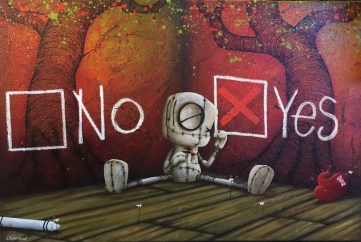
Then what is it? What is the Achilles Heel of the resilient? What is the repelling force that stands counter to the success of leaders brave enough to shake off a world that tells them No No No when all they hear in their heads is Yes Yes Yes?

Presume for a moment this entrepreneur is You. Get your highlighter ready. You’ll want to make note of this for the rest of your career.

The problem might be YOU.

Don’t highlight that. I haven’t gotten to the important part yet. The part you need to highlight is this:

If you’re not going to listen to the critics who will tell you every reason in the world why you are going to fail—and believe you absolutely must tune them out in order to be a renowned, world-class leader—you are going to have to be the hardest critic in the world on yourself.

Yes, in order to earn the privilege of ducking all the pessimists trying to steer you away from your dream, you must beat yourself up in ways they can’t even imagine. There is no luxury in resilience. There is only a level of self-critique so necessary that the pain it will cause you as a lone wolf makes child’s play of the third-party negativity you will never hear. What you hear in your head must be far more thundering—and far more impactful.

The real reason most startup leaders fail

It’s not because of a lack of devotion, or a lack of passion, or even because of a lack of talent.

They fail because of a lack of self-critique.

Does this apply to you? Have you actually established yourself as your own toughest critic? I don’t mean a little tough. I mean vicious, brutal, send yourself into a tailspin tough. Sorry to break the news, but that’s why Walt and Steve were often perceived as miserable. They were always very, very tough on themselves, an order of magnitude more thrashing than what any bleacher critic was or even could have been.

I have had the privilege to lead a handful of creative companies and I have had the privilege to be a published author. In all cases I was told innumerable times why I would not be successful. I didn’t hear a word of it. I didn’t need to hear a word of it. In all cases I was already way ahead of the peanut gallery, working and reworking the scenarios of why I wouldn’t be successful.

I study product features like I study word choices. I might tell you that no one on the market has anything like this, but before you’ll hear me utter those words, I have done the homework to assure myself this is worth defending. No one else can do that as stridently as I can. I say “no” to a sentence a hundred times before I let you see it. I edit it, erase it, rewrite it, rework it, change it, question it, then pick it apart word by word until I have exhausted all its failures. Same with a product. Same with a service.

I can only ignore the amateur naysayers because I am my own best professional naysayer.

Let’s take it deeper, to a place you may not want to go. Here’s another reason why startup leaders fail: they doggedly champion a product that is no good. It’s not because the naysayers are right. It’s because the startup leader doesn’t embrace the radical discipline to relentlessly question themselves and, by extension, their product.

If running out of time and money don’t apply as explanations, most entrepreneurs fail for a very simple reason: their idea was not good enough to create a category defining product or service. Too often we dupe ourselves into believing the ordinary is extraordinary. We fall in love with an idea because we gave birth to it, and rather than beating that idea into something exceptional—or dumping it, learning from it, and finding the fortitude to reinvent it into something else—we tell ourselves we will not be dissuaded and we go to market with mediocrity. That’s when we get walloped.

Once again, the tough love, get out the highlighter:

The only way you can defy the odds and ignore the critics is if you have a massive built-in crap filter. If you don’t want someone else to tell you your product is crap, you better be willing to tell yourself it’s crap or you’re going to blow a lot of time and money on nothing.

Artists and inventors have a crap filter no matter how successful they are. Walt did. So did Steve. Walt was told that audiences would never want to see a feature-length animated motion picture. He didn’t hear it, because Snow White and the Seven Dwarves was already worked out in his head, after he had rejected every possible way to make it something people would never want to see.

Steve was told there would never be a market for something as intimidating as home computing. He didn’t hear it, because the Apple II was already worked out in his head, after he had rejected every possible way that it would intimidate people.

Both of these visionaries agonized over perfection and were never satisfied. When they were starting out they were never satisfied. When they were at the bottom they were never satisfied. When they were at the top of their game they were never satisfied. The critics failed to resonate with them because they were lightweights in comparison to their own pounding criticism.

Are you embracing this burden of innovation?

Why do I need you to hear this? Why is this so desperately important to everyone who wants to make a difference and change the world? Because too many hopeful leaders are embracing the rhetoric of “going their own way” without embracing this burden of innovation. Every single day someone shows me a derivative app and begs me to believe in them. It’s a minimum viable product, they tell me, they will build on it and make it great later.

Right, after customers have yawned.

You really think they’ll give you another chance? So yours is 12% faster than your competition? So what? So yours addresses a tiny niche with a quirky set of differentiating features that matter mostly to you for pitching on demo day… So what? Get your eyes off the IPO listings and back on the shelf where the war for customers is lost or won. Don’t be Happy. Be Grumpy.

Incrementality is toxic. Don’t tell me how all your competitors have slightly weaker products than what you’re proposing. Convince yourself you can blow my mind with something that leapfrogs the entire market if not in one product cycle then over a generation. If you don’t want me to tell you that your app is crap then be sure you’ve asked yourself a hundred times before you ignore me. If you don’t know that your app is crap because you aren’t being honest with yourself then you haven’t earned the right to ignore the naysayers.

That’s the secret sauce—knowing when you are ready to play and when the cards you hold are not worth playing. Be that critic and you’ll never need another. When you stand up onstage and tell your story of success, it will undoubtedly be preceded by the chapters of failure that led you to your day in the sun. I want to come to that speech and applaud. I want to see you do it again and again. I want to see you tell the naysayers to jump off a peer.

Are you ready to take on the responsibility of being your own toughest critic? Wield your inner critic in such a way that it allows you to do the best work of your life. Then yeah, tell us all to bugger off and let’s get to work changing the world.

_____

This article originally appeared on The Modern Team.

Photo Image: Courtesy of Exclusive Collections Gallery (Fabio Napoleoni)

Another Good Year for The Good Men Project

CallForBloggersI have just finished my third full year on the board of directors and as strategic advisor to The Good Men Project. It’s hard to believe that much time went by so quickly. On the other hand, it is amazing to see how far we have come in such a short amount of time. Every day we publish no fewer than thirty new stories, and every day we learn something about ourselves and each other. It truly is a remarkable journey. If you haven’t joined us yet, please stop by the site for a read. I’m pretty convinced one visit will not be enough. Like the three to five million people we reach each month, you’ll be back.

If you’re not yet familiar with The Good Men Project, we are an editorial site that focuses on men’s issues in the 21st Century. We call our electronic publication, “The Conversation No One Else Is Having.” What sets us apart and makes us unique is that we are a site with the word “Men” in the title above the masthead, while only half our audience is male. Likewise, we are a site where half our writers are women. In the many comments that follow our stories, men and women discuss difficult issues about marriage, parenting, work-life balance, career stress, family stress, health, sex, romance, relationships, dating, splitting up, advice, confessions, sports, ethics, faith, discrimination in all its forms, justice, growing old, staying young, entertainment, the arts, and pretty much any other human issue you can imagine. We demand high quality writing, respectful commentary, and a firm commitment to dig a little deeper emotionally than you otherwise might expect in high volume editorial. Beyond that, we are an experiment in progress, and we welcome the creativity of every voice that joins us.

This past year has been particularly exciting for us, because our endlessly devoted CEO, Lisa Hickey, relocated to the west coast and set up shop in Pasadena, California. We are now in a fabulous shared workspace environment where any of our writers or editors can stop by and have a cup of coffee with Lisa. Our team of three executive editors, over thirty section editors, and more than 2000 regular contributors around the globe generate topical as well as perennial stories with precision teamwork. We have almost 500,000 Facebook fans, up from about 60,000 the last time I summarized our business for you in early 2014. Something is definitely going right at The Good Men Project. I get the sense you are all heavily into this conversation. Don’t worry, we’re still just getting started.

One of our editors recently asked me in a comment string on another site what I thought was working well at The Good Men Project, and what could be learned and applied to other endeavors similar in aspiration. Well, the number one thing that’s working here is the people — the readers, the writers, the commentors, the staff — all of you are what make this thing matter. Beyond that, I offered three themes that Lisa and I pledged way back would be core to our focus and that we try very hard to make real. Here is what I wrote:

1) Our platform is meant to be a dialogue, not a diatribe. The brand does not define what being a good man is, it poses that question to the community to sensibly discuss in a conversation that never ends. We don’t name a good man of the year, because if we did, the chances he would be unveiled as flawed a minute after we did are 99%. We discuss goodness, we don’t cement a model of good.

2) Diversity to us is air. Because good is so hard to understand, we see the whole of our contribution base as vastly more important than one dominating voice. We are The Good MEN project with half our writers women and half our readers women, so men and women can discuss important things with each other, not at each other. Ethnicity, sexual orientation, age, we cast the widest net we can, so we can learn from each other.

3) We demand good behavior without imposing political correctness. You can disagree with a point of view, but you can’t attack a contributor. We encourage articulate contribution over invective. Again, it’s meant to be a conversation, which means there are rules of civility, but not so many that they curtail free exchange of voice.

Lisa and I spend a lot of time thinking about our brand, the promise we make to all of you and to each other, and my sense is if we are true to these three core values, we will keep growing on a steady trajectory. Like I also say, because we tread on creatively dangerous terrain, it is inevitable that we will step in poo now in again. When we do, we go back to our values, and that’s how we hope to get unstuck.

In the coming year you will see some forward strides at The Good Men Project, where we are now investing the limited but stable financial resources we can forecast.

First, you are going to see a much-needed and long overdue redesign that prioritizes mobile in a way we haven’t before. We know you tolerate our templates with “pinch to expand” dexterity, and that’s not fair in a world gone mobile. Both a responsive site and an app are on the way. Both a responsive site and an app are on the way.

Second, we will be expanding our sponsorship model, where we work with relevant brands to produce content that helps tell their stories in ways that align with our values, but also lets us grow our business. We have always been careful about this, but we have also become quite good at it. When our phone rings with a great sponsorship opportunity, we want to connect the right writer with that message. That writer could be you!

Third, you will see more emphasis on our premium product, where we ask a modest annual membership fee to help support our efforts in a world where advertising can not be our only business model. By the way, if you write for us, you are entitled to a free bronze level subscription badge, so if you don’t have it, email lisa@goodmenproject.com and she will set you up.

Finally, we are going to be experimenting more with video, and we will have some production days in our office for pilot shorts we want to test. If you have ideas or original videos you want to share, don’t be a stranger.

We also plan to increase our coverage of the Presidential Election with unique perspectives on the meaning of campaign verbiage. We will continue to collect far-ranging points of view on movie favorites both current and classic. We will also stay on top of breaking news stories and events, not so much with added mainstream reporting, but with analysis and interpretation of the implications and underlying meaning in mainstream reporting. All in all, we have quite an ambitious agenda, as you would expect of us.

I personally want to thank you for embracing The Good Men Project, where I am not only a business guy, I am a regular contributor. Not surprisingly, I write mostly about business, where I try to focus on the human side of creativity, innovation, overcoming obstacles, and taking on big challenges. It is a joy to share my words with you, and it is a joy to share this space with you. Keep the good words coming, keep us honest and on our toes, and we promise to continue The Conversation No One Else Is Having.

_____

This article originally appeared on The Good Men Project.

Photo Image: Courtesy of Good Men Media, Inc.