Park the Snark

We talk a good game about bullying. Then the claws come out.

Maybe we can’t help ourselves.

Maybe we should try harder.

Last weekend a good portion of the globe enjoyed the annual late winter Sunday evening television marathon known as the Academy Awards. The Oscars and the Super Bowl are two of the remaining real-time TV tent poles broadcast from the U.S. to the rest of the world still commanding appointment viewing of some of the largest assembled audiences joined collectively. Whether they are culturally worthy of that significance is beyond the scope of this blogger, but they are what they are: massive, temporally significant, and dare I say, glamorous.
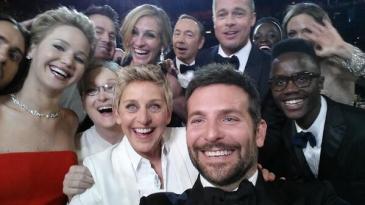
EllenOscarTweetThis year’s Academy Awards offered what many have called the best line-up of nominated commercial films in years. Among the strong critically acclaimed competition, an important film won Best Picture. We saw unusually significant advances in motion picture technology win accolades. An excellent line-up of creative contributors offered heartfelt belief in their projects. We also enjoyed a quite clever world record tweet stunt (“the retweet blasted round the world”) emerge from a reasonably relaxed show format that seemed to try hard not to focus on itself too seriously, but to put that focus on the work being honored.

I don’t know if it was one of the best Oscar shows ever, but it seemed to me a credible, enjoyable celebration of creativity, all the more poignant given the immense geopolitical events mounting on the world stage as it played. It was a good night for Pharell Williams to sing “Happy.” A lot of us felt that way.

Then came Monday morning. Or if you really wanted to get in on it, later Sunday night.

What was the most insulting joke told by the host?

Who had the bad taste to show up with the worst vanity surgery?

How awful was that mispronunciation of someone’s name?

Can you believe that awful gown? She has to be the worst dressed, no contest.

What kind of self-aggrandizing acceptance speech was that?

Did you see how drunk he was at the party?

What kind of backstage snub comment was that?

Did you see the look on his face when he lost?

Did you really think she deserved to win?

It’s astonishing. We can’t even have one night to send up fireworks and smile in the glow without the snark. Maybe it’s because I live in Los Angeles and dissing in social circles is as common as saying, “Let’s have lunch,” but it seemed for every word of praise I heard for a winner, I heard three times that many diatribes flicked at presumed losers. Were I able to isolate it to the Hollywood elite, I might feel better encasing it in a cone of irrelevant silence, but I saw and heard it everywhere–online, in the mainstream media, on the phone, wherever news travels.

Folks, this isn’t news. It’s babble. It’s unimportant. It’s not particularly clever. And it’s mean. Really, really mean.

Sure we are a society of tabloid media. Websites and TV shows and grocery checkout racks thrive on insults, humiliation, and Schadenfreude. Most of this is not satire, not irony, not well-crafted humor. It’s just junk. Bloated, bombastic garbage. And we absorb it until we become it, and then we spew it right back, as if somehow that makes us part of some intelligentsia, some wise-cracking inner circle that can distinguish meaningful critique from wasted breath. When we join in the rant, we are kidding ourselves. We become part of the problem.

And here’s the problem: the kids around us are listening. They hear every word we say, every word the media relays, every nasty remark that deflects from the celebration that should be going on of wonderful, creative work that helps define our shared culture, commercial or otherwise. Then they go to school and the clear message is that bullying is verboten–completely off-limits, not allowed, punishable by extreme… what? Any chance there is a slight conflict going on when what they hear in their heads are our voices institutionalizing the public act of professional cruelty? We wonder why bullying is everywhere, but we don’t hear it in our own everyday dialogue.

What the heck is wrong with us? Really, we can do better. All we need to do is talk more about stuff that matters, less about stuff that doesn’t, offer praise with enthusiasm where it’s earned, and try to be a tiny bit more polite when someone happens to make a boo-boo, or we perceive them as making a boo-boo.

Because you know what? We all make boo-boos. And I have yet to meet anyone who enjoys ridicule, especially when they just did something out of the ordinary, whether the words travel behind their back or in their face.

It hurts. So let’s stop.

Public Service Made Customer Service

Earlier this year on The Daily Show, Jon Stewart asked Nancy Pelosi a rather awkward question: In effect, can our government still do big things? She never really answered the question, which was also kind of awkward. I don’t think she saw it coming. He was really probing into the nature of government competence and our ability to trust elected, appointed, and civil service employees to be great at their jobs and exceed our expectations. It was not meant to be a partisan question, but somehow that’s where it went, which sort of ducked the broader concern, which sort of reinforced his critique.

Like I said, it was awkward, and it got me thinking, why should the output of government services–or public service–not be subject to the same expectations of for-profit customer service? I have been chewing on this for weeks, and I can’t come up with a decent response. I serve in a volunteer role in local government, so I guess that makes me part of the problem, but it also drives me to be part of the solution.

The obvious retort will be that absent the free market and competition, any single point option will more than likely descend into mediocrity as a result of monopoly and entrenchment. I don’t think it’s that simple, because for-profit and non-profit enterprises are both constantly under attack by creative destruction, which when ignored is an equally powerful remedy to mediocrity. Improved methods will obviate the obsolete; it is only a matter of time and catalyst.

Global EntryThis past month I experienced a pleasantly opposite case, where public service did exceed my expectations–with expedience, practicality, and cordial handling. I applied for Global Entry, the Trusted Traveler Network administered by the U.S. Customs and Border Protection Agency. I went to their website, filled out the form in less than half an hour, was promptly notified online of conditional approval, and asked to sign up for an in-person interview at LAX. I quickly discovered there was a three-month wait for an interview, but the site suggested I check back frequently online for a cancellation. I got one within 48 hours for an appointment the same month, went to the interview, was promptly welcomed upon arrival (I was early and they took me when I got there), and ten minutes later I was fingerprinted and done. I was approved online that afternoon. Perfect.

This was exemplary customer service in action. It was almost as if Border Patrol had set out to prove that customer service was still possible within our government where there is an expressed commitment to make it so. They have my applause. I don’t know if I can award them my future business or ongoing loyalty given their scope of offerings, but just like writing a positive restaurant review on Yelp, I am giving them the loudest shout-out I can in as public a forum as I can, which is how the customer service game pays back winners with referrals.

I couldn’t help but compare and contrast that with several other recent observations of public service that simply haven’t embraced that ethos:

HealthCare.Gov – I usually focus on the broader issues of healthcare, which matter more to me than a broken website, but like Jon Stewart in the Nancy Pelosi interview, let’s focus for a moment on the website fiasco. Not only didn’t it work, not only was it impossible to navigate even when it did work, those in charge of deploying it allowed themselves to get fleeced by private-sector contractors. When you run a business with customer service in mind, you are compelled to keep your costs low and be a subject-matter expert before you offer service paid for by your customers. We are the customers of HealthCare.gov. We overpaid and we got a poor experience. Not good customer service.

Jury Duty – It makes us shiver, but it should make us proud. Anyone who gets the notice in the mail immediately starts to hedge, not because they don’t want to perform public service, but because our historic experience of this form of public service is that it is wildly inefficient. How long ago was this antiquated system designed, where you sit in a room all day doing nothing, waiting to be called or released? Yes, it has improved modestly with online registration and log-in, but when I recently spent a full day in a room of 125 people doing nothing of value, and fewer than two dozen of us were used at all, I wondered how it was possible to justify the lost productivity of 100 people times 8 hours, or 800 person-hours gone up in smoke in just the room I sat. It’s so wrong that no sustainable business could ever tolerate it, nor pay for it. If you want me to provide public service, start by seeing me as your customer and commit to process engineering so that my participation is truly of value.

Governor Christie’s Off-the Ranch-Staff – There’s a reason the obscene obstruction of a New Jersey bridge continues to ride the headlines, and it’s not just politics as usual. I use the word obscene purposefully, because using any position of public authority to harm rather than help a constituency goes against everything our democracy represents. When a public servant forgets that his or her salary is paid by the people and not the political party, all bets are off. Maybe there should be a slightly tweaked Hippocratic Oath in government: “First do no malfeasance.” If you go to work with full acknowledgment that you are in public service and your job is to provide customer service to those forking over the dollars for your gig, you couldn’t pull the trigger on anything like this, look yourself in the mirror, and say. “I did what I was supposed to do today.” When you do harm for personal gain, you add no value. You make a mockery of the privilege of serving those who trusted you.

When I was kicking around some of the themes for this post on my Facebook page as I often do before writing a new article, someone posted on my news-feed that it was a silly use of my time to write about stuff like this, because it never changes. Private-sector contractors will fleece the government, no one in the court system cares if they waste our time, and politicians will always use their power to reinforce their authority. I don’t think that’s true, and my experience with Global Entry is proof that we can do better if we make it a goal.

If we refocus the orientation of public service to be around customer service, it de facto has to improve. Perhaps more importantly, if we don’t keep tabs on the kinds of small to medium items called out here, how can we possibly have faith in the really big stuff entrusted to government: national security, fiscal solvency, social justice, and the like. There has to be a service model underlying all these tasks, subject to scrutiny, objective benchmarking, and listening to the customer. No, we’re not going to vote on what constitutes a valid TSA safety post or police DUI checkpoint, but we should always expect to be treated with courtesy when authority is surrendered for the greater good. Authority should be enacted with reason, humility, and respect so that it wins our buy-in and loyalty. Our aim should be to inspire all contributors to do their finest work all the time, to demand it of themselves as an absolute, to seek constant improvement of systems, teams, and individuals.

Think about it: virtually every customer-facing business now asks you to rate every experience you have with them, and the smart ones deploy this feedback almost in real-time to win competitive advantage. Start rating your experiences with public-service agencies, whether they request it or not, and not just at election time. Demand better and we will get it, maybe not in real-time, but sooner or later creative destruction does its job and washes away the ancient with one flavor or another of much celebrated reform.

And don’t forget to say Thank You when you catch someone doing something right. Everyone likes to get a thumbs up when it’s earned!

A Very Good Year for Good Men

GMPI started writing for The Good Men Project in its second year of life, offering to share some of my thoughts on business, creative leadership, and management also published on my own blog. In its third year I joined the board of directors and became a strategic advisor to the CEO. As we embark now on its fourth year, I continue onward, helping to accelerate our growth, invigorated by what our CEO and team have accomplished in driving, “The Conversation No One Else is Having.”

What is this Good Man Project? It’s an editorial content destination you’ll find on the web and through mobile, riding the wave of digital publishing through curated editorial viewpoints on topics ranging from love and parenting to ethics and sports. Founded by entrepreneur Tom Matlack, our vision is never to tell anyone what we think a good man might be, but to share the considered points of view of thousands of vetted contributors on the uneasy questions surrounding the issues of being a man in the 21st century. Why Good Man and not Good Person? We observe that there are any number of sites dealing with the broader issues faced by both genders, but almost none taking a serious approach to some of the deeper issues faced by men. Curiously, we have found our audience to be half men and half women, with our contributors mirroring that dichotomy. Perhaps more interestingly, we find no bias as to whether a topic is covered by a man or a woman, and in the often hundreds of comments that follow our stories, we observe men and women talking with each other about subjects you seldom observe strangers discussing and debating without invective or attack. It’s a wild line we walk, and we love it.

How are we doing after three years on the playing field? Here are a few metrics that make us especially proud:

  • We have surpassed 150 million cumulative page views.
  • We have published over 22,000 articles.
  • We have ranked as high as #243 in Quantcast.
  • We average about 3 million page views per week, with more than half our stories getting over 5000 views and our best stories over 100,000 views. And of course we occasionally have runaway hits that are off the charts.
  • We have over 60,000 Facebook fans and over 100,000 Twitter followers.
  • Our work is overseen by more than 30 editors from the U.S., Canada, Costa Rica, Malaysia, Spain, and the U.K.

What do we think about this? We call it a decent start. If you had asked anyone at the launch of The Good Men Project how far into the future 100 million page views would be, I promise you no one would have said 3 years–not a chance! So when we think about what our business might look like a year from today, it is impossible for us to predict much of anything other than to say we aspire to do better.

When asked to what do I attribute our joyous success to date, that’s easy: People, Products, Profits, in that order. Yes, that happens to be my life mantra for innovation and the theme of my blog, but like I say, for me, these aren’t words, it’s a mandate. Recently I was reviewing a draft of our annual report with our CEO–more about her in a moment–and as we edited our slides, I got fixated on a virtual org chart that we didn’t have a year ago. It was a matrix of our editors and the categories they cover every week. In looking at that chart and how it tied back to our exponentially increased workflow, it was once again obvious to me that none of this would be possible without the immense talent in our community; these are the People who create our Product. That Product, our collection of stories and voices to which we add new material almost every waking hour of the day, is what our customers experience. The excellence of that Product is our lifeblood, and our unending commitment to improve it is what has graciously allowed us to create an embraced customer experience. Customers mean the world to us, their experience is what matters most, but it is our team that creates that experience, and that is where we focus our energy. And I’ll let you in on a little secret, having focused on People and Products, we are already modestly profitable, albeit at a very early scale, enough to let us recommit to our core values.

None of this would be possible without the ceaseless commitment of our CEO, Lisa Hickey. Lisa’s passion for this subject is exemplary, and her evangelism for our brand and our community is a source of pride for everyone involved with this mission. I honestly don’t think she sleeps. She is at the helm of every aspect of The Good Men Project from uptime to story selection to ad sales to social media integration. And yes, Lisa is a woman guiding The Good Man Project, and that is a big part of what makes us unique. She is welcoming, encouraging, open-minded, and forward-thinking. Most of all, she is a great partner, and I will have to twist her virtual arm to leave this paragraph in the post.

We thank everyone involved–our readers, our commentors, our writers, our editors, our sponsors, and our suppliers–for being part of this launch. We hope if you are a regular, you will sign up for our free email list (we publish a fantastic daily digest) or consider becoming a premium member for a small fee that includes a welcome gift. If you haven’t visited The Good Men Project in a while, come see how we have shaped and molded and evolved our site over the first three years, then join our community and help us take it together into the future. Like I said, we’re just getting started. We have a tremendous amount of work to do, and we can’t do it without you!

Not Amused by the Dolled Up Wolf

As I have been out discussing my debut novel, This is Rage, over the past few months in bookstore readings and radio interviews, the question often comes up as to whether it is similar to the latest high-profile motion picture from Martin Scorsese, The Wolf of Wall Street. My answer is no for three reasons. First, my story is purely fiction, and Wolf is based on a memoir. Second, my story is exaggerated for the literary purpose of satire, and Wolf appears to be exaggerated (or not) for spectacle. Third, my story depicts a cast of amoral characters on a collision course with poetic justice and renders a series of life lessons and impacts offered for discussion, while Wolf has no moral center and crudely celebrates the life of a scumbag. Fair warning, more eye-opening spoilers ahead.

wolf-of-wall-streetI usually quite like Martin Scorsese pictures, but I really despise this one. I don’t think he set out to make a movie that glorified the inexcusable crimes of Jordan Belfort, but that’s what’s on the screen, and now that people are crying out against the film, Scorsese and his cast are left with few options but to defend their work as creative expression. I don’t dispute their right to produce the film or make money from the enterprise, I simply wonder why it was necessary, especially for such an accomplished company of actors led by no less than Leonardo DiCaprio. You see, while some of us see through the veneer of statements proclaiming the indictment of Belfort as a cautionary tale, the literature simply isn’t there to support the defense. An extremely simple fix would have gone a long way to offset the damage caused by this movie in showing the devastation caused to the victims of the penny scam swindling. We never, ever see anyone get hurt by the incessant wave of fraud that takes money from the pockets of innocents and hands it for abuse to criminals. Not once, anywhere in the film, do we see the pain created when a garbage stock is sold to an ignorant or unsuspecting victim at 50% markup. Would it have been that hard to show that white-collar crime is not victimless? Do people still not understand that when sycophants like Belfort (and Bernie Madoff) lie to clients and empty their pockets, entire livelihoods–and futures–are wiped out?

It’s not funny. It’s not the stuff of sardonic humor. It’s too real. Horrific acts need to be condemned without ambiguity, or at the very least illustrated through juxtaposition to depict thought-provoking irony. The justice system failed to cause Belfort to endure fair punishment; he did 22 months soft time and now he is a celebrity. How about that, a bona-fide celebrity for publicly exposing that he lived a putrid life and is now selling his salesmanship skills as legitimate in pay-to-attend seminars, further brought to visibility by a Hollywood movie deemed worthy of frothy awards. The movie shows everything that goes against the grain of humility and equality, but let’s send up flares and say it’s a tour de force.

You know what else isn’t funny?

Sniffing cocaine off the rear end of a hooker, all paid for with piles of your stolen cash. Nyuck nyuck.

Driving a Lamborghini on public streets under the severe influence of quaaludes and endangering the lives of people around you. Nyuck nyuck.

Getting oral sex in a glass elevator from a co-worker while the rest of your company watches from the trading floor. Nyuck nyuck.

Laughing yet? No, apology not accepted. How about when a crowd of Wall Street insiders gathered for a screening of the film in Battery Park and cheered at its most lascivious moments, essentially endorsing the behavior of Belfort and his punk posse, making it clear that generating big money was laudable, and spending it lavishly even more laudable. Yeah, it happened. You remember these guys, they were the ones our federal government bailed out when the great recession was at its worst. Now they are the same guys who think it is time for Washington to back off on regulation, since everything is “back to normal.” Yep, welcome to the new normal.

No, I’m not indicting all of Wall Street; quite the contrary. I believe in the fundamental strength of our economy, and that trust in investment is the backbone of financial advancement. We put our money into stocks and bonds long-term to see our free market assets grow collectively over time–capitalism for the long haul, compounding legitimately for the greater good. It’s not meant to be a con man’s game. It’s not meant to be a fixed casino. So why portray it that way, and why would anyone who makes his or her living off the public trust applaud such despicable behavior? Starting to wonder if the 1% and the 99% are separated by more than just wealth?

Here’s something else that’s not funny, and the core of what caused my emotional reaction to this vile portrayal of a pathetic American life: It’s an open letter from Christina McDowell published in the LA Weekly. Ms. McDowell’s father was one of the pukes that Belfort threw under the bus to arrange for his reduced sentence, and her life in the ashes that followed was emblematic of the very discord that Belfort created. Because her father was also a criminal, she does not make excuses for the suffering brought on her by the loss of her family’s affluence, after which she sank into poverty as a result of her father’s lying and conniving. Instead she writes with immense empathy for the victims of both her father and Belfort, wondering as I do why these victims show up nowhere in the film, instead remaining faceless and invisible, as if nothing tangible was really taken and incinerated. This passage the day after Christmas left me especially disturbed:

So here’s the deal. You people are dangerous. Your film is a reckless attempt at continuing to pretend that these sorts of schemes are entertaining, even as the country is reeling from yet another round of Wall Street scandals. We want to get lost in what? These phony financiers’ fun sexcapades and coke binges? Come on, we know the truth. This kind of behavior brought America to its knees.

Nope, not funny. Not entertaining. No moral center. No poetic justice. So as the actors and technicians and storytellers and creative journeyman who crafted this epic adaptation make their way to the stage to accept their trophies this season and deliver all sorts of silly speeches about the role of art in society, think about what they did and what they could have done. Art and entertainment can be a stylized mirror, or a refracting lens, or a pastiche of temporal mores, or a slice life that causes us to interpret the actions of characters and ideas of creators. Or it can just sit there like a lump and take our money for nothing, no different from the scoundrels depicted. Two stacked wrongs don’t make this right. Don’t get fooled again. Hold the Oscars, hose this one down with a power-steam cleaning and let it dribble down the gutter where it best can dissolve from future memory.