Fully Unfinished Business

PrivacyThe original title of this post was Nasty, Messy, Murky, and Looming.  Maybe I should have stuck with that!  As we turn the corner on 2013, a number of problematic, complex issues stand out for me as squirmy uncomfortable and lazily unresolved.  The four I note below all make headlines regularly, but I am not seeing nearly enough being done to address the core causes.  Perhaps there is not enough worry about the impact.  There should be.  Have a look at the list and see how closely this lines up with your own deep concerns:

Inequality:  I believe completely in our capitalist economy.  For the long haul.  For the benefit of everyone, not a detached few.  Late this year, President Obama made his case for the necessity of economic mobility as the backbone of democracy.  The key to addressing further bifurcation into 1% and a 99% has to be rooted in education — brilliant, inspired teachers opening the minds of young citizens, encouraged by their families to thrive, with sound reason to believe in the American dream.  Our middle class has to be strong for our economy to be strong, which means we need to have new enterprises with promising jobs, and trained minds ready to tackle those jobs and over time build careers.  In a recent Los Angeles Times Op-Ed, Richard Riordan and Eli Broad made the point that “It Isn’t a Sin to be Rich,” yet at the same time they called for compassion among the wealthy to reinvest their resources in helping others.  I think we’d be wise not to further politicize the notion of polarization — if we want to build a lasting marketplace of goods and services, we all need to share in its creation as well as its consumption.

Privacy: This is an awful, hypocritical mess.  For most of this year our federal government declared that the NSA was not out of line parsing metadata.  Late in the year a consortium of Silicon Valley titans sent a letter to the President and Congress highlighting “the urgent need to reform government surveillance practices worldwide.”  Many of these are the same companies perfecting advertising products that digital marketers use to better target consumers, which of course relies on the collection of personal information.  Edward Snowden — whose tactics and methodology are indeed questionable and not without dire consequence — has been branded  a criminal, but how front and center was our dialogue around privacy before he ignited the firestorm?  Last week an individual on the other end of a customer service call with my telecom provider actually asked me verbally for my PIN “to protect my security” in verifying my account — was this something he had been allowed to see in my file or was he phishing?  As someone who has spent three decades in media, I can tell you the technology around profiling is advancing way faster than our ability to digest its implications, and I urge you to continue asking a lot of questions and not take simple solutions at face value.  These are civil rights we are dancing around here.  You bet I want a good deal on a new HDTV and I want to be safe at the airport, but I don’t want my personal information readily available to any number of individuals who may have access today and then will be pissed off when they are fired tomorrow.

Healthcare: Something tells me that we are going to be arguing about this one for the rest of our lives, and the next generation or two will still be trying to wrestle it from abstraction to effectiveness.  I believe we have taken a small step forward, but like many, I am conflicted in the immediate results I am observing.  There is a very long road from dreaming to doing, and while change begings with a powerful vision, it is equally necessary to pound through the details until efficacy is more than a triumphant slogan.  Insurance companies are quite good at finding their way around the delicacies of mandates, and any number of conversations you can have right now will serve up individuals who are winners and losers.  Until we are all winners — until we all have truly affordable, truly high quality healthcare — our work is not done.  Some of us will pay more than we did before, but no one should pay more for less service, and no one who needs care should slip through the cracks because of affordability, deductibles, out-of-pocket expenses, or co-pays.  There are miles to go before we sleep, and much reform ahead before we celebrate our accomplishment.

Government Gridlock: Despite the recent federal budget agreement, we are nowhere close to healing.  With midterm elections on the horizon, there is reason for concern.  The entire idea of “reaching across the aisle” seems to me an anachronism that has to be replaced with “do your jobs and govern responsibly.”  Should those who opposed the Affordable Care Act achieve a majority in Congress, will they continue to prove obstructionist and seek to repeal the new programs, or will they do what is wise and amend the law to be more effective and constructive?  Will each debt ceiling debate continue to threaten to destabilize our currency and trading floors with the outlandish notion that government default could somehow be warranted as a strategy?  Does anyone even want to discuss reasonable solutions around assault weapons in hands beyond the military, and is the refocused energy on mental health relief going to be funded or a talking point?  We share our democracy, we share the capital markets, we share a love of freedom, and we share a right to sensible resolution of real-time concerns through debate and consensus, not grandstanding and entrenchment.  We have the right to demand better, so let’s start asking for it on a regular basis, not just when the #^%$* hits the fan.

I do think as long as we keep highlighting the ambiguities in ideology brought to bear through tangible initiatives, we have reason to be optimistic.  Rigorous, heartfelt discussion is our path from here to there, and as long as we don’t sweep our messes under the rug with a label of “mission accomplished,” we should have continued reason to be optimistic.  What could be more revitalizing than committing to making our world a better place?  Yes, we have so much more work ahead of us.  Let’s get to it, shall we?   The new year begins, let’s do our best to be proud that we did something aligned stepping forward in 2014.

Brands in Memoriam 2013

Amazon CEO Jeff Bezos made a spectacular impact recently when he went on 60 Minutes the day before Cyber Monday and gave us a glimpse at the future—a fleet of small delivery drones he branded Prime Air. It was a bold statement, and whether intended or not an incomparable public relations move that got much of the nation talking about his online retail company at precisely the most important time of year for consumer purchasing.

Yet I might be in the minority thinking that was not the most interesting thing Bezos talked about on television and in the zillions of video clips that got sent around the digital world in the days that followed. What I latched onto in the Bezos appearance was this little exchange with Charlie Rose:

Jeff Bezos: Companies have short life spans, Charlie. And Amazon will be disrupted one day.

Charlie Rose: And you worry about that?

Jeff Bezos: I don’t worry about it ’cause I know it’s inevitable. Companies come and go. And the companies that are, you know, the shiniest and most important of any era, you wait a few decades and they’re gone.

Charlie Rose: And your job is to make sure that you delay that date?

Jeff Bezos: I would love for it to be after I’m dead.

Well, if Jeff Bezos who is currently sitting on top of the business world knows that sooner or later his company is toast, I think that is about as telling a tale of creative destruction as I can imagine! With that, here is this year’s short list of additions to the Dead Brand Graveyard:

BlockbusterBlockbuster: Aptly named for its status as the big bust of this year, Blockbuster is a sad loss for me. Harken back to the early days of video home rental and there were thousands of mom and pop stores in neighborhood strip malls. It seemed inevitable that these shops would fall victim to industry consolidation to achieve buying power and scale where margins were thin, and Blockbuster came to rule the day. My experience of Blockbuster was that it somehow held onto that mom and pop feel of a local video store, and at least where we rented they always were friendly, helpful, movie nuts, and the checkout line moved pretty quickly. Then as VHS gave way to DVD, along came the startup Netflix to reinvent the space, and Blockbuster went to sleep. By the time they woke up and decided that Netflix was onto sometime with their mail order subscription programs, Netflix was already reinventing itself as a digital distributor, and Redbox had figured out how to pick up the kiosk business with zero personnel vending machines. Blockbuster was two generations behind the innovation curve, and when Dish Network bought Blockbuster ostensibly as a storefront competitive tool in its battle with DirecTV, it was too little cavalry too late to justify the ongoing operating costs.

Current TV: It is hard to argue that Current TV ever acquired much momentum as a brand unto itself, although it’s hard not to draw a certain amount of attention when one of your masthead investors is former Vice President of the United States Al Gore, coming off a nail biter contested single state vote count that almost made him President of the United States. If you poke around the web for remnants of Current TV’s brand strategy, it was to be something like a news network for ages 18 – 34, where much of the content would be user-created, uploaded to a destination online site, and then curated for television cable audiences. I think the notion that I have to say something like denotes that the ill-formed brand strategy never got much resonance, which might have been reinforced when the strategy suddenly shifted to hiring high-profile former ESPN star turned MSNBC darling Keith Olbermann—at a big salary, with even bigger expectations. The concept of building a line-up around a tent pole Olbermann anchor also never resonated, so when Al Jazeera America came knocking with a monster payday for the founders of the 60 million subscriber reach network, it was an easy call for our former VP to call it a win and walk off the field. Not surprisingly, Olbermann went back to sports.

MetroPCS: Remember when we could look forward to airwaves of virtually unlimited choice and price competition due to the wonders of telecom deregulation? No, you forgot, too? MetroPCS is another brand that probably didn’t leave behind a lot of emotional longing with customers, but it is interesting to note that its founding dates back to 1996 and it came to position itself as a carrier with unlimited wireless communications for a flat fee and without an annual contract. The company was a pioneer in 4G LTE rich communication services, and with more than 9 million subscribers grew to become the fifth largest carrier in the United States—both good reasons for it to be acquired by T-Mobile which cemented its position as the fourth largest carrier in the nation. Still feeling good about all the many companies out there fighting hard for your smart phone bill?

What are the key takeaways from this year’s exit crop that might inform a Bezos-like objective of bolstering your brand to outlive your own era? First, speed is everything in the digital age, rest even a millisecond too long on your laurels and it will probably be too late to catch up with that company that leapfrogged you (Blockbuster). Second, a confused brand strategy results in a confused product strategy (and vice-versa) and swinging at that with pricey tactics doesn’t clear the confusion (Current TV). Third, an undifferentiated commodity without sufficient scale will not stand solo long in a consolidating market (MetroPCS).

Last year in my Brands in Memoriam post I went out on a limb and called Blackberry dead. I took a little heat for that, what I probably should have said was RIM (Research in Motion), the holding company for Blackberry was dead, and Blackberry was on deathwatch. Honestly, I feel okay about calling Blackberry dead, to me it’s spiritually dead, and while some loyals are still pounding thumbs on their mini-keyboards, it’s hard not to believe the clock is tick-tick-ticking to Final Jeopardy on this one. Slammed by creative destruction and inexcusably poor management—a very tough critique because it was a visionary company much beloved that lost vision—it is today a zombie brand at best.

Going out on less a limb this year, I don’t think I would be alone in calling for grave concern around the survival of Sears, J.C, Penney, and Radio Shack. I will climb out a little further and hope that Dell finds a fruitful path soon, as it is hard to believe the PC or laptop business is on the mend, or there is much room on the shelves for another flavor of tablets or tablet/keyboard combos. U S Airways is also likely to evaporate when its merger with American Airlines is completed. I hope I am wrong about all of these because we are talking an awful lot of jobs at risk in our too fragile economic recovery if we lose any let alone all of these. Let’s hope management is inspired with some leapfrog ideas for reinvention and revitalization.

Did I miss any for this year or in the near term gun sights of creative destruction? Feel free to chime in below and add your assessments, predictions, and prognostications. Just remember, if you tiptoe out on the limb, forward judgments of demise have an excellent history of being proven wrong!

Wings: Remastered and Revisited

Wings_coverA few decades back, before I became a software and media executive and long before I returned to writing, I wrote the “screenplay” for a succesful computer game called Wings.  That “interactive movie” — as it was marketed — was a World War I flight simulation that followed the lives of the very first fighter pilots, trying to make combat sense of fragile biplanes curiously equipped with machine guns.  It was published by an early innovator in gaming known as Cinemaware, which set out to make games look, feel, and tell stories more like movies.  Recently the Cinemaware brand was resurrected via a Kickstarter campaign to fund a mobile version of Wings, that if successful will contain the entirety of the many pages of story and dialogue, plus a lot of new material.  I have no financial interest in the new Wings, but it does bring back fantastic memories, a slice of life from an earlier time.  The new team asked me to do a text interview to support their campaign, which I decided for nostalgia to publish here as well.  Enjoy!

Please provide a brief bio of yourself.

At the moment I’m a first time novelist, my book This is Rage: A Novel of Silicon Valley and Other Madness just released last month to good reviews.  I’m also an investor, a start-up board member, an executive coach instructor, a blogger, and former corporate executive.  I was CEO of SHOP.COM, Executive VP of Disney Online, and VP Entertainment and Education at Broderbund Software.  I read a lot, follow the L.A. Dodgers, study wine, and am active in children’s welfare issues as well as local government.  If that’s not brief enough, cut everything except the part about reading and the Dodgers.

How did you originally join Cinemaware and get to work on Wings?

I met some of the Cinemaware team at a UCLA conference called The Future of Television in the late 1980s.  They told me they were creating interactive movies.  I had just written a spec screenplay called Miniatures about radio controlled model aircraft that sort of predicted the U.S. drone program.  It was the first thing I had written on a computer, a monochrome XT.  They asked me if I ever thought about working on a computer game.  I said No.  They showed me Rocket Ranger and It Came from the Desert on the Amiga.  Then I said Yes.  Quickly.

How was it working with the Wings team on the Amiga?  What do you remember most about that time?

It was a magical time, a time of possibilities.  I had experienced five years in traditional media of hearing why we couldn’t do certain things, how everything had to be done a rigid way, and how little respect there seemed to be for the writer.  Everything at Cinemaware was, yeah, let’s try that and see if we can make it work, why not?  I also remember writing on a Mac SE/30 for the first time, and I couldn’t believe why anyone would use anything other than that — so much for my XT.  And I remember when our competitor, Origin Systems, leaked a demo of their outer space saga Wing Commander, and our team was like, hmm, that’s a pretty compelling 3D engine, but our story is way better, so back to the drawing board, and they completely rewrote our flight simulator in about 2 weeks to be more state of the art.  Oh, and I remember when someone brought in the first Amiga with a 20MB hard drive and we could install both floppy disks without having to play with disk swapping or a slow seeking second external floppy drive, and that just seemed like the best possible gaming experience you could ever have — until we heard rumor about something coming called a CD-ROM.

How did you go about doing research for the game?

John Cutter, the game’s visionary designer, and I got ourselves invited backstage at the Air & Space Archives in San Diego, where we discovered a lot of the old U.S. Army Air Corp files were stashed.  We were blown away by how welcomed we were there, the military librarians spent hours with us digging out old files, it was a smorgasbord of history, and they couldn’t have been more helpful.  They kept bringing out boxes and boxes of dusty old papers and black & white photographs and let us have at it.  It was a super find and let us dig deep into a very special time of innovation, courage, and pain.  We devoured stacks of books on World War I (we even included a bibliography in the Aviator’s Briefing Manual, I’m guessing the first bibliography for a computer game).  We watched the 1927 silent movie Wings — winner of the first Academy Award for Best Picture — and The Dawn Patrol (1930) so many times on VHS by our QA release date I think we could recite the storylines in realtime without anything on the monitor — then we chose to borrow only the atmosphere: the title, the sets, the costumes, font styles from the text cards, but none of the stories or characters.

What do you think makes Wings such a special gaming experience?

I think it really was the first computer game to try to tell an epic story that was more theater than shoot ’em up, but we kept plenty of shoot ’em up.  We tried extremely hard to make the character role-playing real, to get inside the head of a 19-year-old kid who probably had about as much chance coming home alive as he did surviving enough sorties to live long enough to become squadron commander.  We obsessed on details of the period, used every pixel wisely, created a true sense of responsiveness in the story, something that would set off endless discussions about the true nature of interactivity.  We also kept the game controls immensely simple.  It wasn’t a super complex gravity based simulation where you had to be an engineer to takeoff and land the plane or fight virtual physics to keep the contraption airborne.  We simply “cut to” you in the air and said Just Fly and Shoot.  We brought in a lot of non-gamers with that simplicity, but funny enough, the hard-core gamers praised us for it as well.

Can you tell us what the team wanted to implement in the game, but didn’t have the time or resources to do?  Any special hidden gems or trivia for Cinemaware fans?

First you have to remember what we were dealing with getting the game to ship on two 512K floppy disks, as if any big blockbuster developer today could comprehend how little data that is.  Our programmers were masters of compression, and kept squeezing and squeezing.  The music  was astonishingly intelligent, but the short redundant loops made our composers crazy, so I’m sure they will be delighted with the enhanced score on the remastered version.  Every screen shot was a big hit to storage, and I remember the artists begging to include more storyboards, but that wasn’t possible.  Luckily for me text was as economical to store then as it is now, so I didn’t feel the same thrashing.  I do remember the branching tree logic making me nuts and having to write multiple outcomes for every mission, wondering if it was humanly possible to cover every fork in the story and how many people would care that on a given pass through the game they would only see fractions of the screenplay (we positioned this as a customer benefit, creating replay value).  I remember when the marketing folks “requested” we cut from three floppy disks in beta down to two in order to improve gross margin on wholesale, which almost created a revolution in the hallways.  Our indefatigable producer, Jerry Albright, reminded us it was OK for them to ask, and that we had to respect them for trying, then emphatically told them not a chance.  Then somehow our miracle programmers pulled it off and we shipped the master on Reel 1 and Reel 2.  I also remember a few brainstorms we had after we realized what a unique product we had developed, one for a CD-ROM version with recorded spoken dialogue that of course never happened, and one for a Wings sequel that would have been set in WWII, and who knows where that would have taken us.

If Cinemaware had a chance to expand on Wings, what do you think could be better developed or explored?

That’s sort of like asking the creative team who made the original movie version of Wings how they would have made it a talkie.  The remastered version being funded on Kickstarter is doing all the right things — improved graphics, enhanced music, more missions, improved physics in the engine — all of that brings out the best in what we did so long ago.  The important thing is that we gave the game heart, layered grounding in reality staying true to the source material, emotional resonance woven through a role-playing experience.  As long as you remain true to heart, the polished production values will fully bring out the best.

Ken, you also pledged for this campaign, thank you so much for the support.  What made you do it?

It is a very small sum of money to let an entirely new generation of gamers see where we started as an industry, and maybe a few grown-up parents will get to share the experience with their kids.  Really, it’s not much money for a lot of game, and it is a fun game, part of what got us here.  It’s kind of like the silent movie version of Wings we watched over and over — what if someone hadn’t bothered to preserve it, can you imagine having lost a gem like that?  I can’t, no way.  We all come from somewhere, it’s important to remember that and even more important to share the memories.

Pilot Shot

16 New Things I’m Thankful For (2013 Edition)

With Thanksgiving on the horizon, it’s time again to take a step back from our daily grind and consider the rejuvenating goodness that dots the landscape all around us.  Last year I kicked off my own blogging tradition with a post that featured 16 Things I’m Thankful For.  Here in reasonably simplicity that speaks without much preamble is my itemized, non-prioritized, yet still incomplete version for this year:

1) I can stop saying someday I am going to write a book.  I did that.  Many of you have been exceptionally gracious in your embrace of it.  The reviews are heartening, and the emails I am getting from people telling me they chuckled, teared up, or are living through similar challenges tell me the words are starting to meander to outer circles.  To share these words is pure fulfillment.

2) Health care is going to be accessible to a lot more people who desperately need it.  Yes, the ACA website was botched and Obamacare v1.0 is not exactly what the doctor ordered, but we have started on a long overdue journey of empathy and caring that is befitting of our prosperity.  In a decade the launch will be no more than a footnoted glitch, and wellness will be broadly understood as a civil right.

3) U.S. armed forces previously on combat duty are largely out of Iraq and have not fired a shot in Syria.  Hopefully we are turning the corner.  Give Peace a Chance.

4) Our new little rescue pooch (Kole) is teaching our senior bigger dog (Ellie) a lot of new tricks.  I have the pictures to prove it.  Dogs are good for each other, and good for the soul.  I learn a lot from these mutts, and they don’t much complain when I read dialogue to them.

5) I have not opened a bad bottle of Rioja this year, and not paid more than $20 retail for the privilege.  The values in Spanish wines remain astounding.

6) My amazing wife continues to change the world by bringing English language skills to college students studying in the U.S. from abroad who love her for it.  She is so good at what she does, it is humbling.

7) The Dodgers made it to the NLCS and got as close to the World Series as they have in 25 years.  Wait ’til next year.

8) Good Men Project is at record traffic levels and building a tremendous community.  Our CEO, Lisa Hickey, is heroic.  Our team of editors, staff writers, and independent contributors is tackling complex issues with equal parts gravitas and good humor.  Next year we focus on video, mobile, and subscriptions in addition to new categories, better sponsorships, and broader syndication.

9) Thrift Books is growing, growing, growing.  Our new President, Mike Ward, is 100% focused on People, Products, Profits, in that order.  All three are really good.  We are blessed, we are expanding, and we are green!

10) The feedback I receive from our CTI Executive Coaching students gives me reason to smile ongoing.  They are taking the message of People, Products, Profits into corporations all over the world, helping executives perform better with a grounded human approach that unlocks creativity and makes innovation happen.  Teaching this workshop has been a rare opportunity.  Hearing back from our coaches in the field reminds me that business can always be made better and more sane.

11) The FDA just banned trans fats.  We won’t miss them, not even a little bit.  Fewer heart attacks, longer lives, healthier families.

12) Trans-Siberian Orchestra returns this year to Southern California.  My wife and I missed the last two holiday tours (although we did see Night Castle live) and we are going the day after Thanksgiving.  #TSOtime

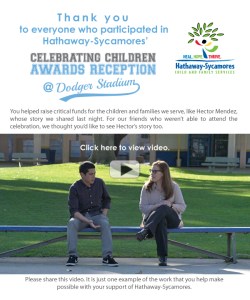
13) Our Celebrating Children event at Dodger Stadium raised over $150,000 to help support the kids and families we serve.  Click on the image at the bottom of this post for a little video that tells Hector’s Story and you’ll get an idea why this work matters as much as it does.  And hey, we got to meet Dodger Great Maury Wills, who was on hand to share stories of Chavez Ravine past.

14) I am working on my next writing project with one of the most talented editor/publishers a fellow could ever hope to welcome into his life.  And the project after that.  And the one after that.  So hey, go buy the one that’s out there so I can come tour your neighborhood on his nickel guilt free.

15) Two of my close friends beat nasty forms of cancer this year.  They were brave, resilient, noble in their struggle, and triumphant.  They taught me a lot, more than I could have imagined.  Raise a glass of Rioja, you earned it!

16) I’m not hungry.  I’m not thirsty.  I’m not sick.  I have a comfortable place to live, plenty of clothes to wear, time to read and share ideas.  I wish everyone on earth could type those words.  The basics are still too much a rarity.  We would all do well to remember that before we utter the words, “I want…”

Happy Thanksgiving 2013, whether you share the holiday in the United States or somewhere else in the world in spirit.  Celebrate the joys that are yours.  Earn Each Moment.

Hector