On a Mission or Just Staying Awake

One of the themes I explore in my forthcoming debut novel, This is Rage, is the notion of motivation.  This is a subject I hold dear, and one I focus on a great deal in the executive coaching workshop I co-lead with John Vercelli.
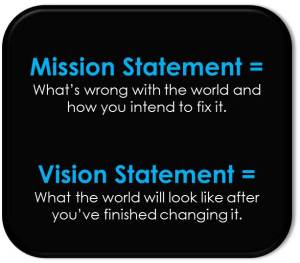
mission-statement-vs-vision-statementIf all a mission statement is meant to do is fill a half page in your human resources handbook, it is probably not worth the time to write it down.  One of my former teachers and board members used to say he had a vision of all the great mission statements in the world collected in a single volume, and there could be no possible better bedtime sleeping remedy than trying to force oneself through those pages with one’s eyelids open.  Again I agree, if a mission is just a string of words — Buzzword Bingo without a juicy prize — it will not motivate, but let’s consider a few potential examples of applying a personal leadership mission in attempting to inspire a team.

Here are three choices I offer participants in the workshop, all of which we’ve heard in some variation, from the absurdly failing to the boldly aspirational:

Choice 1:

To make this department much more efficient and profitable!

Choice 2:

To overcome market forces and prevail over our competition!

Choice 3:

To provide my team with the support and resources they need, to the very best of my ability, to collaborate and do the very best work of their careers.

My response to Choice 1:

Not gonna inspire, management by fear is so not cool.

My response to Choice 2:

You’re starting to get my attention, through an occasional yawn.

My response to Choice 3:

I’d build you a log cabin in the arctic if you asked me.

Call me an optimist; people like to be inspired.  It’s not a sleight of hand.  Real leadership means rallying people around a cause, to subordinate their own personal quirks to the shared agenda adopted.  The leader’s job is to create the environment for sharing.

Is it the business leader’s job to make her or his department more efficient and profitable?  Do we really need to ask?  It goes without saying, so don’t seek glory in the obvious.  Is it the business leader’s job to respond to market forces and win market share from the competition?  Once more I ask, where’s the question?  Any answer to this presupposes a complete lack of faith in the common sense of why we are employed by our company and not another.  Is it the business leader’s job to rally, help, support, test, and muster the collective wisdom of those assembled to form a team and work together?  That should be just as obvious, but try saying it aloud and look at the surprised gazing around you.  That’s what people want to hear.  Uttering the manifesto is the first step toward building trust and accomplishing the impossible.  True, it’s just the first step, and trust is easily shattered when actions upend words.  Yet it’s an important step, and it does fire up hearts and minds much in advance of a spreadsheet.

It also connotes vulnerability — to the very best of my ability — which again is all in fact you can ever do.  Not proclaiming more makes you human, perhaps a form of life other people are more willing to follow.  Be honest, not only about what you can do, but in admitting that you are not de facto possessive of superpowers.  Try it out, it just might give you superpowers.

In my novel, a few clever and powerful people are trying to make a whole lot of money.  That is not a bad thing, until they forget that how you make the money is the difference between taking along a deserving set of others and leaving almost all of them behind.  Most of the people in the story just want to do their jobs, to find a way to love their jobs, to shake off the demoralization that has come from the illogical separation between task and income.  When a job is a paycheck, you don’t need a mission statement or real leadership, you just keep your head low and get through the day.  When a job is about something more, it’s still a paycheck — we all need a paycheck — but the purpose of the work is a much more substantial driver, creating better outcomes and better paydays.  Improved business comes from more engaged employees, and getting those employees engaged is a soft skill that in the hands of a master can conquer most obstacles.  That’s when work is fun, when we believe in something, when we believe in the leaders and their values and their rallying cries and we choose to be a part of innovation’s path.

The promise of the start-up is to build something new with heartfelt values at its core, and in closely held companies at modest scale it is much easier for founders to maintain the kind of personal mission and creative culture that reflects this entrepreneurial DNA.  When an exceptional start-up enters a period of hyper growth, hands on sustenance of idealized culture becomes considerably more difficult.  Should the start-up go public, it too easily can take on the shape and form of the goliaths it sought not to be, and then the challenge of maintaining a mission grounded in shared values is often put on trial.  The disconnect between what was innocently envisioned and what inertia morphs can be terribly upsetting to the grasping loyals, who hold their idealism in longing, hoping at length for the pledge to retake honest meaning.

Still it is important to remember than the personal leadership mission can endure.  Indeed it might be less than a grand corporate mission statement, but I believe conviction is almost always within a business leader’s reach at all levels of an organization.  Committing to a personal leadership mission is a choice — a brave choice with its own risk — and while rare, a good one in the spirit of Choice 3 has a decent shot at creating significantly more employee engagement and long-term value than the other two slug lines.  It’s all a matter of executive style, setting a tone for the broadest possible positive, tangible outcomes.

It is too easy to check out, and once people check out, try getting them to check back in.  As my story compounds, an awful lot of people check out — because they don’t feel valued, because they don’t feel inspired, because they see what they do each day as separate and divorced from the actual process that creates income for the business and value for the shareholders.  Tie those pieces back together and real innovation comes a good deal more naturally.

Leadership is not so much a word as a behavior, a walking example of what it means to be intertwined with the enterprise.  It does begin with words, words that are grounded, words that do something.  Choose those words carefully, lead by example, motivate by inclusion, dole out support without reservation.

You want to keep things humming, make it a little less comfortable and a little more complicated — for yourself, not those you guide.  In the book, I take you to the extremes of this world view, heroic and cowardly and all that binds the spectrum.  The words did not come easily to me, but I committed myself to resilience and found them over time.  You can, too.

The Beatles at Sea

I don’t think I am likely to run out of things to write about The Beatles.  Scratch that.  There is no chance I will ever run out of things to write about The Beatles.

How about The Beatles on Norwegian Cruise Line making our away around the calm summer waters of the Hawaiian Islands?  That’s about as magical a place for The Beatles as I can imagine, beyond the Sea of Holes and across the Sea of Time.  Toss in a set list that spans the entirety of Beatlemania performed by one of the most gracious husband and wife musician couples I have ever met — now you’re talking magic, an experience so utterly perfect it’s hard to believe it’s even real.

TobyBeauBeatlesToby Beau is the joyous source of this sound celebration, a rock band with Texas roots dating back three decades, now performing on the main stage and in cabaret surroundings of the Pride of America.  It’s not the usual kind of place you would find me, nor where you might expect to be sharing in the sing along chorus of Hey Jude.  I think that was a big part of what made it all so wonderful, it wasn’t the expected in any sense of manner or place, and yet it all just clicked the way brilliant music and expert performance always succeed — pleasing the mind, pleasing the senses, creating realtime context that is both Yesterday and Today.

Last week my wife and I spent a week island hopping in my home state of Hawaii with about 2000 fellow NCL passengers.  No, it was not a normal thing for us to do, but playing tourist can be fun if you do it right with plenty of time for snorkeling, hiking, biking, and kayaking.  We didn’t spend much time at the buffet, but we did catch all of the live music.  Vacations can be an amazing time of discovery, where you can relax and float downstream, and whenever we hear there are Beatles tunes in the house, well, we just go check it out.  About midway through our week we ventured to the main showroom and met ax man vocalist Balde Silva, who performs every single week of the year beside his sometimes lead, sometimes harmonizing wife Rennetta Dennett Silva, the two of them still the core of Toby Beau.  Their biggest hit, My Angel Baby, came in 1978, around the time they were touring with such high power acts as the Doobie Brothers, Bob Seger, and Steve Miller.  Balde and Rennetta are music industry survivors who have reinvented themselves any number of times over the years, not only proudly still playing live music, but playing it together, having a blast, and obviously forever in love.

That brings us full circle, back to The Beatles, at sea, and the kind of love that lives forever in a set of songs that work no matter where they are played, that prove themselves over and over again precisely because they take on new meaning when bounced off new walls.  Music veterans like Toby Beau evidence what it means to play flawlessly, inserting subtleties that are different each night, reflective of the experience that unexpected places can offer, reverberating off audience participation, taking in the physical moment and replacing it with a memory.  It takes a truly inventive catalogue to pull that off endlessly without becoming rote.  Musical excellence is one part material, one part craft, one part passion, and one part ethereal.  A cruise ship is just a venue, a stage is just a platform, but layer in the mystical concoction of the lads from Liverpool with a pair of performers determined to inject love into the tunes, and the formula becomes fully extemporaneous in the emotions that swell.

Balde and Rennetta take it a step further, offering the story of The Beatles through bits of spoken history, stitching together the songs as a real life fairy tale.  This is not impersonation but tribute, commencing with the earliest days of I Want To Hold Your Hand and A Hard Day’s Night, winding the road to Yesterday and Nowhere Man, then reaching with bravado to We Can Work It Out and Back in the USSR.  We get Something by George, then we Get Back, then we Let It Be.  Hands wave in the air for Hey Jude, and then the band covers a Beatles cover with the dance floor encore, Twist and Shout.  It all takes less than an hour, less than a dozen cuts, but once again we have taken the journey anew, heard it differently, felt it reimagined, shared it somewhere we probably won’t return but can carry with us forever as its own idea — an interpretation shaped by its circumstance, constant in its creative rejuvenation.

The Beatles stayed together less than a decade, an incomprehensibly brief interlude that resulted in a body of work that remains inexhaustible in inspiration.  Balde and Rennetta have stayed in the game as long as they have because of their love of the music, their love of the art form, and their love of each other.  The combination of all that love and craft and chemistry just got added to my canon of musicality, new energy flowing through time-tested lyrics, new theater emerging from a bit of the acoustic and a mastery of the electric.  We didn’t go to sea to find it, we found it by chance, spontaneous discovery — and because we shared it, once again it is ours.

Let the music wander where it will, infuse it valiantly with love, the world is at your command.  What we discover in the familiar is the awakening of the imaginative, the surprise of the open-ended revitalized by care and intension.  You can hear it differently if you allow the phrasing to bend here, there, and everywhere — the artists’ touch a composite of admiration and trust.  Thank you again, Balde and Rennetta.  Thank you again John, Paul, George and Ringo.  The music is perfect.  The music is forever.  The music is a gift to be celebrated and loved.

Whose Ad Is It Anyway?

Investors and company executives are cheering of late for the resurgence of Facebook above its IPO price from about a year ago.  Mobile growth is the story at Facebook, and many are pleased with the associated revenue progress.  I wish everyone well tallying their riches.  I am still not sure how much significant value is being created, particularly as it applies to the company’s core advertising business.  And hey, I was a very early believer in this business model and all the promise it held as the definitive interactive media platform of a generation — kind of like the first time as I kid when I saw a movie on HBO, a complete movie on television with no commercials, I just  knew something good had happened and someone was going to get rich as a result.  Uh, that was for taking the ads away.

If you are active on Facebook, particularly mobile, you probably weren’t surprised by the earnings improvement.  You’ve seen the ads — oh, have you seen the ads — you can’t miss them, right there in your news feed, as intrusive as the interface mandates.  Recently an ad for a salacious French maid’s costume was offered to me with the following copy — pretty much full screen — and I was kindly given the opportunity to Like the page:

“This five-piece At Your Service set from Dreamgirl comes with a sexy babydoll with apron, maid’s hat, ruffle back thong, and feather duster.”

Curiously this clever bit of sponsored media appeared above a friend’s timely post on racism and below a post from a financial journal I follow on how to avoid manipulated options.  I suppose under certain circumstances this might be considered targeting, but I can honestly assert I was not in the market for such an outfit, either for myself or as a gift, nor had any click stream I created left a trail for the behavioral targeters.  Perhaps they could have offered me a nice bottle of Bordeaux, which would have made sense since I am a wine enthusiast and often post articles about my favorite varietals on Facebook, and I’m guessing their database knows I have a Pinterest board on the subject of value excellence (“Good Wine, Good Price“), but no such luck.  I am a middle-aged male, heterosexual, and married, so maybe that’s the profile they sold to the advertiser.  I would guess that the CPM (in ad-speak, that’s “cost per thousand” impressions, where the M is the Latin numeral) was very, very low, offset by volume that was very, very high.  Again in ad-speak, we sometimes call that “dollar-a-holler.”  In these cases, maybe a nickel.

Just so it’s clear that I am not picking on Facebook, my friends at AOL Mail where I have maintained the same email account for about a quarter century, now offer a curious feature: After I send an email, the confirmation screen is filled with singles looking for a date.  It’s nice to see that the advertiser is not presumptuous; sometimes they offer me women and sometimes men.  The fact that the advertising delivery system is ambivalent toward my preference is unusually progressive.  It also is quite genially unconcerned that my wife continues to see my email send pages resolve to these artifacts on our shared monitor.

Note to New Media Companies, with love, from Old Media Companies: Some things have not changed, including that there are still four key constituents in the advertising equation:

1) The manufacturer or seller of products and services.

2) The ad network or agency.

3) The media delivery vehicle or platform.

4) The viewer of the ad.

For full value to be created, all four have to be satisfied by the results of the supply chain.  For real ongoing business, it is most essential that #1 and #4 are happy, so that #2 and #3 can speak to a job well done.

Let’s look at all four in the French maid and available-singles ad examples and see who is happy working backward:

4) Me: Not happy, except that it gave me an idea for this story.

3) Facebook and AOL; Happy (except if they read this post); they got paid by #1.

2) Agency or network: Happy; they found plentiful inventory in the form of my news feed and mail page, and they also got paid by #1.

1) Advertisers: Should not be too happy; they paid the bill, and I am making fun of them for it.

So the owner of the bill and the receiver of the message are not happy (#1 and #4), but the middle-folks are just fine with it (#2 and #3).  Oh, they’ll tell you they are working on it, improving their targeting technology and all that, but they aren’t losing sleep, because they got paid.  They should be losing sleep, lots of it.

There is also an implicit fifth constituent, the expanded community surrounding the nucleus of the supply chain, particularly of significance in our interconnected world of social media.  When an offer is useful and enticing, like many of the tested e-coupons on RetailMeNot, pleased customers will gleefully pass them along.  That’s free evangelism from existing fans to unlimited prospects, making ad dollars work even harder through leverage.  When ads are garbage, they are terminal, mercifully so.  In fact, bad-vertising can hurt a brand through negative association — poor word of mouth is difficult if not impossible to combat.  Wonder if your would-be customers are laughing at you?  You may not know until the community turns on you, then it’s costly to recover, or perhaps too late.

When advertising works — the right, relevant message in front of the right, engaged human being — it can be an excellent experience.  Absent concerns about privacy, you might embrace the very respect involved in not having to see ads you don’t care about.  But all this posturing about collecting intelligence on customers to deliver better leads — how come I’m still getting ads for reverse mortgages on My Yahoo homepage, which has every financial feed coming through loud and clear to tell them I’m a reasonably well heeled owner?  That page is still sold as remnant inventory (in ad-speak, leftovers) at bargain-basement prices, maybe less than the French maid costume or the singles ads.  Some money being left on the table there?  They’ll probably tell you no.  They would be wrong.

As the national dialogue on privacy invasion is reaching fever pitch, even POTUS has been dragged into the ruckus with a defensive “Don’t worry, we respect you while we protect you” mantra.  That dialogue is likely to resolve itself in the dialectic, because it is a civil rights discussion grounded in our cherished democracy.  I actually think that problem is going to get solved before the ad targeting starts to get it right, because there is too much money at stake for annoying and disrupting us that no one really wants to give back.  Like the story goes, always follow the money — the real today-money, not the theoretical long-term-value, someday-we’ll-get-this-right money.  Why would you want to do that?

Maybe I’ll just watch HBO.  The price has skyrocketed, but the shows are pretty good, and it is still ad free.  I am always willing to pay for that.

HBO Image

The $20 Brand Bond

Amazon LogoLet’s talk about lifetime value of a customer for a few seconds. I use the term “a few seconds” purposefully.

Recently I bought one of those discount vouchers for a neighborhood deli, where you pay something like half of face value and then cash in full value when you’re at the restaurant. This one wasn’t from Groupon or Living Social, but from Amazon Local. When I went to cash it in, the deli was out of business. Tough times always for restaurant retail. It happens. Went to another place for lunch. Oh well.

I got home that night, went to the customer service web page for Amazon Local, found the template under Contact Us, and submitted a one-sentence email notifying them of the event. How long did the response take? Less than a minute. Full credit.

Yep, Amazon Local “bought” this voluntary endorsement for a whole twenty bucks. Plus my ongoing loyalty. My lifetime value to Amazon the Brand just increased a good deal more than twenty bucks, perhaps a hundred times that, maybe more. Why? Well, first because they respected me and my time, but more so because they laid the pipe to assure me that if something bigger ever needed to be addressed, I could count on them.

What did they do right internally to cause this function to be enacted externally? For one, they fully empowered their staff, someone in a call center likely on the other side of the world. There is no way in that brief turnaround their staff person had to ask anyone for permission to do anything. They saw an issue, they jumped on it, case closed.

We look for WOW THE CUSTOMER moments in business all the time. We spend hundreds of millions of dollars on advertising to get someone to sample a new product or service, so that somehow a WOW THE CUSTOMER moment can occur. This one cost an entire twenty-dollar bill.

Compare this experience to another I wrote about earlier this year, where try as I might, I could not get one of the largest retailers in the world to help me locate a $5 replacement part for a thousand-dollar appliance I had purchased from them. That retailer competes with Amazon, probably does not know it, and will never get another dollar from me. If you have a moment, go read the transcript I shared from that interaction. Coincidentally, I happen to have shared that post with a rising star at Amazon back when it happened who was aghast when he read it. He had no idea of the contrast to come.

This is not meant to be a lionizing of Amazon. Full disclosure, they were a minority investor in my previous company and proved to be a formidable competitor, daunting in many respects, not the least of which was their near-rabid obsession with precision, time to market, and transaction perfection. They had vast resources to call on that were not available to me, but they used them wisely and never skimped when it came to the customer experience. That is a big part of how they got to be best in class, and consistently one of the top performers in the Internet Retailer Top 500.

Germane to Amazon’s perfection is a mandate of setting a customer service standard that is so extraordinary and so rare it can seem financially irresponsible to emulate—so much of net margin goes right back into the expense line to serve the customer. Market analysts often shiver when they report on Amazon, wondering how their eye-popping trading multiples can last, with so much volume but so little relative profit. Amazon seems to pay little mind to these analysts, instead worrying instead about customers. That leaves them no choice but to focus on lifetime value, calculating it in complex equations with net present value back to the reinvested capital that most others would probably harvest.

How tempting it is to consume the fruit of that harvest, but harvest has to come each year, and that is why we focus on brands. Here I lionize the customer service commitment as an essential and grounding component of the brand promise. It is the shortest business case study in the world, yet almost every company you encounter gets it wrong.

A service culture in the information economy puts the CEO at the bottom of the hierarchy and the customer at the top. The customer is the boss. The people closest to the customer, individual contributors like those in customer service, are the ones who interact with customers. They make or break your brand. How much discretion and authority are they usually granted? None. How much should they have? As much as you can pile on. They own the customer relationship, so they own your future.

Go on, hire the highest paid consulting firms and retain power player ad agencies. Hold multi-day off-sites for brainstorming retention strategies. Give motivational speeches about reframing your mission and vision.

Or just be really, really, really appreciative of your customers. Love your customers, every single one them, embrace them as strategic imperatives, bonds that build moats.

What’s the ROI on world-class handling of those who frequent your brand? You tell me.