Staying Forever Young

May you build a ladder to the stars

And climb on every rung

May you stay forever young

Those lyrics were written by Bob Dylan around 1973. I was in the sixth grade when it was released, so hey, I fit the bill. If I could quote the entire song here without violating copyright, I wouldn’t have to write the rest of this blog post. There you go, blame the copyright laws for making me try to find the words to reflect on the inspiration of a Nobel laureate.

I’m experiencing a moment of sentimentality, but allow me to position that as a positive. Last weekend my wife and I saw the musical Girl from the North Country, which is a collection of more than twenty Dylan songs wrapped around a rather grim story of a boarding house full of exhausted souls during the Great Depression. It’s a a curious pastiche, but from what I can tell Dylan endorsed it. The penultimate number is Forever Young. You don’t need to know more than that — just that this song landed a powerful blow on me at an opportune moment, which is what an impossibly eternal song never ceases to do.

Dylan wrote the song for his children. It has popped up in every context imaginable over the ensuing decades. Google it, the impact is vast and varied. This month it is speaking to me.

A few weeks ago my niece got married on a beach in the rain. She and her fiance looked every bit the part of a couple starting on the next phase of their journey. You can’t help but see the light in the eyes of young love and remember when you stood where they stood. Your youth is your superpower. It is filled with hope, promise, aspiration, and authenticity. The older generations invited to share in the celebration see themselves in the eyes of the betrothed. We are aware of our age, but that isn’t what runs through our minds when vows are exchanged. We try to connect the now to then. In that moment, we remain forever young.

I happen to be on my way to a college reunion. It is a milestone that can be divided evenly by too many integers. The decades behind can’t help but denote age, it’s the underlying purpose of the occasion, to bring together in the present people who learned from each other in the past. Recently my classmates started posting photos of themselves from that time long ago, before mobile phones, digital cameras, and electronic image archives in the cloud. Mama don’t take my Kodachrome away! That’s borrowed from Paul Simon for anyone not of a certain age. Yep, those photos have been sitting in envelopes from mail-in film processing, pasted up in laminated albums stashed under beds, now succumbing to scanning technology and <gasp> social media. I look into the bright eyes of students I knew when Reagan was president and I am convinced they remain forever young.

I look at the conflict in our nation and as hard as I try I barely recognize the place I thought it would become. I talk to my dad about living through World War II as a child and his dreams as a third-generation American for the broadening perspective he believed was ahead for all of us. I’m not sure he realized how idealistic he was as a young man, not fully comprehending the scope of the Civil Rights movement as it emerged all around him, but certainly not expecting to hear so many of the angry expressions currently creeping back into the vernacular. When we sit together now at baseball games, I remember being a young boy also sitting with him at baseball games wondering if the world could be any more perfect than watching Al Kaline catch a deep fly ball to right field on the warning track to end an inning. Today at the games we share, I wonder if my dad in his mind sees himself the way I see myself, not our current age, but with the idea that the life then ahead of us would always be driven by imagination over conflict. In those shared moments of retained dreams, we remain forever young.

Age is real. None of us escapes it. Some of us navigate its trials better than others. It can be genetics. It can be lifestyle. I’d like to say it can also be attitude but like so many my age I’ve seen too much to crawl under that blanket. What I do know is that inside each of us is that very wish Dylan asked us to preserve. It’s there for as long as we remember it, revitalize it, rekindle it. Our bodies will slow, maybe even our minds will slow, but our vision of what we can be is ours to infuse with resonance, To see ourselves in those earlier years can carry us into a more profound, more hopeful, more caring, and more empathetic present for as long as it lasts.

That is the song I am hearing right now and it’s blasting on all channels in stereo.

May your heart always be joyful

May your song always be sung

May you stay forever young.

_______________

Image: Pixabay

Getting Better


The Beatles sang it. Now I feel it.

I’m not saying things are great. For many they are not. I’m not even saying good. I’m saying better. It’s qualitative. It’s relative. It’s palpable. It’s real.

I don’t care if Trump wasn’t convicted. If 43 U.S. senators want to live with the shame of turning a blind eye to a lying, seditious, self-serving megalomaniac, that’s their lifelong curse. It’s not survival politics as much as it is inescapable shame. The badge of cowardice doesn’t wash off. No bleach will eradicate it.

That cynical, boisterous voice is gone from the White House bully pulpit. That alone makes me feel better.

His Twitter account has been silenced. That’s even better. That’s a real punishment, where we are protected from harm. Not quite a penitentiary, but a fitting alternative sentence, particularly in his mind.

If he tours again on hyperbolic rhetoric or creates his own “alternate facts” media network, he’s sectioned off. We can ignore him. If his followers want to adore him they can have that space in obscurity.

Our new president is sane. Joe Biden is thoughtful. He reads, listens, and takes advice from subject matter experts. He reconsiders his positions. He is immersed in dialogue, not monologue.

He’s reversing the damage. Climate change. Environmental justice. Immigration and border normalization. Broader access to healthcare. Global wellness as a shared concern.

Economic compassion. Sustainable job creation. Sensible credit and finance policies. Respect for our allies. Clear, coherent, calm lines with our adversaries.

Cabinet secretaries are taking shape with gravitas, conviction, relevant experience, and an emphasis on character. They will likely serve without unnecessary drama and ridiculous turnover.

Mostly the voice of government is quieter. The tone is softer. It is moving into the background so we can focus again on our lives, our businesses, our daily routines, short-term and long-term planning.

Science is science again. Facts are facts again. Fake news is fake news again.

Journalism is not the enemy of the people. Hard questions are the safeguard of our democracy.

The notion of any potential sympathy for white supremacy or xenophobia has been erased from the office of the president. To the extent there was any ambiguity around tolerance for racist acting out, it is clear that it will be prosecuted.

Those who participated in the violent January 6 insurrection are being indicted, tried, and convicted. Aside from their cheerleader-in-chief, they will be sentenced and go to prison.

Unity is an inspiring ideal on the table. It is noble to challenge the nation to come together and address our problems. It is a lofty ambition. If the choice has to be between unity and sanity, I’ll take sanity.

Covid-19 vaccines are moving into the mainstream. By midyear, we should have one if we want it. This human suffering and loss of life will end.

Optimism. Pragmatism. Confidence.

Empathy. Humility. Decency.

Trust in words. Belief in promises. Not perfect, but directionally agreed as aspirational.

Blood pressure is down, at least mine. Cortisol levels are decreasing.

Most of all, we are rediscovering honesty. The blatant, unending lies have got to go.

We still have an insurmountable way to go on income inequality, civil rights, Black Lives Matter, hunger, homelessness, all of the endless maladies that divide us. If we can admit that with candor, we can commit to priorities of positive consequence.

We are regaining freedom. We are regaining quality of life. We may be inching forward, but we are off our knees.

The republic has survived. It was a close call. If I ever did, I will never again take democracy for granted.

We are slowly, deliberately healing. That’s what needs to happen. That is progress. That’s what it means to get better.

We are getting better. I absolutely believe we will get even better

Getting so much better all the time.

_______________

Photo: Beatles Complete (1976)

Life After Trump


I am hopeful this is the last time I write about Donald Trump. To the extent that he obeys the law and vacates his position on January 20, 2021, and doesn’t run again for the presidency, I do have more interesting subjects to pursue.

I’ve tried ignoring him the best I could these past several years, but it would have been irresponsible not to call him out on his malfeasance. I attempted to look for interesting angles where I could in attempts not to repeat the obvious, but as a writer I had to be on the record as part of the resistance.

I don’t care if he starts TrumpTV or his loyal followers continue to listen to his divisive lies to the last day he broadcasts. I want him out of legal power. As the nation heals, so will I, although I suspect I will heal more slowly than most. His representation of an America so diametrically opposed to my ideal has taken a toll on my immune system.

More than half the nation didn’t sign up for this American carnage. A monster dumped it on us. Now we’ve dumped him.

Am I relieved? Only inasmuch as a cataclysmic disease goes into remission. You know it’s still there. The cancer is his belief set. Too many Americans still subscribe to that indefensible set of lies.

I’ve been thinking about the arc of our generation, the arc of the moral universe, as Dr. King reminds us: “no lie can live forever.” Our struggle for civil rights wasn’t expected to be without setbacks, but it also wasn’t meant to be bluntly derailed. Trump tried to hijack fifty years of progress in four years of devolution. I’m going to take a flier and say he failed, but now with broad restraints removed from the dialogue that would have us surrender too many of the hard-won social norms that edged us closer to justice, how will we choose to revive our spirits?

I think the ultimate legacy of this cynical presidency will be the accelerated deterioration in the public’s ability to discern fact from fiction. This president didn’t create the notion of fake news; he simply used his unyielding platform to make it a meme. He purposefully blurred the definition of traditional journalism for self-serving convenience. This may not be a crime in the lawbooks, but I think it is a crime against humanity.

There is fake news. It is not when a trained reporter for the Wall Street Journal makes a mistake and prints a retraction. It is when an undisciplined individual with an agenda expresses an unedited opinion as a fact without remorse, often in the chaos of social media, but sometimes opportunistically with more deliberate distribution. There is a lot of gray area between those poles, but it doesn’t take an advanced degree to understand which way the pendulum is swinging. The litmus test is intention and methodology. Is the intention to get to the truth or obscure it?

It’s not just the Trumpers to blame. The reactive nature of Trump’s opponents is often equally without reservation or hesitation. I don’t think the malady is entirely about retreating to echo chambers. I think it’s about the shameless effectiveness in discrediting the notion of authoritative sourcing.

We grew up to believe in asking for the source behind an assertion. If the public comes to believe that all sources are equally fallible, then all that is left is self-selection into bias or convenience.

To me that is the true definition of fascism—if we can believe in nothing empirical, we are left to align with a decision-maker on blind capitulation. Then all that’s left is a numbers game to determine right or wrong, also known as situational ethics, a world where there is no court of “correct” adjudication. Adherence is purely democratic and won with a majority, regardless of conviction.

That legacy is Orwellian, and it’s terrifying.

Are we at a point of no return in life after Trump? I don’t think so.

I think restoring faith in precise journalism is a critical remedy, but the how of that is in no way obvious. All media can now be lumped into the category of fake news, depending on who is making the argument.

No matter how much we may disagree, followers and detractors of InfoWars and the New York Times each believe one side is accurate and the other is lying. Somehow both of these get labeled into a bucket called media, and both are accused by those who dismiss the other as fake news.

That is the challenge facing us—can we find a way back to well-reasoned argument, or are we hopelessly lost in noise? Because the problem is solvable, I need to stay optimistic,

Watching the HBO documentary After Truth, a broad exploration of the deteriorating spread of fake news, it occurred to me what a mess we are in. We can agree that fake news is a thing, but as long as we fundamentally disagree on its definition, that definition can be weaponized.

As long as winning an argument is more important than having the correct information to assess an argument, we remain at risk of destroying each other in the name of winning. Call it the end of civility, call it the end of democracy and the doorway to fascism—whatever you call it, it’s not a world where the arc of the moral universe bends toward justice.

That to me is the key challenge to life after Trump. We share a national infrastructure and pay taxes to a common federal government, with separate and to some extent irreconcilable visions of how we assess fairness, responsibility, justice, and facts. A new president isn’t going to resolve that. If we don’t commit to the need for resolving that as fundamental to our success, our best moments are likely behind us.

I don’t want to believe we can’t agree on what is true, but like many of you, I am weary after so much fighting. I don’t want to say I am exhausted, but I am ready for a dose of stability, a roadway that isn’t crumbling under my feet. I believe in government, but I want it in the background of my life so I can paint the foreground. I don’t want to talk about what the president tweeted today, whose career he destroyed, or the obvious embarrassment of his latest falsehood. I don’t want to feel exasperated before my work even begins. I want to trust science, logic, dignity, and common sense.

I want the truth to be the truth and a lie to be a lie and for most of us to agree on the difference.

If we can get there, life after Trump will be better, if for no other reason than we will leave behind the low point of celebrating absurdity. If we can’t discover a set of shared values that define us as a nation, then I suppose it won’t matter.

I’m going to take another flier and bet on integrity. We will learn together how to build a consensus around what is true, because we have experienced a taste of what happens when we fail to recognize this necessity. We live in the same world, and there are realities in that world that are inarguable. Orwell put it as succinctly as it can be said:

Freedom is the freedom to say that two plus two make four. If that is granted, all else follows.

Let’s start life after Trump by agreeing on that.

_______________

Photo: Pexels

Paul

I keep thinking I’m going to run out of things to write about The Beatles. I keep proving that notion wrong, at least to myself.

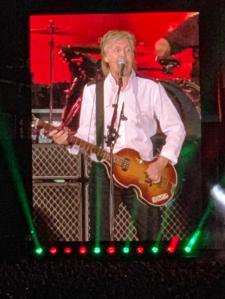
I recently enjoyed the final night of Paul McCartney’s Freshen Up Tour. He played to about 50,000 fans at a sold-out Dodger Stadium, where I last saw him five years ago. In fact, I included the setlist of that previous concert in the appendix of my second book, Endless Encores.

My key observation then was that Paul was as committed to his new music as he was to his historic catalog. That is what has allowed him not only to stay in the game for six decades, but to remain at the top of his own game—that constant hunger for reinvention. That is what has made him not just an artist, but a legend.

I had a new observation this time, partly about us, and partly about much more than us.

We are aging through time. These songs are becoming a constant.

Our memories are a snapshot in time. These songs bridge those snapshots.

We are temporal, driving the arcs of our lives. These songs are a continuum.

We will not be here forever. These songs could be.

These songs are ours to enjoy, but they don’t belong to us. They don’t even belong to Paul or The Beatles. They belong to the world.

These songs are universal. They bring us together. They make us happy. They make us remember.

We connect the dots of our life’s timelines from song to song, and in the moment of a single song played back at various points throughout those long and winding roads.

I remember first listening to “Sgt. Pepper” as a child and it takes me back to the record store where I bought the album. I remember first listening to “Band on the Run” as an adolescent and I am back in the hallways of school. I remember first listening to “Here Today” and I am transported to that sad December day when I was in college and John was murdered.

Each song fixes a moment in time that is never erased. Sometimes these moments get back-burnered for a while, but then the associated song reignites our memory. It’s a visceral reaction. It cannot be preempted.

Then there are the songs that pop up all through our lives. I remember “Blackbird” when I initially tried and failed to play it on my first guitar, scratching up my copy of The White Album with each needle reset. I remember hearing it at a New England rally protesting the war in El Salvador. I remember hearing at it the memorial service for a dear friend who loved The Beatles and left this world much too early in his own life. Whenever I think of the ceaseless work we still have to do in civil rights, I hear the lyrics in my mind: “You were only waiting for this moment to arise.”

A single song can traverse the entirety of our lives, inspiring one emotional reaction in our youth, an entirely different response in adulthood, and something even more profound as we continue to age. That’s an awful lot of punch for three minutes of commercial composition. Call it the miracle of creativity. Maybe we’re just very lucky to be in this audience.

Is this somehow unique to Paul, or even to The Beatles? Of course not. We all have our own take on the soundtrack of our lives. Yet sitting there in Dodger Stadium far from the stage but genuinely close to the music, my mind wandered from here to there and back again.

This night’s setlist spanned the entirety of an impossible 60something year career. All those perfect songs held me in the moment and connected the dots of my own journey. The songwriter’s inspirations became my timeline and all of our shared history.

In a single performance, all these songs come together in a temporal theme. We connect the dots of our lives in the collision of moments forced into relevancy. Sadness, joy, loss, love, babies born, children grown, the progression of our careers, the paths of our relationships, generations of sharing—it’s all there in the continuum.

For the performer on the grand stage, it’s his life’s work in stunning summary. For those beyond the proscenium, it’s pure accessibility, sheer singalong joy, and dancehall madness.

At the end of the show, Paul thanks us because we are one with his brilliant talent. We are part of it, and now we pass along the music to others who will not know The Beatles as more than a story. They will not see Paul play live. They will only know it is real because of the continuum. Their memories will replace ours. That is the continuum. It is why art is more permanent than we can ever imagine.

John Lennon is gone, but the songs remain.

George Harrison is gone,  but the songs remain.

George Martin is gone, but the songs remain.

Ringo Starr plays two songs live with his former mate, perhaps never again, and the songs remain.

Paul McCartney at age 77 puts on a three-hour rock show without a break that reminds us who we were, who we want to be, who we want to be with, and who we still can be. We connect the dots of our lives through his lyrics, rhythms, and melodies. There is something eternal about that.

Not convinced this is a form of magic that is as rare as it is tangible?

Listen again to the songs. Just listen to the songs.

This is awe.

Paul reminded us not to wait past the point of no return to say what needs to be said.

There’s one person I need to thank for bridging the continuum that is the almost six decades of my life.

His name is Paul.

_______________

Photos: Bruce Friedricks