World Series Reflections: 2025 Edition

You might have noticed I’ve published fewer blog posts this year. The political climate has made it hard to write about things that seem trivial in comparison. I’ve found it difficult to comment on news of the day without adding divisiveness to the national dialogue, yet unsettling to try to ignore it with distanced topics. I suspect I’ll resume my regular cadence at some point. I’m not sure when, but I will remain at the keyboard infrequently as my DNA requires.

You might also have noticed that the Los Angeles Dodgers just won the World Series for the second year in a row. That is another infrequent happening, and while perhaps not life-changing, joyously worth a few comments from a devoted fan.

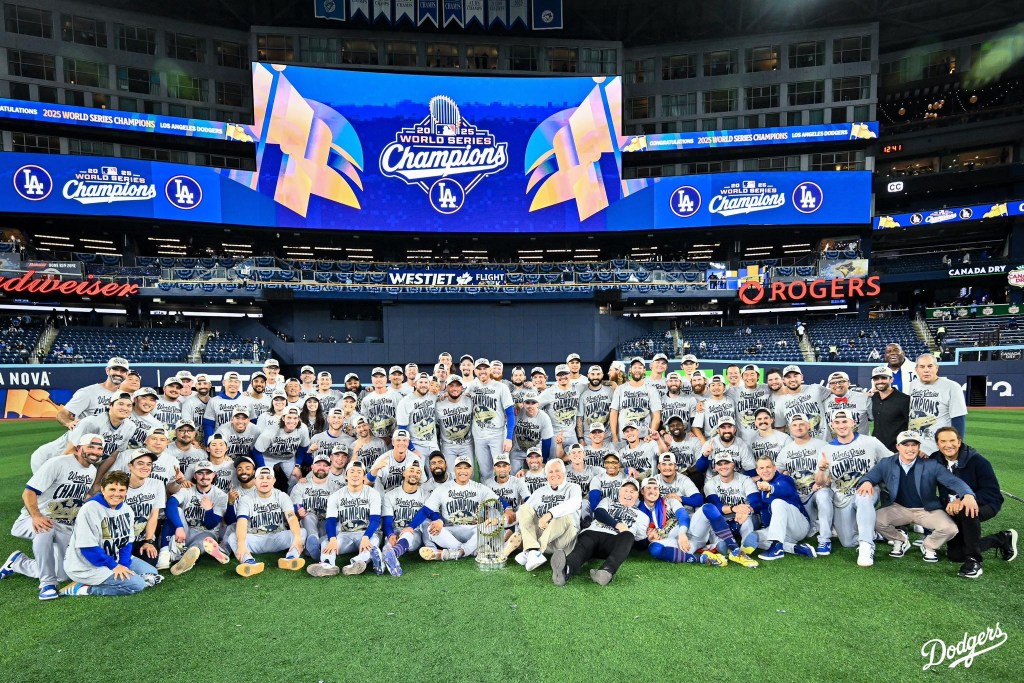
The entire MLB postseason this year was filled with unpredictability. The World Series was a fitting final act to that rollercoaster, with an 18-inning marathon Game 3 and a fought-to-the-finish Game 7 that went down to the last swing of the bat. I won’t recap the play-by-play, others have done that with endless detail, but I will say it was a game that turned on both the performances of superstars and journeymen.

That’s one of the things we love about baseball. Any team can beat any other team on any given day, no matter how good or bad. Chance is always at play. A ball can literally get stuck in a wall crevice and change the outcome of a game (it happened in Game 6). A series MVP like pitcher Yoshinobu Yamamoto can demonstrate consistent excellence on the mound in the clear sight of Sandy Koufax, or a little-known infielder with heart like Miguel Rojas can come off the bench and tie a game that seems all but lost.

Impact can happen at any moment from any player. The game can seldom be predicted.

What does this innocent children’s game played by highly trained adults teach us? We learn from the applied metaphor of baseball that you always play hard to the end. Resilience is your heartbeat. It pays to be indefatigable. You never give up. Never.

Baseball is so many things in the mirror of life. It is the ultimate combination of athleticism and strategy, training and statistics, physical readiness and endless number crunching. It is a game of mistakes — the only sport that counts them on the scoreboard. It is a game of overcoming failure, where a player who gets a hit 2 out of 10 times at bat usually gets dumped, and a player who hits 3 out of 10 often will be paid millions of dollars — crazy many millions of dollars. Unless you are a pro, you’ll never see a 100 mph fastball whip by inches from your body. In fact, the pros can’t see it either, but sometimes they time their swing right, make contact, and put it in the outfield stands.

I had hoped to see the Dodgers win the World Series at home for the first time since 1963. Not only didn’t that happen, but we lost both games I attended with my brother, who was quite the ballplayer in high school and college. So was my dad, who couldn’t attend this year, but texted me at every key moment with his coaching suggestions. I never had the talent, but curiously, I was pretty good with the numbers.

When we lost both those games, I thought of a marketing idea for the front office: how about they give us a 5% rebate for every run we lose by? So if we lose 6 to 1, we get 25% of our ticket price refunded. This would just be for the wildly overpriced World Series tickets. I’ll be sharing that concept free of charge on my annual season ticket feedback form. I don’t expect a response.

The two games we lost at home were more than offset by the final two games we won on the road. The drama of those two games would make for an Academy Award winning movie no matter who won. Note to Kevin Costner, Redford is unavailable — do you have one more baseball epic in you? And who would you like to play?

Hats off to the Toronto Blue Jays, who have waited since 1993 to get back to this big stage. Their ball club oozes talent, from the future Hall of Famer Vladimir Guerrero Jr to the wild ascent of pitcher Trey Yesavage from Single A minor league ball to triumph in the World Series seven months later.

The Dodgers magical starting lineup — Ohtani, Betts, Freeman, Smith, Muncy, Edman, Teoscar Hernandez, Kike Hernandez, Pages — will live in our imagination with most returning for another season. We also witnessed the impossible elegance of an unknown reliever in Game 3 named Will Klein, and in that same game the single inning bridge of the departing great Clayton Kershaw. Manager Dave Roberts made a number of gutsy, counterintuitive moves throughout the series that could have gone either way, but at last the risks played in his favor.

Maybe it will be enough for Costner to make a cameo, a lot of good picks there. AI can help with the aging thing.

It’s all one for the storybooks, but I’ll close with a quiet moment that summed it up for me. When I arrived at the entrance gate for Game 5, I said to the friendly parking attendant I see all the time, ”I’ll bet you’re sad it’s the last day of the season here at Dodger Stadium.”

”What do you mean it’s the last day?” he replied. “We have a parade next week. We’ll all be here for that.”

We had lost the game the night before and the series was tied at 2-2. There was no question in his mind there was going to be a parade. No question whatsoever.

Resilience to the end. Hope in the face of adversity. Optimism facing inescapable, ceaseless competitive resistance.

As Bart Giamatti wrote so eloquently about the game long ago, “It is designed to break your heart.”

Not this time.

Win or lose, this is the game we love.

________________________________________

Photo: TORONTO, ONTARIO – NOVEMBER 2: World Series Game 7 between the Los Angeles Dodgers and Toronto Blue Jays at Rogers Centre on Sunday, November 2, 2025 in Toronto, Ontario. (Jon SooHoo/Los Angeles Dodgers)

Big League Debuts

I get choked up when a baseball player makes his first official appearance in an MLB game. When I say choked up, I mean I viscerally feel what is taking place on the field. I was in Dodger Stadium when Dustin May first pitched. I recently watched Gavin Stone and Bobby Miller do the same on television with no less emotion running through me.

Those first starts are the culmination of endless sacrifice, physical preparation, and mental resets. There are so few positions available in professional sports it is almost ludicrous to bet one’s future on it. When I see young ballplayers walking onto an MLB field for the first time, usually with their families in the stands on very short notice, I feel a sense of awe and trepidation. A lifetime of dreams can continue for years after that debut, or possibly end right there on an underwhelming performance and a flight back to a playing field a tenth in size.

The power of hope and the threat of failure are all at once alive in a single and unrepeatable moment. I struggle to find the words to convey the meaning of that spotlight and the unknown future it presents as a test, but seeing that ballplayer suited up for the first time and given a spot on the roster by a manager is always in my eyes volcanic.

Then there are the veterans who perform even better late in their careers than they did when they first came up. Clayton Kershaw won his 200th game this season, becoming only the third Dodger to achieve that milestone, reaching an achievement shared with just 96 players in MLB history. I’d like to tell you Kershaw’s debut clearly foreshadowed the legendary career ahead of him, but five weeks after his first MLB game, he was sent back to the minors for fine-tuning. That’s when he recommitted to getting back in The Show and proving he belonged on a big league roster. Nothing could stop him from realizing his potential. He has worked hard every day of his career.

Why does talent reaching the launching point of potential bring me to stunned silence?

The why is as simple as I can say it: I revere talent.

You might have guessed, this isn’t just about baseball. All talent climbing to the apex of a focal point is forever for me an uncanny unveiling. A launch in the majors is not the real start of a career, that happened back in grade school, then again in high school, then again in the draft, and any number of games won or lost along the way in each leg of a player’s journey. Walking onto a big league stadium field for the first time in uniform and on the official roster is a moment of recognition, an entry in a time capsule that isolates a key reward point. It is real to the individual and a metaphor to all who are watching it in real time.

When talent sees the spotlight, when one person’s dream becomes reality, we all can look inside ourselves and see the shape of our dreams.

Talent is such an overused, even abused term. Talent is precious. It’s part nature and part nurture. When it reveals itself, the world breathes differently. At least I do.

There are all kinds of talent: sports talent, artistic talent, design talent, scientific talent, leadership talent, mentoring talent, teaching talent, parenting talent — you name something difficult to do, and if you see someone doing it better than a lot of others, it likely involves talent.

Some start with more natural ability than others but when we see talent at work it is seldom a lightning strike or an accident. Behind the realization of talent is a regimen of development that calls upon all the same forms of dedication and commitment evidenced in the training of athletes. I don’t believe it’s different for doctors, dancers, or poets, perhaps just less visible to the unsuspecting.

I often hear business people talk about the war for talent. That phrase troubles me. Filling jobs is not a war for talent. Creating an opportunity that attracts talent to unlock its potential is not a war at all. If your company is doing work of significance and someone with talent becomes aware of that opportunity, the fit will become natural. That is precisely the scenario where one plus one equals three, five, or ten.

Plug real talent into an ordinary opportunity and little exciting is likely to happen. Attempt the impossible with ordinary applicants and equally little is likely to happen. Marry real talent to real opportunity and the sky is the limit. That to me is the power of talent. That is why I revere talent.

I have been blessed over the past four decades to work beside a number of individuals who quietly changed the world through their talent. Some were gifted beyond imagination. Some just worked harder than all those who thought they wanted to compete with them. Most of their names you will never know, but they were game-changers in my life and the many seemingly impossible hurdles we crossed together. They weren’t just good. They were as good at what they do as Clayton Kershaw is at what he does.

When you are in the company of talent, almost nothing seems impossible.

Bobby Miller won his first three games and then encountered reality and lost a huge one. Gavin Stone at the moment is back in the minors. Their talent remains unquestionable, but how it will reveal itself fully won’t be known for a long time, Neither will debut again, but those debut dates will be memorialized on the scoreboard every time they appear in their active careers.

You had a debut and so did I, maybe not tied to a specific date, but close enough to remember the circumstances. We will watch others do the same. The inspiration of seeing talent emerge is unlimited in scope. When you see the next young ballplayer walk onto the field in that brilliant moment of emergence, remember the applause you offer is your own moment of celebration.

_______________

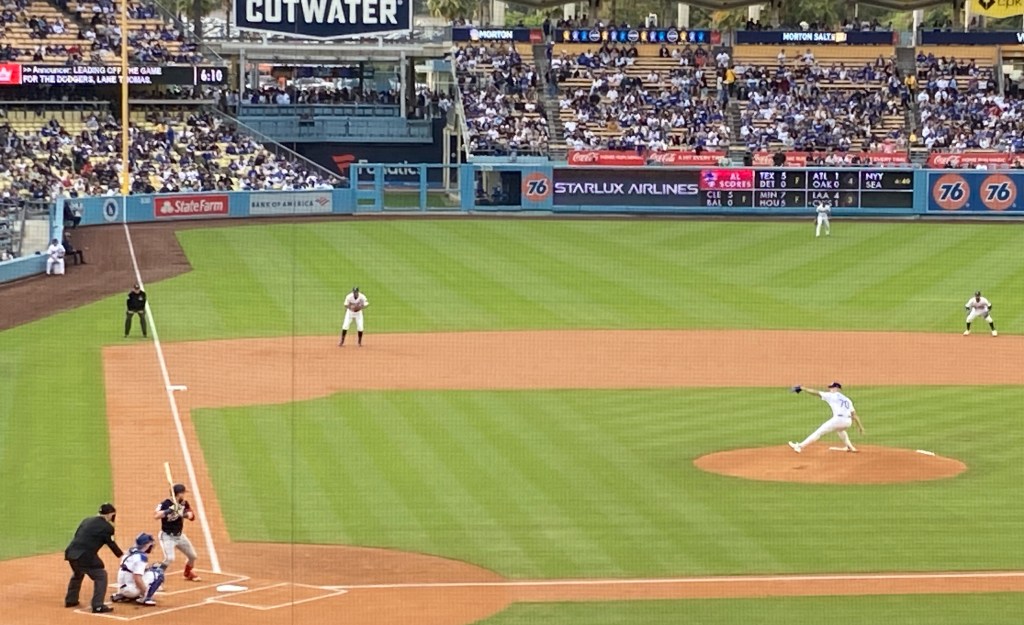
Photo: The Author at Dodger Stadium, Miller’s Home Debut

When Your Team Loses

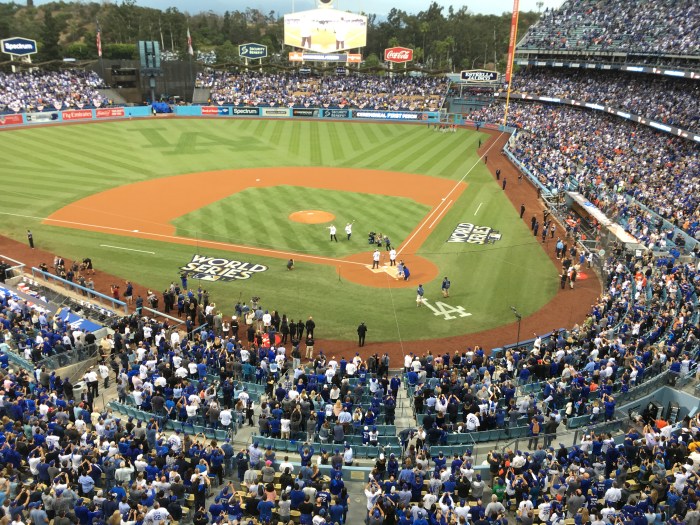
The Houston Astros won the 2017 World Series last week. The Los Angeles Dodgers lost. It was an epic contest. Many have observed it was one of the greatest World Series match-ups in the history of Major League Baseball. It lasted into the mythic and deciding Game 7, crossing tentatively into the month of November, creating the first-ever Game 7 at Dodger Stadium and the first-ever MLB game played in November at Dodger Stadium.

This year’s fall classic delivered all of the drama any fan could want from a World Series. There were come-from-behind victories one after another, larger-than-life villains and heroes caught in an explosive discussion of racism, more lazy walks and majestic home runs than most of us could imagine, and two world-class managers locked in a battle of wits. It was an endurance contest. It began in Game 1 at 103 degrees on the sweltering Chavez Ravine field and ended there eight days later some forty degrees cooler. It brought many viewers back to the game who had abandoned baseball for its slow pace in our ever-hectic world. It was the perfect collision of talent and human will emerging from an always imperfect playing season.

Then it was over.

Only one team could take home the Commissioner’s Trophy. One team did, in a stadium not their own but on a makeshift stage they made their own. The local contenders, who could win only three of seven games, looked on from the home team dugout and watched the award ceremony broadcast to the globe. Behind the blue-flagged dugout sat their fans, also staring vacantly beyond the bright television camera lights with sadness and acceptance. I was among those fans. I slumped in my hardwood seat and watched the grand on-field celebration to my right and the silence of humility to my left.

Bart Giamatti, former MLB Commissioner and President of Yale University, probably said it best in his acclaimed essay The Green Fields of the Mind:

It breaks your heart. It is designed to break your heart.

That is the game, where each preliminary round of the postseason always ends in an event called an elimination game, and then the World Series itself winds down to the final elimination game. When your team is eliminated from competition, your season is over. There are no appeals. At the final elimination game, one team is victorious. The other team retains the consolation prize of league champion, but it is increasingly less of a bragging right than it was in professional baseball’s beginnings over a century ago.

The eliminated team leaves the field with a broken heart shared with its fans. That is the design. It needs no improvement. A loss is as perfect in its ability to stir emotion as a win means to those who share a parade in the glorious days following the final pitch.

So why does any of this matter? Baseball is a business, a big-money enterprise where fans shell out enormous sums of money for ballpark visits, television and internet subscriptions, staggeringly high-margin junk food, proud but ridiculously overpriced authentic field wear, signed souvenirs, trading cards, collectors’ memorabilia, and tiny parking spots where door dings are as much a part of the game as the ceremonial first pitch. Players are traded back and forth late in the season as insurance for a playoff spot, and just because you call it your home team doesn’t mean many of the players on the payroll call it home.

Why does it matter? If you are a fan, you have to answer it in your own way. Let me try to answer it in mine.

Never mind that the Los Angeles Dodgers, a controversial transplant from Brooklyn today playing in the second-largest media market in the nation, haven’t even appeared in a World Series since 1988, the year ace Clayton Kershaw was born. Never mind that the Dodgers are the team of historic #42 Jackie Robinson, whose jersey number is the only one retired across both the National and American leagues. Never mind that Dodger Stadium, the model for modern stadiums when it opened in 1962, the year I was born, is now the third-oldest stadium among the 30 in MLB. All of that is nice context, but it doesn’t reasonably define why I would feel sorrowful over a loss in Game 7.

In fact, in a world plagued by continuing terrorism, nonstop acts of violence, social vitriol, political lunacy, global instability, and wildly unjust economic inequality, why do seven months of three-hour-plus games played day and night on well-manicured fields by young millionaire athletes directed by billionaire ownership groups matter at all? It shouldn’t, right? We’re adults, aren’t we? We’ve got important stuff to worry about, not the velocity of a breaking ball walloped by a carved piece of wood and sailing 400 feet into the bleachers of a 50,000-seat arena.

Well, let’s try it another way and go back to Bart Giamatti, a Renaissance scholar and baseball fanatic who left us much too early but was gracious enough to capture some meaning in all of it in his own temporal longing:

There are the truly tough among us, the ones who can live without illusion, or without even the hope of illusion. I am not that grown-up or up-to-date. I am a simpler creature, tied to more primitive patterns and cycles. I need to think something lasts forever, and it might as well be that state of being that is a game; it might as well be that, in a green field, in the sun.

That is why it matters to me. It matters because it lasts all our lives. It dies with the coming of winter and is reborn in the spring. I love the game because my father loved the game. It is essentially the same game, forget the bells and whistles and data analytics and all that newfangled scoreboard jazz. The game no matter what is fully unpredictable to the final out, the alchemy of athleticism, calculating strategy, and too often chance. It is consistent in its ritual routines, relentless in its aggregate simplicity, intoxicating in its repetitiveness. Forever it has broken hearts. We share that from generation to generation, from season to season. It is absolute in its constancy, absolute in its recurring challenge, absolute in its finality — until it comes again.

It always comes again. It has to come again. It is designed to break your heart.

When your team loses, you internalize the emotion, politely congratulate the winning opponent, and make no excuse for the silliness of the sadness in your obsession with constancy. We all like to win. We all want to win. We all want to be part of winning. Yet more than that, we all want to be part of something that matters because it holds us together with permanence solely because its vitality is assured in its unfailing renewal.

The Brooklyn Dodgers, who didn’t win a World Series until 1955, owned the nickname Dem Bums. Each year they lost, Dem Bums and the fans who followed them would finish the season with the same words: “Wait ’til next year.” Dem Bums knew the answer to what you do when your team loses.

I’ll see you at the green field next April. Opening Day is traditionally played in the early afternoon. With a little luck the sun will be shining on all of us.

______________________

Photo: By the author, Ken Goldstein (11/1/17)