World Series Reflections: 2025 Edition

You might have noticed I’ve published fewer blog posts this year. The political climate has made it hard to write about things that seem trivial in comparison. I’ve found it difficult to comment on news of the day without adding divisiveness to the national dialogue, yet unsettling to try to ignore it with distanced topics. I suspect I’ll resume my regular cadence at some point. I’m not sure when, but I will remain at the keyboard infrequently as my DNA requires.

You might also have noticed that the Los Angeles Dodgers just won the World Series for the second year in a row. That is another infrequent happening, and while perhaps not life-changing, joyously worth a few comments from a devoted fan.

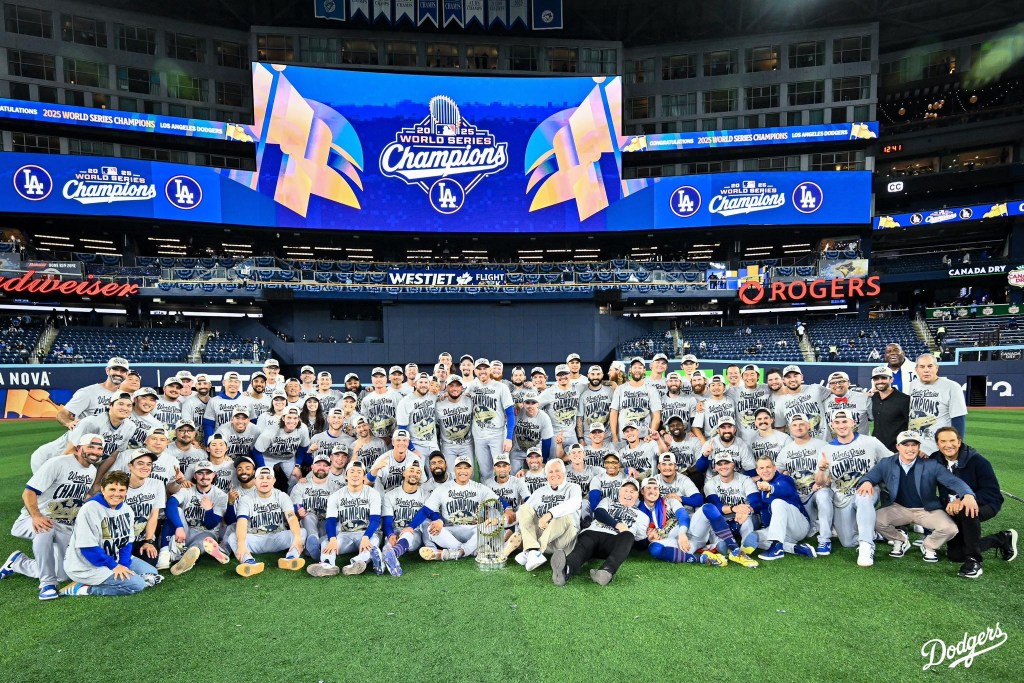
The entire MLB postseason this year was filled with unpredictability. The World Series was a fitting final act to that rollercoaster, with an 18-inning marathon Game 3 and a fought-to-the-finish Game 7 that went down to the last swing of the bat. I won’t recap the play-by-play, others have done that with endless detail, but I will say it was a game that turned on both the performances of superstars and journeymen.

That’s one of the things we love about baseball. Any team can beat any other team on any given day, no matter how good or bad. Chance is always at play. A ball can literally get stuck in a wall crevice and change the outcome of a game (it happened in Game 6). A series MVP like pitcher Yoshinobu Yamamoto can demonstrate consistent excellence on the mound in the clear sight of Sandy Koufax, or a little-known infielder with heart like Miguel Rojas can come off the bench and tie a game that seems all but lost.

Impact can happen at any moment from any player. The game can seldom be predicted.

What does this innocent children’s game played by highly trained adults teach us? We learn from the applied metaphor of baseball that you always play hard to the end. Resilience is your heartbeat. It pays to be indefatigable. You never give up. Never.

Baseball is so many things in the mirror of life. It is the ultimate combination of athleticism and strategy, training and statistics, physical readiness and endless number crunching. It is a game of mistakes — the only sport that counts them on the scoreboard. It is a game of overcoming failure, where a player who gets a hit 2 out of 10 times at bat usually gets dumped, and a player who hits 3 out of 10 often will be paid millions of dollars — crazy many millions of dollars. Unless you are a pro, you’ll never see a 100 mph fastball whip by inches from your body. In fact, the pros can’t see it either, but sometimes they time their swing right, make contact, and put it in the outfield stands.

I had hoped to see the Dodgers win the World Series at home for the first time since 1963. Not only didn’t that happen, but we lost both games I attended with my brother, who was quite the ballplayer in high school and college. So was my dad, who couldn’t attend this year, but texted me at every key moment with his coaching suggestions. I never had the talent, but curiously, I was pretty good with the numbers.

When we lost both those games, I thought of a marketing idea for the front office: how about they give us a 5% rebate for every run we lose by? So if we lose 6 to 1, we get 25% of our ticket price refunded. This would just be for the wildly overpriced World Series tickets. I’ll be sharing that concept free of charge on my annual season ticket feedback form. I don’t expect a response.

The two games we lost at home were more than offset by the final two games we won on the road. The drama of those two games would make for an Academy Award winning movie no matter who won. Note to Kevin Costner, Redford is unavailable — do you have one more baseball epic in you? And who would you like to play?

Hats off to the Toronto Blue Jays, who have waited since 1993 to get back to this big stage. Their ball club oozes talent, from the future Hall of Famer Vladimir Guerrero Jr to the wild ascent of pitcher Trey Yesavage from Single A minor league ball to triumph in the World Series seven months later.

The Dodgers magical starting lineup — Ohtani, Betts, Freeman, Smith, Muncy, Edman, Teoscar Hernandez, Kike Hernandez, Pages — will live in our imagination with most returning for another season. We also witnessed the impossible elegance of an unknown reliever in Game 3 named Will Klein, and in that same game the single inning bridge of the departing great Clayton Kershaw. Manager Dave Roberts made a number of gutsy, counterintuitive moves throughout the series that could have gone either way, but at last the risks played in his favor.

Maybe it will be enough for Costner to make a cameo, a lot of good picks there. AI can help with the aging thing.

It’s all one for the storybooks, but I’ll close with a quiet moment that summed it up for me. When I arrived at the entrance gate for Game 5, I said to the friendly parking attendant I see all the time, ”I’ll bet you’re sad it’s the last day of the season here at Dodger Stadium.”

”What do you mean it’s the last day?” he replied. “We have a parade next week. We’ll all be here for that.”

We had lost the game the night before and the series was tied at 2-2. There was no question in his mind there was going to be a parade. No question whatsoever.

Resilience to the end. Hope in the face of adversity. Optimism facing inescapable, ceaseless competitive resistance.

As Bart Giamatti wrote so eloquently about the game long ago, “It is designed to break your heart.”

Not this time.

Win or lose, this is the game we love.

________________________________________

Photo: TORONTO, ONTARIO – NOVEMBER 2: World Series Game 7 between the Los Angeles Dodgers and Toronto Blue Jays at Rogers Centre on Sunday, November 2, 2025 in Toronto, Ontario. (Jon SooHoo/Los Angeles Dodgers)

The Thing About Vin

This month I suspect the nation is accidentally divided into two unsuspecting camps: Those hearing the beloved name Vin Scully for the first time, and those who feel the world has lost a soul whose voice permeated their imagination for what seems like forever. I probably don’t have to tell you, but my tent is in Camp Two.

I’ve been reading, watching, and listening to the touching tributes to Vin all month now, waiting for the words to come to me that might add something different to the mix. Like so many fans of baseball, I am finding it impossible to quantify the impact Vin has had on the game and my life. Let me try to get there by focusing on what Vin brought into our lives that exceeds anything to do with a child’s game played by adults for well over a century on our pastoral fields of dreams.

Vin was decent in a way that defines decency. Try to think of anyone in the public eye where you never hear a single bad word uttered about him. People like this about someone but not that, people argue about the talents and abilities of professionals, people offer pointed critiques of someone’s shortfalls despite their success. I’ve never heard anyone utter a cross comment about Vin. Never. It’s uncanny. I can’t think of anyone else who fits that bill.

Vin was a storyteller of the highest order. We frequently overuse the word storytelling to describe the sequencing of events that constitute an unfolding narrative, but Vin turned broadcasting into art and baseball into a series of real-time epics built from a foundation of plot and character. You never had to love the Dodgers to love the resonance of Vin’s unmistakable voice. You listened to the anecdotes excerpted from the lives of MLB players told gracefully between balls, strikes, hits, and runs. You never missed a play, and every chapter of the story added up to a portrait of an era.

Vin brought us together. Whether you were sitting in Dodger Stadium with a transistor radio earplug hanging below your ballcap, watching a big screen with rowdy strangers in a sports bar, or sitting at home texting friends and family while Vin did the play-by-play alone in the booth, everyone choosing to participate in the day’s game came together as part of the event. Vin was inclusive, and he made us inclusive. Our differences didn’t matter on game day when he had the mic. His friendship was our friendship. Vin made sure everyone felt welcome to be part of his 67 years of telling campfire stories while athletes performed them in stadiums linked to historic moments.

“Hi, everybody, and a very pleasant good evening to you.”

“If you have a sombrero, throw it to the sky.”

“A Black man is getting a standing ovation in the deep South for breaking the record of an all-time baseball idol.”

“In a year that has been so improbable, the impossible has happened.”

“I know in my heart that I’ve always needed you more than you’ve needed me.”

Vin turned simple words into profound statements, moments into musical notes, radio and television commentary into sound bites for the ages. Today that might seem corny, impossible to pull off without sounding dated or forced. I guess when you have the perspective of almost seven decades to evolve your act, whatever you say is instantly perfect. It’s jazz. You’ve rehearsed as much as anyone alive, so you can improvise without a worry. You also instinctively know when quiet beats loud.

The stories of Jackie Robinson, Sandy Koufax, Hank Aaron, Don Larsen, Fernando Valenzuela, Don Drysdale, Willie Mays, Roberto Clemente — they are each 100% their own, and Vin knew that more than anyone. Vin was forever the reporter, never the story, that was his inviolable commitment. Yet the stories were better because he told them. Everyone knew that. If you had a story in the game, you wanted Vin to tell it, to record it for the ages, to make it vital, enchanting, and historic. Doing the outlandish in a game that has never seen a moment like yours is one thing. Having Vin lock down the tale for all of time is quite another.

As I think about all the kind words I’ve read and heard about how deeply this one humble man touched so many lives, I am repeatedly left breathless by the stories the fans themselves have shared. Fathers and sons who couldn’t find the right words to say to each other turned on the radio and had a catch while Vin called the game. Families who couldn’t afford the price of tickets parked their cars in open spaces, opened the tailgate of an old station wagon, spread a picnic blanket and grilled hot dogs as Vin made them feel like they were at Chavez Ravine. Brooklyn loyalists who never forgave Walter O’Malley for moving the team west generations later got satellite TV and fell in love again with their Dodgers bridged by the same voice who loved the team as much as they always had.

So here’s the thing about Vin, where the legend of simpler times and radio days brings us to the less innocent evolution we’re all trying to navigate with fragments of heart and hope. Some of us are getting older, losing the icons that carried us from youth to adulthood while poignantly keeping us young at heart. Every April baseball season begins with enormous hope, and every October it ends with one World Series champion. We all know the beginning and end of that cycle come with a change in the cast. Some of our favorite players will be gone. Some of the most important people in our lives may be gone. That is the sad and precious reality of our time together. Our memories are both powerful and fragile. When we remember a common voice that triggers the goodness in those memories, biological age for an instant is no longer a thing.

Vin was there for so many of those memories. He had the seat of honor at so many of our tables. He will stay tied to those memories as long as we stay tied to those memories. The gift of his life was to enrich the lives of all those who carry forward those memories. He wanted that even more than to call a perfect game. For Vin, every game was a perfect game.

I’ll give the wind-up to Vin, because I cannot imagine any other way to set up the close and get off the air:

“When I was eight years old, I fell in love with the roar of the crowd coming out of the speaker of a four-legged radio. When you roar, when you cheer, when you are thrilled, for a brief moment I am eight years old again.”

Yep, so am I. Thank you, dear Vin Scully. Your gift of optimism and connection is once in a lifetime, once in a century, once in sports history. Your gift forever keeps us eight years old.

_______________

Photo: Library of Congress

Can Business Be Philosophical?

Recently I shared with you my passion for philosophy. You probably know I also have a profound passion for business.

And music, The Beatles, The Dodgers, wine, literature, children’s needs, social justice, and other stuff.

Back to philosophy and business: can they intersect?

This is where a lot of cynicism enters the picture.

Mark Zuckerberg says he is all about free speech and building global communities. He would have us believe a business—at least his business—should not be editing political expressions, even for accuracy. He asserts this is up to individuals to assess, or for the government to regulate if it can figure out a reasonable and fair way to impose guidance.

Should we believe Zuckerberg the visionary or Zuckerberg the voracious competitor? It doesn’t take a lot of analysis to know his goal is to keep selling ads, that any restrictions on free expression create a slippery slope for the addiction of his site contributors (i.e. all of us powering his pages with free content). It’s pretty clear he wants a level playing field around restrictions, meaning if the government regulates Facebook, he wants it to regulate all his competitors where he maintains a competitive advantage and is likely to win with ubiquitous rules.

Are free speech and “leave me alone to make money” compatible ideals, or the best possible excuse for self-interest?

Let’s try again.

Google’s stated mission is “to organize the world’s information and make it universally accessible and useful.” They are all about creating a definitive archive for global knowledge, about ensuring the best customer experience, and once upon a time about not being evil. That’s some philosophy!

Have you done a search on Google lately? Remember when organic search returns were clearly separated in columns from sponsored search returns? Yeah, that was before mobile made that largely impossible with much smaller screens. Today you practically have to be Sherlock Holmes to know what’s a paid ad on Google and what’s global knowledge. The keyword ads are everywhere. There’s a reason. They figured out how few bills the world’s information actually pays when displayed. They know which clicks are bankable in that trillion-dollar valuation.

One more for the road?

Apple wants us to believe it is at the heart of protecting our privacy, right to the edge of protecting the login codes of suspected dangerous criminals. Maybe that’s a big idea we have a hard time embracing because its scope means the tiny basket of bad eggs has to enjoy equal privacy if we want to protect the gigantic basket of good eggs.

Yet if privacy as a strategic mandate is a paramount position at Apple, how does the company abstract itself from all the apps that transmit our personal information to the data-mining servers of the world as fast as we type it in? Apple says it makes secure devices that are safe to use; that’s all they do and they do it brilliantly. If those devices open tunnels between those seeking data and those leaking data (again, all of us), that’s our tunnel to barricade or avoid, and it would be illogical to ask them to detour us otherwise.

Can a company have a point of view on elevated ideals, or are these polished notions just a bullhorn cry from the PR department?

I guess it all comes down to what we want to believe is a pure, important idea, and how far a company will go to spin a concept to its own advantage.

The issue is one of authenticity. Does a company truly embrace beliefs that are worth evangelizing, or are its statements around absolutes justifications of convenience?

Proclamations are not philosophy. A mission statement is not philosophy. Company values are not philosophy. All of these are constructs meant to unify the purpose of a business, but the business entity’s constant struggle with ambiguity, competition, and the demands of ownership too often compromises ideas when financial interests are at risk. We can say we want to act in a certain way, but will we always?

I have to admit, I have been guilty over the years of trying to inject philosophy into business practice. I have not been terribly successful. The conflicts of interest abound, and the enormously hard work of maintaining consistency can be exhausting. I used to have my employees read a book called Freedom and Accountability at Work by Peter Kostenbaum and Peter Block. It is about existentialism in the workplace. All but one colleague told me they couldn’t get past the first chapter. At least they were honest about it.

How do we avoid hypocrisy and cynicism in a world where we want to be better? We are often told Millenials want us to rise to a higher standard, that cause-based marketing resonates strongly with their brand loyalty. I think it is possible to “do good while doing well,” but I don’t think we accomplish this if we pretend we’re something that we’re not.

Instead of declarations that render themselves hopelessly artificial, companies can humble themselves in restraining their platitudes around the possible. Instead of attempting to hide behind crumbling categorical imperatives, business might be better suited to achievable standards that are consistently authentic.

Tell me the truth all the time, and I may trust you. Don’t tell me why your definition of truth is defined in the unreadable footnotes at the bottom of the page.

Be aspirational, and I may join in the celebration of your mission and values. Don’t tell me that your company has discovered or defined a nobility that somehow makes you better than your competition.

Be well-meaning in the goods and services you provide, whether ensuring quality or seeking a healthier supply chain, and I may respect your brand. Don’t proselytize and expect me to believe you are pursuing a higher calling—profits be damned—when transparency betrays your more obvious motivations.

A business can be great, even legendary, without being philosophical. Let it be honest, consistent, and authentic—that’s plenty to tackle and enormously difficult on top of being outrageously good at something. The agenda of business is measurable, culminating in success.

Leave philosophy to the philosophers. Who would that be? That can be any of us—the storytellers around the campfire, the quiet voices in a coffee shop, the ardent dialogue in anyone’s home. The agenda of sharing, exchanging, and challenging ideas is immeasurable and ultimately boundless.

_______________

Photo: Pexels

Opinions That Matter

Be cautious with the advice you seek. Be more cautious with the advice you offer.

I enjoy and appreciate seeking business input from all kinds of people on all kinds of topics, but lately, I’m noticing that much of what people offer is too off the cuff. I usually know a problematic opinion is coming my way when I spend several minutes framing the complexity of a souring issue, and the assessment I receive is preceded by this phrase:

“Why don’t you just…”

That warning prelude is often followed by a very simple response in a sentence or fragment encompassing very few words. Some examples of confounding suggestions:

“Why don’t you just reduce your overhead?”

“Why don’t you just hire someone else?”

“Why don’t you just find a new supplier?”

“Why don’t you just change the value proposition to your customer?”

“Why don’t you just worry less about your brand?”

All of these phrases were spoken in earnest, in a neutral tone without any particular agenda or adversarial intention. I said my thing and they said theirs.

There’s another warning sign that preceded these suggestions—the words were delivered quite quickly, the “Why” being initiated almost instantly on the period ending my lead-in sentence.

There is a word to describe this kind of give and take. It would best be described as “conversation.”

It could also be described as “bar talk.”

There’s nothing wrong with conversation or bar talk, as long as we realize that’s what it is. Banter is entertainment, not problem-solving. Words that pass the time are not thoughtful solutions. In matters of consequence, I find chit-chat troubling traveling in both directions.

The easiest response to a “Why don’t you just…” suggestion is probably the obvious: “Uh, yeah, we thought about that and ruled it out… months ago.”

A less polite response might be: “Buddy, can you take this discussion a bit more seriously?” If you are in a bar in the midst of bar talk with someone who has been drinking a few hours, be careful in selecting that response, or at least judicious in the tone you use to convey it.

The lack of thoughtfulness in idea-sharing may come down to a matter of confidence and overconfidence. I applaud you for having a quick response to my nagging torment. It is possible I missed the obvious in the fog, but when I hear my problems so easily solved, what I really hear is someone who might not have failed enough. We all fail and to some extent learn from failure, but where is the empathy in our counsel when it comes to someone else’s dilemma, where we are less likely to lose anything if we are wrong?

Some call that having skin in the game. There is nothing that will slow down your response rate quicker than putting your own money or success at risk. You may be confident in making an investment, but when it starts to flounder, overconfidence should have already left the building.

Opinions can be interesting, but when they fail to embrace consequences, they can undermine trust in relationships.

When I am sharing a problem with you, I am not simply venting. I am seeking an improved outcome. If you want to help me, try getting me to rethink the problem in areas I might be stuck. Try some of these approaches on me and you’re likely to catch me listening more intently:

“What is the data telling you about changes in circumstance?”

“When you made that choice, what were the key factors that led to your initial decision?”

“Are your competitors in the same boat, or is this unique to your company?”

“Is the situation temporary and likely to reverse with more usual market conditions, or have the market conditions fundamentally changed?”

“What other advice have you received on the topic, and how was it helpful or damaging?”

If I share a problem with you, I don’t expect you to have the solution. Unless I have gotten ridiculously lucky, you probably can’t solve my problem. Yet if we work through a set of abstracts together, it is possible you might cause me to look at the problem differently and start me on the path to identifying a new solution. Dialogue like that in times of trouble has infinitely more value than a spitball suggestion.

Ego gets in our way when we think the winning outcome of a discussion is to have the right answer. That kind of overconfidence is unrealistic at best and reckless at worst.

Our roles in listening to each other are about being helpful, about unlocking hidden secrets in our judgment and navigating safely around treacherous obstacles. Slam dunks may win bragging rights, but in my many decades on the job, I’ve never heard one that changed the landscape in real-time.

Our words have consequences. Noble advice requires discipline and credibility. If what you prefer is bar talk, let me know and I’ll tell you why I think the Dodgers lost the last two World Series. I can’t imagine anyone in Dodgers management asking my opinion on that. Why would they seek an opinion that didn’t matter?

_______________

Image: Pixabay