Those Thin Blurred Lines

The more I watch this year’s election unfold — especially the Presidential Debates — the more I am reminded of that old axiom I wrote about early in the life of this blog, “Our greatest strengths are our greatest weaknesses.”

Campaigning for office is no small trick.  A candidate enters the race with a set of convictions, values,and ideas, as well as a personal communication style and inescapable personality quirks.  That individual has to maintain authenticity while winning support from those who might not be all that easy to convince. We play by the rules in a democracy of representation, where majority rule determines our elected officials and they determine our laws, ostensibly voicing the will of the people.  Yet we also seek leadership from aspiring candidates and those elected, to help the electorate understand and embrace new concepts and styles they may not initially support, but leaders believe they may come to support.

How jolly is that?  Be yourself, but not so much that non-supporters rule you out, then enact the will of the people, while helping guide them to points of view they don’t necessarily embrace.  Lots of contradiction.  You’d wonder why anyone would want to do it — yet hardly unique to electoral politics.

Anywhere there are people, there are politics.  If you don’t think you have office politics all around you on the job, perhaps you work under a cone of silence.  There are politics in families, politics in communities, politics among friends.  Our very individuality — those special and defining ideas and elements that make us unique — ensure that we will not always agree with one other individual, let alone a pack.  John Stuart Mill famously wrote about the Tyranny of the Majority, one of the more challenging aspects of democracy, where a single brave voice is sometimes necessary to dissent from common agreement and be willing to be right, however unpopular.

And there you have it, the individual in conflict who has to win support, yet be true to self or risk critique of being a phony.  That individual — whether President Obama, Governor Romney, Vice President Biden, or Representative Ryan — knows most of all that their greatest strengths are surely their greatest weaknesses.  As I have watched them in the debates, well-prepared but under extreme pressure, I have seem them dart in real-time between polar opposites, showing us who they are and what they think, but attempting to course correct for acceptable balance where too much polarity will ensure ultimate failure.  Here’s a short list of what I am seeing push and pull for the proper outcome, like so many other people I know in uncountable contexts:

Confidence vs. Humility.

Courage vs. Recklessness.

Introspection vs. Salesmanship.

Creativity vs. Predictability.

Flexibility vs. Resolve.

Idealism vs. Realism.

Humor vs. Gravitas.

Accountability vs. Deniability.

Talking vs. Listening.

Watching vs. Acting.

Thinking vs. Doing.

Responsiveness vs. Perspective.

Candor vs. Diplomacy.

Attributes as well as ideas always create balancing acts, with true and effective balance so rare, so hard to find.  Perhaps that’s why it is easy to point the finger at our elected officials with accusations of their flip-flopping and being two-faced.  They try to be themselves, yet they try to appeal to those who might find them objectionable — just like the rest of us in our working and non-working interactions.

No one wants to elect or work for a hypocrite or a say-anything, do-anything, be-anything competitor.  Yet maybe we are missing some of the point, that there are those among us who can find balance, slide across the middle and back again, and master the manner of dialing back some of their strengths while bolstering their weaknesses as one and the same act.  Tough to even think about, but where you see a true winner, it is possible you may be seeing someone so in touch with their diverse attributes that they cause you to embrace the unfamiliar and unsuspecting in ways you hadn’t imagined.  Call that person a master politician — or someone who knows how to lead by bridging the resistance of those around them and inspiring the imagination that builds a following.

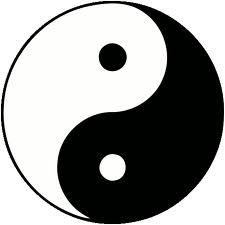
What are some of the Yin-Yang qualities that you observe in the candidates, good and bad?  In those with whom you work?  In yourself?  Please share them, let’s see what the list looks like when we build it together as recognition, with a keen focus on impact, implication, and outcome.  Where style is content, look for the bridge to consistency and authenticity.
Do Books Matter Less?

The pre-Socratic Greek philosopher Heraclitus was an early observer of the ever-occurring change in our universe. About the same time in the 5th Century BC, Parmenides pondered the notion of permanence, what we could presume in nature to be essential. Between the two of them, we have a thesis and an antithesis that have yet to reveal a synthesis beyond argument some 2500 years later. We see change all around us in almost unfathomable complexity, while we wonder what we can hold onto as firm. For me, it’s a good problem to have, as contemplation of the unsettled forces us to chew harder and argue better.

Then there are books.

In a recent Wall Street Journal piece with the header “Books That Are Never Done Being Written,” Nicholas Carr contemplates the far-ranging impact of digital distribution on long-established but fluid notions of traditional publishing:

An e-book, I realized, is far different from an old-fashioned printed one. The words in the latter stay put. In the former, the words can keep changing, at the whim of the author or anyone else with access to the source file. The endless malleability of digital writing promises to overturn a whole lot of our assumptions about publishing.

The realization that books are no more permanent than this year’s understanding of medical treatment is hardly shocking. The very paradigm of printing on paper and binding a work has throughout its history adopted the notion of editions and revisions. Where would the school textbook industry be without an excuse to update a classroom volume rather than allow you to feel comfortable buying a dog-eared half price two-year old version? If we only needed one unabridged edition of the Complete Works of William Shakespeare, think of how many academic preface summaries we would have been denied annotating discovered corrections in the core text.

Yet in the worlds of literature and even political theory, we do seem to maintain an expectation that the version we read of Charles Dickens or John Stuart Mill is largely the same as the draft the author called final. “A Tale of Two Cities” even when presented in its initial serialization was eventually finished, as was the essay “On Liberty,” and when we buy a copy of one of these today, either in paperback or download, we do believe in the authenticity of replication representing if not a fully steady state, a pretty firm slice of life. That is helpful not only in getting us all on the same page for discussion and critique; it also offers us grounding in history and social evolution, the ceaseless churn emerging from deliberately placed bricks in the wall.

I have a hard time thinking today is much different, and no matter the short attention span theater that victimizes so much of our patience, my sense is our books have never been more important — no matter the brevity of their life-cycle, no matter their imposed truncation or expansion, no matter their delivery format or storage means on a wooden shelf or cloud server. Our books will change as they must, but their timeliness and meditation as a collective might be the primary permanence we retain, even if it is more spiritual and metaphorical than natural or physical. The means of delivering the book does not define the book; it is largely irrelevant, a timely convenience worthy of disruption. The material of delivery is subordinated to the material of substance. It is the content that matters, not the media. The Platonic Form is the ideal, and that cannot be taken from us by technology.

However we acknowledge its consumption mechanism, the book as ideal is a bridge among scattered coordinates. We learn to read an organized set of drawn thoughts to see what is meant by change, and those who have the gift and discipline to construct a book add to the global library of permanence by carrying the torch that challenges all that came before. Historic observation is clear and consistent: the buildings decay, the land can be conquered and utilized anew after wars and governments are gone, but the ideas underlying arts remain for examination. The composed book is the codification of the idea however it is presented — that does not change.

My amazing wife, who is also an amazing teacher, enters her classroom on the first day with a simple statement:

“Our books are our treasures.”

Her specialty is English as a Second Language, and whether she is teaching adults or children, this mantra is always the same. Books are precious. If you look around our house, you might see why this is our chorus. Books are everywhere. That is what we want to be surrounded by. We also have a Kindle and an iPad.  They are filled with books as well.

Another recent story in the Wall Street Journal discussed how the price of e-books was sometimes dropping below the price of “real” books, which I guess means paper books. To me, one is no less real than the other. The broader question is whether the great majority of people should still find the time for long-form written expression in a world cluttered with half-baked tidbit social media posts like this one. The answer has to be yes, because if we are going to allow character count to trump in-depth inquiry, we condemn our more severe concerns to being adequately addressed by less than substantial narrative. Our pace of change is only becoming more frantic, and the hope for some form of understandable permanence is all the more desirable in addressing unending anxieties. Committed writing and reading get us a good deal of the way there, because the acts of reading and writing might be one of the few forms of permanence we can share.

I say this as someone who just spent the better part of a year writing my first book, which is now in first draft and undergoing edit. I haven’t talked much about the book, and won’t until we get closer to publication, but let me say that whether anyone reads it or it sells a single copy, it will remain one of my proudest achievements. Right now it is a long book. It will get shorter to accommodate marketing concerns, but hopefully it will still be a substantial book. I couldn’t have said all I needed to say in a blog post or I would have. Believe me, I would have!

In our world of constant and increasing hyper flux, books can be thought of as a noble but flawed exercise in establishing some sense of the enduring. Now that digital publishing allows current authors easy access to further disturbing permanence, any foothold in establishing the concrete may remain even more illusive, but the stepping-stones of thought that bridge us from there to here can certainly maintain significance if we view thought as continuum, a timeline. In that regard, as a roadmap or even a set of breadcrumbs, books for me have never been more relevant, nor the mission of authors any less permanent. Some books are good and some are bad, some certainly more ephemeral than others, but the connectivity of books is ongoing. Apps or facings, that is as it should be, as long as I can read.

_______________

Photo: Pixabay