Don’t Yell at the Pilot

If you are a regular reader of this blog, you know I spend a lot of time on planes. When you fly a lot or spend a hunk of time at airports, you observe human behavior in many of its less magnificent expressions. There’s no way around it — the more you fly, the more likely things are to go wrong. It’s a numbers game. Take 100 flights, and if just 5% of them don’t go as planned, that’s five bad days of travel interrupted. That 5% is optimistic.

Frequent travelers know that getting angry at the people trying to help you with a canceled or rerouted flight is not likely to get you what you want. You may think yelling at the person on the other side of the computer will get their attention. What you don’t know is what they are typing, or would have typed if you had been a little kinder.

Last week I had one of those bad business travel days. Shortly after takeoff, we were notified by the captain that there was an unexpected rumbling we all heard in the retraction of the landing gear. Although he assured us we were safe, to be even safer he was going to make an unscheduled landing at the next major airport we were approaching.

You can imagine the groans from the cabin passengers. “There goes the day.” “So much for our plans.” Yep. That’s what happens. The captain makes the call and the plane goes where the captain says it goes. Twenty minutes later we were on a runway and at a gate two hours short of our destination.

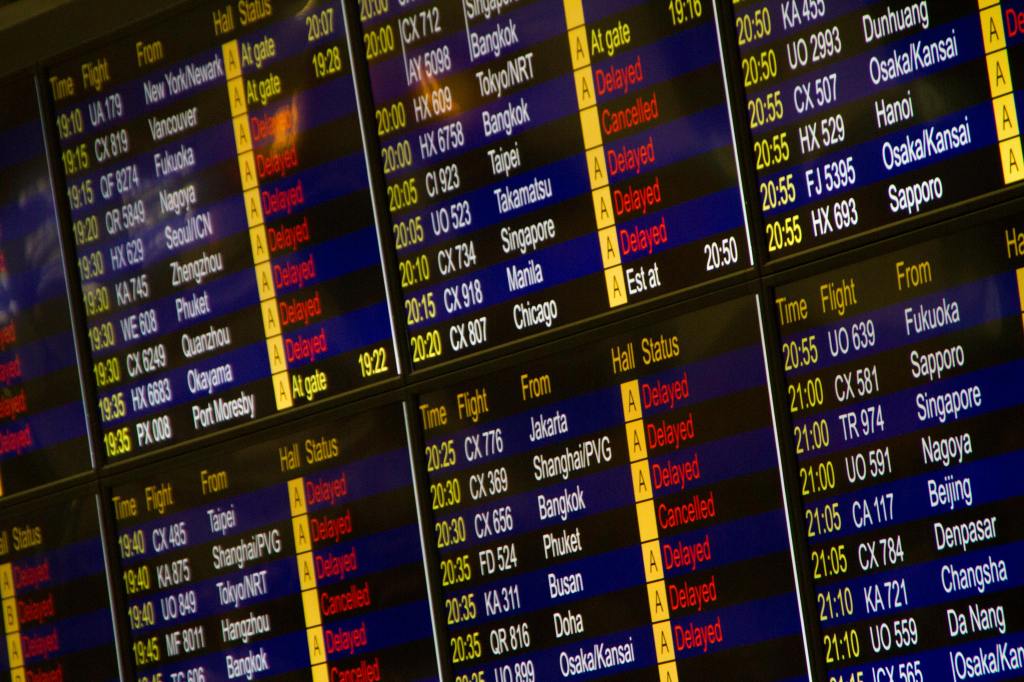
Indeed there was confusion when we landed. We were asked to disembark and wait at the gate. Job 1 of course was to inspect the plane and see if it could be airborne again. If you have ever experienced this scenario, you know the chances were maybe 10% that plane was going back in the sky the same day, but you do what the crew advises and take it a step at a time.

Because we were an unexpected landing the gate was understaffed. While they tried to get the connecting passengers rerouted, they asked the single destination passengers to wait for a call on whether the plane was safe to fly again or we would need to be rebooked. Frequent travelers know not to wait — you get on the phone or internet, rebook while seats are available on other flights, and take whatever seat you can get to keep moving. Of course not everyone can be helped immediately with long lines and on-hold wait times, so there was reasonable angst in the gate area.

Reasonable, that is, until the captain came off the plane and visited with us while we waited. That’s when people became unreasonable. He told us the likelihood of that plane taking off again the same day was extremely low, and we should all be making other plans. He was honest and straightforward. He didn’t have to do that. He didn’t even have to talk to us. In exchange for his candor, a number of passengers started yelling at him. “This is unacceptable!” “Do you know how to run an airline or not?” “What compensation do we get for this inconvenience?”

There are a few cardinal rules frequent travelers embrace. Don’t make jokes when passing through security. Don’t step in front of small children or anyone in a wheelchair when boarding or deplaning. And don’t yell at anyone in uniform. Ever. Do not yell at a flight attendant. Absolutely never yell at a pilot.

For all these angry passengers knew, this pilot might have just saved their lives. Sure he said there was no danger in the air, but you don’t know if that’s really true. A captain would never create a panic in the cabin. This captain made a call and set the plane down. Now we’re calling family to tell them we’re going to be late and worrying about retrieving our luggage. Could it be worse? At 37,000 feet above the Earth?

I remember during Covid when passengers were complaining to flight attendants about wearing masks. Sometimes that exploded into yelling. I thought to myself, what makes people think that flight attendants have any discretion over enforcing federal policy? What can passengers possibly hope to accomplish by yelling at those making it possible to fly during the pandemic?

Airline inflight personnel are heroes who look after our safety first and foremost. They don’t run the airline. They aren’t in management or marketing. They are not jet manufacturers or maintenance crews. Their job is to get us where we are going safely. They do that with 99.99% accuracy, maybe more 9s. To yell at a pilot for the inconvenience someone might be suffering is beyond ignorant, beyond disrespectful, beyond lunatic. The pilot did his job. Applaud him, thank him, write a letter of commendation on his behalf.

Don’t yell at the pilot. Never. You’ll get where you’re going because a highly trained and experienced professional kept that option open for you. Their thousands of hours in the cockpit prepared them to make split-second decisions, perhaps a few consequential times in their careers, that allowed you to read these words. I’m in awe of their talent, commitment, dedication, and perfectionism. Yell at them and you’re going to get a different kind of feedback from passengers like me, their most devoted fans.

_______________

Photo: Pexels

The Difficult and the Daunting

You may have heard recently that Amazon is pulling back a bit on hiring and warehouse space. With all their vast resources in strategic planning, the executive team there overshot on leasing square feet their forecasts no longer support. I suspect they will manage through this just fine in the long run with little impact on earnings, but it is a powerful reminder of how difficult it is to predict future business both when you’re in an up-market and a down one.

We all get this wrong now and again. It’s normal and usually navigable. The problems come when balancing present challenges heavily compromises a company’s future, or betting only on the future sours a company’s current performance to the point where no one cares about the future.

I am often humbled by the nagging paradox of making tough business decisions every day at the relentless pace of 24x7x365. Running a company in response to everyday circumstances in the present will always be difficult, Running a company for an opaque future will always be daunting.

We have to do both well to accomplish our current goals and set the table for the next generation of growth prospects. Favor either the present or the future too heavily and the question becomes whether you want to lose now or later. While that’s not an option any leader wants to consider, if we don’t see the delicacy in how one affects the other, our intentions can be undermined by our outcomes.

We often hear about the pressures of being a public company, how corporate leaders make choices to focus on quarterly earnings from which they financially benefit immediately over building strong companies for the long haul. I do think this happens at some companies where short-term stock performance can dramatically impact executive compensation. Too often those companies fall prey to what Clayton Christensen famously has called The Innovator’s Dilemma and allow their long-established norms of success to be fully disrupted by more nimble competitors.

There’s a more ironic take on this notion, where equity markets sometimes forgive emerging companies for failing to produce earnings at all in the near term in the hope that someday they will have gained so much market share that they will prove invincible. This all-or-nothing strategy has paid off handsomely for companies like Amazon that didn’t produce earnings for years, reinvested heavily in their growth, and today reap the benefits of that bet. Sadly, this example has been exploited by too many newly public companies that don’t even consider near-term profitability a goal, allowing lazy business models to overshadow unfounded optimism that someday their customers will reward them with enviable positions.

A company that bets only on the future, never becomes economically successful, and runs out of cash can be train-wrecked just as decisively as a once successful company that fails to address The Innovator’s Dilemma. If the executives steering either of those failures happen to be selling shares along the way to a company’s demise, a feast of lawyers will follow.

Inflation and rising interest rates make the cost of doing business higher for everyone. We painstakingly decide how much of these costs we pass along to customers and how much we absorb. The benefit of preserving current operating margins is always tempting, but the rewards of long-term customer loyalty and lifetime value speak for themselves. How do we decipher the balance between current and future financial results? Data will often shine a light on the path, but there are no conclusive textbooks with clear answers to these calculations.

It truly is hard to run a company both for today and tomorrow. We have to consider the staff sizes we need, the leases we’ll require, the stability of our supply chains, price elasticity, and the promise of our brands. We also carefully must watch cash flow, our balance sheets, compensation, incentives, technology advancements, and investments in future product cycles. What works today may or may not work tomorrow. It is seldom that what works perfectly in one set of conditions works just as well in another.

There are no perfect answers, but the fluidity of making a decision now for its short and long-term impact usually weighs heavily on those who wrestle with the impossible crystal ball.

Covid-19 has been a good reminder of how difficult and daunting decisions can be. We were all blind during Covid and it was easy to misread fluctuating data. No leader had substantial experience with stay-at-home working conditions. No one knew how long the pandemic would last, how it would impact supply and demand, or how it would impact investor sentiment. If that wasn’t enough of a challenge, most of what we thought going into Covid proved to be wrong, and most of our assumptions about how employees, customers, and investors would behave post-Covid have been equally wrong.

If you want to be humbled, try making decisions that address the unknown with this level of frequency. You’ll likely realize you’re wrong more than you’re right, but the less tangible skill we develop is how to rethink and react quickly when we discover we are wrong. That’s why the rewards for creating a company that is “built to last” are immense, but the odds of lasting fifty years are long.

When it comes time to decide short or long, know you have to do both, and do your best you to keep dialogue and debate flowing among diverse opinions. The decisions we make have an impact we might be able to see today, but unless you know someone who has a gift the world has never seen, we are almost always speculating on the impact a year or more from today. Sometimes it’s decades before we find out if we were right or wrong.

We choose to sign up for the difficult and the daunting. The longer I do this, the more humbling it is.

_______________

Photo: Pixabay

Managing Through Absurdity

I began 2020 by asking the question: Can Business Be Philosophical? Little did I know it was going to be a test.

As this very difficult year comes to an end, I’ve been mulling over any learning I can carry forward. I’ve been pondering the fundamental notion of quarantine, a strategy I’ve never before considered as a defense against an invisible assailant. I’ve even taken to religious texts for clues on interpreting the darkness. I’m not finding many answers to my perhaps impossible questions, but I do find myself zeroing in on a direction in thought that has guided me as a coping strategy in traversing shaky ground.

What are we supposed to learn from the year of pandemic? If there is no learning in crisis, then a repeat of the same crisis is inevitable. I don’t believe that because it ends the contest between fatalism and free will. We can’t throw in the towel that easily.

Understand the Malady

Might I suggest we have been living through a period of absurdity?

Covid-19 thus far taking the lives of more than a million and a half people globally and 300,000 Americans is absurdity.

The failure of our government to be in a state of readiness for this crisis is absurdity.

Conflicting policies between federal, state, and municipal restrictions is absurdity.

Misaligned interstate regulations in a nation where we travel freely is absurdity.

Hospitals with ICU wards beyond capacity is absurdity.

Categorical rejection by millions of a protective vaccine is absurdity.

Systemic racism is absurdity.

Failure to acknowledge and address systemic racism is absurdity.

Police brutality directed at people of color is absurdity.

Suffering wildfires and hurricanes while rejecting climate science is absurdity.

A president who lies endlessly for convenience as an alternative matter of style is absurdity.

A soundly defeated political candidate and his followers denying the legitimacy of validated democratic process is absurdity.

That’s a lot of absurdity. It can’t be tucked away in a vault. It can’t be explained away by any retroactive framework. Our ability to move on confidently hangs in the balance.

Maintain Integrity

I wonder, have we arrived exhausted at a place and time where all opinions are due equal consideration? If I say that the moon is made of cheese, is that just another point of view I get to insist is as valid as any other idea? Are we so proud of killing political correctness that we have forgotten the pernicious blurring effect of false equivalency?

Like all of us, this year I had to make a lot of hard decisions. Many of them impacted the lives of others. I worried at length about the easy draw of relativism and situational ethics.

By relativism, I mean the temptation to justify a decision I might not otherwise make because of the material circumstance of contemporary events.

By situational ethics, I mean the ability to justify a twist in the consistent application of values as warranted by endlessly deteriorating real-world conditions.

Neither of these is ever desirable, but faced with absurdity, it is easy to see how one could slide toward an argument that was de facto temporary and expirable.

Don’t Make It Worse

In times of turmoil, we must never cross our own lines of absolute right and wrong, but can we know for certain under extreme duress where those lines begin and end?

I suppose some might think the justification or compromise of authority in our pragmatic world is linked to intention. Is the outcome of a tense judgment call broadly beneficial or narrowly self-serving? If we do something we otherwise wouldn’t for a public purpose, for the greater good, is it okay to bend our own rules? If we don’t do it to benefit ourselves, can it be less highly scrutinized?

Those are all curious frameworks I’m sure many in leadership positions encountered this year. None of it worked for me. I chose instead to steer toward a path I could consider consistent. That was an early lesson in managing through absurdity. When faced with absurdity, the first mandate had to be not to compound the absurdity with more absurdity.

Remain Methodical

I thought I might call this post: “What I learned this year.” Then I decided I didn’t learn it this year. The learning has been cumulative. Socrates suggested that all learning is recollection (Socrates also believed in reincarnation, so of course all learning would be recollection).

This year I have been recalling the battles of previous crises: 9-11; the internet bubble; a corporate hostile takeover; a shareholder war; the CDO financial collapse. These were all instances of absurdity. We know that 2020 is not an isolated collection of discord; it’s recency might just make it feel that way.

Maybe that’s the key learning: absurdity can’t be suppressed. It can at best be navigated. Calm, thoughtful teamwork is a good place to start. Collective learning and brainstorming are usually more exponential in effect than individual edict or hunch.

That doesn’t mean we can allow absurdity to become our norm. Dysfunction has to be called out. Identifying dysfunction is often where healing begins. We will be tossed into absurdity again, and the choice will remain: dig in deeper or dig our way out. We’ve proven conclusively we can do both.

Not long ago I happened upon a streaming performance by Bill Irwin at The Irish Repertory Theatre in New York. He enacted several passages from one of my favorite plays, Waiting for Godot. Beckett’s existential masterpiece is about absurdity, about inaction masquerading as action. It is a play of anxiety where nothing happens except for the characters’ recognition of their own circuitous fate. Are Didi and Gogo noble in trying to identify purpose when escape is beyond their ability to see past the proscenium? They may go nowhere, but they never give up hope. The unsettling themes of tedium and uncertainty seem incredibly apt for our times.

Learn to Learn Quickly

Yes, it’s been a hell of a year. Loss, fear, isolation, alienation, pressure, financial inequality, hardball rhetoric, political divisiveness, ceaseless conflict— it’s been a nasty witch’s brew of stress. Are we ready now to embrace empathy?

My ongoing observation in getting past this and getting on to that is that life is too short. I don’t mean that to be cerebral or pithy, but practical. We can’t learn stuff fast enough to put it to work. Just when we start to understand how things work we are old and retiring. If only we could learn it sooner, faster, how much better our work, our interactions, the whole of our lives might be. If only knowledge as recollection could be accelerated to a state of immediacy.

Sadly our journeys aren’t predictable that way. We know what we know when we know it. We can’t reach for answers we don’t have because absurdity comes calling. Our experience emerges and compounds at its own pace. We can no more control the amassing of experience than we can control the unfolding of absurdity.

We must take what we know, apply it the best we can when faced with turmoil, and remain true and consistent to the values we cherish. We will fail often, but the faster we fail, the faster we learn what not to do. That modest confession is my takeaway in managing through this morass.

That’s not absurdity. That’s reality.

I wish you a brilliant, healthy, revitalizing new year of recovery and inspiration.

_______________

Photo: Pixabay

Trust Is Not Negotiable

I’ve been thinking a lot about trust.

I’ve been thinking a lot about truth.

I’m trying to wrap my head around what I thought for fiftysomething years were the basics: If we’re going to climb a mountain together, we have to agree on what mountain we’re climbing, where it is, are there airports nearby to get in and get out, has it been climbed before and under what circumstances—you know, the facts.

We won’t necessarily know the exact temperature at the top, the weather patterns tomorrow or the next day, the precise condition of the trail at every turn, those sorts of variables. There are always unknowns ahead of us that we’ll discover together, but if we can’t start on the same page, how can we possibly agree on plans to address the unknowns?

I find these days truly unsettling, not just because there is a debilitating health crisis before us, but because I don’t have enough trusted information to know what the crisis is and the ability to share in that belief set collegially with a vast majority of the population.

We are confused. We are bombarded with conflicting information. We are scared, anxious, and divided when we need to be informed, building consensus, and united.

How do we address monumental problems when we have little idea what we can believe?

In the age of the Internet, with the ability to share more factual information globally than in all of history, we are mired in noise.

How do we navigate a crisis and ask people to make personal sacrifices—not the least is the temporary surrendering of certain personal liberties—without a unified voice in leadership speaking with sound judgment and reverence for the impact of expert advice?

To me, the deepest impact of the Covid-19 pandemic beyond the tragic loss of human life remains the nagging head fakes that cause me to have no idea what to believe.

Contradictory information is not just a health concern. The unrestricted blending of fact and speculative opinion can undermine our entire economy. If truth blows in the wind, if we have no idea what basic financial information constitutes truth, how can we wisely invest? How can we guide careers? How can we effectively build plans for our future?

Trust and truth are not just about bidirectional knowledge transfer or multi-directional pollutants of critical exchange. Once we accept the notion that lies will be lies and are simply part of the fabric of sharing a planet, we effectively invite opportunism and exploitation as normal behavior. Today there would seem almost nothing that surprises us in lowering our expectations of those whose paths we may cross.

As quickly as the novel coronavirus was becoming a national emergency, some of our fellow citizens took it upon themselves to empty stores shelves of toilet paper, hoarding for themselves rather than caring about the needs of others.

As soon as hand sanitizer became scarce, many sellers of it started price gouging. Even though we have laws about profiteering in crisis, even though it is a purely inhuman act, they did it to extract obscene profits, to hell with the ongoing trust of their customers.

Earlier this month it was revealed that an international criminal operation was filing fraudulent unemployment claims in the United States. Congressionally directed funds meant to help people became the target of a scam. My own company saw one of the first fraudulent claims.

With so many people working from home, phishing and identity theft are on the rise. Credit card fraud is escalating. Fellow human beings see upside in the confusion brought on by the rapid adoption of technologies meant to connect us. Instead they would steal from us.

We are parroting unseemly behavior. We hear lies coming from our foremost leaders. Somehow that becomes permission to follow suit. Self-interest becomes justified and paramount. What we allow we let spread.

Why is all of this bothering me so much, beyond the underlying sickness it unmasks in our global community?

I am a brand builder. The basis of a brand is trust. A brand is a promise. Without trust in a brand, most products become random commodities. The balance of price, quality, and service is reduced to the lowest common denominator. Without brands, we don’t have customers, we have transactions. That is a pure downward spiral in economic viability.

I am also a business leader. When I say leader, I only can apply that descriptor in as much as people choose to follow me. Certainly I can impose hierarchy and insist on the power of authority. If you have ever managed creative people, you know how far that will get you.

If all trust is gone, then I have to assume trust in me is gone. If all truth is gone, I can’t expect anyone to believe anything I say is the truth. A complete lack of credibility in the chain of command is the fastest path to chaos in business I can imagine.

So yeah, it’s personal. If the societal fabric is unwound by manipulation and cynical agendas, my efficacy is also tainted. If you don’t trust my brand, you won’t be my customer. If no one trusts my direction, I can’t do my job and I will have no product to sell.

Is every detail in a company always able to be posted on the side of a cube wall? No, certainly not, there are all kinds of trade secrets and human sensitivities that merit protection. I am not particularly a fan of radical transparency. It sounds much better than it is and I have seldom met colleagues with the pure objectivity to pull it off.

Does it mean there is no way for us to walk down a path of honesty and clarity without a categorical imperative? If you don’t understand that there are shades of grey in decision-making that don’t cross the boundaries of trust, I’m not sure anything I’ve written here will be of value to you.

Integrity is a calling. It is a beckoning aspiration that molds and shapes behavior. Intention matters. Respect matters. Acknowledgment of consequence matters.

If you have shouldered the responsibility of executive leadership or brand stewardship, you know that once integrity is compromised, it is almost impossible to restore faith in a promise of any kind. We teach this to young children, why the smallest lie matters because it makes the next lie possible. Once you’ve lied or cheated and you’ve been caught, no one can ever be certain of your words again.

Am I giving up the fight against the absurd? Hardly. Am I done compromising around the notion of false equivalency? I’ve yet to compromise on values that are sacrosanct and I see no value dancing around an undisciplined contradiction that is empirically wrong.

We can’t let down our guard against emboldened con artists. The disease they spread will never have a cure.

Trust is not negotiable because truth is not negotiable. Talk yourself out of that and you have opted into the source of aimless unwinding.

Trust has to matter to you. Telling and hearing the truth has to matter to you. Commit yourself to demanding more of your own integrity, and one by one we might be able to rebuild our way out of unearned gains and stolen promises.

_______________

Image: Pixabay