Rage On

It’s a strange way to end a strange year.

About a decade ago I wrote a book about an internet uprising in support of a pair of unlikely criminals who kidnapped a pair of executives after accidentally killing a businessperson during the abduction. In hindsight, it’s a bit eerie given current events.

The book is called This Is Rage. It’s a novel of outlandish observations and counterintuitive character behavior I assembled from a career in technology and media. Much of the underlying ethos had been eating at me in repeated cycles. My goal was to paint in the extreme, to bridge the dying days of old world communication with the uncharted future of a world without filters. It was meant to be outrageous, plausible only at the fringes, a look into events that possibly could happen, but held resonance more as a cautionary tale than a slice of life.

I knew the premise was plausible because I’ve been a student of the commercial internet since it entered our lives. I watched it bring out the worst in people, particularly behind anonymity, but also the ways uncontainable sentiment could be exploited by businesses, politicians, and other special interests. I knew the events could spin out beyond the control of those seeding them, while a clever few would convince themselves they could harness the battered convictions of those who felt forgotten.

I meant it as satire in the spirit of Tom Wolfe. In the years that followed, the line between satire and reality began to blur. Then one day, it seemed to me the line was gone.

Skits on Saturday Night Live and news headlines often became indistinguishable. Something called fake news became identified as unreliable information emerging from unconfirmed sources that took on snowball effects with implied credibility. Just as we got our heads around the notion of fake news, it became an easy label for anything someone didn’t want to believe. Deepfakes, videos that appeared to be evidence of real activity, were revealed to be manipulated images edited for effect without regard for truth. The act of lying was sometimes referred to as alternative facts.

Imagine that, alternative facts as a reality we should consider.

This confluence of powerful, widely distributed technology and internet anarchy has exceeded most of what I imagined, yet the one storyline I hoped was long into the future no longer is. While I anticipated the fiery populism most often expressed with unchecked anonymity, I held the belief that human character would nonetheless gravitate toward a sense of justice. The stretch in my satire was that in fully unrestrained expression, a villain could in the public eye become a hero. This to me was a bridge too far, and that if a movement began to form in that direction, the goodness in us would win out. The failings in our logic would become uncomfortably apparent.

I was wrong. Today the headlines tell us popular sympathy can align behind a villain if the circumstances motivating a crime are deemed by spiraling opinion somehow more pernicious than the crime itself. It was impossible then and it is impossible now for me to believe a vote of internet emotion can take the side of the criminal who murders an insurance executive because he finds the victim’s business unethical. I say it is impossible to believe, and yet it is reality.

How did we get here? As I have written so many times before, the implications of the technology weaving through our lives takes its toll whether we understand it or not. Our ability to digest the psychological impact of technology can’t keep pace with the deployment of its power. We use the internet freely, we express ourselves in whatever form of truth we believe is appropriate, but the ability to decipher how our behavior is being altered eludes us as individuals and in the collective.

There are no alternative facts unless we allow them. Fake news is not a convenience unless we allow it be. Villains are not heroes unless we allow them to be.

There will be more rage, I am assured of that. People are angry, confused, and sadly turned against each other for the gains of those who fuel the rage. While we are free to express ourselves without restraint in anonymity, it’s hard for me to think of that as freedom when we could be empowering each other with shared values and vetted knowledge.

We don’t need to hide behind falsehoods. If we are made to feel afraid for saying the emperor has no clothes, we need to rediscover the courage to stand ahead of the herd. Transparency may prove increasingly challenging in a world gone mad, but actual facts are available if we commit to the work of identifying them. Argue with data and a passion for clarity over impulse.

It is a privilege to write for you, and I believe I have one at least one more book in me. Before I get to that, I am going to have to come to terms with what is meant by satire, and whether being predictive has any value at all. Irony is only a teacher if the comparisons we attempt are rooted in decency that is broadly recognized.

As we begin a new year, remember that there are facts worth unearthing, unsung heroes all around us worth celebrating, and plenty of villains playing out schemes to convince us they are worthy of trust. I’ll finish the year on a thread of optimism and say that together we can separate a worthy example from a fabricated manipulation. The choice to offer applause only when it has been earned remains at our discretion.

_______________

Image: Pixabay

My Beatles Top 10

Paul McCartney, John Lennon, Ringo Starr, George Harrison

Is it just me or we in the midst of a Beatles Renaissance? Each month of this decade offers a 50th anniversary of something surrounding The Beatles. I’ve already attended the 50th anniversary of The Beatles concert at Dodger Stadium. I’ve enjoyed a screening of Ron Howard’s documentary Eight Days a Week featuring the band’s live tours of the U.S. to celebrate the 50th anniversary of their final stadium appearance. I’ve bought the live performance audio CD with reengineered recordings from the new film. I’ve subscribed to the new Beatles Channel on SiriusXM. I’ve marveled at multiple “Deconstructing The Beatles” lectures by my friend Scott Freiman, whose live presentations are now memorialized on DVD.

Okay, maybe it’s just me. Then again, with my new novel coming about how the soundtrack of our lives is inescapable in charting our life paths, The Beatles have never been more in the forefront of my mind.

For many years I have wanted to suggest my own Beatles Top 10 song list, but I have resisted for multiple reasons. First, because it does seem to change from year to year, depending on what’s consuming my attention or memory. Second, because I have been strictly advised by most Beatles luminaries that this is a fool’s errand—to rate The Beatles catalogue is akin to publicly stating the order in which you love your family and friends (a 2017 noble but flawed attempt to force rank all 213 songs is strong evidence of this). Third, because a single omission or overstated opinion might start an argument far more volatile than any around religion or politics, again putting the goodwill of colleagues at high risk. And fourth, because for all these reasons and more, I would undoubtedly be on course to a retraction, apology, restatement, or mass deleting of this post from the digital world, which is of course impossible.

Lists have a sad tendency to become permanent, even if deemed ephemeral.

Well, too bad, I’m doing it, if for no other reason than to defy my own fears, which I am certain John, Paul, George, and Ringo would applaud. I’ve restricted the list to songs written and recorded by The Beatles in their organic whole, without covers or selections from their various solo careers. The list is not in a precise order 1 to 10, because that numeration does ebb and flow with my mood, and so they remain unnumbered out of sheer fear of regret. Directionally this is my set list, and I hope I can stick to it.

Ladies and gentlemen, The Beatles!

In My Life (1965)

Hey, it’s my wedding song. If I don’t put it in first position I’m really in trouble. But it’s my wedding song for a reason, and the lyrics sit in a silver frame on my wife’s dresser because I bought the frame and put them there for both of us to read every day. Have a look at the words sometime. You may want to change your wedding song. “In my life, I love you more.”

While My Guitar Gently Weeps (1968)

This George Harrison tune haunts me unendingly, even more so since we lost George in 2001. I remember walking into a rock memorabilia store in Las Vegas years ago and seeing The Concert for George playing from a DVD on a widescreen and just standing there mesmerized with the sound pouring out in tribute. The guitar licks emerge like spoken lyrics and weave in and out of the simple verses with delicacy and determination. If you wanted to solo within the voice of an originator, this song gives you the chance of a lifetime.

Get Back (1969)

Whenever the word “Beatles” crosses my eardrums, I think of this song. It’s the quintessential tune that harnesses the ethos of the band, emerging from the tension of the end of their career but harkening back to the earliest days at the Cavern Club. If you ever get a chance to see the amazing Cirque du Soleil show Love at The Mirage in Vegas, or simply immerse yourself in the soundtrack mixed by George Martin, note the placement of this song in the early transition of the show from one era to another. The back beat is railroad steady yet quiet, it roars and rumbles without being bombastic. It is sonic, uncompromised rock ‘n’ roll, with Billy Preston on the backing keyboards to bring it home.

Nowhere Man (1965)

Ever have a song you can’t get out of your head because you’re not supposed to get it out of your head? This song, which somehow found its way into the core of the Yellow Submarine screenplay and inspired the character Jeremy Hillary Boob Ph.D., sings to me at every level of interpretation and inspiration. It begins a capella, offers some of the band’s finest happy harmonies, and tells a story that reaches into our hearts. “Isn’t he a bit like you and me?”

I Saw Her Standing There (1963)

Should you have the poor fortune of walking into a karaoke bar when I’m the leadoff fodder, I will be kicking off with this standard. It’s simple, it’s lively, it’s old school, and it works. It’s my wife’s second-favorite Beatles song no matter how badly I botch it. There is also a bit of sentimentality in it for me, as I remember when Lennon came out of hiding in 1974 after a tough few years, he was brought onstage for this one by Elton John—even more ironic because it’s a McCartney vocal. It’s on the B-side of “Philadelphia Freedom.” If you don’t know what a B-side is, my apologies.

Here Comes the Sun (1969)

How can a song be purely joyous and enormously sad at the same time? George Harrison had a way not only with melody and instrumentation, but with short words as fuses of emotion. Similar to “While My Guitar Gently Weeps” (and for that matter, “Something,” which just barely misses my list), it seems as though this epic was meant to be covered and reinterpreted. Did you see George play it with Paul Simon on Saturday Night Live in 1976? Yes, you need to do that.

Come Together (1969)

This is one of those Beatles tunes that sort of doesn’t fit in with the rest of their discography. It’s almost too dark for the lads from Liverpool to pull off, yet they do. The drumbeat cooked up by Ringo is as hallucinatory as the lyrics are caustic and scary. Possibly the only good thing to come out of the disastrous movie adaptation of Sgt. Pepper’s Lonely Hearts Club Band was the Aerosmith cover of this piercing track. If John hadn’t envisioned it for The Beatles he might have handed it to Steven Tyler (to be fair, the Earth, Wind, and Fire cover of “Got to Get You into My Life” is the only other decent tune to come out of that movie, but I digress).

All You Need Is Love (1967)

As if it weren’t enough for it to be a perfect anthem for the 1960s and every decade to follow, this beautiful tune debuted on one of the first global satellite TV broadcasts of all time, adding science to art to a community be-in that included Mick Jagger and Eric Clapton sitting on the floor. It also was well placed as the denouement resolution to the Yellow Submarine movie in lovingly crushing the Blue Meanies. Love, love, love.

Eleanor Rigby (1966)

“Ah, look at all the lonely people.” Yeah, on many days I’m one of them. When I was in high school the lyrics to this song somehow appeared in our poetry anthology. It was one of the more controversial classroom moments I can remember as a young student of literature and music, and I never forgot it. The question posed in English class was how to differentiate the contemporary (where the root word is “temporary”) from the canon worthy of poetic study. I wondered why that was important. I still do. “Eleanor Rigby” still makes the canon for me.

“Abbey Road Medley” (1969)

As I wrestled with the rest of the catalogue, I honestly couldn’t come up with a tenth song. I argued with myself and couldn’t find a way to win. I know it’s cheating, but I settled on the Abbey Road Medley, which is technically up to eight songs that begin with “You Never Give Me Your Money” and close with “The End.” Some people think it starts five songs later with “Golden Slumbers” and “Carry That Weight,” which is the shorter version Paul has been playing in his latest live tours as an encore. Regardless, it’s a powerful collection that spans the band’s musicality from rhythm solo to storytelling to full orchestration. It finishes big as a rocker. It’s how a lot of people remember the band coming to an end, myself included.

Agree, disagree, or want to chime in? I’m all ears, and always up for a good Beatles chat. Let me hear from you. Pretty soon these 50th anniversaries will have expired and we won’t have such a good excuse.

_______________

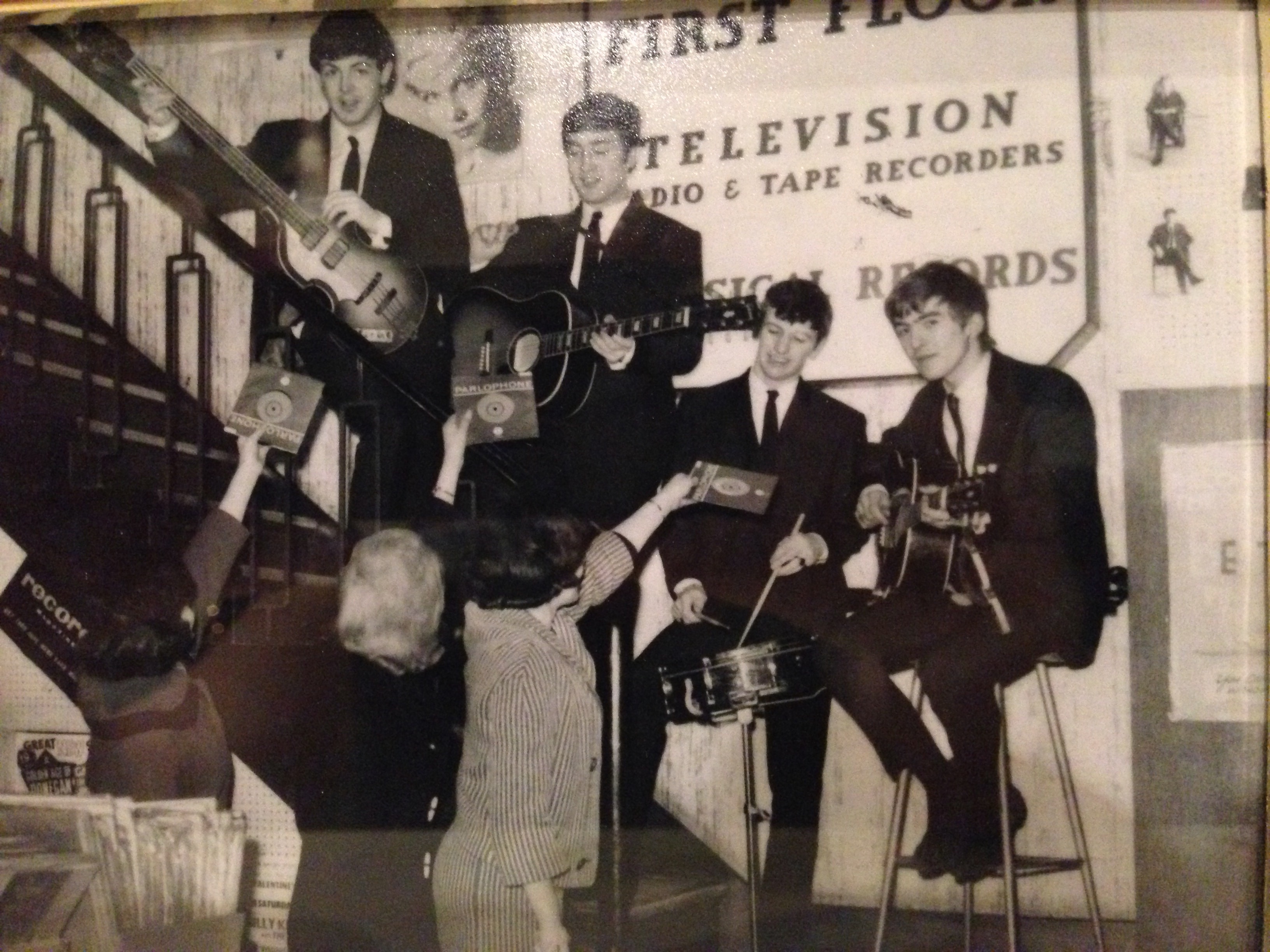
Photo: Freda Kelly circa 1962 (a gift to the author)