Let It Be

I write this evening from London on the last day of a short business trip. I am pounding this out on an iPad so it may be a bit less polished then some of my posts, but I want to share the passion with you somewhat unedited, while it is still fresh and resonating.

While here I enjoyed the tremendous experience of seeing the new Beatles revue, Let It Be, at the Savoy Theatre. The experience was full of wonder and magic, precisely the way music and theatre can touch your heart when you least expect it. The Savoy Theatre is an especially magical venue, one of the oldest working stages in London and the first public building in the world to be lit entirely by electricity in the late 19th century.

imageYes, it’s another Beatles cover show, like Beatlemania, like Rain, like so many appearances of The Fab Four. The lads appear in multiple costumes from the Beatles era, but are not allowed to call themselves The Beatles, nor use the names John, Paul, George, or Ringo. They refer to each other as The Bass Player or The Singer or The Drummer, and of course Billy Shears gets an appropriate shout out since he is a character of fiction. They start in black suits and thin ties, then put on Nehru jackets, then some colorful hippy fabrics, then the Sgt. Pepper Uniforms, then wilder hippy fabrics, then the John character in the white suit and long hair followed by the John character in the shoulder length hair, military shirt and sunglasses. You know the drill.

We open with I Saw Her Standing There, She Loves You, I Want to Hold Your Hand, then we’re off to Shea Stadium, then the Rubber Soul period, then Pepper, Magical Mystery Tour, Abbey Road, and we round it out with Get Back, the title number, and Jude. They don’t exactly go in order, more a thematic pastiche. There are television bits in the background showing black and white commercials of the nice lady in awe dropping the pearl in the Prell shampoo bottle, occasional blasts of Jimi Hendrix over Vietnam bombings, the marches, the flower posters, the peace signs, the weeping teens falling over each other in the stadium crowds—all of the familiar nostalgia that we have seen so often but still celebrate as boomers. No creative breakthroughs, no big picture inventions, no stagecraft of staggering originality. It was a concert of Beatles songs, two and a half hours with a break, four guys who didn’t look like The Beatles absent the various wigs, and the Paul character even played a right-handed (gasp!) Hofner bass.

So why was this show so different, so memorable, so moving, so unforgettable, so touching?

Two reasons.

For one, at half a century I might have been the youngest person in the audience.

The other, the audience was almost entirely British.

You might expect at a West End Beatles revue in London-town the show goers at a Saturday matinee might be mostly tourists. They were not. They were locals. They came to relive their youth, if only for an afternoon, and they loved every second of it. They were on their feet, they were twisting and shouting, they were dancing in the aisles, they clapped and sang along word for word, they echoed the chant: “All we are saying, is give peace a chance.”

No one in that room felt they were 60, or 70, or 80. You could not tell anyone in that room that this was a 50th celebration of anything. This was real, this was vital, this was now.

And this was British. Very, very British. Lovely, as they say. Brilliant.

Yes, the image of John in Central Park is literally chiseled in Strawberry Fields. Memories of George in Los Angeles recording studios are etched in our minds. Ringo and Paul sightings in the Hollywood Hills have become as natural as any other celebrity on the west coast. We share the music with the world, but somehow we came to sense that The Beatles adopted America, and Americans unofficially adopted The Beatles.

Yet they are British, beloved here in a way I never before fully understood or felt until I spent this joyous time with their countrymen. Their fans here are perpetual, like those who have shared Shakespeare and Dickens and even Lloyd Webber with the entire world. The creativity and inspiration that has flowed generation after generation from this island in the North Atlantic never ceases to blow my mind. The impact is astonishing, the consistency in trendsetting almost baffling.

The people here are exceptionally proud that so much of what has touched them has touched so many others all over the world. The Beatles are a part of them and carry their love to us in ways that words cannot convey. You simply have to be on your feet in the crowded room feeling the music penetrate your bone mass to get it.

You say you want a revolution? That’s a revolution.

Now back to a few words on age, which I think is what really brought that tear to the corner of my eye. When that Yellow Submarine on the scrim behind the band sails through the Sea of Holes and past the Sea of Time to the Sea of Green, something enduring becomes clear, almost too real. John was taken from us, and hasn’t been here since I was a freshman in college. I still feel that loss. George has left us, and my guitar still gently weeps. We graciously do have Paul and Ringo—Ringo is even opening an exhibit this summer at the Grammy Museum in Los Angeles. Two Beatles no longer living, but all four Beatles somehow alive.

And the fans, The Baby Boomers born between 1945 and 1964, each day a few more slip away. At the end of that tail, I have the least gray hair, some have all gray hair, some have no hair at all. When the Paul character sings, “When I’m Sixty-Four,” it’s the midrange of the audience. He was in his 20s when he wrote it. They were all in their 20s when they created that vast catalog of songs—not a bad one to boot—all in less than a working decade. Those songs remain as vibrant and relevant today as they were when we bought the singles on vinyl 45s.

How does that work?

The music keeps us young. The music compels us to stay young. When we hear and feel the music we have no ailments, no doctors to see, no life letdowns or shortcomings or missed opportunities. We are optimists with our lives entirely ahead of us, just as we were when we first heard the needle hit the record, pops and hisses, mono and stereo.

We remember all the lyrics, every guitar riff, where the drumsticks hit the cymbals, and when it’s time to harmonize on the refrains. We hold onto this because it keeps our youth, our joy, our hope. When you see an aging couple set aside their walking canes, swaying their hands in the air left to right and right to left on the final chords of Hey Jude, you know magic is happening.

Time travel is indeed possible. You are transported in mind and in toe-tapping body. The music is that perfect, that potent, that mystical, that important. It just feels that good.

We boomers didn’t get everything right. We know that. We know that peace and love and world harmony are still elusive dreams. The Beatles make it possible for us to feel those dreams anew, to be young in a way that is transformational, a dream as only it can be, a perpetual time to Imagine.

You can always see the clock ticking. You can always know what time it is. You can’t take away youth.

16 Things I’m Thankful For Right Now

Last year approaching Thanksgiving I reprinted an oldie which I had sent to a former office team a while back.  Your reaction was kind, and I don’t think I can do much better than that at the moment, but perhaps there is merit in sharing some items that are currently giving me reason to smile.  Here without extended preamble is the short, unscientific list:

1) We live in a representative democracy where the peaceful and orderly handoff of authority is presumed.  As an aside, call me an optimist, but I’m spiritually betting we don’t swan dive over the Fiscal Cliff.

2) I get to write and publish this blog.  I can pretty much say anything I want without fear of disappearing into the night.

3) Diversity is cool, and increasingly, the law.

4) This year I got to celebrate my Dad’s 75th birthday with him, something he didn’t get to do with his father.  And I got to write about it.

5) My brilliant wife’s magical work teaching English as a Second Language and helping immigrants prepare for their American citizenship exams endlessly reminds me that one person can make a difference.

6) I have never run out of reasons to listen to The Beatles, and each one of their songs still makes me wonder how they pulled off that catalogue in less than ten years.

7) Yosemite, just Yosemite.

8) My dog may not see as well as she used to, but somehow she still has plenty of puppy in her.

9) The Giving Pledge will not only fuel a previously unimaginable wave of charity by choice of living billionaires, it can inspire everyday people to give what they can and know each dollar matters.

10) Frank McCourt has been extracted from ownership of The Dodgers and Chavez Ravine has survived as sacred ground.

11) Good health for those who have it.  More help for those who need it.

12) I received a generous inflow of emails this past year from former employees telling me how they are still making People-Products-Profits-In-That-Order work hard for them.

13) There is little chance I will run out of interesting stuff to read in this lifetime, new modes to ingest it, or social sharing networks to circulate my discoveries (the trick is not getting distracted by dreck).

14) I have completed a working draft of my novel, which a few of you have even read, and at last connected with a brilliant editor who totally gets it and can help me get it in front of more of you.

15) With modest prodding, yeast consumes sugar in harvested grapes, and with a few artisan touches the juice becomes wine — so much so that two glasses are never the same.

16) The candle count on your birthday cake may be daunting, but the brightness created by all that light does make it easier to see a bit better.

Happy Thanksgiving 2012.  Celebrate the joys that are yours.  Earn Each Moment.

Dodging The Greatest Hits Graveyard

I’ve kept a frequent presence at rock concerts ever since I was a kid. Back in the day, live rock and roll shows were reasonably affordable—even if you did have to sleep on the street to get tickets—because bands toured in support of the latest record they had produced. Live shows were a catalyst for selling singles and albums, pushed local radio play, sold t-shirts and memorabilia, and paid for the road antics of the bands who could live and party on “permanent vacation.”

The concert world today is obviously different because the ecosystem is so drastically different. There are still monster arena tours like U2, Springsteen, or the Rolling Stones 50th (gasp!) corporate sponsored anniversary. There are small gatherings of devoted fans at venues around 5000 seats for tireless road warriors like Cheap Trick or Chicago. There are nostalgia plays in casino showrooms or destination bars with one or two surviving members of one-hit wonder acts. And there are tremendous new stars like Adele who play the old game a new way and can still fill amphitheaters at top prices, sell plenty of music downloads, and inspire faith that the CD has a tiny bit of life left for the bygone tribe.

What I have noticed over the course of this music evolution is the underlying key to longevity and not moving down the food chain hasn’t much changed—the survivors tend to deliver a healthy balance of old and new material. This is no small problem, as the fans who come out to concerts are no doubt screaming for an artist to play their big hits. It’s natural. It’s satisfying. It’s a trap.

TSO2005A few weeks ago my wife and I went to see one of our favorite groups, the still somewhat niche band Trans-Siberian Orchestra, best known for their annual Christmas shows and the ever-present holiday single, Christmas in Sarajevo. TSO blends heavy metal power chords with classical music and electric violins, usually with an interspersed layer of spoken storytelling. Several years ago they started branching out from Christmas themes, recording and touring a fantasy tale called Beethoven’s Last Night. This was the first time we had seen the show performed live, and while it was familiar to us, it was not well-known to much of the devoted audience. That was pretty brave, I thought, to tour a concept album that was not necessarily top of mind with their audience, but then they did something I found even more courageous. Toward the end of the show, when they had finished playing Beethoven and the audience expected they would play some oldies, they instead played several entirely new songs that had not even been released online. No one had heard these songs except those who had seen the tour, and the applause following was as you might suspect a bit tentative. The nervous quiet during these songs was not because they were bad, it was because they were new. If you are a regular on the live music scene, you know that awkwardness—but without it, there are no new hits.

New music has to be debuted at some point, that’s why it’s called a debut. Audiences can be very tough on new songs, they pay good money to hear hits and the survival of any act is contingent on meeting the expectations of fans. Yet long-term success is equally contingent on innovating, and facing an audience with the unknown or unfamiliar is always a daunting prospect. Who would willingly trade thunderous applause for quiet, polite clapping? The greatest acts know they have no choice.

Most of the hot Top 40 bands in the 1970s and 1980s would periodically release Greatest Hits albums, mechanical collections of their charting singles, usually pushed by their record labels for bankable cash acceleration. Some of these became all time bestsellers, notably The Eagles and Elton John. The question I always used to wonder when I handed over my cash for a dozen song vinyl collection was whether this was the end of the band or the beginning of a new chapter. For too many, we know how that played out, and we know where those bands are playing today, if at all. A Greatest Hits or “Best of…” album was easy money, the equivalent of predictable thunderous applause. Pushing out new work would remain the heart of risk, and the genesis of going to the next level.

Nothing about this cycle is unique to music. Business is the same, especially technology wrapped as consumer products. You need to play to your familiar success, the current incarnation of your brand, but the moment that catalogue is fixed, you’re doing dinner theater rather than headlining at Carnegie Hall. Think RIM with the standing ovation worthy Blackberry, Kodak and Polaroid with endless scrapbooks of silver snapshots, perhaps now Best Buy longing for a different curtain call than their former contender Circuit City. They all climbed the charts, but staying there remains a different story.

Steve Jobs liked to say that he never believed in focus groups, because it was not the job of customers to tell you what they wanted—how could they know what they wanted when it hadn’t yet been invented? No civilian could concretely describe iTunes, the iPod, the iPhone, or the iPad prior to their release. You can only imagine how many pundits prior to the success of these inventions could tell you of their impending doom solely on the basis of unfamiliarity. Of course Apple never stopped marketing its core line of computers during this unbelievable expansion of reach, they were still playing hits while composing new material and seeding it to the faithful, those with whom they had established profound affinity and could ask to trust them further with the unknown.

I also don’t think it is a coincidence that Steve Jobs was a huge fan of The Beatles, who in an active career that spanned all of about eight years never stopped putting out new material, took themselves off the road to focus on composition and the creative process, then reinvented their sound with almost every album, including a few radical pivots like Sgt. Pepper. Is it counter intuitive that the actual career of The Beatles was so short despite all that new material and no Greatest Hits collection until after their break-up? Possibly, but if impact is the name of the game, it is hard to dispute that The Beatles succeeded most of all at avoiding that most dreaded of dead-ends, The Greatest Hits Graveyard. Their incomparable legacy remains vibrant because they pushed themselves so hard to be innovating all the time while crowd pleasing.

Celebrated descriptors like “Built to Last” and “Good to Great” are hard-won praise tied to nimble companies for navigating the same difficult balance for so many years of reinvention. It’s a lesson in courage and vision that is as difficult to learn as it is to replicate, but it is that very bravery that can guide any individual career from ordinary to enviable. Facing the anxious reception of the untried might not be pleasant when a clear alternative is available, but it’s the only trail that bypasses the one-hit wonders.

Like Is Not Enough

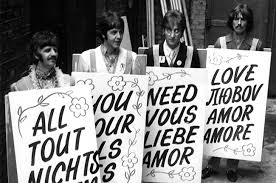
AllYouNeedAll You Need Is Love” — Lennon/McCartney, The Beatles

Facebook over the past several years has done the unexpected in creating exponentially vast usage of the noun/verb Like. This has been fun for those of us who indulge in broadly stamping our personal approvals on anything from a friend’s single syllable utterance to the launch of a new wave of flavored taco shells. Some argue the Like button has diluted the very significance it is meant to convey by spawning misguided promotions to increase click tallies, while others maintain it is the metaphysical fuel that rocketed Facebook into the stratosphere as the place advertisers have to be to mine explicit commendations. Regardless of the ultimate conviction it conveys, Like is an ultra easy way to express a soft high-five in public without any substantive commitment, and if you change your mind, you can Unlike something just as quickly.

While the full measure in a Like action remains on the light side of hand-waving, for marketers it can nonetheless provide an easy litmus test to note directionally if their intended messages are registering at all. Registering is not necessarily resonating, but it is a decent stride across the starting line. Getting someone to Like your brand for the long haul—on Facebook or along the purchase funnel—will never be a small task, but my sense is there is one constant in consistent success: For star marketers to get a Like, they must first Love.

I wrote about a similar topic not long ago in a post about eating your own dog food, where I suggested if you don’t use your own products, how could you expect anyone else to pay you for the privilege. This is a tangent to that thread, where of late I have observed entire marketing teams dogged by cynicism. They are charged with brand evangelism, but in their own minds, they are either not engaged in the true value proposition of their products and services or they have given up on their own futures, proclaiming themselves victims of an ice age they believe is imminent and unavoidable. I believe we often refer to this malady as the self-fulfilling prophecy.

Recently in a meeting with a team of executives who had invited me to help them with some seismic strategic planning issues, I noticed a through line where all of the many accomplished marketing executives in the room found a way to get on each other’s bandwagon, lamenting that their company’s future was not bright. I thought this was simply a down cycle in the conversation which is normal in brainstorming, but the negative energy was a contagion. Here we were, charged with helping reinvent the company, a blue sky path to infusing new levels of Like into brands that were already broadly embraced, but no consensus was emerging on how past Like could become new Like, or dare I say it, Love. As an outsider, I saw that their brands were certainly challenged in the market place, they had seen some decline, but they had in no way collapsed. Yet here the brand stewards being paid quite well for their presumed passion had convinced themselves their brands were dying—a sickness that was terminal and could not be reversed. Where I really got myself in trouble was asking the team how many of them still loved these brands. The rest of the assignment was awfully quiet.

If a brand steward does not start the day in Love with a brand, by the time that apathy translates and diffuses itself into a campaign of communication tactics, Like is not going to be there with the public. Better the executives hand in the baton and give the assignment to someone else who might find a way to convince themselves there is light ahead, yet throwing yourself on the sword for lack of conviction is not a road well-traveled in business. Instead it is likely that these brands will die, even though they could fight on, because no one behind them has the Love to fight. I wonder if the CEOs at the top of these companies know their chief lieutenants have already surrendered to creative destruction rather than rallied to next generation rebirth. Even if the beaten executives are right and the brand is destined to die, shouldn’t someone else who doesn’t believe that be given the chance to prove otherwise—to try with honest enthusiasm to wrestle imagination and go a different route that might just work despite the naysayers? Perhaps some of the CEOs are biding time as well, but my sense is most of those wouldn’t last too long in a board meeting. Love has to be real, and it has to start at the top.

Can someone in a marketing job walk away nobly from a lack of Love? Sometimes I think it is necessary and essential. A very successful friend recalled for me recently how early in her career she was working for a multi-national corporation on a vastly successful billion dollar brand that had of late stalled in its growth, years after it had gone wild and saturated market share. The team brainstormed and came to the conclusion that to reignite growth, marketing programs would have to implicitly suggest that the brand being marketed met the needs of a more healthful alternative already for sale, and that by shifting use from the believed healthful product to the growing brand, nothing would be lost and everything would be gained. Mind you, nothing illegal was being plotted and the campaign would by default have to meet truth in advertising laws, but the very idea that the only way to grow the brand was to pull attention from a more healthy alternative did not sit well with my friend. She understood the strategy, but she fell out of Love, and even out of Like. She did the right thing and left the company. Today she runs her own company and I can tell you this—she Loves her brand.

Remember this: a brand is not a logo or a trademark or a pithy name—a brand is a promise. You can stop loving a product line because it needs to change, indeed loving a product line too much can be a trap, but products are directed to evolve because loving the brand is a driving force. A brand is a set of choices that begins and ends with meeting customer needs. The branding process begins with ideation, continues through product development, then translates into communication (these days bidirectional feedback loops, like we see in social media, more than soap box broadcasting) and ultimately does or doesn’t result in customer loyalty. When you make a promise to your customers, you are obliged to make good on that promise. My sense is for that to happen repeatedly and predictably, if you are part of the creative cycle, you must Love, Love, Love your brands. If you don’t, no one else will.

If for some chronic reason you’re convinced a brand truly is at end of life, the right thing to do is protect working capital and advocate to take it out of commission mercifully. It is wrong to shovel high-priced coal into an engine you believe will no longer run because you’re pretending to believe a directive handed down that you knowingly disavow. Don’t try to fake it! If you don’t Love your brand, go find another that you can Love. If you are biding your time waiting to be found out, don’t worry, you will be found out. Your customers will do that for you. You need their Like. They deserve your Love.

Love, Love, Love.