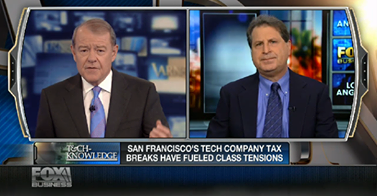
 Last week I was invited to appear on Varney & Company, the midday (EDT) market commentary on Fox Business Network hosted by Stuart Varney. It was an opportunity to talk about my novel, This is Rage, and how some of the themes it encompasses apply to current tensions in the Bay Area around affordable housing, income inequality, and the more heated rhetoric of late around our ability to discuss and resolve complex social issues rather than pour rocket fuel on the fire pit.
I didn’t think the live TV interview would be a walk in the woods, and to be honest, I’m not unhappy with it. Varney said what he had to say, I said what I had to say, and I appreciated the near five minutes on-air to promote my book. The strange part for me was what followed. Here are a few of the tweets:
U VILE SOCIALIST COMMIE POS I FELT RAGE WHEN U WERE TALKING!
U R a SOCIALIST donkeyshit4brains COMMUNIST traitor U DO NOT BELIEVE IN CAPITALISM OR LIBERTY I wanted to reach thru screen n STRANGLE your ignorant ass!
Ken is a fool – his comment that if you are rich you should be happy to pay whatever is asked of you – priceless!!
And this comment, posted on my Amazon page:
Saw Goldstein on a Biz program and turns out he’s just another Jew who believes government is not stealing enough from us. Why are so many Jews of this collectivist mindset?
I am not sure what I said to upset those people to that extent, nor did I go on the show to talk about tax policy. My point was rather straightforward: when you hear an outcry, listen, and before you dig in your heels and fan the flames of a conflict, ask yourself if there is something you can do to ease the tension. I do think the repercussions of widening inequality will continue to be severe, not only on moral grounds but in the name of good business. Historically it has been the buying power of the middle class that fuels corporate earnings, and that middle class can remain strong only if income levels do not further polarize. To know my career history—which was strangely not mentioned in the introduction to the piece, though I was carefully vetted for my credentials prior to the interview—is to know that I believe in our capitalist system and have been a fortunate beneficiary of investment and free-market economics. Were Varney and I really that far apart, or were theatrics applied to make it seem we were further apart than we were? Once I was labeled an outsider in the Fox system, was I simply fair game for rejection by the loyalist audience?
You have to wonder, if someone disagreed with my point of view, would it be ludicrous to expect a tweet like this from a genuinely concerned observer who might even choose not to remain anonymous:
Ken, rent control is not a solution that works in our economy, let the market decide prices or the system will fail.
Of course it would be utopian to expect that kind of exchange, but perhaps it is not meant to be by media design. Ratings follow the heat, and there is more viral value in stirring the pot than in civil discourse. As I explore in my own book, controversy can be a form of currency, whether organic or invented. If you don’t want to engage in the brawl, your voice may willingly go unheard. A recent piece in The Atlantic by Jon Lovett entitled “The Culture of Shut Up” noted the following:
The bottom line is, you don’t beat an idea by beating a person. You beat an idea by beating an idea. Not only is it counter-productive—nobody likes the kid who complains to the teacher even when the kid is right—it replaces a competition of arguments with a competition to delegitimize arguments. And what’s left is the pressure to sand down the corners of your speech while looking for the rough edges in the speech of your adversaries. Everyone is offended. Everyone is offensive. Nothing is close to the line because close to the line is over the line because over the line is better for clicks and retweets and fundraising and ad revenue.
Lovett’s concern is that much of the manufactured outage emanating from entrenched media verticals aimed at driving inflamed social media response is antithetical to the free speech it is supposed to represent. I think he is onto something. An awful lot is being said, but how much of that speech is being crafted in considerable thought? If you do have something you feel is important to say, how willing are you to say it in a public forum if you know only seconds after the words leave your lips, strangers are at the ready to attack you, your character, and implications in any spontaneous string of words that may have slipped through your lips without the imposition of editing?
You bet, it’s scary. Want to know why a lot of people who might be good at public office have no interest in running for election? You must really have the courage of your convictions to say anything at all in a public forum, then have blubber-thick skin to weather the attack, and then the media-training skills to know when to hit back and when to walk away. Should the vitriol boil over, you might also worry whether any of those words could become expressions of violence, which curiously enough leads back to the very subject of my appearance on Varney: the outcry of people in the Bay Area being priced out of the housing market. Varney asked me whether this might become physical, to which I replied, I hope not. Some of it comes down to whether anybody is really listening to the authentic outcry, and whether they are playing it back as a media sound bite to amp up their numbers.
Can we have an intelligent discussion and debate about inequality in this country without throwing out memes like “class warfare” and “tax-the-rich socialism”? I think so. I like investing, I like motivating talent to achieve heroic goals, I like serving customers, and I like the longterm rewards that come from years of hard work. I also maintain a sense of empathy for those who are down on their luck, for those who are not in the right place at the right time, and for those who try hard but nobly fail at any endeavor. Are those radical views that cannot be reconciled when we talk? Well, if they can’t, maybe we shouldn’t talk. And there goes free speech.
When I sat in the little windowless room waiting for the prompt in my ear bud for the first question from Varney, I wasn’t thinking about tweets or memes or nasty reactions to my words. I was thinking about what he might ask me, and what I might say, and whether I would come across as credible. Maybe that was naive. Maybe I should be more worried about trying to exchange ideas where the intersection of those ideas is more valuable than what either of us might devise on our own. I had asked my dad the night before how to handle the interview if it got tough. He told me to just be myself. I think that was good advice. That’s who you see on the video. I’m okay with that.


 CorporateIntel