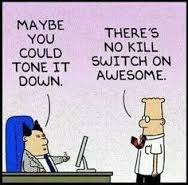
 It’s a new year. With another trip around the sun completed and ahead, we mortals often go to our cabinets to withdraw the long-procrastinated projects we someday hope to deploy. In that revitalized spirit of invention, people often ask me for my opinion on this or that idea. Often it’s a start-up business idea. Sometimes it’s an investment opportunity. Occasionally it’s a request for feedback on a manuscript. I’m sure you’ve been asked to be a sounding board for similar notions and found yourself in a similarly awkward situation.
“Hey, mind if I bounce something off you?”
I usually respond, “Why do you ask?”
You may ask yourself, Why does he ask the question “Why do you ask?”
My question to your question is born of its own overarching question: Do you really want feedback, or do you just want me to tell you that what you are pitching is wonderful?
Yeah, you’ve been there. It’s a tough place to be, because it’s impossible to be sure what the other person is actually seeking. Is the seeker in need of a boost of self-esteem, where anything critical you offer is likely to triple that person’s therapy bills and end a rebound before it finds form? Is the pitch-person stealth-seeking your financial commitment, where any positive response on your behalf will be followed by a deal memo solicitation at a valuation that would make the Uber people blush? Is the ask truly heartfelt but the work so early and unedited that it could be more harmed than helped by a random response?
It’s not easy to offer an opinion on someone else’s work. Way more can go wrong than can go right.
I tend to find that most people who ask for my opinion don’t really want feedback. They want validation. If you’ve partaken in-depth of the creative process, you know they aren’t the same. Validation is net neutral. Feedback can save your ass.
What do I mean by that?
Validation is a bifurcated switch. If I say the work is good, you’ve heard all you need to hear. If I say I don’t think it’s good, you’ve heard exactly what you didn’t want to hear. The effect is net neutral because either way I have added no value to your project. If I say it’s good, so what? You already thought it was good or you wouldn’t have shown it to me, so I’ve done nothing but increased your standing bias. That takes you nowhere you couldn’t have gone without me. If I say it’s bad, we may no longer be friends, not because I don’t want to be friends but by being honest (even if diplomatic) I have likely hurt your feelings. There isn’t much positive energy that can follow.
If feedback is what you seek and I have any grounded expertise to offer, then perhaps we have a place to go together. That feedback is almost certainly going to be nuanced (“this part makes some sense, that part not so much”) but it has to come your way without consequence to me or expectation of a secondary agenda that involves me. If I want to get involved, I promise I will let you know, but the act of giving you feedback should be reward in itself. That means you have to enter into the feedback discussion with an openness to critique solely because you want your idea to improve, or perhaps decide instead you don’t want to waste any more time on it. There can be no ulterior motives or it’s not feedback, it’s evaluation. I don’t want to evaluate your work. That’s your job, not mine.
As an author, I seek feedback constantly. When I draft something, I always go out for feedback from a broad sample of demographics. When I get good feedback it can be life-changing, because anything that I have missed and you found I can fix. Is it painful? It’s horribly painful. Yet even worse than negative feedback is the silence of no feedback from someone who said they would offer it. That tells me with uncanny certainty that I have failed to connect with their voice. Do I regret asking? Never for a moment.
As much as we dread feedback, we actually should cherish it, because it is the only path from mediocrity to something that matters. The creative process is laden with setbacks, but each time we find a nugget of corrective action, we can improve. That’s what makes the creative process both daunting and healing. It is the reality of success quantified one fix at a time. It’s never fun to edit away what doesn’t work, but that’s how innovation at its finest evolves. There are no shortcuts. If you ask, be sure you want to listen for the answer. It may not be pleasant, like medicine, but hopefully it makes us better one way or another, if it’s the right medicine.
Most people don’t know how to give useful feedback, especially tough feedback that can help us improve our thinking or channel it to more productive ends. Words of validation or invalidation are relatively easy to render and equally useless. Offering consistently constructive feedback is an art. Be careful whom you ask to help you, or you can really go astray.
If you don’t want feedback, don’t ask for it. If you ask for it, don’t be defensive when you get it. If you don’t ask for it, you probably will never reach your potential. If you do embrace it, you can make a small idea become a big idea. A big idea becomes something tangible when we add the necessary recourses and fight past the objections readily available from amateurs. Those who embrace feedback are resilient by nature. There is power in vulnerability. Embrace it, and the sky is the limit.
Do you still want my opinion? I don’t mind if you say no, but if you ask carefully, I’ll try to answer in the same honest spirit.
# # #
Author’s End Note: It’s been hard to write about anything other than Trump the past year. I am still aghast at what has happened, but I am forcing myself back into more diverse subject matter as sanity demands. With my third book now in first draft and about to go into the editing process, I find my love of words never more pronounced, but never more conflicted. It’s hard to write about normal subjects in a world where nothing I once considered normal ever will be again. It is impossible to think about characters more outrageous than the strange ones emerging on the stage of reality. Regardless, I am committed to diversifying my output in continuing this creative journey we began together. I’ll still write about Trump when I must, but I promise you I will pursue more interesting material, if only to prove that he hasn’t won. Stay with me, and I’ll stay with you.
____________
This article originally appeared on The Good Men Project.
Image: Dilbert.com ©Scott Adams


 CorporateIntel