On Polarization

In my last post I suggested that a good product development process was not democratic, it was the product of clear leadership, shared vision, teamwork, and consensus building.  Given the unacceptable performance of our elected leaders currently chewing up news headlines, I wondered what application effective free enterprise might have on the product development process that is democracy.  What can we expect of democracy in the laws and policies it creates if we think of that enterprise as group of employees whom we fund?

Imagine working for a company where you were assigned to solve an extremely difficult, hugely complex, mission critical project, and the best your team could come up with was a status quo stalemate where almost any way you projected various outcomes of the stalemate, the company was doomed to failure.  Because of the stalemate, you were more concerned about whether you would have a job when all was said and done than whether you helped your company make any progress solving the problem.  Your supreme tactic would be to blame the other side of the stalemate for the stalemate, and hope that enough people believed your story rather than theirs so that you survived and they didn’t.

Then the proverbial *$&# hit the fan.

Would this somehow be a justifiable position?  Ethically, emotionally, or logically?  Would you feel good about yourself, that you had acted within the bounds of expectation for which you had been given authority?  Would you really think you were safe from the temporarily ducked wrath of those who put you in the job?

I don’t think so.

Ringing any bells?

It is essential that we always remember in a democracy the government works for the people.  That’s makes every taxpayer an employer, since we fund the operations of our elected officials and those they appoint.  Think of yourself as a traditional employer.  If your employees were acting in the way our government is acting — posturing and manipulating and behaving with a level of dysfunction that would never be acceptable in any corporation — would you continue to tolerate it?  I would not.  I would demand cooperation, collegiality, collaboration, and progress.  Most of all, I would insist on honesty over spin, humility before ego.  That is only right in exchange for the trust of authority, plus salary and benefits.

How do we lose sight of this?  Because we fear government?  Because we don’t understand government?  Because we have become cynical and weary listening to rhetoric in all the media channels it now flows, endless noise absent of substance that drives us to the refuge of silence?  Because we are overwhelmed by the process of government where change seems so elusive we find it less painful not to engage than to engage?

Hegelian dialectic encapsulates a framework where the evolution of ideas and events is resolved through history in a process of thesis meeting antithesis resulting in synthesis.  Any reasonable person can understand this even if he or she has never heard of Hegel, who may be attributed disproportionate credit for the model.  The concept is as much observation and interpretation as it is construct, opposing opinions are always present and result in outcomes, intended or not.  Nation A and Nation B do not have a shared belief set.  If they resolve their differences amicably, change occurs.  If they do not resolve their differences amicably, they go to war.  One point of view slams into another point of view, one largely prevails, and change also occurs — much of it unpredictable.  We can only hope that the change is for the better, we cannot ensure it.  Consider the consequences of knowing attempts to drive change for unsound motivation — we get what we get.

We know that change happens when the pain of change is less than the pain of staying the same.  If we accept the status quo of the current process, the pain will remain.  If we demand better, we will get it.  Self-serving entrenchment is not a strategy of public service, partnership is.  This requires more than a letter or two to our elected officials threatening the loss of your vote, it requires a consistent communication loop that makes our expectations of consensus building a mandate, a necessity rather than an abstract goal.

It is an honor and a privilege to serve in elected public office, not an entitlement and in democracy not a power grab.  It was never meant to be a career, it was meant to be an opportunity for those with some hard-won bits of knowledge, experience, and wisdom to give back to the community through a period of public service.  That is the beauty and brilliance of representative democracy, the leadership is expected to evolve and turn over specifically for the public good.  When we all forget that and allow the political landscape to exist as an ecosystem unto itself — an inorganic bureaucracy that feeds and fuels its own self-aggrandizing perpetuation — we abandon good business practice and invite shenanigans.

I don’t expect the government to make a profit, it is a service organization meant to be self funding for critical needs, thus the true practices of free enterprise cannot apply.  Yet the basic behaviors and expectations of executives and managers that any responsible and passionate business owner or employer would demand must apply, or dysfunction will continue, and the business owners will suffer the consequences.  If you have ever been part of an enterprise where management allowed dysfunction to take over, you know how quickly the tables can turn and the potential devastating outcome.  It can happen quickly, without enough warning, and without a path to correction.

We all learn in grade school that the framers created a series of checks and balances specifically to ensure that one set of ideas did not permanently crush another.  However they did not design our legislative product development process so that it would bring stagnation and impasse, anymore than a business would want checks and balances to impede innovation and growth.  Ronald Reagan and Tip O’Neill showed us just a generation ago that we can have our cake and eat it too, so there is a proven model in recent memory.  We need to embrace that now or we all lose.

Good managers do not leave the most important problems to the last second.

Good managers appreciate the differences in the points of view around them and strengthen their outcomes with a mix of ideas.

Good managers talk to each other, not with poorly staged sound bytes to third-party forums to relay messages to each other.

Good managers put the enterprise and those they serve first, their teams above self-interest, and only accept reward when those conditions are met.

This isn’t hard, it is standard operating procedure for anyone who has ever worked in an important company role under time sensitive and otherwise impossibly difficult circumstances.

Demand better as an employer.  We deserve it.  We’re footing the bill.  This we have in common, all of us.

Product Development is Not Democratic

Following up my last post on the scarcity of successful internet brand turnarounds, I had a number of interesting discussions with colleagues in search of the answer why. While it would be impossible for me to boil that down to a single concept in a single blog post, the common theme seemed to be the extraordinary difficulty in reinventing the key products or services under a once a powerful but now fading brand, such that the new offerings were up to the standards of the original breakthrough experiences.

Digging deeper into this theme of why a brand that was created of innovation could have such a hard time finding reinvention in subsequent cycles of innovation, the culprit fueling failure often found the compass needle pointing at process. Where some form of good process once allowed staggering creativity to flourish, failure to reinvigorate good process most often led to uninspired product development, lackluster offerings to customers, and ultimately a continuation of the downward spiral where a turnaround was the hope. Called out for especially pernicious result:

1) Tepid Innovation—believing that a little idea was a big idea almost in desperation for lack of identifying a big idea. Copycat products that responded to market leaders to segment small bits of their commanding market share consumed energy where market leading ideas remained in small supply.

2) Lack of shared vision—weak leadership failed to articulate a big idea around which teams could rally, so buy-in became compelled rather than organic. Empowering strong leaders to lead is not often enough a company’s core competency, because truly creative rebels don’t want to be managed, they want to be sponsored, so that they can make change happen in cultures that prefer conformity, and conformity is not how you win market share. When the right leaders are chosen and empowered, they can build a shared vision by leading, not managing.

3) Corporate intervention—a young company acquired for its Think Different mentality and bold new ideas becomes indoctrinated in the prevailing corporate culture of the parent, and begins to see the world through the lens of the acquirer rather than for the reasons it was acquired.

4) Lack of listening—there is no longer a measurable correlation between time on the job and quality of concept. The youngest arrival in a company may just have the best ideas, but if there is no forum for real listening and discussion, the most creative voice can be too easily silenced.

5) Marketing/Engineering Wars—rather than partner, the two necessary sides of the winning formula argue for the sake of winning the argument. They forget what it means to win—that their competition works at another company.

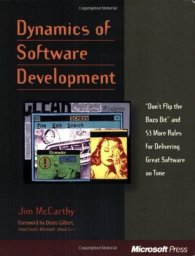
Dynamics of Software DevelopmentMany of these themes are explored in the brilliant and surprisingly nontechnical book Dynamics of Software Development by Jim McCarthy, which I have encouraged every senior executive I have met to read as well as every staff leader I have mentored. In my experience the core issue comes down to learning how to build a consensus, understanding that consensus building is not polling or voting or majority rules. Product development is an expertise, like any other profession. Many individuals can learn to do it adequately, but few can do it extraordinarily.

Look at some of the new wave of great companies and you see the top-tier of product development pros at the helms: Mark Zuckerberg, Reed Hastings, Elon Musk, Reid Hoffman. Of course those are all CEOs of substantial, important, disruptive companies and they are not available for brand turnarounds at internet companies on the rebound, but the question remains, are the people being put in charge of turnarounds somehow similar in nature and characteristics to the great leaders of product development? Are they able to articulate a vision around which people can rally willingly and with trust? Do they listen to a multitude of opinions and then make decisions that incorporate feedback because it is critical, not because it represents a political agenda? Do they have good taste, and can they see beyond the state of today to leapfrog a competitor with perhaps something that didn’t do well in a focus test? Have they built a process in their environment where good work can shine and fast iteration can overcome mediocrity in rapid succession?

Consensus is an astonishingly complex concept; it is not at all compromise. It begins with vision, It is evangelized through leadership, It becomes stronger through group participation and feedback, but it is guided to completion by the same vision and leadership from which it emanated. Consensus goes off track when a leader feels for whatever reason that bits of all contributions most be included to create the consensus, the proverbial camel with two humps. That is wrong, because all comments and critiques will not be right if breakthrough products are your goal. Group participation is a must to achieve organic buy-in, listening is a must for a leader to bypass being feared as a despot, but for great product development to triumph, a vision must remain strong, pure, unique, original. That can never be taken for granted, and everyone on a team will not always be happy at every twist and turn. Yet if you have ever had the privilege of working on a world-class, game changing product, you know that most sins are forgiven when it all comes together through good process, and it does not look anything like the system of checks and balances we see in representative government.

Product development is driven by a different motive set, of creative destruction and inspired disruption, a high stakes arena where often winner takes all, second prize means you go home. Democracy does not work there, and democratic compromise is not workplace consensus. Show me a great product, and I know you will find iteration, but I bet you won’t find haggling.

Vision is what launches a brand. Vision will always be key to reinventing a brand. Process is the key to translating ideal vision into working reality. Consensus is the element of process that gets everyone on a team to remain part of the team, because success is owned by the team, not by its individual components. Get most of that right and product development has a fighting chance, and so might reinvention.

Fleeting Moments in iHistory

Why don’t internet brands make comebacks?

myspaceWith the recent attention on onetime market leaders AOL, Yahoo, and MySpace to inject new creativity into their platforms, I have been talking with a number of people about why this notion isn’t business as usual, with the expectation that success is much more probable than unlikely. We are so quick in the internet age to exchange snarky remarks about last year’s fading nameplates, as if it were all but inevitable that a fallen giant cannot get up and march on. Why?

Well, aside from our gossipy predisposition to critique, there is a good reason we take a skeptical point of view about internet brands that have seen better days—in almost all cases, those were their best days. Major turnarounds don’t seem to be the norm. Sadly, they don’t seem to be out there much at all. We can point to several works in progress where noble efforts are underway, but we can’t really write a business school case study on a revamp that is making history and ripe for the textbooks.

Although this is reality, it does not make sense, certainly not good business sense.

Most traditional brands go through life cycles: they are cool for a while, then something inevitably goes wrong—operational mishaps, disruptive entrants, or market forces—then visionary management attacks the problem and turnarounds do happen, sometimes monster turnarounds. Think about what happened with the rise and fall and rise of Disney, the same but even more so at Apple, the customer win back at Coke after the public rejection of new-Coke, multiple cycles up and down at Sony, the same to a lesser extent at MTV. All of these instances gave management—often new management—a starting point for the very real consideration of turnaround plans. Management carries out the traditional SWOT (Strengths-Weaknesses-Opportunities-Threats) analysis, and the discussion centers around how probable the turnaround plan under consideration might be, not a passive discussion of should we bother. You always bother.

Look at what happened at the Wall Street Journal—newspapers have been pronounced on their way to the graveyard, but the brand has never been stronger and circulation is growing on multiple platforms. That is giving the New York Times hope, the Los Angeles Times as well. You always try because the asset you have is too valuable not to try. CBS, NBC, ABC, HBO, they all have good and bad seasons, but you don’t think about walking away after a bad season. Look at MSNBC, how it struggled out of the gate, now it has an identity. Sticking with an established beachhead can work, surely not all the time, but there are so many examples where the uphill effort is proven to be worth it.

Like internet brands that have enjoyed success, non-internet brands once in the limelight come to the outset of a turnaround with some remaining loyalty, mass reach, measurable unaided awareness, and some core value proposition. The fact that tastes have changed or tactics have failed doesn’t mean you have lost everything; you just have a lot less of it. You have something to work with, so you don’t walk away. Your investors would not be pleased with those kinds of write downs.

Let’s think about the dotcom bubble and all the brands it birthed, starting with the portal wars—Excite (then Excite @Home), Lycos, Looksmart, Infoseek (then Go.com)—they all had huge followings! Now they are answers to trivia questions. What about Friendster, eToys, Netscape, NeoPets, Encarta, GeoCities, Pets.com, Webvan? These were all massively attended internet destinations, great names with tremendous followings built on innovation and creativity. Was there really nothing better to do with their identities than turn away?

I started to wonder whether our relationship with brands today is somehow different from our relationship two, three, four decades ago. Were we somehow more willing to give brands a second chance then that we are not now? Is this generation of consumers somehow wired differently? Have we come to a new understanding of inertia so that once cold something must stay cold? That would have been an easy answer, but one trip to the Apple Store will change your mind quickly. Spend a little time in the store with the other customers and you will soon be reassured how much a once loved, then dismissed, then reinvented brand can be loved anew. Ask tweens about Disney Channel, which they never would have been caught dead watching a generation ago, but now it too has been reinvented to become a trendsetter.

Brand laws may evolve, but they haven’t died.

What seems most ironic to me is that when you look at the giants of brand reinvention, the core turnaround strategy is not financial engineering, but rediscovery of the company’s roots in innovation. Disney expanded its theme parks, its own hotels, rebuilt its animation efforts, created the Disney Store, and rode a wave of home video before acquiring ABC and later Pixar and Marvel. Upon the return of Steve Jobs, Apple pioneered the iMac, then iTunes, then the iPod, then the iPhone, then the iPad, all the while building out the Apple Stores. Microsoft from a standing start entered the entertainment world with Xbox, as Sony had done prior to that with PlayStation. Clearly these involved massive investments, but they were bets on products and services, new ideas from talent and passion within the company.

Can we imagine a day when Google, Amazon, eBay, or Facebook are no longer top of mind with consumers? What about Netflix, LinkedIn, or YouTube? If history is a guide, it is entirely likely one of these or another equally strong internet property will fall out of favor. Are we likely to see it left to harvest? I would bet 100% the answer is no. Reinvention will be the order of the day, and revitalization will follow with new products, new services, and creative marketing to support those initiatives, no different from the offline world.

Internet brands are born of talent and passion—they are the very picture of innovation. So why if they can be invented with innovation can they seldom seem to be reinvented with innovation? Is the answer to be found in independence vs. acquisition by an umbrella company, where founding talent departs and corporate bureaucracy takes over? Possibly, but that seems more like an observation to me than a fait accompli. Just because a young company is bought on the way up or down doesn’t mean it cannot survive a downtown. The question has to be what is being done to address the downturn. If the downturn is being addressed through a product strategy with talent and passion, there is every reason to believe a new vision can have success. Just because it hasn’t happened doesn’t mean it won’t happen. We all have reason to want it to happen, because that creates more opportunity for the industry and sends the right message to customers, that we do listen to them and change can happen when we are serious about it.

Optimism as a driving force is always good. The change that happens in the analog world will translate to the digital world. When a once adored brand is down, root for reinvention.

Your Gun, Your Badge, Your Honor

Last week I attended a panel discussion at the LA Film Festival called Your Gun and Your Badge whose participants included:

Robert Crais (Writer, Cagney & Lacey, Baretta; author of the Elvis Cole mysteries)
David Milch (Writer, Hill Street Blues; creator NYPD Blue)
José Padilha (Director, Elite Squad, Elite Squad: The Enemy Within)
Gerald Petievich (ex-Secret Service agent and author, To Live and Die in L.A.)
Moderated by Los Angeles Times contributor Mark Olsen

Full disclosure, I worked for David Milch more than 20 years ago and consider him not only one of the finest working writers today, but an immensely impactful teacher.  I hadn’t heard him speak on the writing craft since I worked for him so long ago and arranged a series of lectures he gave, which carried forward the ethos he previously established when he taught creative writing at the university level.

Mark Olsen of the Los Angeles Times set the tone for the panel by noting our location downtown, the heart of so many noir tales and a reality base for police activity that defines many episodes from which fiction is derived.  All of the writers shared varying perspectives from successful careers as storytellers, but what struck me most about the discussion was its common theme focusing on authenticity.  This notion of establishing the set of norms that constitute a world view and then remaining true to them transcended police work in my mind, it even transcended the procedural staging of those norms in the form of entertainment.  In approaching their craft, the writers universally noted the mandate for extensive research as a requirement of their approach, and a bottom line almost moral responsibility to understand the details of the world they would portray before they could begin interpreting it.

Gerald Petievich, a 20 year Secret Service agent turned novelist and later screenwriter, repeatedly used the term “verisimilitude” to describe the requirements of his characters.  Jose Padilha, who was sued in Brazil for his portrayal of violence as commonality in the Elite Squad, referenced the suit as evidence he had achieved the authenticity he sought.  Robert Crais, attempting to define process in his approach to character development, quoted the renowned author Joseph Wambaugh who wondered, “Does the cop work the case, or does the case work the cop?”  David Milch talked in detail of how we watch characters struggle to overcome their failings, summing up his reflection with the powerful descriptor: “If there is a God he wants us to be honest; if there isn’t, it’s even more important.”

As I kept hearing these words become almost the foundations of a chorus — authenticity, verisimilitude, honesty — it occurred to me that so much of what we consume as popular showmanship is experienced in the form of escapism.  Our hunger for Super Hero movies seems insatiable, and with occasional exceptions, the documentary film as a form of commercial entertainment has seen better days.  Yet authenticity is a broader construct than a simple portrayal of reality — as was noted by the panel, Ziegfield was as committed to getting every stitch in every costume right, not because the audience could necessarily see it, but because whoever was wearing the costume had to know it was correct to convey the same notion of authenticity under that banner.

The consistency of this message of the artist’s commitment to authenticity was inspiring and thought-provoking.  Anyone can pay lip service to the notion of honesty, but an audience can feel the writer’s dedication in the work when presented.  But what about in the workplace, is our commitment to verisimilitude as profound as that of the author?  Is it as pronounced as it should be?  Is there a relevancy in this ethos to how we approach day to day business, the seriousness of our research, the authenticity of our value propositions and commitments to colleagues and customers?

It occurred to me that I had never heard a panel discussion at any business conference I ever attended even remotely like this one, certainly not with top dogs of equivalent stature in their respective fields who have earned the permission to delve in such expression.  Thinking about the headlines of late — of homes with mortgages underwater, of securities backed by worthless collateral, of for profit schools leaving students in debt without marketable skills, of a once trusted giant of personal financial management now behind bars — I wonder where is the verisimilitude in all that.  Surely a scam is born every few minutes, without them there would be much less to write about, but the creators of products and services might do well to see intrinsic value in the pride of authenticity, the self-knowledge and reflection that it is expected of us no differently from the creators of books, television shows, and movies.  Just as we can abandon any form of media if the hard work of noble construction is not present, so can a brand be abandoned by customers in a world of choice.

The applicability of authentic commitment seems less metaphorical than an actual model of success, where the judge is first oneself, followed then by making the offer available to others.  A scene depicted without requisite deliberation is a skit.  A brand evangelized without a consistent promise is a logo.  It’s not hard to see the distance, but it takes more than words to close the gap.

We all crave authenticity. We all crave verisimilitude. We all crave honesty.  Imagine the power of unlocking the value in that inspiration in everything we do.  The storyteller may lead, but we all can have a great deal of skin in this game if we hold ourselves accountable for the same level of commitment to detail, rigorous study, ongoing iteration, and a set of beliefs that reflects equal parts respect for the subject and the audience.  That to me is a story worth telling, experiencing, and sharing.

It’s not just about police work, it’s about all work.