It’s All Getting Personal

It’s a bit weird, this Author thing. Let me try to explain.

For as long as I can remember, putting words on paper has been an integral part of my life. It started when I was a kid, with little plays and poems. Then in high school it became short stories and full-length plays. Then in college some more plays, some student films, and the occasional joke for a journeyman standup comic. When I was done with school, I wrote about a dozen screenplays, and then when the Writers Guild strike hit, I wrote an epic story for one of the very first movie-like computer games.

Shortly after that I moved to the business side of the computer software publishing model, only occasionally penning a bit of dialogue here and there for a certain Carmen Sandiego. My life became focused on technology, marketing, sales, finance, and team leadership. As I’ve said before, I really didn’t write much for a couple of decades, other than business plans and PowerPoint decks, which I was later told might have had saleable option rights for media exploitation given my need to always tell a story (if only I then had an agent!).

All through these periods of business creativity and innovation, I never had much trouble calling myself a writer, because I felt pretty good about my ability to form pithy sentences and get other people to take an interest in them. Even when I wasn’t writing per se, people would call me a writer, and I would show up at writerly events and schmooze with writers because I could keep up with the banter and liked most of it. I felt fine about this. It never felt stuffy, arrogant, pretentious, or the least bit weird.

Then I hung up the spreadsheet programs for a while and wrote my first novel, This Is Rage. Suddenly I was an Author—at least that’s what my publisher called me. I fell into silence at that descriptor. That was weird. In that same window, one of my most valued mentors introduced me at lunch as a Novelist. I looked at him in fear and more silence. “No, it’s just me, Ken, the writer.” It was and it wasn’t. That’s when things started to change.

You can go online and look up all the different uses of Writer vs Author vs Novelist vs. Schmuck Who Types and Prays for Good Reviews and Modest Royalties (that last one is harder to find in search, so I think I’ll tag it). Here’s the really hard part, especially for me: Once you decide you want to sell books and do public readings and speak at lunches and conventions, you have made the implicit decision to transform yourself from Writer to Author. What’s hard about that? You now find yourself being public about things you never thought were your job to expose. Take, for example, this blog post. It’s a little different from most of my others, huh? It’s getting personal.

PlatformIn the publishing world, they call this “building your platform.” It’s not a platform you stand on in Hyde Park and it’s not a platform you adopt as a political candidate. It’s the sum total of all your networking outreach, private and public. You gotta go light up Twitter (@CorporateIntel) with clever BRIEF memes your soon to be amassed Followers can follow. You gotta have an Author Page on Facebook that gently steers people toward buying your new book without being too crass about it. You gotta pump up your LinkedIn Profile so your business associates know what you’re doing but don’t think you’ve gone completely rogue. You gotta get busy on Google+ which means you have to figure out how Google+ works and learn to repost everything there to get it scraped into the index.

Why in tarnation do you need to do all this? Can’t you just write the dang book (that’s hard enough!) and toss it over the wall to your publishing team? Well, I suppose you can if your name is Stephen King, J.K. Rowling, or Malcolm Gladwell. The rest of us quickly learn our real name is more like P.T. Barnum. When you are deemed an Author, you are also deemed Promoter-in-Chief, because if you won’t get out there and rally people behind your work, why on earth would anyone else? The introverted tendencies of writing reverse themselves into Living Out Loud! If you don’t think you can do it, you can always go back to being a Writer. In this day and age, writing for an audience is putting yourself out there, and no matter how uncomfortable it is to type the word Author after your name as some bizarre form of professional title from The Bloomsbury Group, you really have no choice other than to accept obscurity without a fight.

Okay, two more points and then I’ll wind down. First, if you know me, you know I’m a lousy introvert, and second, if you know me, you know I ain’t going down without a fight. Publisher says build the platform, I’m building the platform. Please don’t leave me out here on the ledge in the clown suit alone. Like me or something.

Here’s how I am reconciling this weirdness, this discomfort, this near unholy demand to say please pay attention to me. I’m going back to my business roots. It’s all about mission statement. It’s all about brand promise. Writer, Author, or Schmuck, that’s my job.

Sometimes the simplest ideas are the easiest to forget, and the ones most worth remembering. Two years ago I wrote a post on the importance of a mission statement in a business. What I emphasized was that it only mattered if it was more than words. At the top of this blog you see the words:

Ideas. Business. Stories.

That has been my brand promise to you, the underlying essence of this whole Author mishigos. You buy that, you buy me. I’m pretty sure the rest is arts and crafts.

Rolling deeper into my non-Author roots, as I was driving to a meeting last week, I heard a snippet of a radio interview with Dane Ban, the CEO of much-beloved Trader Joe’s. He was asked what advice he most often gives emerging entrepreneurs. He replied that a business has to be about a mission. Rather than leave it at that, which already resonated with me, he went on to quote the esteemed Peter Drucker in The Practice of Management:

“There is only one valid definition of business purpose: to create a customer.”

Simple. Relevant. Profound. Try to challenge it.  Very, very hard.

So as weird as it feels to me, as uncomfortable as it is being made for me, I am building that platform in advance of the launch of Endless Encores. Its subtitle is not coincidental: “People, Products, Profits—In That Order.” That also appears near the top of this blog in my mission statement. It all comes around. Like I said, it’s all getting personal.

Come along for the ride, will you, please? Don’t force me to come to my senses and claw my way back in. That might make me a writer again. How scary would that be?

_____

This article originally appeared on The Good Men Project.

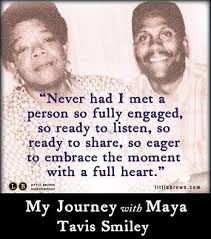
Tavis and Maya

Tavis and MayaEvery year the Los Angeles Times Festival of Books continues to cement itself in my psyche as a major go-to event. Now the largest book fair in the United States, its bustling aisles fill the USC campus for two days with eager authors and insatiable readers. Each year I joyously look forward to attending, not just for the schedule of talks I plan to experience, but for the inevitable surprises I discover. This year’s surprise was an exceptionally powerful book talk on an open-air stage by Tavis Smiley about his lifetime of interaction with Maya Angelou.

Although I have not yet read Smiley’s new book, My Journey with Maya, my takeaway from the forty-five minutes my wife and I listened to him speak was profound enough to report here as a stand-alone inspiration. Smiley talked openly and honestly about how he personally crashed and burned after a failed election campaign for Los Angeles City Council following a gig on the staff of Mayor Tom Bradley. With a mountain of campaign debt crushing him, he was to be evicted from his apartment with no prospect of employment. A friend arranged a happenstance job for him to travel with Angelou on a brief trip to Africa as an assistant, mostly to carry luggage. That kicked off a lifelong friendship and dialogue between them where they didn’t always agree, but Smiley always found a way to learn.

I’m going to read the book and I hope you will as well, so I won’t go into a lot of detail here on all he said. What I want to share are the two most striking learnings from Angelou that Smiley encoded, largely because they have been stuck in my head and churning ever since we stood there in the sunshine listening to him. I have only seen Smiley a few times on television over the years, but standing in front of him, hearing his passion, listening to the heartfelt words that flowed from his inner being completely coherently without any notes or podium, I was moved completely by the sweat and memory that poured from his soul. The two ideas that Angelou planted for growth in his brain couldn’t have been more relevant to me than if I’d heard her say them to me herself. As far as I am concerned, I think I did hear her speak on both counts, channeled in full energy by his voice calling on hers:

“Baby, we find our path by walking it.”

“Sometimes rejection is redirection.”

If you think those are just broad, sweeping, generic statements of advice from the elevated dais, stop here and go read someone else’s reflection, or perhaps today’s stock market results. On the other hand, if you’re like me, copy those words onto a Post-it and put them in plain sight for the next decade or so. When Maya speaks, it’s a good idea to listen. Tavis did, and his life was reinvented.

I write a lot on this blog and in my books about resilience and reinvention, the lifeblood of innovation. When I heard Smiley put the notion of self-motivation in so few words from Angelou, I was heartened, invigorated, and inspired. She got it. He got it. I wish everyone could get it. And still, transferring the words of others into action is immensely difficult, filled with pain, buried in setbacks, and only on the most wondrous of occasions celebrated in brief victories.

Smiley was adrift after losing his election and identity in public service. He sat stunned and stared at the failed image of himself. He wanted desperately to reinvent, but had no idea how. He was frozen. Angelou saw through him to his core. “Baby, we find our path by walking it.” If it had been a Nike commercial saying “Just do it,” it couldn’t have been clearer advice: Just do something. Do anything that matters to you. Find thought in action, not in dire contemplation. Whatever you do is better than nothing, and it will inevitably lead somewhere. Sometimes I tell people to form a plan—a conceptual roadmap of any kind—not because you will follow the path from here to there, but because if you start with a map, you will go somewhere, and that has to be better than nowhere. You won’t connect the dots—the dots will connect themselves in ways you never could have imagined. Yes, you find your path by walking it. Get busy. The rest will be discovered when you least expect it.

Smiley was crushed because the electorate said no to him. He wanted to serve, but the voters said “no thanks.” Again Angelou saw motivation in the otherwise unfortunate result. “Sometimes rejection is redirection.” If the voting public did not wish to recognize Smiley as an elected official, was that the only way he could realize his dreams? Obviously not, because a few years later Angelou appeared as a guest on Smiley’s national PBS talk show. How about that? From apartment eviction to the interviewer’s chair in so little time you almost think he made the whole thing up. He didn’t. He listened. He accepted “no” as meaning “not now, not here.” Then he went another way, and his dreams were realized beyond all imagination. Can it happen to you? Yes, if you see the negative before you as motivation to go another way. That new way might be a million times more fulfilling than what you thought was your only way. We have no only way, just opportunity to be who we need to be in an as-yet undiscovered path.

Both of these precepts have been guiding lights in my own life, yet until I heard Tavis channel Maya in an unplanned walk by the stage where he happened to be speaking when I was on my way to another place, I wasn’t aware how much I shared with so many others there on the grass listening intently to every word. Maybe we are more similar than different. Maybe we all do share the same dreams of enrichment and fulfillment. Maybe if we all listen to each other a little more closely, we can help each other get from the stagnant to the unstoppable. To quote another dreamer, “Imagine.”

I sure do love the Los Angeles Times Festival of Books. I can’t wait until my walking path takes me back there next year for another dose of redirection. See you under the tents. I’ll be the guy taking copious notes, or maybe talking ideas if you start the conversation.

My Second Book

As noted by the title, tEE Coverhis post is meant to announce the forthcoming release of my second book, Endless Encores. It will be published by The Story Plant on September 22, 2015 in hardcover and as an eBook. Since that is still several months off and I have at times already mentioned the book is coming, let me come back to that in a moment.

I often get into the discussion of whether corporate mission statements matter.

I also wrestle with people on whether we are blowing hot air when we say we want to hire the very best talent we can.

Then there is the loaded question of whether bringing a true “change agent” into a company suggests an oxymoron.

The answer to all three of these questions for me is quite simple: It depends whether your answer is cursory or heartfelt, pat or authentic, expository or evangelistic.

You’re likely quite familiar with the expression Don’t Be Evil. It was the rallying cry of one of the most successful digital companies of our time in its offering prospectus. Here’s a tangent to that declaration I’d like to offer that can put to rest most questions around an empowering mission statement, talent that matters, and harnessing a change agent: Don’t Be Cynical. Today let’s call that DBC.

If you DBC when you speak to mission, you will find nothing more powerful to inspire people to do the best work of their careers. If you DBC when you speak to the impact of extraordinary talent, you will surround yourself with the real deal and reap the rewards. If you DBC when you identify a human change agent, you will open your doors to innovation and allow change to happen.

Fall back into corporate-speak on any of these borderline-highfalutin ideals, and you will suck all the life out of the room. No question. The spread between demoralization and inspiration is just that wide, but the line separating them is micropixel thin. Walk that line carefully. Fall to the wrong side of the balance beam and you lose; to the correct side, and you win.

That’s why I wrote Endless Encores.

What is cynical? Cynical is a poster in the lobby that reads “Our people are what we value most.” Then earnings are announced and miss expectations. Wall Street punishes your company’s stock. There is a layoff and a thousand people see that poster as they are walking out the door carrying boxes of work mementos.

What is DBC? DBC is the same lobby, same poster, but an announcement that because of a soft quarter, all senior management team members are deferring annual bonuses and taking a voluntary pay cut of 10% to cover the shortfall in earnings until the company regains growth momentum. No one walks out the door. The mementos stay on the desks. The boss holds a pizza party to reset the year’s goals. Everyone recommits to achieve growth together.

DBC can be extremely hard to master, mostly because we usually don’t set out to be cynical; we sadly roll ourselves into the muck tub. It’s great to say galvanizing words, but they inevitably have to be followed by felicity in our actions, and that’s when it becomes the greatest of all possible business challenges: to marry the power of intentions with the expectation of outcomes. Said another way: Can our delivered actions live up to our rousing words?

It’s not Utopian. It happens. It’s what matters. If you say it, mean it. If you mean it, do it.

Let’s make it harder. Can we do it consistently? Can we do it again and again? Can we have careers that span more than a single triumph, encompassing values that become us, delighting customers with outrageous excellence in good times and bad?

To invoke another catch phrase, Yes, We Can.

Speaking of catch phrases, if you’ve been following this blog for any amount of time, or even if this is your first visit, you’ll note in the blog’s description the words “People, Products, Profits—in that order.” Those are the business words I have tried to live by these last three decades, part rallying cry, part personal philosophy, part sanity meter. If you’ve worked with me you’ve heard those words way too many times and possibly even begun to repeat them. When I’m called to look at a creative company and I don’t see those words at play, they flow freely from my lips. There’s a reason. They work.

This book is about those words. It’s about how to have a career that matters, how to infuse those around you with passion, how to love your customers, how to innovate and reinvent without fear of failure, and how to avoid the trap of the one-hit wonder. That’s a lot to cover in so few words, and yet, the book is not a very long one (those who might have been concerned another volume like This Is Rage was on the way can breathe easy). Strangely, the book took me just as long to write, because as my wise editor, Lou Aronica, warned me in advance, writing simply about immensely complex ideas of discipline is no small trick. If you want to get people fired up about something that can change their lives without sounding like a soapbox pundit, you have to pick every word carefully, and that takes time.

Why condense a lifetime of highly personal learning into a book and share it with people I may never meet? I want you to succeed, over and over, and I know you can. I want you to understand why it will make you more productive to embrace the notion of DBC. I want you to master this framework, become a mentor, and pass on your good fortune to others. I want People, Products, Profits to be the worst-kept secret on the planet. I want you to take this little business parable, the story of Daphne Lonner and Paul Beckett, read it all the way through, and then keep it near your desk when you need a hit of pure oxygen.

You can repeat. You should repeat.

A few years ago I wrote a post called Dodging the Great Hits Graveyard. I had been at a Trans-Siberian Orchestra concert with my wife, sitting down front surrounded by fans who had come to hear the familiar tunes of their Christmas show. In the middle of the second set they stopped playing familiar tunes and introduced something completely new. There was an awkward pause, and it would have been easy to assume that the band had taken an immense risk and bit off a raw chunk of failure with the lost energy. Three years later, that song became the tent pole of a new album and tour, joyously celebrated by old fans as well as new. Somewhere in that window I knew I had to turn the fear of the new into a story of returning triumph, even if every triumph wouldn’t be a foregone conclusion. That’s when I knew I had to write about DBC. That’s when I knew I had to write Endless Encores.

I hope you’ll follow some of my recurring themes in the months leading up to publication, and once you have the book in your hands, please let me hear from you. Missions matter. Talent matters. Change agents matter. Don’t Be Cynical. Surround yourself with People, Products, Profits—in that order. You too can have a shot at a lifetime of repeat success, letting the moments of failure become learning opportunities, not endpoints.

Come meet Daphne and Paul. If innovation and reinvention are in your sights, their story might be your story. You can pre-order a copy of Endless Encores so it is sent to you on publication date. Below is an excerpt to give a sense of where this tale wants to take you. See you on the winning side of the balance beam.

♫ ♫ ♫

“Do you like music?” asked Daphne. “Contemporary bands, classic rock, pop tunes from various times?”

“Sure, of course,” said Paul. “Who doesn’t have a favorite band or two?”

“Those bands that are your favorites—did they have one or two hits, or a pretty decent run over the years?”

“You mean like the Eagles? The Rolling Stones? The Beatles? Obviously they had a string of hits, sometimes one after another.”

“How hard do you think it was for them to keep trying to top themselves?” asked Daphne.

“Hard,” conveyed Paul. “Very, very hard. In my business, hardly anyone repeats.”

“More like the one-hit wonders on the pop charts from the sixties, seventies, and eighties,” noted Daphne. “‘My Sharona.’ ‘Tainted Love.’ ‘Kung Fu Fighting.’ ‘Video Killed the Radio Star.’”

“You’re dating yourself a little,” chuckled Paul. “But yes, you nailed it. I don’t want to be a one-hit wonder. I don’t want to be like Friendster or Pet Rocks or the Cabbage Patch Kids. I want to make lots of hits, like you said, an endless series of hits. I want to be that guy. How do you make hits time after time after time?”

“A lot of us ask ourselves that question,” shared Daphne. “I wish I could tell you the answer. What I can tell you is that luck is not such a bad thing. It’s okay to embrace it.”

“Yeah, but can you repeat it?” asked Paul. “Can you make it happen again and again, predict it, make it repeatable?”

“From my experience, I think the best you can do is increase your odds. To build a career that allows for Endless Encores, you can never stand on your laurels. You have to be innovating all the time, not just when the clock is ticking against you. You do a little crowd pleasing with what they know, then a little thought leading by showing them something new.”

“It would be difficult to think about Endless Encores with a limited repertoire,” noted Paul.

“The only sure path to a limited repertoire is not to push yourself beyond the familiar. Your range is only gated by your courage to pursue the unknown, despite the doubters who relish the false safety of narrowing your path. You risk, you stretch, you can’t know what’s going to stick. No matter how much you know the familiar will carry you, you navigate the balance of old and new, constantly committing to reinvention. Repeat success is getting comfortable with the uncomfortable, knowing that luck will shine again, but never knowing when or how.”

Help, You Need Someone

“Hope you are well.”

We are all guilty of typing those words. It’s the email equivalent of “Have a nice day,” though usually as a salutation. It means that in a few sentences someone is going to ask you for a favor. In customary parlance, it’s someone you haven’t heard from in quite some time. It’s also likely someone who doesn’t much care if you are well.

Help2In the very early days of this blog, I wrote a piece of advice about networking. I thought about that a lot these past few weeks with the release of my novel. Launching a first book at mid-life is a somewhat absurd task. The odds of commercial success are so tiny, you almost can’t calculate them. When countless people in my network—from high school through college through each phase of my career—rallied to my support across the board, I was literally breathless. There is nothing I wouldn’t do for these people: job referral, job reference, resume review, preparation for a pitch, media training, media intervention, hospital visit, you name it! I am there for them in perpetuity, and they are here for me now.

Don’t take this for granted. It does not happen by accident, nor does it happen as the norm. If you haven’t yet been crushed by that discovery, you will soon enough. Don’t be dismayed. Only you can fix the problem, and it’s a problem worth fixing. But it’s not a sticky patch on a leaky roof.

Networking is still so bizarrely misunderstood, it boggles my mind. It is not a system of stored and replaced favors. It is the building of bonding relationships where people want and choose to help each other. Pay It Forward is about as constructive a strategy for longevity as I’ve experienced. Relentless excellence and indefatigable commitment aren’t bad either.

If you want to have a robust network that might help you someday when you truly need the help, build it now; you’re already behind. If you think you can pull off a big-time favor swap real-time, you’re almost certainly deluding yourself. Build your network for the future by offering to do things for others, even if it’s an inconvenience. If you do it enough, some of that work will create powerful memories of connection, even more than appreciation. That’s a well filled with sweet water when you are someday thirsty.

At the very least, if you have nothing to offer someone, show a keen interest in what they do. A few weeks ago I gave a talk about my book at Stanford. I did it because a friend who loved the book asked me. My friend showed enthusiasm, her friend (the teacher) showed enthusiasm, I responded with enthusiasm. No tangible value was created, no business leads exchanged; it was all just goodwill. Yet that wasn’t what won in the networking. One of the students reached out to me after the class with a well-composed email discussing an enigma surrounding one of the characters in the book. The student asked me how that applied to a real-world work situation. It took me a while but I responded, which opened the door for the student to ask some more heartfelt questions. I liked the heartfelt part, that’s just me, but that student has now bridged access to what was once a total stranger’s network. To me, that’s good business practice. We’ll see how he works it over the next decade. I’ll bet he handles it well.

Here’s another example: A few years ago I was in a weekend workshop, not as instructor but participant. I saw promise in the material and was there for the learning. There were people at all levels of their careers and personal development; ages spanned four decades. One individual was quite young and struggling, fresh from college outside the United States, but passionate and curious about everyone’s life path. I asked her after the workshop to email me once or twice a year to let me know how her career was going. Strangely enough, she has. I’ve received about a half-dozen updates, not too many but enough that I remember her name and long-term goals. I’ve given her some advice, but nothing of real value yet. I’m guessing at some point I will. Maybe she’s banking on it, or maybe she’s just sincere. English is not her first language, but she has not as yet typed the words “Hope you are well.”

Staying in touch is not a onetime event. It takes work to be connected, give and take, sharing ideas and information, not just asking for something. If you don’t want to do the work, don’t bother extending the outreach. You would be shocked at how many people I’ve suggested stay in touch with me after an initial meeting and never do. They forget, or they don’t care, or they don’t see value in it, or they are disheartened by the lack of immediate gratification. I am grateful to them. It helps me manage my workload—one less rising star I might someday champion.

Watching new grads bang their heads against the job market is terribly frustrating, because they haven’t had the experience to know how they could approach it better, with fortitude and resilience. Watching later career professionals suffer the same resistance is even more frustrating, because by now they should have powerful networks of their own, but if they didn’t invest along the way in others, that network today is likely too thin. Remember that LinkedIn and Facebook are tools, but networks are between people. The glue that bonds networks is history, and history comes from doing things, often and selflessly, for and with each other. When it comes to bolstering a platform of human support for your unlikely and unexpected needs, you’ll need to make that brand deposit now for future withdrawal. No surprise, you have to Think Different. It’s not a quid pro quo, you don’t get a favor for giving a favor (not a good one, anyway), but if you authentically invest in goodwill, you’ll enjoy a deep reserve of goodwill. When it’s time to dip your ladle, you want it to be an underground lake.

Networking is not what you can do for me. Networking is what I can do for you. Before you ask.