I Was On Fox Business Network

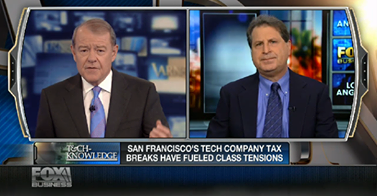
Varney 041714Last week I was invited to appear on Varney & Company, the midday (EDT) market commentary on Fox Business Network hosted by Stuart Varney. It was an opportunity to talk about my novel, This is Rage, and how some of the themes it encompasses apply to current tensions in the Bay Area around affordable housing, income inequality, and the more heated rhetoric of late around our ability to discuss and resolve complex social issues rather than pour rocket fuel on the fire pit.

I didn’t think the live TV interview would be a walk in the woods, and to be honest, I’m not unhappy with it. Varney said what he had to say, I said what I had to say, and I appreciated the near five minutes on-air to promote my book. The strange part for me was what followed. Here are a few of the tweets:

U VILE SOCIALIST COMMIE POS I FELT RAGE WHEN U WERE TALKING!

U R a SOCIALIST donkeyshit4brains COMMUNIST traitor U DO NOT BELIEVE IN CAPITALISM OR LIBERTY I wanted to reach thru screen n STRANGLE your ignorant ass!

Ken is a fool – his comment that if you are rich you should be happy to pay whatever is asked of you – priceless!!

And this comment, posted on my Amazon page:

Saw Goldstein on a Biz program and turns out he’s just another Jew who believes government is not stealing enough from us. Why are so many Jews of this collectivist mindset?

I am not sure what I said to upset those people to that extent, nor did I go on the show to talk about tax policy. My point was rather straightforward: when you hear an outcry, listen, and before you dig in your heels and fan the flames of a conflict, ask yourself if there is something you can do to ease the tension. I do think the repercussions of widening inequality will continue to be severe, not only on moral grounds but in the name of good business. Historically it has been the buying power of the middle class that fuels corporate earnings, and that middle class can remain strong only if income levels do not further polarize. To know my career historywhich was strangely not mentioned in the introduction to the piece, though I was carefully vetted for my credentials prior to the interviewis to know that I believe in our capitalist system and have been a fortunate beneficiary of investment and free-market economics. Were Varney and I really that far apart, or were theatrics applied to make it seem we were further apart than we were? Once I was labeled an outsider in the Fox system, was I simply fair game for rejection by the loyalist audience?

You have to wonder, if someone disagreed with my point of view, would it be ludicrous to expect a tweet like this from a genuinely concerned observer who might even choose not to remain anonymous:

Ken, rent control is not a solution that works in our economy, let the market decide prices or the system will fail.

Of course it would be utopian to expect that kind of exchange, but perhaps it is not meant to be by media design. Ratings follow the heat, and there is more viral value in stirring the pot than in civil discourse. As I explore in my own book, controversy can be a form of currency, whether organic or invented. If you don’t want to engage in the brawl, your voice may willingly go unheard. A recent piece in The Atlantic by Jon Lovett entitled “The Culture of Shut Up” noted the following:

The bottom line is, you don’t beat an idea by beating a person. You beat an idea by beating an idea. Not only is it counter-productive—nobody likes the kid who complains to the teacher even when the kid is right—it replaces a competition of arguments with a competition to delegitimize arguments. And what’s left is the pressure to sand down the corners of your speech while looking for the rough edges in the speech of your adversaries. Everyone is offended. Everyone is offensive. Nothing is close to the line because close to the line is over the line because over the line is better for clicks and retweets and fundraising and ad revenue.

Lovett’s concern is that much of the manufactured outage emanating from entrenched media verticals aimed at driving inflamed social media response is antithetical to the free speech it is supposed to represent. I think he is onto something. An awful lot is being said, but how much of that speech is being crafted in considerable thought? If you do have something you feel is important to say, how willing are you to say it in a public forum if you know only seconds after the words leave your lips, strangers are at the ready to attack you, your character, and implications in any spontaneous string of words that may have slipped through your lips without the imposition of editing?

You bet, it’s scary. Want to know why a lot of people who might be good at public office have no interest in running for election? You must really have the courage of your convictions to say anything at all in a public forum, then have blubber-thick skin to weather the attack, and then the media-training skills to know when to hit back and when to walk away. Should the vitriol boil over, you might also worry whether any of those words could become expressions of violence, which curiously enough leads back to the very subject of my appearance on Varney: the outcry of people in the Bay Area being priced out of the housing market. Varney asked me whether this might become physical, to which I replied, I hope not. Some of it comes down to whether anybody is really listening to the authentic outcry, and whether they are playing it back as a media sound bite to amp up their numbers.

Can we have an intelligent discussion and debate about inequality in this country without throwing out memes like “class warfare” and “tax-the-rich socialism”? I think so. I like investing, I like motivating talent to achieve heroic goals, I like serving customers, and I like the longterm rewards that come from years of hard work. I also maintain a sense of empathy for those who are down on their luck, for those who are not in the right place at the right time, and for those who try hard but nobly fail at any endeavor. Are those radical views that cannot be reconciled when we talk? Well, if they can’t, maybe we shouldn’t talk. And there goes free speech.

When I sat in the little windowless room waiting for the prompt in my ear bud for the first question from Varney, I wasn’t thinking about tweets or memes or nasty reactions to my words. I was thinking about what he might ask me, and what I might say, and whether I would come across as credible. Maybe that was naive. Maybe I should be more worried about trying to exchange ideas where the intersection of those ideas is more valuable than what either of us might devise on our own. I had asked my dad the night before how to handle the interview if it got tough. He told me to just be myself. I think that was good advice. That’s who you see on the video. I’m okay with that.

Piercing the Bubble

Almost daily now I’m asked my opinion of whether we are in a stock market bubble. It’s a curious line of inquiry, and inevitably leads to any number of further ponderous meditations that follow:

“What do you think of that King Digital IPO; did Candy Crush get crushed for good?”

“Is Bitcoin for real, and is now the time to get in?”

“Does it look like Zynga is on the mend? Did they hit bottom and create a buying opportunity?”

“What happens to Yahoo’s price post Alibaba?”

“Box or Dropbox, which do I want to own?”

GodotI can almost imagine Didi and Gogo having this conversation in a contemporary reworking of Waiting for Godot. They’d go back and forth on each headline for a few minutes, and the resolving cadence would always be the same: “Nothing to be done.”

They’d probably be right. And wise. And existential. And of course they would be ignored, two bums with nothing but holes in their shoes, playing insufferable word games beside a dying tree.

And I’m probably the wrong person to ask. Crystal-ball predictions of dicey, professionally picked over offerings seem as wacky to me as hardworking people forking over portions of their paychecks to the state government for lottery tickets.

Speaking of which, there’s something even stranger afoot of late, a new pattern of dialogue running through the frenetic networking schmooze scene. It goes something like this:

“WhatsApp wasn’t worth $19 billion.”

“Agreed.”

“It was worth more.”

“You’re kidding. How do you figure?”

“Well, look at what Snapchat turned down at $3 billion. That app had 36 million users and would have gone for $92 per user.”

“Oh, I get it. And WhatsApp had 450 million users, so at $19 billion, that’s a mere $42 per user.”

“You’re right, what a steal. Facebook should have paid more. I bet they would have if WhatsApp had played coy.”

“What about Instagram?”

“I don’t know, what’s Instagram?”

In most discussions of relative valuation based on anything more complicated than revenue, EBITDA, growth rate, and some basic ratios like price/earnings, my head starts to hurt. Ignore all fundamentals, project abstract strategy on modeling unknown monetization value, and you lose me.

That doesn’t mean I’m right, it just means I know when it’s the right time for me to sit out a dance. It’s kind of like someone asking me which is the surer thing in Vegas: poker, blackjack, craps, or roulette. My answer: If you can’t afford to lose, don’t play; and if you can, what does it matter—pick the game that’s the most fun for you and knock yourself out. Someone will take home a mountain of cash every day, because a casino only works if there are winners. Most people will leave their bounty behind, not only to pay the winners but to pay the house for brokering the trade and serving subsidized cocktails—plus the gigantic water fountain out front of the brightly lit, air-conditioned cement tower in the middle of the desert.

Don’t get me wrong, I believe in investing. Most everything I have earned working over the years has more than doubled in value over time because of investing—really boring diversified asset allocation in various index-like vehicles, bolstered consistently over time through saving and dollar-cost averaging. Yes, I have speculated on occasion, and I have even had a winner or two, but even then I looked at the core financial analysis when I bet, and those numbers always had growing dollar signs in front of them.

Now I’m hearing young entrepreneurs echoing the exit lingo. “If we can just get 500 million users of our app, how can we not get bought for $20 billion? That’s a massive discount! And we only need to raise another $65K to make it through beta with a minimum viable product. For another $20K we can stress test the server, too. That’s less than $100K investment for a decent front end and the return of a lifetime. Do you prefer the term sheet via email or text?”

This is a different kind of Gold Rush, with its own beguiling logic and normalized ethos, plus many sideline winners selling new-age picks and axes. Should the notion of Built to Last cross your lips in any public gathering, you are likely to be met with curious stares at best, and more often ostracising scorn. Free salty snacks will not be replenished in the small paper bowl you hold. This is not a discussion of how value is created by serving customer needs with wondrous products scaling in gross margin and the brand extensions that follow. This is a discussion of filling the strategic needs of an acquirer that has slipped into low organic gear and is sitting atop a stockpile of cash, the war chest itself a creation of optimism, inflated promises, and dare I say it, Irrational Exuberance. It’s a party and a playground. Fundamentals are for losers. Job experience is the enemy. Don’t be a downer.

As the JOBS Act begins to open the doors democratically to a new set of speculation-based investors—equity crowdfunding is the freshly cleared frontier—I hope they will do the hard work of learning to assess valuation before they write checks equal to 5% of their net worth or annual income. You’ll hear lots of stories about the next killer app, or the next levitating brick, and you may be lucky enough to be in the room with the next undiscovered wunderkind. But if the story that wunderkind is telling you has lots of math but no defensible revenue and profit realization, ask yourself, Where did he or she learn this math? Is it sustainable? Why hasn’t someone else with a lot more disposable income or risk capital taken this deal off the table if it is so good you can’t say no to it?

There’s always a bubble, and there’s always a bottom. The good news is that once you get past the moonshots, no one has yet figured out where the sky ends in its entirety. Boom and bust. Bust and boom. If you draw a trend line through a lifetime’s worth of data, pacing the erratic market highs and lows, the slope is still northbound.

I like that line a lot. That line protects me from worrying too much about a bubble.

Dear RadioShack

RadioShackGreetings, my fellow nerdy friends. I read with concern last week in the business press that you are closing as many as 1100 stores, following your well-received Super Bowl commercial earlier this year. You are not alone. Sears is closing stores. Staples is closing stores. Quiznos is closing stores. There seems to be plenty of commercial real estate coming on the market in all shapes and footprints. I wanted to write to you because I used to love the RadioShack brand, and I would hate to see it join the other tombstones in the Dead Brand Graveyard. You see, I was a bit of a geek as a kid, still sort of am, mowed a lot of lawns and bought my first CB Radio at RadioShack way back when, then used to love to hang out with the other geeks in the store.

So I wonder if the big-salary strategy teams sitting around the table in your headquarters this modern moment have asked themselves the following ten very personal questions:

1) When was the last time they shopped unprompted as a customer in a RadioShack?

2) What did they love about walking into the store?

3) What did they love about the shelf displays in the store?

4) What did they love about the merchandise on sale in the store?

5) What did they love about the staff in the store?

6) What was in the store that was unique, perfectly priced, or presented so well they couldn’t say no to it?

7) How much did they spend of their own money in the store?

8) Did they tell a friend about the experience and urge that friend to also visit the store?

9) When they got home, did they think, oh wow, I should have bought something else while I was there?

10) Are they actually excited about visiting that store again as soon as they can?

The reason I ask is, I never worked at a RadioShack, but I used to be able to answer every single one of these questions in the affirmative. I was a brand evangelist for RadioShack. I actually loved your brand.

At the moment I have no clue what it stands for, except every once in a while I need an obscure electronics plug or unusually shaped battery, and I drop by because you’re paying top dollar for a great location right between my bank and a sushi place I enjoy. If it pops in my head, sometimes I drop off a bucket of old batteries for you to recycle, and if you have the gizmo I need, I gladly fork over about $3 to $8. The guys at checkout always ask for my zip code for some reason, even though I know you know it, because you used to mail me a catalogue several times a year with cool stuff to come see and at least one great coupon offer, but no one there seems to know me after 40-plus years of stopping by. I’m glad you still have the little wired metal gizmos when I need them, and I wish I could spend more money while I was in the store, but there’s really nothing I need or can’t get online cheaper, and the guy behind the counter doesn’t seem to want to swap stories about weird-shaped neon mini bulbs anymore. I miss that guy, he was a geek like me.

You were once the Tandy Corporation, remember? You sold leather goods. Then you reinvented and became RadioShack, and we geeks thought it was a cool place to gather, kind of like Egghead, before they became rent-free NewEgg. You had the TRS-80 and knew how to load software on it! Are some of those geeks at your conference table? Do they love your brand the way we did–not like, but actually love? If they don’t, are they able to articulate what happened to the magic?  Because if they can’t, and they don’t want to go to RadioShack like a real customer, then why should I? I mean, sure, anyone can hire an agency to do a killer commercial, and you can love a commercial, but that’s not the same as loving a brand. It’s also not the same as a reason to go into your store.

I do believe you have to eat your own dogfood if you want someone else to give it a taste. That’s just me. Call me a simpleton without an MBA, but when I love a brand, and I have reason to recommit my loyalty to that brand time and again, price is only one part of my decision funnel. I want a brand that comes with a promise. What’s yours?

I won’t be writing this letter to Sears or Staples or Quiznos, although I do occasionally frequent those stores, but I did want to share my thoughts with you, because there was a time not long ago when you meant something to me. Like Borders. Like Tower Records. Like Blockbuster. Those old friends are no longer to be found. I wonder if the people sitting around the table in their final year loved their brands as much as their customers once did, or if they just ran spreadsheets and focus tests.

There’s a lot going on in a store; it’s a great laboratory for learning. When there’s nothing going on there at all, you can learn even more.

It all begins with a promise.

Signing off now, that’s a big 10-4.

Park the Snark

We talk a good game about bullying. Then the claws come out.

Maybe we can’t help ourselves.

Maybe we should try harder.

Last weekend a good portion of the globe enjoyed the annual late winter Sunday evening television marathon known as the Academy Awards. The Oscars and the Super Bowl are two of the remaining real-time TV tent poles broadcast from the U.S. to the rest of the world still commanding appointment viewing of some of the largest assembled audiences joined collectively. Whether they are culturally worthy of that significance is beyond the scope of this blogger, but they are what they are: massive, temporally significant, and dare I say, glamorous.

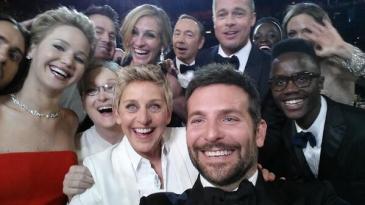
EllenOscarTweetThis year’s Academy Awards offered what many have called the best line-up of nominated commercial films in years. Among the strong critically acclaimed competition, an important film won Best Picture. We saw unusually significant advances in motion picture technology win accolades. An excellent line-up of creative contributors offered heartfelt belief in their projects. We also enjoyed a quite clever world record tweet stunt (“the retweet blasted round the world”) emerge from a reasonably relaxed show format that seemed to try hard not to focus on itself too seriously, but to put that focus on the work being honored.

I don’t know if it was one of the best Oscar shows ever, but it seemed to me a credible, enjoyable celebration of creativity, all the more poignant given the immense geopolitical events mounting on the world stage as it played. It was a good night for Pharell Williams to sing “Happy.” A lot of us felt that way.

Then came Monday morning. Or if you really wanted to get in on it, later Sunday night.

What was the most insulting joke told by the host?

Who had the bad taste to show up with the worst vanity surgery?

How awful was that mispronunciation of someone’s name?

Can you believe that awful gown? She has to be the worst dressed, no contest.

What kind of self-aggrandizing acceptance speech was that?

Did you see how drunk he was at the party?

What kind of backstage snub comment was that?

Did you see the look on his face when he lost?

Did you really think she deserved to win?

It’s astonishing. We can’t even have one night to send up fireworks and smile in the glow without the snark. Maybe it’s because I live in Los Angeles and dissing in social circles is as common as saying, “Let’s have lunch,” but it seemed for every word of praise I heard for a winner, I heard three times that many diatribes flicked at presumed losers. Were I able to isolate it to the Hollywood elite, I might feel better encasing it in a cone of irrelevant silence, but I saw and heard it everywhere–online, in the mainstream media, on the phone, wherever news travels.

Folks, this isn’t news. It’s babble. It’s unimportant. It’s not particularly clever. And it’s mean. Really, really mean.

Sure we are a society of tabloid media. Websites and TV shows and grocery checkout racks thrive on insults, humiliation, and Schadenfreude. Most of this is not satire, not irony, not well-crafted humor. It’s just junk. Bloated, bombastic garbage. And we absorb it until we become it, and then we spew it right back, as if somehow that makes us part of some intelligentsia, some wise-cracking inner circle that can distinguish meaningful critique from wasted breath. When we join in the rant, we are kidding ourselves. We become part of the problem.

And here’s the problem: the kids around us are listening. They hear every word we say, every word the media relays, every nasty remark that deflects from the celebration that should be going on of wonderful, creative work that helps define our shared culture, commercial or otherwise. Then they go to school and the clear message is that bullying is verboten–completely off-limits, not allowed, punishable by extreme… what? Any chance there is a slight conflict going on when what they hear in their heads are our voices institutionalizing the public act of professional cruelty? We wonder why bullying is everywhere, but we don’t hear it in our own everyday dialogue.

What the heck is wrong with us? Really, we can do better. All we need to do is talk more about stuff that matters, less about stuff that doesn’t, offer praise with enthusiasm where it’s earned, and try to be a tiny bit more polite when someone happens to make a boo-boo, or we perceive them as making a boo-boo.

Because you know what? We all make boo-boos. And I have yet to meet anyone who enjoys ridicule, especially when they just did something out of the ordinary, whether the words travel behind their back or in their face.

It hurts. So let’s stop.