Creativity and Courage

Teddy Roosevelt — who legend has it never wanted to be called by that name — is back in the news, at least to the extent that we are finding reason to quote him of late.  In response to an earlier post of mine, a friend who had a challenging year sent me the following quote from Theodore Roosevelt:

It is not the critic who counts; not the man who points out how the strong man stumbles, or where the doer of deeds could have done them better. The credit belongs to the man who is actually in the arena, whose face is marred by dust and sweat and blood; who strives valiantly; who errs, and comes short again and again, because there is no effort without error and shortcoming; but who does actually strive to do the deeds; who knows the great enthusiasms, the great devotions; who spends himself in a worthy cause; who at the best knows in the end the triumph of high achievement, and who at the worst, if he fails, at least fails while daring greatly, so that his place shall never be with those cold and timid souls who neither know victory nor defeat. 

The quote comes from a speech Roosevelt delivered at the Sorbonne in Paris on April 23, 1910, just after the completion of his presidency.  He ponders a world which is increasingly industrialized, the role of the common man in its development, and the critical nature of risk in our capitalist economy.  Roosevelt is optimistic about America’s role in the New World, the rising living standard for the middle class, and the importance of learning — academic and experiential — to the evolution of our civilization.  “The poorest way to face life is to face it with a sneer,” spoke the former President.  He was a champion of character.  He had no appetite for the voice of the cynic.

There is a lot of substance in Roosevelt’s reflection, but the essence for me comes back to the notion of the creative process, whether in business or government or science or art, what it means to put oneself in the public light with new ideas.  I write a good deal about innovation and creative destruction, how it is essential to the evolution of our norms, but not enough about the drive behind that process, the extremely hard work of dodging the ordinary and then attempting to get others onboard where they might otherwise be uncomfortable.  Getting attacked is no fun, but it comes with the territory of the new.  Creativity is not only exhausting, it’s messy.

I think this is what Roosevelt was getting at, how leaders in any field first dare themselves to expose a new idea, then attempt to explain that idea to others, then prepare themselves to share the bounty in success or accept the blame in failure, as if neither is more likely or important than the other.  The point in finding the courage to advance an untested notion is specifically that, to test it.  If the notion proves of merit than the win is broad, but if not, the win is equally broad because the test has eliminated a dead-end we all can acknowledge and use as a new reference point for further testing.

It is the courage to address the critic, the skeptic, that is so uncommon.  We know it when we see it, but we don’t see it enough.  We are hungry to hear ideas, but too often all we hear is naysaying.  It is much easier to be a critic than an innovator, in that the innovator approaches creativity with self-critique an implicit part of the process, a means, not an end.  The critic whose work begins and ends there offers opinion, even explanation, but if there is no build on the work of the innovator, then what is the value added?

We hear our political candidates bash each other for sport, so much so that we become numb to it.  They are not listening to each other and we are not listening to them so what good is being accomplished by the perpetuating standoff?  When this happens in business, companies are lost.  When it happens in science, we run in place.  When it happens in the arts, our culture becomes stagnant.  Roosevelt looked forward and advised us to fear the downside of not trying more than the downside of coming up short.

The individual who has a story to tell risks all, because the more that story is original, the more it is likely to be rejected.  Think of the powerful corporations who did not believe we would all have our own computers someday, and the few individuals who thought we would and got them to our desktops.  Think of Martin Luther King’s vision for a desegregated America, the resistance against his ideals, and the normalcy today of celebrating diversity.  Think of The Beatles dreaming in those seedy clubs in Hamburg, when much of the music establishment was convinced that guitar bands were on their way out.  Think of the first doctors and medical researchers to propose the notion of a vaccine, how frightening that seemed to so many, and the diseases we would still suffer today were it not for their willingness to persevere.

Not all ideas are good, and not all visionaries are right.  True visionaries know this, and they know that failure will always be part of the package.  As we listen to those around us attempting to tackle the more complex problems of the day, perhaps we would do well to remember that even if an idea proves wrong, the people courageous enough to explore that idea might be doing something right.  Everyone wants to win, but not everyone is brave enough to want to try.  Where we are unable to find that courage in ourselves, let’s not forget to praise it in those who are exposing themselves to critique.

Look for the spark in the brave people around us who worry less about what others say about them, and worry more about overcoming constraints on what can be possible when we appropriately embrace courage.  To be honest, they don’t much care what the crowd thinks, but the crowd has everything to gain by inviting themselves to the party.  We have more challenges facing us today than the Progressive Republican President Roosevelt could have imagined, yet even more paths to triumph through knowledge if the most inspired creative voices are heard.

Bird by Bird

And now for something from the other side of the brain… I want to share with you a book I read this summer.  It was introduced to me by my good friend and classmate, Will Schwalbe, who among other things was Editor-in-Chief at Disney’s Hyperion books and has since founded Cookstr.com.

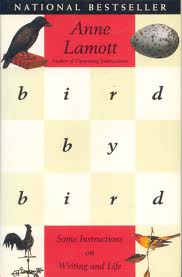
The book is called Bird by Bird: Some Instructions on Writing and Life.  It’s by Anne Lamott.  It was originally published in 1994.  I read it for the Instructions on Writing.  I’m sharing it for the Instructions on Life.

Lamott’s guidance was extremely helpful to me as a creative inspiration, but that is precisely when I realized the entire book can be read as a linked set of metaphors.  Even if you don’t have the least bit of interest in creative writing, I would still recommend this book.  Let’s start with the basic conceit, lifted from the back cover, quoting the author:

Thirty years ago my older brother, who was ten years old at the time, was trying to get a report on birds written that he’d had three months to write,  [It] was due the next day.  We were out at our family cabin in Bolinas, and he was at the kitchen table close to tears, surrounded by binder paper and pencils and unopened books on birds, immobilized by the hugeness of the task ahead.  Then my father sat down beside him, put his arm around my brother’s shoulder, and said, ‘Bird by bird, buddy.  Just take it bird by bird.’

Okay, if you don’t have a little goofy sentimentality in your outlook you can link off now and ignore the rest of this blog post, because that passage reflects the spirit of Lamott’s clear observations and confidence, encouragement without pretension, honesty and uplifting outlook.  It worked for me.

Anne Lamott is not a cheerleader, more like the Burgess Meredith with the water bottle and bucket in Rocky’s corner between rounds — I’m also guessing she wouldn’t wilt if she had to slash your eye open if like Rocky it got sealed shut.  She knows you are going to get hit hard, and she reminds you that you know it too.  She tells you not to get distracted by that which doesn’t matter to the process of writing.  Much of this she learned from her father, who was also a career writer.  He taught her it was the doing that mattered, not the surrounding mechanical functions that seem like they matter.

bird by bird 2What struck me repeatedly in Lamott’s mini-lessons was her deep understanding of process — that output of a work is not so much the full work itself, but an assembly of building blocks, one at a time, each a commitment, and only in totality something more.  She does not advocate bonehead process or ridiculous formulaic mandate — this is not a how-to manual — she just wants us to care about what we are doing and accomplish it in a series of heartfelt steps.  There are no shortcuts, it’s a little more each day, a continuum that adds up to a satisfying and cohesive whole.  This is not breakthrough thinking, but it’s a lesson we need to learn over and over, and it’s not just about writing.  Creative process is the heart of innovation.   Think of all the elements that make the iPad great.  If all the elements weren’t great, it would not be great.  Same with a restaurant menu and wine list.  Same with an office skyscraper or memorial monument.  Same with a short story, same with a novel.  Summary impression rests in the details, all the many tiny parts or moments — and all those details require hard thought and careful design.

Lamott is smart about this, she tells you that getting it right is not going to happen out of the gate and unnerving strides at perfection can be your worst enemy.  She has an excellent descriptor for the real quality of the first drafts to which we aspire.  I’ll let you discover that on your own so the word does not get scraped here.  Her point is, just get the words out, work on making them better later, a layer at a time.

She also allows us not to obsess unnecessarily with locking the full road map before we explore, because again that can impede our work.  How far do we need to see ahead?  “About two or three feet ahead of you” is plenty she tell us, quoting E.L. Doctorow: “..writing a novel is like driving a car at night.  You can only see as far as your headlights, but you can make the whole trip that way.”  She says this is “right up there with the best advice about writing, or life, I have ever heard.”  I tend to agree.

There is tremendous empathy in Lamott’s world view, she offers a sense of shared experience that is reinforcing and comforting.  Lamott talks about the imaginary radio station playing in your head — another colorful descriptor I will let you discover — that tells us over and over again why we can’t do something, why the work we are doing is neither good nor worth doing.  Learning to turn off that radio is our key to moving forward, we all hear it from time to time, but when it becomes perpetual, that is when our ability to create interesting work stops completely.

Lamott is just so honest and clear about all the factors that stop us from moving forward because she not only has experienced them, she continues to experience them.  She does not position herself as a guru or weekend seminar success evangelist, but simply as someone who can reflect on problems of creativity because she deals with problems of creativity endlessly in her own life.  She is even more honest in telling us that no one can make these problems go away once and for all, certainly not with any form of temporal success.  All we can do is know that these obstructions will always be there, so we must embrace confronting them.  Sometimes it really is good to know that none of us are experiencing roadblocks on our own, the fact that someone like Lamott tells you she is experiencing what you are experiencing is precisely the empathy that builds strength and resistance because the experiences are shared, bad and good.  Her humility is reinforcing and refreshing and uncompromisingly inspiring.

“Bird by Bird” is not a long book, it can be read if you wish initially in a single sitting, but it is the kind of book you will find yourself coming back to for this chapter or that, this phrase or that.  Lamott writes with good humor, even when she tackles very difficult and personal matters of her own life and those around her.  The more I think about her framework, the more I am convinced it is much more broadly applicable then perhaps she even considered.  I see the guidance as useful in company life, in financial life, in family life, in political life, and in government life.  All of these require effective process to get them right, there are no shortcuts, and the rewards can be the smallest where the challenges are the greatest.  That does not mean the rewards aren’t meaningful, but it is the context of those rewards and the expectations that one sets for success that truly inform us when we are steering toward a final draft.

How do you get from idea in your head to finished manuscript?  The same way you build a company.  The same way elegant software libraries become paradigm defining customer experiences.   The same way we fix the economy and replace our government leaders with people who want to work on behalf of the people instead of themselves.  Process.  Commitment.  Focus.  Humility.  Honesty.  Bird by bird by bird by bird…

Product Development is Not Democratic

Following up my last post on the scarcity of successful internet brand turnarounds, I had a number of interesting discussions with colleagues in search of the answer why. While it would be impossible for me to boil that down to a single concept in a single blog post, the common theme seemed to be the extraordinary difficulty in reinventing the key products or services under a once a powerful but now fading brand, such that the new offerings were up to the standards of the original breakthrough experiences.

Digging deeper into this theme of why a brand that was created of innovation could have such a hard time finding reinvention in subsequent cycles of innovation, the culprit fueling failure often found the compass needle pointing at process. Where some form of good process once allowed staggering creativity to flourish, failure to reinvigorate good process most often led to uninspired product development, lackluster offerings to customers, and ultimately a continuation of the downward spiral where a turnaround was the hope. Called out for especially pernicious result:

1) Tepid Innovation—believing that a little idea was a big idea almost in desperation for lack of identifying a big idea. Copycat products that responded to market leaders to segment small bits of their commanding market share consumed energy where market leading ideas remained in small supply.

2) Lack of shared vision—weak leadership failed to articulate a big idea around which teams could rally, so buy-in became compelled rather than organic. Empowering strong leaders to lead is not often enough a company’s core competency, because truly creative rebels don’t want to be managed, they want to be sponsored, so that they can make change happen in cultures that prefer conformity, and conformity is not how you win market share. When the right leaders are chosen and empowered, they can build a shared vision by leading, not managing.

3) Corporate intervention—a young company acquired for its Think Different mentality and bold new ideas becomes indoctrinated in the prevailing corporate culture of the parent, and begins to see the world through the lens of the acquirer rather than for the reasons it was acquired.

4) Lack of listening—there is no longer a measurable correlation between time on the job and quality of concept. The youngest arrival in a company may just have the best ideas, but if there is no forum for real listening and discussion, the most creative voice can be too easily silenced.

5) Marketing/Engineering Wars—rather than partner, the two necessary sides of the winning formula argue for the sake of winning the argument. They forget what it means to win—that their competition works at another company.

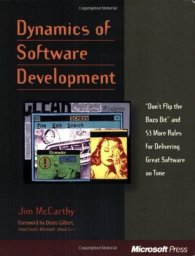
Dynamics of Software DevelopmentMany of these themes are explored in the brilliant and surprisingly nontechnical book Dynamics of Software Development by Jim McCarthy, which I have encouraged every senior executive I have met to read as well as every staff leader I have mentored. In my experience the core issue comes down to learning how to build a consensus, understanding that consensus building is not polling or voting or majority rules. Product development is an expertise, like any other profession. Many individuals can learn to do it adequately, but few can do it extraordinarily.

Look at some of the new wave of great companies and you see the top-tier of product development pros at the helms: Mark Zuckerberg, Reed Hastings, Elon Musk, Reid Hoffman. Of course those are all CEOs of substantial, important, disruptive companies and they are not available for brand turnarounds at internet companies on the rebound, but the question remains, are the people being put in charge of turnarounds somehow similar in nature and characteristics to the great leaders of product development? Are they able to articulate a vision around which people can rally willingly and with trust? Do they listen to a multitude of opinions and then make decisions that incorporate feedback because it is critical, not because it represents a political agenda? Do they have good taste, and can they see beyond the state of today to leapfrog a competitor with perhaps something that didn’t do well in a focus test? Have they built a process in their environment where good work can shine and fast iteration can overcome mediocrity in rapid succession?

Consensus is an astonishingly complex concept; it is not at all compromise. It begins with vision, It is evangelized through leadership, It becomes stronger through group participation and feedback, but it is guided to completion by the same vision and leadership from which it emanated. Consensus goes off track when a leader feels for whatever reason that bits of all contributions most be included to create the consensus, the proverbial camel with two humps. That is wrong, because all comments and critiques will not be right if breakthrough products are your goal. Group participation is a must to achieve organic buy-in, listening is a must for a leader to bypass being feared as a despot, but for great product development to triumph, a vision must remain strong, pure, unique, original. That can never be taken for granted, and everyone on a team will not always be happy at every twist and turn. Yet if you have ever had the privilege of working on a world-class, game changing product, you know that most sins are forgiven when it all comes together through good process, and it does not look anything like the system of checks and balances we see in representative government.

Product development is driven by a different motive set, of creative destruction and inspired disruption, a high stakes arena where often winner takes all, second prize means you go home. Democracy does not work there, and democratic compromise is not workplace consensus. Show me a great product, and I know you will find iteration, but I bet you won’t find haggling.

Vision is what launches a brand. Vision will always be key to reinventing a brand. Process is the key to translating ideal vision into working reality. Consensus is the element of process that gets everyone on a team to remain part of the team, because success is owned by the team, not by its individual components. Get most of that right and product development has a fighting chance, and so might reinvention.

Spider-Man and the Creative Process: Worlds at Odds?

From The Wall Street Journal, Speakeasy — March 11, 2011:

“The Many Trials of ‘Spider-Man'” by Peter Schneider

Julie Taymor is a brilliant talent.  So is Peter Schneider.  They have both seen immense success in their careers, and experienced untold ups and downs.  So when Peter chooses to speak publicly on the creative process, he does so with empathy and class.  We want our creative heroes to win, but the odds are just so against the outcome.  That makes the people who choose to accept these tasks all the more vulnerable, and unique.

This passage in Peter’s op-ed particularly grabbed me, it is an analogy well-worth encoding:

“A show does not come off the rails in one day. It is the cumulative impact of many wrong turns. In Jon Krakauer’s book “Into Thin Air,” there is a moment when the climber thinks he is going to die and wonders how he got into this awful and dangerous position. Looking back, he realizes that it was not one big mistake of judgment. Instead, it was 10 little decisions that seemed inconsequential along the way but, in retrospect, turned out to have led him into a precarious and nearly fatal situation. At some point, the cumulative impact of all those wrong decisions makes it impossible to regain your bearings.”

I will be picking up on that theme of how small decisions have unseen consequences many times in future thoughts.  It is core to my ethos, and it is extraordinarily real!