The Problem with Joker


I don’t write about movies often. On the occasions I do, it’s likely because something bothered me.

Joker really bothered me.

I can’t deny the performance of Joaquin Phoenix. He is a gifted actor. He gave a masterful depiction of a troubled, anguished, sick character.

That only makes my criticism more severe.

I’m also not going to argue against First Amendment expression. The creators have an inalienable right to make and distribute this work, for profit or otherwise.

That simply makes them guilty of intellectual laziness at best, and self-serving irresponsibility at worst. I think both have occurred, and I am deeply troubled by this because of the film’s enormous audience reach. Its success makes the laziness and irresponsibility all the more pernicious. They could have done better. They deliberately elected not to do so.

I’m going to tell you why I think this movie is psychologically problematic, but first, let me warn you, this will be one of the worst spoilers ever. Do not read a sentence further if you intend to see the movie and don’t want the ending ruined.

Okay, if you’ve seen it or don’t care to see it but want to know why I’m upset, please read on.

It is important to remember that the core source material for this literary work is a comic book. I read comic books a lot as a kid, and in fact I was about as big a fan of Batman as they come. That was in the escapist pages of a comic book.

The character portrayal in this onscreen depiction seems to me evolved from the school of naturalism, extending the realm of realism to a more interpretive form of social commentary. The extreme portrayal seems less a form of entertainment than it is a comment on cruelty and its origin. The clown makeup does not separate the storytelling from the gritty suffering in the streets. The imagery throughout could appear as hyperrealism, as Stanley Kubrick approached similar territory in A Clockwork Orange, but that would have required artistic choices that aren’t evident in Joker.

There can be obvious real-world consequences to confusing the worlds of fantasy and framing souped-up slice-of-life imagery as somehow predictive or inevitable.

The ending for me is what matters when an artist seeks to claim the high ground of unconventional storytelling, purposeful inclusion of uncomfortable scenarios, or violence that is meant to disturb us in order to reboot our thinking.

It is precisely the ending of Joker that is the biggest problem for me.

Even deeper than the ending is the punchline, which snaps into place so conveniently because the unmasked Arthur Fleck aspires to be a comedian. The irony in that kind of payoff could have been emotionally rich and telling. Instead, it’s simply exploitative because it’s enunciated as instructional.

Here’s the punchline: “You get what you f*ing deserve.”

I was almost okay with the movie until that line was uttered. That’s when I believe the writers, producers, and director abandoned moral ground and just went for accelerated shock value.

I guess it’s the writer in me that feels a churn in my stomach when fellow creatives let hope for commercial success undermine their better judgment. It’s not about political correctness. It’s about pride in authorship, embracing the seriousness of disciplined expression. There are consequences to our craft worthy of foresight.

It’s extraordinarily difficult to craft a satisfying ending to any story. The more outlandish the story, the more difficult it is to structure an acceptable conclusion. By acceptable I mean an ending that doesn’t waste an audience’s time and reflects the values of those who create it. No creative team wants to be embarrassed by an ending that ruins all that comes before it, but the true test of an ending is time. How we feel when we create something is one thing. How history treats it or how we feel about it decades after its creation are entirely different benchmarks.

My immediate sense is that there are at least two distinct, conscientious ways to think about resolving a work of popular fiction as the creatives involved start working toward an ending. There’s poetic justice and there’s existentialism.

If the intention is poetic justice, a wrong should be avenged. It should be made clear that evil will not triumph over good, and though any world is imperfect, the arc of our commonality ought to bend toward justice.

If the intention is existential—nature in its own social element—no moral summation is required; the world depicted is exact, unforgiving, and unapologetic. Yet here a storyteller with something to say may bravely suggest an observation of irony or social critique. The observed criminality may not be a tool pointing toward redemption, but it can be a window of material reflection.

Neither of these occurs in Joker, and that is where the bad is enshrined.

When late in the movie Arthur is invited on “The Murray Franklin Show,” he shoots his idol dead and utters the words: “You get what you f*ing deserve.”

It’s a carefully plotted moment and among the worst forms of premeditated murder imaginable, celebrated live on television before a presumably horrified viewing audience.

Sadly, that is just a setup use of the punchline. The truer horror is to follow.

A few minutes later, the wealthy Thomas Wayne and his wife are shot dead in the street by a rioting supporter of the savage clown. He echoes the same phrase: “You get what you f*cking deserve.”

Arthur uses his punchline to justify the act of homicide. That allows the stranger to justify his act of homicide.

This is an act of parroting. This is an act of emulation. In the story, both teaching and learning have occurred. Unfortunately, the lessons are abhorrent.

The moment the elder Waynes are slaughtered is without discussion or reflection specifically because it is integral to the larger epic of Batman. The child, Bruce Wayne, watches the brutal murder of his parents, which sets him on his life’s path to become The Dark Knight who will commit his adult life to avenging this wrong.

I’m sorry, I don’t buy it. That implied forward arc is not responsible storytelling. An act this vicious must be resolved in its own context or it is no more than isolated, exploitative horror.

Again, why am I so bothered?

Think of all the unconscionable violence around us. Think of the common occurrence of mass killings, of widespread gun violence too often triggered by mentally troubled individuals who have lost any sense of a moral compass.

Presume a tiny segment of the population watching this movie and these unnerving scenes are themselves abandoned victims of social cruelty. Might they see their own suffering in Arthur’s eyes? Might they also be in any way mentally disturbed as the film’s protagonist?

What message is this movie sending them? Is it a moment of necessary caution or claimed victory? Is it a moment of hesitancy or reinforcement of their unapplied curb on self-control?

What the hell is the purpose of this punchline beyond its catchy shock value? Was this two-beat mimicry necessary to secure the film’s blockbuster potential?

My answer is that the filmmakers could have done so much better if they’d wanted something better. They could have had their cake and eaten it. All they had to do was worry as much about the possible byproducts of the film’s success as achieving financial gain. It’s not that hard to care about what you’re saying directly or inadvertently. It just has to matter to those at the helm.

If you want to tell difficult stories, you work harder to create difficult endings. Don’t walk away from the problems you frame just because you can. You have the right, but doing it isn’t right.

Joker isn’t right.

_______________

Photo: Warner Bros Gallery

Can Business Be Philosophical?

Recently I shared with you my passion for philosophy. You probably know I also have a profound passion for business.

And music, The Beatles, The Dodgers, wine, literature, children’s needs, social justice, and other stuff.

Back to philosophy and business: can they intersect?

This is where a lot of cynicism enters the picture.

Mark Zuckerberg says he is all about free speech and building global communities. He would have us believe a business—at least his business—should not be editing political expressions, even for accuracy. He asserts this is up to individuals to assess, or for the government to regulate if it can figure out a reasonable and fair way to impose guidance.

Should we believe Zuckerberg the visionary or Zuckerberg the voracious competitor? It doesn’t take a lot of analysis to know his goal is to keep selling ads, that any restrictions on free expression create a slippery slope for the addiction of his site contributors (i.e. all of us powering his pages with free content). It’s pretty clear he wants a level playing field around restrictions, meaning if the government regulates Facebook, he wants it to regulate all his competitors where he maintains a competitive advantage and is likely to win with ubiquitous rules.

Are free speech and “leave me alone to make money” compatible ideals, or the best possible excuse for self-interest?

Let’s try again.

Google’s stated mission is “to organize the world’s information and make it universally accessible and useful.” They are all about creating a definitive archive for global knowledge, about ensuring the best customer experience, and once upon a time about not being evil. That’s some philosophy!

Have you done a search on Google lately? Remember when organic search returns were clearly separated in columns from sponsored search returns? Yeah, that was before mobile made that largely impossible with much smaller screens. Today you practically have to be Sherlock Holmes to know what’s a paid ad on Google and what’s global knowledge. The keyword ads are everywhere. There’s a reason. They figured out how few bills the world’s information actually pays when displayed. They know which clicks are bankable in that trillion-dollar valuation.

One more for the road?

Apple wants us to believe it is at the heart of protecting our privacy, right to the edge of protecting the login codes of suspected dangerous criminals. Maybe that’s a big idea we have a hard time embracing because its scope means the tiny basket of bad eggs has to enjoy equal privacy if we want to protect the gigantic basket of good eggs.

Yet if privacy as a strategic mandate is a paramount position at Apple, how does the company abstract itself from all the apps that transmit our personal information to the data-mining servers of the world as fast as we type it in? Apple says it makes secure devices that are safe to use; that’s all they do and they do it brilliantly. If those devices open tunnels between those seeking data and those leaking data (again, all of us), that’s our tunnel to barricade or avoid, and it would be illogical to ask them to detour us otherwise.

Can a company have a point of view on elevated ideals, or are these polished notions just a bullhorn cry from the PR department?

I guess it all comes down to what we want to believe is a pure, important idea, and how far a company will go to spin a concept to its own advantage.

The issue is one of authenticity. Does a company truly embrace beliefs that are worth evangelizing, or are its statements around absolutes justifications of convenience?

Proclamations are not philosophy. A mission statement is not philosophy. Company values are not philosophy. All of these are constructs meant to unify the purpose of a business, but the business entity’s constant struggle with ambiguity, competition, and the demands of ownership too often compromises ideas when financial interests are at risk. We can say we want to act in a certain way, but will we always?

I have to admit, I have been guilty over the years of trying to inject philosophy into business practice. I have not been terribly successful. The conflicts of interest abound, and the enormously hard work of maintaining consistency can be exhausting. I used to have my employees read a book called Freedom and Accountability at Work by Peter Kostenbaum and Peter Block. It is about existentialism in the workplace. All but one colleague told me they couldn’t get past the first chapter. At least they were honest about it.

How do we avoid hypocrisy and cynicism in a world where we want to be better? We are often told Millenials want us to rise to a higher standard, that cause-based marketing resonates strongly with their brand loyalty. I think it is possible to “do good while doing well,” but I don’t think we accomplish this if we pretend we’re something that we’re not.

Instead of declarations that render themselves hopelessly artificial, companies can humble themselves in restraining their platitudes around the possible. Instead of attempting to hide behind crumbling categorical imperatives, business might be better suited to achievable standards that are consistently authentic.

Tell me the truth all the time, and I may trust you. Don’t tell me why your definition of truth is defined in the unreadable footnotes at the bottom of the page.

Be aspirational, and I may join in the celebration of your mission and values. Don’t tell me that your company has discovered or defined a nobility that somehow makes you better than your competition.

Be well-meaning in the goods and services you provide, whether ensuring quality or seeking a healthier supply chain, and I may respect your brand. Don’t proselytize and expect me to believe you are pursuing a higher calling—profits be damned—when transparency betrays your more obvious motivations.

A business can be great, even legendary, without being philosophical. Let it be honest, consistent, and authentic—that’s plenty to tackle and enormously difficult on top of being outrageously good at something. The agenda of business is measurable, culminating in success.

Leave philosophy to the philosophers. Who would that be? That can be any of us—the storytellers around the campfire, the quiet voices in a coffee shop, the ardent dialogue in anyone’s home. The agenda of sharing, exchanging, and challenging ideas is immeasurable and ultimately boundless.

_______________

Photo: Pexels

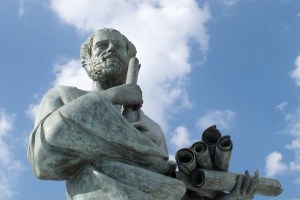
The Study of Philosophy

With all of the ways one could spend four years in college, why would anyone study philosophy?

It’s impractical.

It’s largely self-serving.

Given the vast syllabus of reading necessary to be even modestly well versed in both Eastern and Western thought, there is terribly little material one can cover in such a short amount of time.

It makes no sense to absorb oneself in such an esoteric endeavor with such thin coverage and so little quantifiable value.

It’s an expensive way to squander time, and even harder to explain to those helping pay for it.

Yet I did it, albeit about three and a half decades ago. Truth be told, I still spend unreasonable amounts of time delving into such curious texts as Kierkegaard’s Either/Or and Sartre’s Being and Nothingness.

Why?

Why Then and Why Now are two different things. Let me try to begin with a justification, and then tell you how it has helped me to be better in business, better in service, better in life.

Philosophy is mostly about reading literature, but not the fun stuff. It’s mostly non-fiction, and it’s mostly argued opinion, if not conjecture. There is some history and an occasional parable, but mostly it’s very dense expository in translation. Occasionally you get to drill into something quirky and theatrical like Beckett’s Waiting for Godot, but that’s a tangent, not core curriculum. I mostly focused on the Western canon, so that means works originally composed in Latin, Greek, German, French, and Russian. The translations are often as head-scratching as the source texts.

From the middle ages to the Renaissance in Western philosophy, there is little differentiation between theology and philosophy, so if you don’t want to read about God, this is probably not going to be your thing. You can reject faith later as is often the tradition in modern existentialism, but you have to read a lot about it to reject it comprehensively. Faith is a subject of mainstream devotion and much conflict in our culture. It’s worth learning about it, regardless of what you choose to believe.

The tension in philosophy between quantifying the physical world and attempting to explain metaphysics is persistent and unresolved. Logical argument as a discipline embraces mathematics until calculations outreach contemporary science, forcing abstraction onto problems that later generations will solve. Laws, ethics, psychological motivations, justification for conflict and its resolution, and even aesthetic judgment all prove evolutionary. What is certainty at one time is speculation in another.

Rejection, revision, and reform are the guiding constants of substantial ideas. It’s all quite messy, contradictory, and exhausting.

Philosophy for me as a young person became a passion of personal growth, self-realization, and academic inspiration. It was helpful to me that it was mostly non-emotional because I was also a student of the arts, which were emotional. I needed the balance. I needed the complementary discipline. I needed to be satisfied that hard questions were worth attempting to answer, even if those who answered them began by rejecting the last person who tried to reject them. Somehow that all seemed progressive and appealing to me.

I also managed to convince myself that the power of logic was broadly applicable in almost any field of inquiry. At the very least I would find the structure of articulating an idea useful in dramatic storytelling. While it might not have seemed obvious or even apparent to me how that could be put to use in purchasing food for consumption, I had faith I would figure it out at some point.

Ah, faith—it surfaces in the least likely of circumstances.

There was also this quintessential challenge from Socrates in Plato’s Apology:

“The unexamined life is not worth living.

Those words messed me up because I took them seriously. I even wrote and directed a short film in college specifically about the reincarnation of Socrates in modern times to make this point. It was called Apology. It was supposed to be funny. It wasn’t, but the dialogues of Plato became so ingrained in my consciousness that I had to give it a try.

Failure came early and often after that, but with much clearer reason.

That was Why Then. Let’s cut to Why Now. Yes, there actually is a timeliness to all this.

Our next presidential election is on the horizon. A lot of awful stuff has happened since our last presidential election. I’m upset. I’m more than upset. I’m baffled, befuddled, and out of sorts. Our nation may never heal. I doubt we will get over these scars in my lifetime.

Philosophy remains my comfort zone. It’s a place I go to make sense of things that do not, will not, and perhaps cannot make sense. I wrestle with this all the time. It does not immobilize me. I get things done. To my surprise, I have indeed learned how to apply logical argument to my work. I use it in storytelling and even find ways to wind ponderous floating into the plots of my novels. I also use logic to make arguments in business—in sales, in legal, in coaching. That’s become a byproduct of philosophical usefulness. The core practice is now about coming to terms with the absurd.

I’ve heard all the rhetoric about how our president got elected, about somehow appealing to a forgotten middle class. He has never acknowledged income inequality as one of the defining issues of our generation, never displayed any evidence of empathy or humility, yet he declared himself the champion of hard-working people authentically in need of a break. Those voters may have been duped, but he is an absurdity, as is their loyalty. Our embrace of ignorance and authoritarian mindlessness is absurdity. I use philosophy to live with the absurdity. As long as I am wrestling with difficult ideas, I am convinced the wrestling matters.

Where there are ideas, someday there will be solutions.

The unexamined life is not worth living.

Why are we here? Why is there consciousness?

To do this hard work.

To self-define in the name of combating the absurd.

To commit authentically to making that which is bad better.

Might there be such a thing as Applied Idealism? It’s a counterintuitive notion, difficult to contemplate certification, but spiritually tempting. Samantha Power grapples nobly with reaching for a more attainable abstract in her new book, The Education of an Idealist. It’s comforting to know we are not alone in our outlandish aspirations.

When I envision structures of evaluation, I often discover that the separation of thought and action is at best temporary, if not arbitrary. Logic does not exist outside a problem; it is embedded in the problem. Ethics aren’t distinct from rules and laws; they are expressed in the adoption of rules and laws. Pragmatism does not have to be isolated from hope. When I contemplate a model of assessment and apply it rigorously, I can be held in check by obstruction, but I can’t long be fooled.

As long as I can study, I can stay a fighter. As long as I can delve into the abstract, I will always have more stories to share with you. Once in a while I may even get you to chuckle. That’s when I know your mind is opening and perhaps ready to absorb something new.

In the end, is the study of philosophy a tragic waste of time? I guess for many that might be a fair conclusion. I’ll never see it that way. I see it as vital. I see it as necessary.

Stay tuned to this channel. There’s a lot more philosophy ahead. Considered yourself warned. Or alerted. Or ignited. Ideas are always free. What we do with them is seldom without cost.

_______________

Image: Pixabay

Are Americans Happy?

Uber drivers can surprise you. They can shake up your thinking. They can get you to pause and reflect differently on the day.

A recent early-morning haul with an Uber driver to what I knew would be a long and unpleasant meeting did just that for me. The driver was an Ethiopian immigrant who had been in the United States for about a decade. He and his wife had come here for a better life. His two children were born here.

At first he was quiet, presuming I didn’t want any conversation at this hour. When the freeway traffic slowed our progress, I started to draw him out a bit. I was glad I did.

His basic sense was that America was filled with unlimited opportunities for anyone who wanted to work hard and apply themselves. The ability to make money here—legally and with relatively few logistical obstacles—was virtually unlimited. He actually loved being an Uber driver the past five years. He had control over his time, could spend time with his family, and while the income he earned was modest by American standards, he felt good about the quality of life it allowed him compared with his earlier years in Ethiopia, where money and opportunity were scarce.

What he didn’t understand was why so few Americans he met were happy.

To the contrary, he found most of the Americans he encountered unhappy. The people who rode in his car, no matter how well dressed or where they were going, largely seemed unhappy. The people he saw shopping in WalMart, with all the abundant product offerings on the shelf at such low prices, seemed mostly unhappy. When he took his children to school, which was free, most of the children and parents he encountered seemed unhappy.

He wondered why.

While he wouldn’t trade his life in America for any chance at a permanent return to Ethiopia, he shared that in his younger years, whenever he walked down the road, he would smile broadly and wave hello to everyone he passed, known to him or not. He said he tried that when he initially came to this country, but people looked at him like he was mentally unbalanced, so he stopped.

He told me in his village if someone didn’t come out of their home for a few days, it was normal to knock on the door and see if that person was okay. If they were sick, it was normal to ask if they needed anything from the market and to get it for them without asking in advance for payment. He said to do that here might land him in jail.

He told me when anyone in the village had any good fortune, the entire village would celebrate, and the person who enjoyed the good fortune would be predisposed to share it in small ways without anyone asking. He said when he moved into his current neighborhood, the advice he received from previous immigrants was to keep to himself, let neighbors be strangers, and not to expect to give or get much of anything from strangers.

His conclusion after a decade in the United States was that it was indeed a rich nation of financial opportunity, but with financial success of any level, happiness was not part of the deal. His promise to himself was to put happiness first, and anytime financial gain would compromise it, to put the need for joy above the need for more income.

It was a curious but not unfamiliar conversation that served as an ironic preamble to my next eight hours in a conference room with extremely large numbers being floated around various outcomes to a dispute, and not a single person smiling for the entire day.

I don’t actually think about this a lot, because I haven’t been taught to think about it a lot. I have been taught to work hard, to compete, to give my all at all times, to be respectful of the law, but to be wary of all opponents who might unfavorably tilt the apparent zero-sum game of financial haggling.

I do agree there is something very American about this. We were a country of underdogs that became a nation of global leadership. There is a Puritan work ethic we instinctively embrace that dates back to the first freezing winters of our original colonies. Sacrifice for the future is a mostly shared American value, and our popular literature seldom misses a beat in reminding us that winning is everything.

For many Americans, winning is who and what we are, what we aspire to be, and its cost is a necessary evil, a byproduct of the commitment it takes to be the very best at whatever we set out to do.

Are we happy? I am sure many of us are, and my driver from Ethiopia just hasn’t had the chance to meet you if you are.

It may be worth considering some mounting evidence to the contrary.

We are approximately 5% of the global population.

We generate more than 20% of the world’s total income.

We consume upwards of a quarter of the world’s natural resources.

That is a disproportionate share of global wealth that should be making a lot of people happy.

Our citizens own 40% of the world’s guns.

We consume 80% of the world’s opioids.

We incarcerate 25% of the world’s total prison population.

We have over 1000 active hate groups whose only point of validation is to buy into the lie of their ordained genetic superiority.

Does that sound happy?

No matter what we have, we seem to want more. We are a consumer society. Marketers like me helped make us that way. The problem with consumerism is that it has no logical end. If you have an antiquated iPhone 8, you are meant to want a reconceived iPhone 11. You’ll stare at it just as much, but it will have all the new features you think will make you happier. The stress created by having to pay for it is simply a factor of the replacement value.

Although we have all that wealth collectively, we embody income inequality almost as a leaderboard to remind us of the winners of the zero-sum game. We invented the 1%. Instead of trying to work it toward 10%, we are working toward 0.1%.

Too often I think we forget that we weren’t always this prosperous. Prior to the 20th century, we were a nation that barely survived its own Civil War, the bloodiest conflict in American history. We managed to prevail from two subsequent world wars in part because our continental homeland was not invaded.

We emerged after the Second World War as an industrial power with disproportionate military might and a shared conviction to democratize individual earning power. We enjoyed enormous quality living benefits in this brief window that globalization is now spreading more evenly around the planet.

Any notion of this as entitlement is ill placed. We were clever, innovative, opportunistic, and hard-working. The stars lined up behind us. The turnaround in our fortune was epic. I wonder what we really learned from that unparalleled shift in fate. Humility doesn’t seem to make the report card.

We discovered and celebrated optimism as core to our shared values, but did we protect the essence of its desired outcome—the pursuit of happiness?

I don’t see people in public places smile a lot, or visit the neighbors they don’t know, or wave joyfully to strangers on the street. I could be a little isolated, and I am sure there are many of you reading this who will disagree. If you are surrounded by happy Americans, do you think you are the norm or exception?

Maybe the notion of being happy is the problem itself. Perhaps it is antithetical to our nation’s DNA. If we presume that’s the case, and most of us aren’t going to be truly happy in America no matter what we achieve, perhaps there is another aspiration we can embrace.

Instead of trying to be happy, which is a long way to reach from our present core, maybe we can just be more appreciative of the opportunities around us.

I’m not suggesting a Pollyanna happy dance, given the vast discrepancies in our economic and social culture. I’m wondering if it is possible that, like the Ethiopian immigrant I met, we can identify a perspective around an appreciation for whatever benefits might be coming our way.

It could be as simple as relying on the descriptor “more”that we can be ever so slightly more appreciative of what we have and still keep grinding away at the hardships of our reality. The ramifications around empathy, privilege, and life satisfaction would seem unlimited. We might even begin to understand the inescapable realities of globalization.

Is it possible that Americans can be more appreciative?

I really don’t know. I think I’ll ask my next Uber driver.

_______________

Photo: Pexels